

Table of Contents
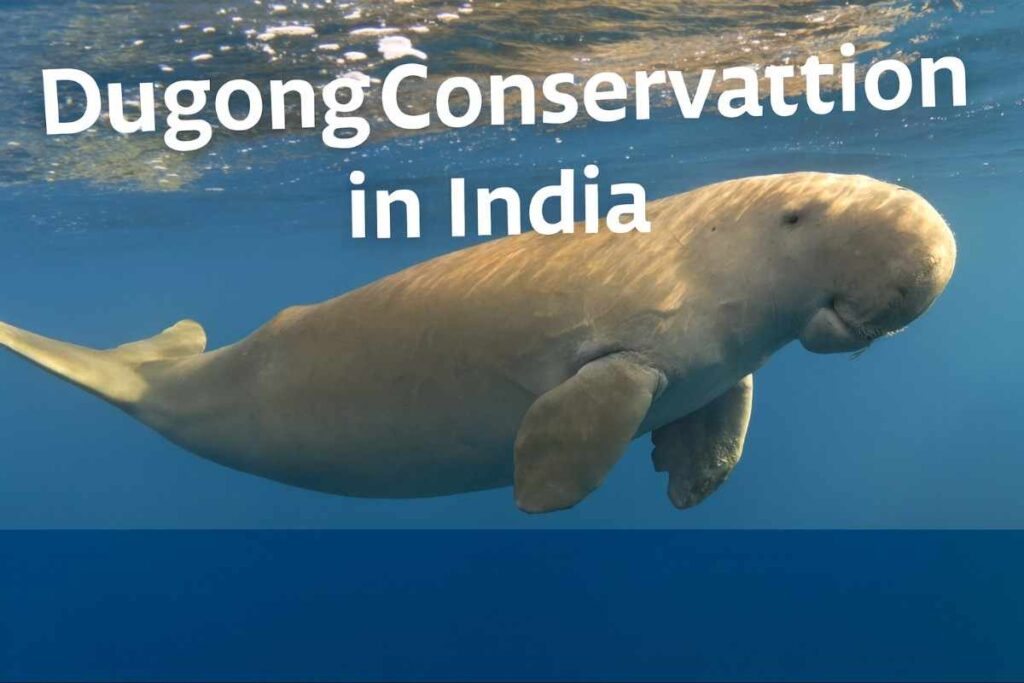
Dugong Conservation in India is becoming increasingly urgent as new reports highlight the species’ steep decline. The latest report unveiled at the IUCN Conservation Congress in Abu Dhabi has thrown a serious spotlight on India’s rapidly declining dugong population. These shy “sea cows,” once common across the Indian coastline, are now fighting for survival due to habitat loss, pollution, illegal fishing practices, and shrinking seagrass ecosystems. With fewer than a handful of viable populations left in the country, the situation is becoming critical. This blog breaks down why dugongs matter, what’s causing their decline, and how India must act—fast—to protect one of the ocean’s most peaceful creatures before it’s too late.
Understanding Dugong Conservation in India: India’s Last Remaining Sea Cow
The dugong is one of those creatures that feels almost magical — slow, gentle, harmless, and honestly just vibing in its underwater world. But behind that chill personality is a species with millions of years of evolutionary history. Dugongs belong to the order Sirenia, making them close cousins of manatees. And fun fact — they’re the only strictly marine herbivores in the world. No carnivore drama, no ocean politics… just seagrass meals and peaceful afternoons. Aesthetic, right?
In India, dugongs once flourished across the coasts of Gujarat, Tamil Nadu, Andhra Pradesh, and the Andaman & Nicobar Islands. But today, the species is so rare that spotting one is almost like seeing a legendary Pokémon in the wild — extremely unlikely and kind of heartbreaking. They’re now considered one of the most threatened marine mammals in the country.
Dugongs are often called “sea cows,” not because they look like cows (although the round belly is giving desi gaay energy), but because they graze on seagrass meadows just like cows graze on grasslands. These meadows are like underwater farms that keep coastal ecosystems alive. When dugongs feed, they stir up the seabed, which helps nutrients circulate — basically doing ocean housekeeping for free. Traditional coastal communities have respected them for centuries, acknowledging their calm nature and their role in maintaining ecological balance.
Behavior-wise, dugongs are introverts. They prefer shallow, warm coastal waters and avoid noise, crowding, and anything remotely chaotic — like a marine version of people who skip weddings to stay home and chill. Their movements are slow and deliberate, conserving energy and staying close to feeding grounds. They can live up to 70 years, which means they’re like elderly ocean sages who’ve seen decades of environmental change.
Reproduction is one area where dugongs struggle the most. Females give birth only once every 5–7 years, and calves need intense maternal care for almost two years. So, if even a few adults are lost, the population takes a massive hit. Nature designed dugongs for a stable, undisturbed world — not the noisy, polluted coasts we’ve built today.
Scientifically, they’re indicators of ocean health. If dugongs are thriving, it means seagrass meadows are thriving. And if seagrass meadows are thriving, it means the marine ecosystem is balanced. But in India right now, both are in decline. Their presence has become so rare that marine researchers describe them as “ghost species” — still there, but barely.
Understanding the dugong is important not just for conservationists but for everyone who cares about our natural heritage. This is a species that has lived peacefully for centuries, never harming humans, never disrupting ecosystems. Losing dugongs would mean losing a piece of India’s marine identity — something we may never get back.
What the IUCN’s Abu Dhabi Report Reveals About Dugong Conservation in India
The report launched at the IUCN Conservation Congress in Abu Dhabi hits like a wake-up slap — the kind you can’t ignore even if you want to. For years, scientists have been warning that dugongs in India are declining, but this new report puts the situation in brutal, data-backed clarity. It confirms that India’s dugong population has reached a critical threshold, meaning the numbers are now so low that recovery is becoming harder each passing year.
The report highlights that India currently hosts fewer than 200 dugongs, scattered across three main regions: the Gulf of Mannar, Palk Bay, and the Andaman & Nicobar Islands. But here’s the catch — most of these sub-populations are isolated from each other. And when animals stop interacting or breeding across groups, their genetic diversity drops. Low diversity = weaker species = higher extinction risk. It’s literally biology screaming, “Bro, do something!”
One of the biggest takeaways from the Abu Dhabi report is how rapidly seagrass ecosystems are disappearing. Dugongs depend exclusively on seagrass for survival, and according to IUCN’s assessment, India has lost nearly 30–35% of its seagrass cover over the last few decades. That’s like taking away the only kitchen from someone’s house and expecting them to survive. Not happening.
The report doesn’t stop there. It digs into the reasons behind the decline, and the findings aren’t pretty. Unregulated coastal development, expanding tourism zones, dredging, sand mining, and oil exploration projects have all contributed to habitat loss. These activities either destroy seagrass beds or make coastal waters too noisy or polluted for dugongs to thrive. And remember, dugongs hate chaos — they’re the introverts of the ocean. Loud engines, crowded coastlines, and constant human disturbance push them farther into unsafe zones.
Another key revelation from the report is the rise in accidental bycatch. Dugongs often get entangled in gill nets and fishing gear, leading to injuries or suffocation. Since they come up for air every few minutes, being trapped underwater becomes deadly. The IUCN findings show a noticeable spike in dugong deaths linked to fishing gear — a tragedy for a species that reproduces so slowly.
The Abu Dhabi report also calls attention to the lack of strong monitoring systems in India. Even though dugongs are protected under Schedule I of the Wildlife Protection Act, enforcement is weak in many coastal regions. There’s limited on-ground patrolling, poor data on population movements, and minimal coordination between agencies. Basically, the system is trying, but not hard enough.
Interestingly, the report praises India’s few positive steps — such as the declaration of the Dugong Conservation Reserve in Tamil Nadu — but says these efforts need to scale up quickly. A handful of actions won’t save a species facing nationwide threats.
The message from the IUCN Congress is simple but urgent:
If India doesn’t act now, dugongs may disappear from our waters within decades.
This report isn’t meant to scare — it’s meant to push governments, communities, and conservationists into serious action.
Major Threats Pushing Dugong Conservation in India Toward Crisis
If you look at the dugong’s personality — slow, peaceful, and minding-its-own-business — it’s honestly wild how much danger this harmless animal is facing. The threats hitting India’s dugongs aren’t small; they’re like a whole buffet of problems thrown at a species that literally just wants to eat seagrass and chill. The Abu Dhabi report makes it clear: if these threats continue unchecked, dugongs might vanish from Indian waters way faster than anyone predicted.
1. Rapid Loss of Seagrass Habitats
The biggest villain in this story is seagrass destruction. Dugongs aren’t flexible eaters — they’re hardcore loyal to seagrass. But India’s seagrass meadows are shrinking due to dredging, pollution, coastal development, and even irresponsible tourism. When hotels, ports, or resorts expand, seagrass beds get buried or uprooted. Without food, dugongs either starve or move into unsafe zones. Imagine being forced out of your home and into a highway — that’s basically what’s happening to them.
2. Fishing Net Entanglement (Bycatch)
One of the saddest parts of dugong decline is accidental capture in fishing nets. Since dugongs surface frequently for air, getting trapped underwater becomes fatal within minutes. Gill nets, trawlers, and ghost nets left behind by fishermen are the biggest killers. The report highlights a rise in dugong carcasses found with net marks. And the worst part? Most fishermen don’t even know they’re harming an endangered species — it’s unintentional, but deadly.
3. Boat Strikes in Shallow Waters
Dugongs live in shallow coastal waters — the same spots where boats, ferries, and fishing vessels zip around. High-speed boats cause collisions that severely injure or kill dugongs. Because these animals move slowly, they can’t dodge the impact. Think of it like a pedestrian trying to cross a highway with sports bikes buzzing through — unfair fight, bro.
4. Pollution and Water Degradation
Marine pollution is slowly destroying dugong habitats. Industrial waste, untreated sewage, plastic debris, and oil spills degrade the quality of coastal waters. Seagrass beds suffocate when sedimentation and toxins increase. Dugongs also ingest plastic while feeding — and that’s a one-way ticket to internal injuries or death. We treat oceans like dustbins, but the species living there pay the price.
5. Climate Change and Extreme Weather
Climate change isn’t just melting ice caps; it’s messing with seagrass ecosystems too. Rising sea temperatures, stronger cyclones, and unpredictable monsoon patterns uproot seagrass meadows and make feeding grounds unstable. Dugongs, being slow movers with low reproduction rates, simply cannot adapt fast enough. Climate change adds pressure to a situation that was already bad.
6. Fragmented Populations and Poor Genetic Diversity
India’s dugong populations are now scattered into tiny, isolated pockets. When groups shrink and get cut off from each other, breeding becomes harder and genetic diversity drops. Low diversity makes the species weaker, more prone to disease, and less resilient to environmental stress. Basically, even a small disruption can push the entire population into collapse.
7. Weak Enforcement and Limited Awareness
Sure, dugongs are protected by law. But on-ground enforcement is often weak. Many coastal communities have never even seen a dugong, so they don’t know the species is endangered. Without awareness, conservation efforts become a one-sided fight.
Government and Global Efforts Supporting Dugong Conservation in India
When a species is hanging by a thread, the first question we all ask is: “So what is the government doing about it?” And honestly, India is doing things — but the real question is whether it’s happening fast enough to save a species that’s already on life support. The truth? Efforts exist, but the scale doesn’t match the urgency.
India’s Key Conservation Moves
India officially lists dugongs under Schedule I of the Wildlife Protection Act, meaning they’re given the same level of protection as tigers. On paper, that sounds hardcore. In practice, enforcement is spotty. Many coastal zones don’t have consistent patrolling, and most fishing communities aren’t fully aware of dugong-safe practices.
One of the most appreciated steps is the declaration of the Dugong Conservation Reserve in Tamil Nadu, covering parts of the Gulf of Mannar and Palk Bay. This is a big win because these areas are major seagrass hotspots. The idea is to reduce human interference, regulate fishing activities, and rebuild seagrass beds. But reserves only work if monitoring is tight — and that’s where challenges still exist.
The government has also started seagrass restoration projects, where damaged areas are being replanted manually. Early results are promising, but India needs these at a massive scale, not as isolated experiments.
Various state forest departments and research institutions like the Wildlife Institute of India are running studies on dugong movement patterns, feeding areas, and population behavior. We now have better data than before — but sadly, the population is falling faster than research can keep up.
Global and International Support
Globally, dugongs are listed as Vulnerable under the IUCN Red List. This status brings in international pressure and funding. The Convention on Migratory Species (CMS) has also pushed for action plans among countries with dugong populations, including India.
Countries like Australia, Qatar, and UAE actively share research, best practices, and sometimes even training modules for conservation officers. The Abu Dhabi IUCN Congress itself was a wake-up moment — giving India global attention, but also global scrutiny.
Community-Level Involvement
One of the most underrated conservation tools is involving local communities. In places like the Andaman Islands, some fishermen voluntarily report dugong sightings and avoid netting in sensitive zones. These grassroots people are actually the MVPs because they’re out at sea daily. But this cooperation is still limited — we need nationwide awareness programs, financial incentives, and dugong-friendly fishing gear.
Are These Efforts Enough?
Short answer: Not yet.
Long answer: India is heading in the right direction, but the dugong doesn’t have the luxury of time. Conservation works only when action is fast, large-scale, community-driven, and science-backed. At the moment, efforts feel like trying to put out a forest fire with a bucket of water — good intention, but not enough muscle.
If India wants to save dugongs, policies need stronger enforcement, habitats need restoration, and communities need to be empowered. Right now, the efforts are solid… but the species needs a lot more urgency.
The Road Ahead for Dugong Conservation in India: What Must Be Done
Saving the dugong isn’t rocket science — it’s actually pretty straightforward. But it does require speed, coordination, and a no-nonsense approach. Right now, India is standing at a crossroads: either step up with strong conservation action or watch one of the ocean’s most peaceful species fade into history. And trust me, losing the dugong would be a massive L for India’s marine heritage.
1. Restore and Protect Seagrass Ecosystems
If dugongs are the guests, then seagrass is the banquet hall. No seagrass = no dugongs. India needs large-scale restoration drives, not small pilot projects. Replanting seagrass, stopping dredging in sensitive zones, and protecting shallow coastal waters must become a national priority. Governments should map seagrass beds using drones and satellite tech to ensure no development project wipes them out unnoticed.
2. Dugong-Friendly Fishing Policies
Fishing communities aren’t the villains; most simply don’t know how fragile dugongs are. India must urgently roll out dugong-safe fishing zones, especially in Palk Bay, Gulf of Mannar, and the Andamans. Providing alternatives to harmful gill nets, promoting community monitoring, and compensating fishermen for releasing entangled dugongs alive can create real change. Awareness + incentives = win-win.
3. Stronger Enforcement on the Ground
Having dugongs in Schedule I is great, but enforcement has to go beyond paperwork. More patrolling teams, better-trained officers, and real penalties for illegal netting or seagrass destruction are needed. Coastal police, forest departments, and research bodies must collaborate instead of working in silos. Enforcement should feel present — not like a distant idea.
4. Research, Monitoring, and Real-Time Data
India desperately needs a real-time dugong monitoring system. Tagging individuals, tracking migration routes, and using underwater acoustic sensors can help identify high-risk zones. Better science = smarter conservation decisions. We can’t protect what we can’t see.
5. Engage Coastal Communities as Partners, Not Outsiders
The people living by the coast are the first responders in marine conservation. Training them, hiring them as “ocean guardians,” and involving them in seagrass maintenance can create ownership. When communities feel respected and included, conservation becomes sustainable. Plus, traditional knowledge from these groups is priceless — they’ve been observing ocean behavior for generations.
6. Climate Resilience Planning
Climate change isn’t slowing down, so dugong conservation strategies must factor in rising sea levels, stronger storms, and warming waters. Restoring mangroves, regulating coastal tourism, and building climate-resilient seagrass beds are essential long-term moves.
7. Strong National Dugong Action Plan
India needs one consolidated national strategy — not scattered efforts. A National Dugong Mission (similar to Project Tiger or Project Dolphin) can streamline funds, research, and enforcement. With the IUCN report sounding the alarm, it’s the perfect moment for India to launch a flagship program.
Final Thought
If India acts now, dugongs can bounce back — they’ve done it in Australia and parts of the Middle East. But delay even a few years, and the loss could become irreversible. The road ahead isn’t easy, but it’s absolutely doable. Protecting dugongs isn’t just about saving a species — it’s about protecting the soul of India’s coastal ecosystem.
About The Author












Leave a Reply