

Table of Contents
Chandrayaan-3 Hop Experiment has become one of India’s most important space science stories of 2026. The attached file shows how Vikram lander’s 50 cm hop and ChaSTE temperature readings revealed a layered lunar regolith structure, surface erosion, compaction, thermal behaviour, and possible water-ice storage clues. In today’s global race for lunar bases, sample-return missions, and south-pole exploration, this finding matters far beyond science textbooks. ISRO says the hop proved a critical capability for future sample-return missions, while current lunar trends point toward permanent Moon infrastructure and deeper resource assessment.
How Chandrayaan-3 Hop Experiment Changed 2026 Lunar Science
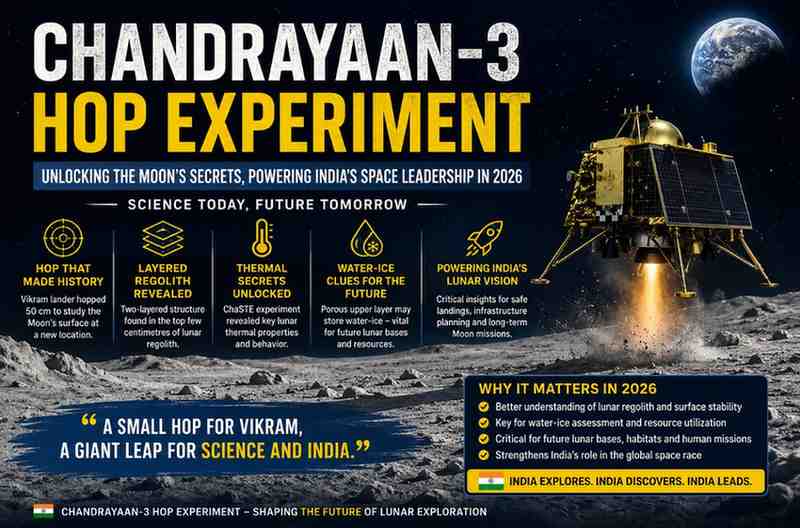
Chandrayaan-3 Hop Experiment changed 2026 lunar science because it turned a small lander movement into a major scientific breakthrough. Vikram’s hop of about 50 cm, powered by residual propellant, allowed scientists to study the Moon’s surface at a slightly different location and observe how engine firing affected the lunar regolith. The attached file notes that this helped reveal surface erosion, compaction, layered stratigraphy, geotechnical variability, and thermal profiles.
The biggest shift came from the discovery that the Moon’s upper surface is not a simple dust layer. The Chandrayaan-3 Hop Experiment showed a two-layered, cake-like structure within the top few centimetres of lunar regolith. The upper 2–6 cm layer was found to be cohesive, sticky, hyper-porous, and capable of acting like a thermal blanket. Density also changed sharply, rising from about 750 kg/m³ near the surface to 1600 kg/m³ below it.
This matters in 2026 because lunar science is no longer only about landing successfully; it is about building, drilling, walking, mining, and surviving on the Moon. The Chandrayaan-3 Hop Experiment gave mission planners real ground-level data on how lunar regolith behaves when exposed to rocket exhaust. ISRO also reported that engine firing stripped away roughly 3 cm of loose material, exposing a firmer layer underneath. (ISRO)
The Chandrayaan-3 Hop Experiment also improved understanding of lunar thermal behaviour. ChaSTE’s temperature probe helped scientists study how heat moves through the regolith, which is critical for future habitats, landers, rovers, and equipment that must survive extreme lunar temperature swings. This is where India’s data becomes strategically valuable: future Moon bases will need stable ground, predictable thermal zones, and possible access to trapped water-ice molecules.
In simple terms, the Chandrayaan-3 Hop Experiment changed 2026 lunar science by converting Vikram from a successful lander into a field geologist. It proved that even a tiny hop can reveal hidden layers, surface strength, and thermal secrets of the Moon. For India, this is not just a proud space achievement; it is a practical step toward future sample-return missions, lunar infrastructure, and long-term space leadership. 🚀
Why Lunar Regolith Findings Matter for Future Moon Bases
Chandrayaan-3 Hop Experiment matters for future Moon bases because it revealed that the lunar surface is not just loose dust; it has layered, uneven, and highly sensitive regolith. The file explains that the Moon’s upper layer is better called lunar regolith, made of shattered rocks and jagged glass-like particles, not ordinary soil. That distinction is important because Moon-base construction cannot rely on Earth-like assumptions.
The Chandrayaan-3 Hop Experiment showed that the top 2–6 cm layer is cohesive, sticky, hyper-porous, and works like a thermal blanket. For future lunar habitats, this is a big deal. A porous surface can affect foundation strength, landing-pad design, rover movement, drilling operations, and heat control around base modules. If engineers misjudge the regolith, even a well-designed Moon base could face instability, dust damage, or thermal stress.
Another major point from the Chandrayaan-3 Hop Experiment is density variation. The file notes that bulk density increased sharply from about 750 kg/m³ near the surface to 1600 kg/m³ below it. This means future bases must be planned after careful site testing, because one patch of lunar ground may behave differently from another just a few centimetres away.
The Chandrayaan-3 Hop Experiment also matters because this porous regolith may help store subsurface water-ice molecules. Water-ice is the gold of lunar settlement: it can support astronauts, produce oxygen, and potentially help make rocket fuel. So, identifying regolith zones that protect or preserve water-ice can directly influence where future Moon bases are built.
In 2026, countries are not just racing to land on the Moon; they are racing to stay there. The Chandrayaan-3 Hop Experiment gives India valuable data for selecting safer landing zones, designing stronger habitats, reducing dust hazards, and planning long-term lunar infrastructure. In short, lunar regolith findings matter because the Moon base of the future will be built not on dreams, but on ground science. 🚀
Chandrayaan-3, Water-Ice Clues, and the New Space Race
Chandrayaan-3 Hop Experiment has become important in the new space race because the Moon’s future is now linked to one question: where is usable water-ice? The attached file says the porous upper lunar regolith layer may be significant for storing subsurface water-ice molecules and choosing future lunar base sites.
Water-ice is not just a science discovery; it is a strategic resource. If future missions can extract lunar ice, it may support drinking water, oxygen production, cooling systems, agriculture experiments, and even rocket fuel. That is why the Chandrayaan-3 Hop Experiment matters beyond India. It gives real surface-level data from the Moon’s south polar region, where global space powers are focusing their long-term plans.
In 2026, the United States, China, and private space companies are not only trying to land on the Moon; they are trying to build permanent infrastructure. NASA’s Artemis programme is now focused on a sustained lunar presence and future Moon-base planning, while China’s International Lunar Research Station plans are moving quickly, with the lunar south pole seen as highly valuable because of possible water-ice reserves. (Space)
This is where the Chandrayaan-3 Hop Experiment gives India a stronger voice. The experiment revealed that the lunar surface has layered regolith, density variation, thermal behaviour, and hyper-porous material. These details can help scientists understand where ice molecules may remain protected beneath the surface. In plain words, the Moon is not just rock and dust anymore; it is becoming a resource map.
The Chandrayaan-3 Hop Experiment also supports future mission planning. If water-ice exists in useful quantities, countries will need safe landing zones, stable ground, rover-friendly routes, and thermal protection for equipment. The file notes that Chandrayaan-3 findings are significant for water-ice assessment, surface stability, and future lunar base planning.
The new space race is different from the old Cold War race. Earlier, the goal was to reach the Moon first. In 2026, the goal is to stay there longer, use local resources, and control key scientific zones. The Chandrayaan-3 Hop Experiment fits perfectly into this shift because it gives practical knowledge about the ground where future bases may stand.
For India, this is a serious opportunity. With Chandrayaan-3’s findings, ISRO is no longer just celebrating a successful landing; it is contributing to the science that could shape lunar settlement. The Chandrayaan-3 Hop Experiment has turned India’s Moon mission into a strategic asset in the global race for water, infrastructure, and long-term space leadership. 🚀
Rocket Plume Interaction: A Key Challenge for Lunar Landings
Chandrayaan-3 Hop Experiment highlighted one of the most serious engineering challenges for future lunar missions: rocket plume-surface interaction. When a lander fires its engines close to the Moon’s surface, the exhaust does not simply disappear. It hits the lunar regolith, throws particles outward, erodes the surface, compacts nearby material, and can change the landing zone itself. The attached file clearly notes that Vikram’s hop helped scientists study surface behaviour at a different location and provided insights into erosion, compaction, layered stratigraphy, geotechnical variability, and lunar thermal profiles.
The Chandrayaan-3 Hop Experiment is important because the Moon has no thick atmosphere to slow down exhaust flow or settle dust quickly. On Earth, air resistance reduces the spread of particles. On the Moon, fine regolith can travel farther, faster, and more unpredictably. This creates risks for landers, rovers, scientific instruments, solar panels, and future Moon-base structures. A landing that looks perfect from orbit can still damage equipment on the ground if plume effects are not understood properly.
The file explains that lunar regolith is not ordinary soil. It is made of shattered rocks and jagged glass-like particles. This makes plume interaction more dangerous. These sharp particles can scratch surfaces, block joints, reduce solar panel efficiency, and interfere with sensors. The Chandrayaan-3 Hop Experiment therefore gives scientists practical data on how this material behaves when disturbed by engine firing.
Another major finding is that the upper 2–6 cm layer of regolith is cohesive, sticky, hyper-porous, and works like a thermal blanket. Its density also changes sharply from about 750 kg/m³ near the surface to 1600 kg/m³ below it. For future landings, this means the surface may not react uniformly. One area may erode easily, while another may remain firmer. The Chandrayaan-3 Hop Experiment helps mission planners understand this variability before designing heavier landers or repeated landing operations.
In 2026, this challenge matters even more because space agencies are planning long-term lunar infrastructure, not just one-time landings. Future Moon bases will need landing pads, dust-control systems, safer descent engines, and carefully selected landing zones. If rocket plume interaction is ignored, every landing could become a mini dust storm with expensive consequences.
The Chandrayaan-3 Hop Experiment changed the conversation by showing that even a small 50 cm hop can produce valuable engineering science. It proved that lunar landing safety depends not only on navigation and fuel, but also on understanding the ground beneath the lander. In short, the Chandrayaan-3 Hop Experiment gives India and the world a clearer path toward safer lunar landings, stronger mission design, and more reliable Moon-base planning. 🚀
India’s Space Leadership in 2026 After Chandrayaan-3’s Breakthrough
Chandrayaan-3 Hop Experiment has strengthened India’s space leadership in 2026 by proving that ISRO is not only capable of landing on the Moon, but also of producing high-value scientific data for future lunar missions. The file shows that Vikram’s 50 cm hop used residual propellant to study lunar surface behaviour at a new location, giving scientists insights into erosion, compaction, layered stratigraphy, geotechnical variability, and thermal profiles.
This matters because global space leadership is no longer judged only by dramatic launches. In 2026, leadership means practical capability: landing safely, studying surface material, identifying future base sites, understanding water-ice potential, and preparing for long-term lunar infrastructure. The Chandrayaan-3 Hop Experiment gave India exactly that kind of credibility.
The breakthrough also placed India in a stronger position in the new lunar economy. The file explains that the upper 2–6 cm lunar regolith layer is cohesive, sticky, hyper-porous, and works like a thermal blanket. It also notes that this porous layer may help store subsurface water-ice molecules and support the selection of future lunar base and habitat sites. That is not small science; that is strategic knowledge.
The Chandrayaan-3 Hop Experiment also supports India’s future missions. If ISRO plans sample-return missions, advanced rovers, lunar drilling, or habitat-related studies, this data becomes a foundation. A country that understands the lunar ground better can design safer landers, stronger mobility systems, and smarter mission architecture. In old-fashioned terms: first know the land, then build the fort.
For India, this breakthrough also carries diplomatic value. Space partnerships are increasingly tied to data, reliability, and mission success. The Chandrayaan-3 Hop Experiment shows that India can deliver all three. It gives ISRO more weight in global conversations on Moon exploration, resource assessment, and south-pole science.
Most importantly, the Chandrayaan-3 Hop Experiment has changed India’s image from a successful lunar visitor to a serious lunar knowledge power. In 2026, when the world is preparing for permanent Moon activity, India’s contribution is clear: affordable missions, precise engineering, and useful science. That combination makes India’s space leadership stronger, more respected, and more future-ready. 🚀
- RBI Intervention to Defend the Rupee in 2026: How India Is Fighting Currency Pressure
- How Neuro-Symbolic AI in Indian Education Can Redefine Learning in 2026
About The Author












Judicial Decorum in Digital Age: 5 Powerful Lessons
[…] Chandrayaan-3 Hop Experiment 2026: India’s Powerful Leap Toward Future Moon Bases […]