

Table of Contents
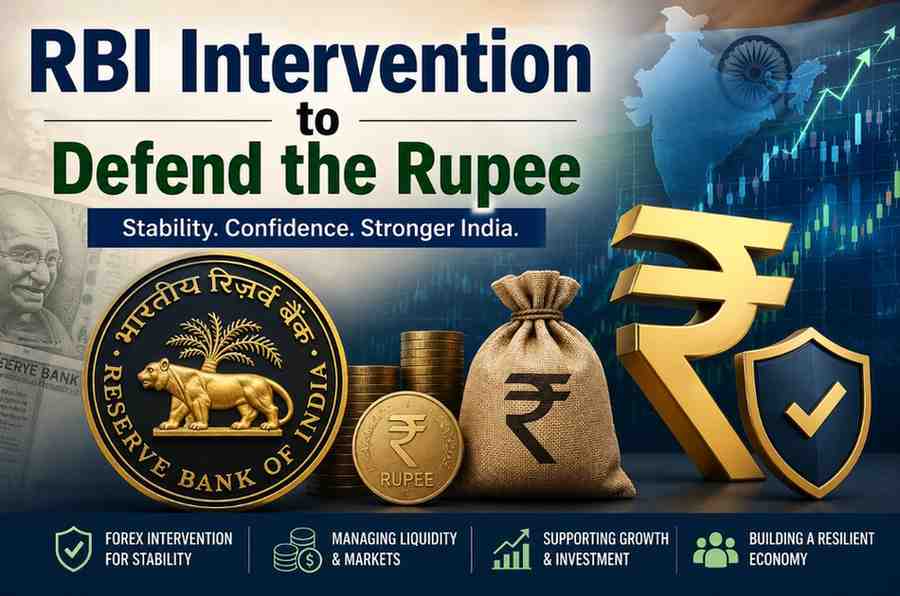
RBI Intervention to Defend the Rupee has become one of India’s biggest economic stories of 2026 as the rupee nears historic lows against the US dollar. The attached file highlights how the RBI is using dollar sales, forex swaps, liquidity management, capital flow measures, and NRI-focused tools to control volatility. Today, this issue connects directly with global crude oil shocks, the US-Iran conflict, inflation risks, foreign investor sentiment, and pressure on emerging-market currencies. With the RBI announcing a USD 5 billion swap auction and reportedly selling dollars aggressively, India’s currency defence is now a live test of macroeconomic stability.
Why the Rupee’s 2026 Fall Became a Major Economic Warning Signal
RBI Intervention to Defend the Rupee became a serious national concern in 2026 because the Indian rupee was not facing a normal market fluctuation—it was nearing a historic low of around 97 against the US dollar. According to the attached file, this sharp depreciation forced the Reserve Bank of India to use daily dollar sales of nearly USD 1 billion and announce a USD 5 billion USD/INR buy-sell swap auction to calm the currency market.
The rupee’s fall is a warning signal because currency weakness affects almost every part of the economy. India imports large quantities of crude oil, electronics, machinery, fertilizers, and other essential goods. When the rupee weakens, these imports become costlier. That directly increases pressure on inflation. Fuel prices, transport costs, food supply chains, and manufacturing expenses can all rise. In simple words, a weak rupee does not stay inside the forex market—it reaches the common household.
RBI Intervention to Defend the Rupee also matters because a falling rupee can damage investor confidence. Foreign Portfolio Investors closely watch currency stability before investing in Indian bonds and equities. If they expect the rupee to fall further, they may pull money out or delay fresh investments. This creates a dangerous cycle: capital outflows weaken the rupee, and a weaker rupee encourages more outflows. That is why the RBI’s role becomes crucial in breaking panic-driven market behaviour.
Another major concern in 2026 is global uncertainty. The file links rupee pressure with the US-Iran conflict, which can push crude oil prices higher and increase India’s dollar demand. Since oil marketing companies need dollars to pay for crude imports, sudden dollar demand can put heavy pressure on the rupee. This is why RBI Intervention to Defend the Rupee is not only about currency management; it is also about protecting India from imported inflation and external shocks.
The rupee’s decline also signals pressure on India’s foreign exchange reserves. When the RBI sells dollars in the spot market, it uses its reserves to increase dollar supply and reduce panic. But this cannot be done endlessly. If markets believe reserves are being drained too quickly, confidence can weaken further. Therefore, the RBI must balance currency defence with reserve protection.
RBI Intervention to Defend the Rupee becomes even more important because excessive depreciation can increase the cost of external debt repayment. Indian companies that borrowed in foreign currency may face higher repayment burdens when the rupee falls. This can hurt corporate balance sheets, especially for firms with weak hedging.
In 2026, the rupee’s fall became a major economic warning signal because it exposed India’s vulnerability to global oil shocks, capital flight, dollar strength, geopolitical tensions, and inflation risks. RBI Intervention to Defend the Rupee is therefore not just a technical central banking action—it is a frontline defence for India’s macroeconomic stability.
How RBI Dollar Sales Are Shaping India’s Forex Market Stability
RBI Intervention to Defend the Rupee is most visible through the Reserve Bank of India’s direct dollar sales in the spot forex market. When the rupee faces sharp depreciation, the RBI sells US dollars from its foreign exchange reserves. This increases dollar supply in the market and reduces panic-driven demand. In 2026, the attached file notes that the RBI reportedly used daily dollar sales of nearly USD 1 billion as the rupee came under severe pressure.
The logic is simple: when importers, oil companies, banks, and investors all rush to buy dollars, the rupee weakens quickly. By selling dollars, the RBI acts like a shock absorber. It does not try to fix the rupee at an artificial level, but it slows disorderly movement. This is why RBI Intervention to Defend the Rupee is important for forex market stability—it prevents a temporary panic from becoming a full currency crisis.
Dollar sales also shape market psychology. Currency markets run heavily on sentiment. If traders believe the RBI will allow a free fall, speculative pressure increases. But when the RBI enters aggressively, it sends a clear signal: one-way bets against the rupee will not be easy. This discourages excessive speculation and gives banks, exporters, importers, and foreign investors more confidence to operate.
However, RBI Intervention to Defend the Rupee through dollar sales has a cost. When the RBI sells dollars, it absorbs rupees from the banking system. This can reduce domestic liquidity and push interest rates higher. If not managed carefully, it can hurt credit growth, business borrowing, and overall economic activity. That is why the file highlights “sterilized intervention,” where the RBI uses tools like Open Market Operations to inject rupee liquidity back into the system.
This balancing act is crucial in 2026. India needs currency stability, but it also needs enough liquidity for banks, businesses, and consumers. Too little intervention may allow the rupee to fall sharply. Too much intervention may drain reserves and tighten financial conditions. The RBI’s challenge is to defend stability without overusing ammunition.
RBI Intervention to Defend the Rupee also protects India from imported inflation. A weaker rupee makes crude oil, fertilizers, electronics, and machinery more expensive. Since India depends heavily on imported energy, a falling rupee can quickly raise fuel and transport costs. Dollar sales help reduce this inflationary pressure by slowing the rupee’s decline.
Another important effect is on foreign investor confidence. If investors see that India’s central bank is actively managing volatility, they may feel more secure holding Indian assets. Stable currency conditions support bond markets, equity flows, and external borrowing.
In short, RBI dollar sales are shaping India’s forex market stability by increasing dollar supply, calming panic, discouraging speculation, protecting import costs, and supporting investor confidence. RBI Intervention to Defend the Rupee is not a permanent cure for global shocks, but it is a powerful emergency tool to keep the currency market orderly.
Why the USD 5 Billion Forex Swap Matters for Banks, Bonds, and Liquidity
RBI Intervention to Defend the Rupee became more strategic in 2026 with the announcement of a USD 5 billion USD/INR buy-sell swap auction. This matters because a forex swap is not just a currency-market tool; it also affects banking liquidity, bond yields, interest rates, and market confidence. According to the attached file, the RBI used this swap when the rupee was under heavy pressure due to depreciation and global uncertainty.
A buy-sell swap works in two stages. First, the RBI buys US dollars from banks and gives them rupees. Later, after a fixed period, the transaction is reversed. This allows the RBI to inject rupee liquidity into the banking system without permanently reducing its foreign exchange reserves. That is why RBI Intervention to Defend the Rupee through forex swaps is different from direct dollar sales. Dollar sales calm the forex market immediately, but swaps also manage domestic liquidity.
For banks, the USD 5 billion swap is important because it improves short-term rupee availability. When the RBI sells dollars in the spot market, rupees are absorbed from the system. If liquidity becomes too tight, banks may face higher funding costs. A forex swap helps offset that pressure by releasing rupees into the banking system. In practical terms, it gives banks breathing room. And in finance, breathing room is not luxury—it is survival with a tie on.
RBI Intervention to Defend the Rupee also influences the bond market. When liquidity tightens, bond yields usually rise because banks and investors demand higher returns. Rising yields can increase borrowing costs for the government and private companies. By injecting rupees through a swap, the RBI can reduce excessive pressure on bond yields and keep the debt market more stable. This is especially important in 2026, when global interest rates, oil prices, and geopolitical risks are already creating uncertainty.
The swap also helps protect monetary policy transmission. If liquidity becomes unstable, banks may not pass policy signals smoothly to borrowers. Credit rates can become volatile, hurting businesses and consumers. Through the USD 5 billion swap, the RBI can support orderly liquidity conditions while still defending the rupee. This makes RBI Intervention to Defend the Rupee a broader macroeconomic stabilisation strategy, not just a currency defence move.
Another major benefit is reserve management. Direct dollar sales reduce forex reserves immediately. But a buy-sell swap is temporary and reversible. The RBI gets dollars now and agrees to return them later. This gives the central bank flexibility to handle market stress without sending a negative signal that reserves are being drained too aggressively.
For foreign investors, the swap sends a confidence message. It shows that the RBI has multiple tools—not only spot intervention, but also liquidity operations, swaps, and capital flow measures. This can reduce panic and discourage speculative attacks on the rupee.
In short, the USD 5 billion forex swap matters because it connects three crucial areas: banks, bonds, and liquidity. RBI Intervention to Defend the Rupee through this swap helps stabilise the currency market, support banking liquidity, control bond yield pressure, and protect India’s financial system from disorderly volatility.
Oil Prices, US-Iran Tensions, and the New Pressure on India’s Currency
RBI Intervention to Defend the Rupee has become more urgent because oil prices and US-Iran tensions are putting direct pressure on India’s currency. India is one of the world’s largest crude oil importers, so whenever global oil prices rise, India needs more US dollars to pay for the same quantity of crude. This increases dollar demand in the forex market and weakens the rupee. The attached file clearly links the rupee’s 2026 pressure with the US-Iran conflict and rising dollar demand.
The oil-currency connection is straightforward. Crude oil is priced globally in dollars. When oil becomes expensive, Indian oil marketing companies must buy more dollars to settle import bills. This sudden demand can push the rupee lower, especially when foreign investors are also pulling money out of emerging markets. Reuters reported that the rupee hit record lows in May 2026 as fading hopes of a US-Iran peace deal pushed oil prices higher, adding pressure alongside portfolio outflows. (Reuters)
This is why RBI Intervention to Defend the Rupee is not only about exchange rates; it is also about inflation control. Expensive crude plus a weak rupee creates a double blow. India pays more because oil prices rise, and then pays even more because each dollar costs more in rupee terms. That can increase petrol, diesel, transport, fertilizer, aviation, logistics, and food supply costs. Reuters also reported that Indian fuel retailers raised petrol and diesel prices multiple times in May 2026 because high crude prices from the Iran war were hurting margins. (Reuters)
US-Iran tensions also affect market sentiment. When conflict rises in the Middle East, global investors usually move toward safer assets like the US dollar. This strengthens the dollar and weakens emerging-market currencies, including the rupee. At the same time, India’s current account deficit risk increases because the import bill rises. A wider current account deficit means India needs more foreign capital to balance external payments. If investors become nervous, that capital becomes costlier or slower to arrive.
RBI Intervention to Defend the Rupee becomes crucial in this environment because the central bank must prevent panic from turning into a self-feeding currency fall. The file mentions tools such as dollar sales, pre-market intervention, forex swaps, special dollar windows for oil marketing companies, and capital flow management measures. These tools help reduce sudden dollar shortages and stop speculative pressure from becoming disorderly.
Recent market reports show the same pattern. Reuters noted that the RBI used aggressive pre-market dollar sales to break the rupee’s negative feedback loop after the currency neared 97 per dollar. The report also connected rupee weakness to higher oil prices from the Iran war, weaker macro expectations, higher US yields, and equity outflows. (Reuters)
For India, the danger is not just one bad trading session. The bigger risk is a chain reaction: oil prices rise, dollar demand jumps, rupee weakens, import inflation increases, bond yields harden, investors become cautious, and the RBI must spend more reserves to calm the market. That is the new pressure on India’s currency in 2026.
In short, RBI Intervention to Defend the Rupee is India’s frontline shield against the oil shock created by US-Iran tensions. If crude prices remain high, the rupee will likely stay under pressure. But if the RBI manages dollar supply, liquidity, and market expectations carefully, India can reduce volatility and protect broader economic stability.
Can RBI Intervention to Defend the Rupee Protect India from a Bigger Crisis?
RBI Intervention to Defend the Rupee can protect India from a bigger crisis, but only if it is used as a stabilising tool—not as a permanent shield against every global shock. The RBI cannot control crude oil prices, US interest rates, geopolitical conflicts, or foreign investor behaviour. But it can reduce panic, manage liquidity, discourage speculation, and prevent disorderly depreciation. That is exactly why its 2026 intervention matters.
The attached file shows that the rupee came under severe pressure in May 2026, nearing historic lows against the US dollar. In response, the RBI used a multi-pronged strategy: daily dollar sales of nearly USD 1 billion, a USD 5 billion USD/INR buy-sell swap auction, sterilised intervention, forex swaps, capital flow measures, and restrictions on speculative exposure.
The first way RBI Intervention to Defend the Rupee helps is by stopping panic in the forex market. When the rupee falls too quickly, traders, importers, and investors may rush to buy dollars, making the fall even sharper. RBI dollar sales increase dollar supply and reduce this fear-driven demand. This does not make the rupee “strong” overnight, but it prevents a free fall. In currency markets, stopping panic is half the battle.
Second, the RBI protects India from imported inflation. A weak rupee makes crude oil, fertilizers, electronics, machinery, and other imports costlier. Since India depends heavily on imported energy, rupee depreciation can quickly affect fuel prices, transport costs, food prices, and industrial production. RBI Intervention to Defend the Rupee therefore helps protect households and businesses from sudden inflation shocks.
Third, the RBI’s forex swap strategy supports banking liquidity. When the RBI sells dollars, rupees are absorbed from the banking system. If this liquidity drain becomes excessive, banks may face higher funding costs and bond yields may rise. The USD 5 billion swap helps inject rupees back into the system while managing currency pressure. This is important because a currency crisis can easily become a banking and bond-market problem if liquidity dries up.
Fourth, RBI Intervention to Defend the Rupee discourages speculation. The file mentions tools such as pre-market intervention, restrictions on banks’ net open forex positions, and action in offshore NDF markets. These steps make it harder for traders to build one-way bets against the rupee. That matters because speculation can turn a manageable depreciation into a confidence crisis.
However, RBI intervention has limits. Foreign exchange reserves are powerful, but not unlimited. If the RBI sells too many dollars too quickly, markets may worry about reserve depletion. Also, defending the rupee too aggressively can hurt export competitiveness and distort market pricing. The RBI must walk a tightrope: enough intervention to prevent chaos, but not so much that it burns reserves unnecessarily.
So, can RBI Intervention to Defend the Rupee protect India from a bigger crisis? Yes, it can reduce the risk of a bigger crisis—but it cannot solve the root causes alone. India also needs stable oil supplies, strong exports, controlled inflation, disciplined fiscal policy, steady foreign investment, and confidence in long-term growth.
In short, RBI Intervention to Defend the Rupee is India’s emergency brake, not the entire engine. It can slow the slide, calm markets, and buy time. But lasting currency stability will come from strong fundamentals, credible policy, and resilience against global shocks.
How Neuro-Symbolic AI in Indian Education Can Redefine Learning in 2026
About The Author












Chandrayaan-3 Hop Experiment: 7 Powerful Moon Findings
[…] RBI Intervention to Defend the Rupee in 2026: How India Is Fighting Currency Pressure […]