
Table of Contents
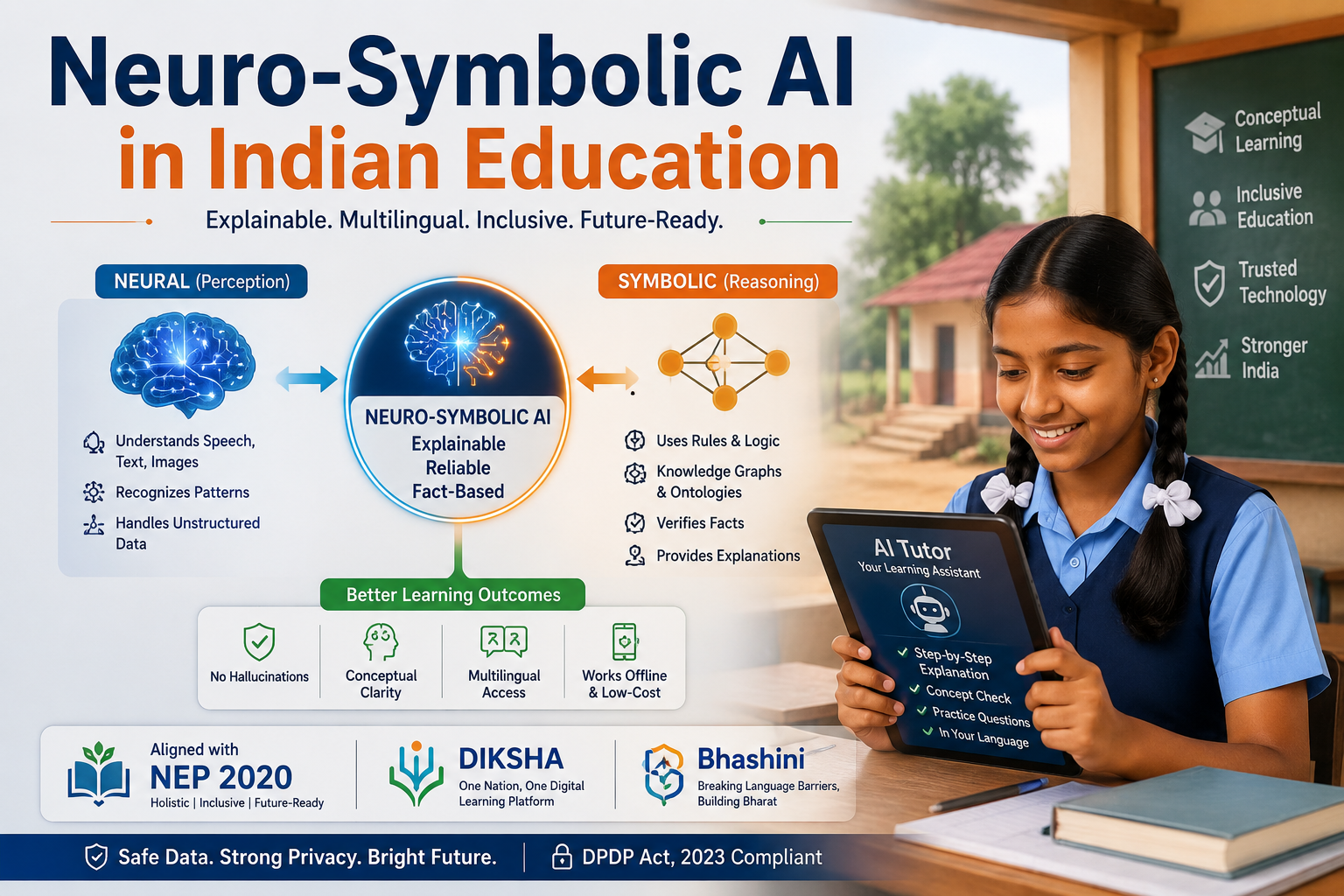
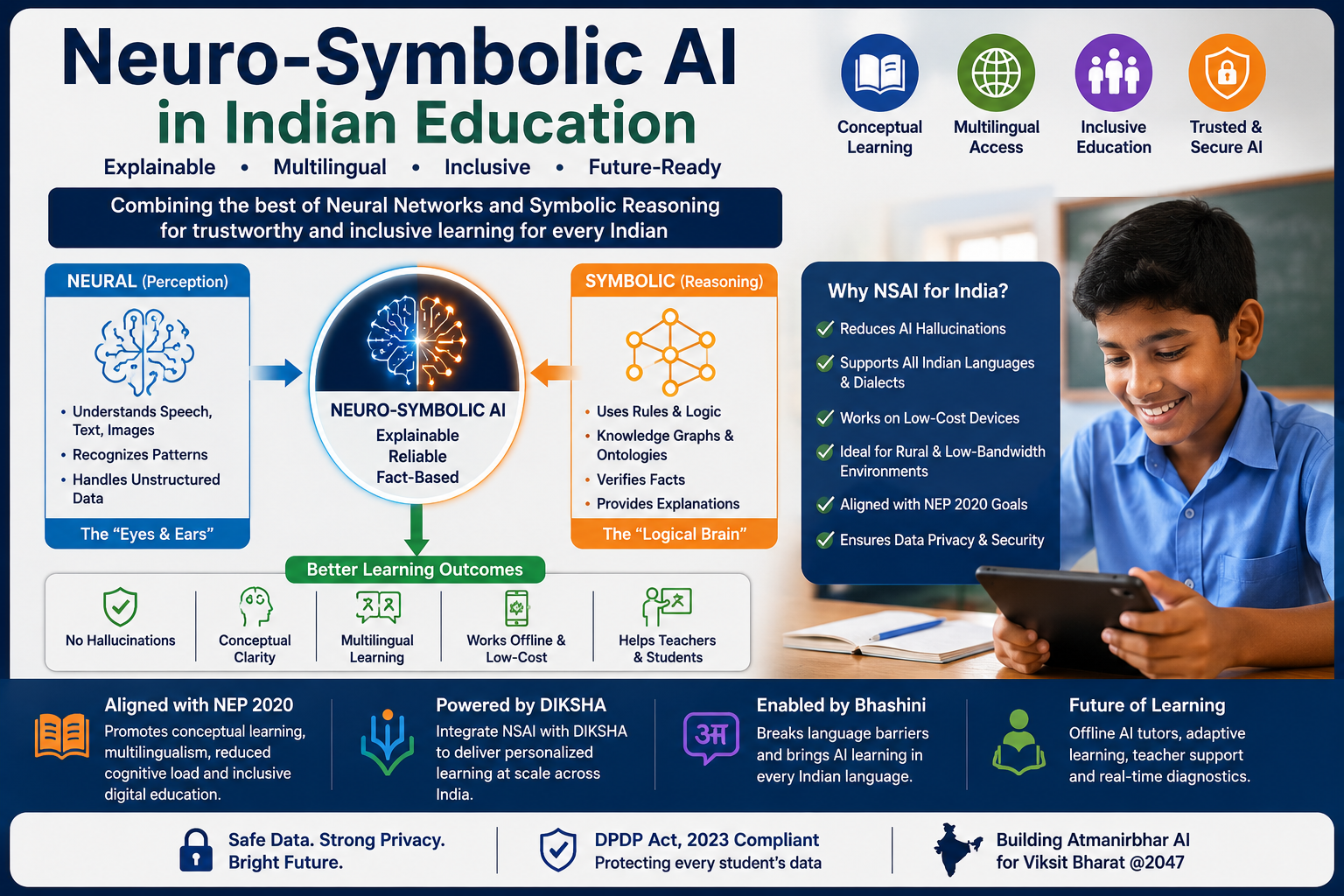
Neuro-Symbolic AI in Indian Education is becoming a serious 2026 conversation as India pushes for trustworthy, multilingual, and inclusive digital learning. The attached file highlights how NSAI combines neural networks with symbolic reasoning to reduce hallucinations, support regional languages, and align with NEP 2020 goals. In today’s world, where AI tools are entering classrooms rapidly, India needs systems that explain answers, protect student data, and work even in low-connectivity rural areas. With IndiaAI Mission, DIKSHA, Bhashini, and global demand for explainable AI rising, NSAI could become India’s practical answer to safer AI-driven education.
Why Neuro-Symbolic AI in Indian Education Matters in 2026
Neuro-Symbolic AI in Indian Education matters in 2026 because India is no longer asking whether AI should enter classrooms; the real question is what kind of AI should guide students. Traditional AI tools, especially large language models, can generate fast answers, but speed alone is not education. A classroom needs accuracy, reasoning, trust, language support, and explainability. This is exactly where Neuro-Symbolic AI in Indian Education becomes important.
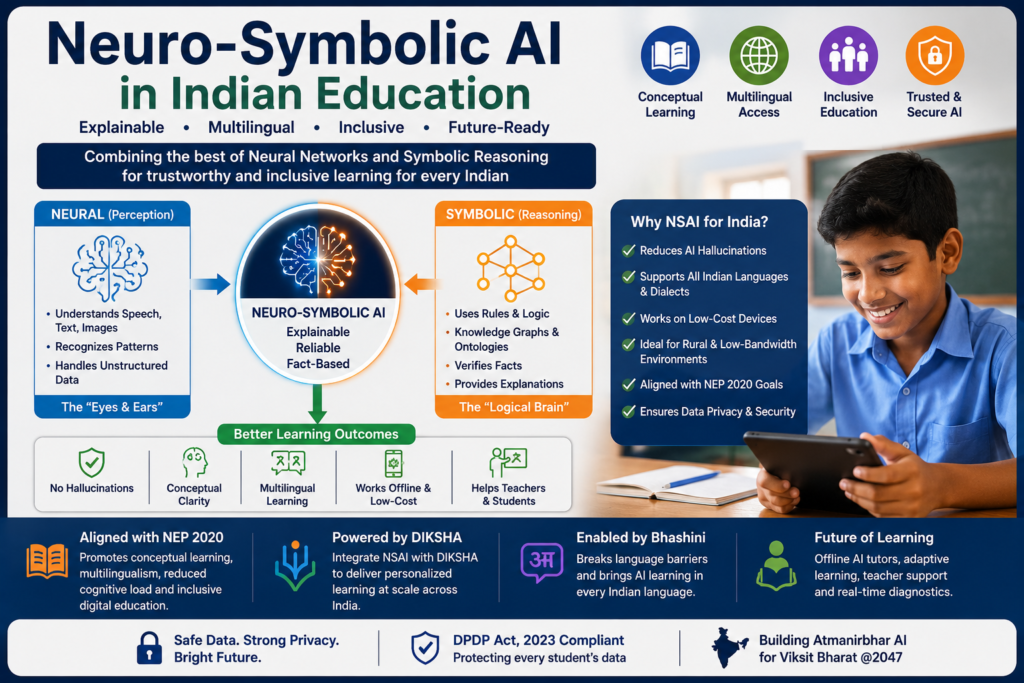
The attached file explains that Neuro-Symbolic AI combines neural networks with symbolic reasoning. In simple words, the neural part understands messy real-world inputs like handwriting, speech, or regional-language questions, while the symbolic part applies rules, logic, and verified knowledge to produce reliable answers. That makes it more suitable for education than AI systems that simply predict the next word.
In 2026, this matters because Indian education is facing three big pressures at once: digital transformation, multilingual learning, and the demand for conceptual clarity. NEP 2020 already pushes India toward flexible, inclusive, and technology-enabled education. But if AI tools give wrong answers, hallucinated facts, or English-heavy explanations, they will not solve the learning gap. They may actually increase it. Neuro-Symbolic AI in Indian Education can reduce this risk by grounding answers in structured curriculum-based knowledge, such as NCERT concepts, state board content, and verified academic logic.
Another reason Neuro-Symbolic AI in Indian Education matters in 2026 is India’s linguistic diversity. A student in Rajasthan, Odisha, Tamil Nadu, or Assam should not be forced to learn through poorly translated English-based AI responses. The file highlights that NSAI can support multilingual learning by combining neural translation with symbolic grammar rules. This can make AI learning tools more accurate in Indian languages and dialects, which is crucial for real inclusion.
The rural education angle is equally important. Many Indian schools still struggle with poor internet, limited devices, and weak digital infrastructure. Heavy AI models need strong servers, high bandwidth, and expensive computing power. NSAI, however, can be lighter, cheaper, and more suitable for offline or low-bandwidth deployment. That means Neuro-Symbolic AI in Indian Education could help students on low-cost smartphones, not just those in premium urban schools.
The biggest value, however, is explainability. Education is not about giving answers; it is about showing why an answer is correct. If a student makes a mistake in algebra, science, or grammar, NSAI can trace the logic gap and explain the exact misconception. This makes it useful for teachers too, especially in classrooms with high student-teacher ratios.
In 2026, India needs AI that is not flashy but dependable. Neuro-Symbolic AI in Indian Education matters because it offers a practical path toward trustworthy, multilingual, curriculum-aligned, and inclusive learning. It is not just another tech trend; it could become the backbone of responsible AI-powered education in India.
How NSAI Can Solve AI Hallucinations in Indian Classrooms
Neuro-Symbolic AI in Indian Education can solve one of the biggest problems created by modern AI tools: hallucination. In simple terms, AI hallucination means the system gives a confident answer that sounds correct but is actually false. In a classroom, this is dangerous because students may accept wrong facts, fake formulas, incorrect historical dates, or misleading explanations as truth.
Traditional Large Language Models mostly work through pattern prediction. They generate answers based on probability, not guaranteed reasoning. That is useful for general writing, but education needs verified logic. Neuro-Symbolic AI in Indian Education is different because it combines neural networks with symbolic reasoning. The neural part understands the student’s question, while the symbolic part checks the answer through rules, facts, curriculum structures, and knowledge graphs. This makes the response more controlled and reliable.
For example, if a student asks a physics question, a normal AI tool may generate a fluent but wrong explanation. But Neuro-Symbolic AI in Indian Education can connect the question to a verified NCERT-based knowledge graph and produce an answer grounded in accepted concepts. This reduces the chance of fabricated information. In Indian classrooms, where many students depend heavily on teachers and textbooks, this kind of factual grounding is essential.
Another major benefit is explainability. A normal AI model may give an answer but fail to explain why it is correct. Neuro-Symbolic AI in Indian Education can show step-by-step reasoning. If a student makes a mistake in algebra, the system can identify the exact logical error, such as misuse of the distributive property or wrong equation balancing. This helps students understand the concept instead of memorising the final answer.
This is especially important in 2026 because AI-based learning is expanding quickly across India. Students are already using AI tools for homework, exam preparation, language learning, and doubt-solving. Without safeguards, hallucinated answers can silently damage learning quality. Neuro-Symbolic AI in Indian Education offers a safer model because it does not rely only on statistical guessing. It brings discipline, structure, and accountability into AI-generated education.
NSAI can also support teachers. In classrooms with high student-teacher ratios, it is difficult for one teacher to check every student’s misconception. A neuro-symbolic system can trace learning gaps and provide teachers with clearer diagnostic insights. That means teachers can focus more on mentoring and less on repeatedly correcting basic errors.
For India, the real promise of Neuro-Symbolic AI in Indian Education is not just smarter technology; it is trustworthy learning. AI should not become a shortcut machine that spreads polished misinformation. It should become a dependable academic assistant that supports textbooks, teachers, and conceptual clarity. In 2026, solving hallucinations is not optional—it is necessary if AI is going to earn a permanent place in Indian classrooms.
The Role of NEP 2020, DIKSHA, and Bhashini in AI-Based Learning
Neuro-Symbolic AI in Indian Education becomes more powerful when connected with India’s existing education and digital public infrastructure. NEP 2020, DIKSHA, and Bhashini are not separate ideas; together, they can create the foundation for responsible AI-based learning in India. NEP 2020 gives the policy direction, DIKSHA provides the digital education platform, and Bhashini supports language inclusion. When these three connect with NSAI, India can build AI learning systems that are more accurate, multilingual, and accessible.
NEP 2020 strongly focuses on conceptual understanding, multilingual education, reduced rote learning, and inclusive access. This matches the purpose of Neuro-Symbolic AI in Indian Education because NSAI does not simply generate answers; it can explain reasoning through structured logic. The attached file clearly states that NSAI aligns with NEP 2020 because it supports conceptual clarity, multilingual learning, and reduced cognitive load.
DIKSHA can play the role of the delivery system. It is already an important digital platform for school education in India. If Neuro-Symbolic AI in Indian Education is integrated with DIKSHA, students from different regions can access AI-powered tutoring, doubt-solving, and curriculum-based explanations through a trusted public platform. This is important because education technology should not remain limited to private apps or expensive subscription models.
Bhashini adds another critical layer: language access. India’s classrooms are not English-only. Students learn in Hindi, Bengali, Tamil, Telugu, Marathi, Odia, Gujarati, Kannada, Malayalam, Punjabi, Assamese, and many other languages and dialects. Traditional AI models often struggle with regional context and produce weak translations. Neuro-Symbolic AI in Indian Education can work better here because symbolic grammar rules and structured language logic can improve accuracy in Indian languages.
Together, NEP 2020, DIKSHA, and Bhashini can make AI-based learning more democratic. A student in a rural government school should get the same quality of explanation as a student in a private urban school. That is where Neuro-Symbolic AI in Indian Education can become a real equalizer. It can combine verified curriculum knowledge, regional language support, and low-cost digital access.
This also matters in 2026 because India is moving toward digital public infrastructure in education, not just isolated ed-tech products. The future will belong to systems that are trustworthy, scalable, and aligned with national priorities. Neuro-Symbolic AI in Indian Education fits this direction because it can be curriculum-linked, explainable, and safer for students.
However, success will depend on proper implementation. DIKSHA must be upgraded with reliable AI layers, Bhashini must support deeper educational language models, and teachers must be trained to use AI-generated diagnostics wisely. NEP 2020 gives the vision, but execution will decide the outcome.
In short, Neuro-Symbolic AI in Indian Education can turn NEP 2020’s vision into practical classroom reality. DIKSHA can carry it, Bhashini can translate it, and NSAI can make it trustworthy. That combination could define the next chapter of AI-based learning in India.
Rural Education, Low-Cost Devices, and the Future of Offline AI Tutors
Neuro-Symbolic AI in Indian Education can become especially important for rural India, where the biggest barrier is not talent but access. Many students in villages and small towns still face weak internet, limited devices, electricity issues, and shortage of trained teachers. If AI education depends only on expensive devices, high-speed internet, and cloud-based platforms, it will help urban students first and leave rural students behind.
This is where Neuro-Symbolic AI in Indian Education offers a more practical solution. Unlike large AI models that require heavy computing power, NSAI can be designed as a lighter system because it uses structured rules, curriculum-based knowledge graphs, and symbolic reasoning instead of depending only on massive data processing. The attached file highlights that NSAI can support frugal innovation, low-bandwidth use, and edge deployment on low-cost smartphones.
Offline AI tutors could change the learning experience for rural students. A student may not always have access to a good teacher, coaching centre, or stable internet connection, but a lightweight AI tutor installed on a basic smartphone or tablet can provide step-by-step explanations anytime. Neuro-Symbolic AI in Indian Education can make this possible by storing verified curriculum logic locally, so the student can continue learning even without continuous internet.
This matters in 2026 because India’s education gap is increasingly becoming a digital access gap. Urban students often get better devices, faster internet, paid learning apps, and private coaching. Rural students may depend on shared phones, patchy networks, and limited school infrastructure. Neuro-Symbolic AI in Indian Education can reduce this divide if it is built for Indian ground realities instead of elite technology environments.
Another advantage is language. Rural learners are more likely to study in regional languages or local dialects. Offline NSAI tutors can combine neural language understanding with symbolic grammar rules to give more accurate explanations in Indian languages. This is not a luxury; it is necessary for meaningful learning. A child understands better when the explanation comes in the language of home and school.
Teachers can also benefit. In rural schools with high student-teacher ratios, one teacher cannot always give personal attention to every learner. Neuro-Symbolic AI in Indian Education can identify where a student is stuck and provide basic diagnostic support. This allows teachers to focus on mentoring, classroom discussion, and emotional support—areas where human teachers remain irreplaceable.
The future of offline AI tutors in India should not be about replacing teachers. It should be about supporting them and giving every student a reliable learning companion. Neuro-Symbolic AI in Indian Education can bring AI from big-city labs to village classrooms, from expensive servers to affordable phones, and from generic answers to curriculum-based understanding. If implemented wisely, it can become one of the strongest tools for educational inclusion in 2026 and beyond.
Data Privacy, Teacher Training, and the Biggest Challenges Ahead
Neuro-Symbolic AI in Indian Education has strong potential, but its success will depend on how responsibly India handles data privacy, teacher training, and implementation challenges. AI in classrooms deals with children’s learning patterns, mistakes, language use, academic performance, and sometimes personal behaviour. That makes student data highly sensitive. If this data is misused, sold, leaked, or used for commercial profiling, AI-based education can quickly become harmful instead of helpful.
This is why Neuro-Symbolic AI in Indian Education must follow strict privacy rules under the Digital Personal Data Protection Act, 2023. The attached file clearly highlights that student data should be anonymized, localized, and used only for educational improvement. It also warns against commercial exploitation by third-party vendors.
Teacher training is another major challenge. AI cannot improve education if teachers do not understand how to use it. Neuro-Symbolic AI in Indian Education can generate learning diagnostics, identify misconceptions, and suggest concept-level feedback, but teachers must know how to interpret these outputs. Without proper training, AI reports may become just another digital burden. India needs upgraded teacher-training programs where educators learn how to combine AI insights with classroom judgment.
The file also mentions the need for improving teacher programs like NISHTHA so teachers can use NSAI-generated diagnostics effectively. This is important because teachers should remain the centre of education. AI can support, but it cannot replace human mentorship, empathy, discipline, and moral guidance.
Another challenge for Neuro-Symbolic AI in Indian Education is building reliable knowledge graphs. NSAI depends on structured curriculum logic, but India has NCERT, state boards, technical education systems, and multiple languages. Converting all this content into machine-readable, accurate, bias-free knowledge structures is a massive task. It will require experts, teachers, linguists, policymakers, and technologists working together.
Bias is also a serious concern. If symbolic rules or datasets carry gender, caste, regional, or language bias, AI may silently reproduce unfair outcomes. Regular audits will be necessary. Neuro-Symbolic AI in Indian Education must be checked by independent educational bodies to ensure fairness and accuracy.
The digital divide remains another barrier. Many rural schools still struggle with devices, electricity, internet, and technical support. Even the best AI system will fail if it cannot run on affordable devices or work in low-connectivity areas. That is why offline-first and low-cost deployment must be treated as a core requirement, not an afterthought.
The biggest challenge ahead is balance. India must adopt AI without blindly worshipping it. Neuro-Symbolic AI in Indian Education should strengthen teachers, protect students, support regional languages, and improve conceptual learning. If privacy, training, infrastructure, and bias are handled properly, NSAI can become a trustworthy education tool. If ignored, it may become another expensive digital experiment.
Frequently Asked Questions (FAQs) – Telecast Global
1. What is Neuro-Symbolic AI in Indian Education?
Neuro-Symbolic AI in Indian Education is a hybrid AI approach that combines neural networks with symbolic logic. Neural networks help the system understand patterns, language, handwriting, and student queries, while symbolic logic helps it reason through verified rules and facts. This makes NSAI more explainable, accurate, and trustworthy for classroom learning.
2. Why is NSAI better than traditional LLMs for Indian education?
Neuro-Symbolic AI in Indian Education is considered better because it reduces AI hallucinations, supports multilingual learning, gives step-by-step reasoning, and can work on low-cost devices with limited internet. Unlike traditional LLMs, NSAI is not only focused on generating answers; it is designed to provide reliable, curriculum-linked explanations.
3. How does NSAI support NEP 2020 goals?
Neuro-Symbolic AI in Indian Education supports NEP 2020 by promoting conceptual clarity, multilingual education, reduced rote learning, and inclusive digital access. It can help students understand why an answer is correct instead of simply memorising information, which matches the policy’s focus on meaningful learning.
4. What are the major challenges in implementing NSAI in India?
The major challenges include the digital divide, lack of infrastructure, linguistic diversity, teacher training gaps, data privacy risks, and the difficulty of building curriculum-based knowledge graphs. For Neuro-Symbolic AI in Indian Education to succeed, India must solve both technology and classroom-level challenges.
5. Why is the DPDP Act important for NSAI in education?
The DPDP Act is important because Neuro-Symbolic AI in Indian Education will handle sensitive student data, including learning patterns, mistakes, and academic progress. The Act helps ensure data privacy, localization, anonymization, and protection from misuse by third-party platforms.
About The Author









RBI Intervention to Defend the Rupee: 7 Powerful Lessons
[…] How Neuro-Symbolic AI in Indian Education Can Redefine Learning in 2026 […]