

Table of Contents
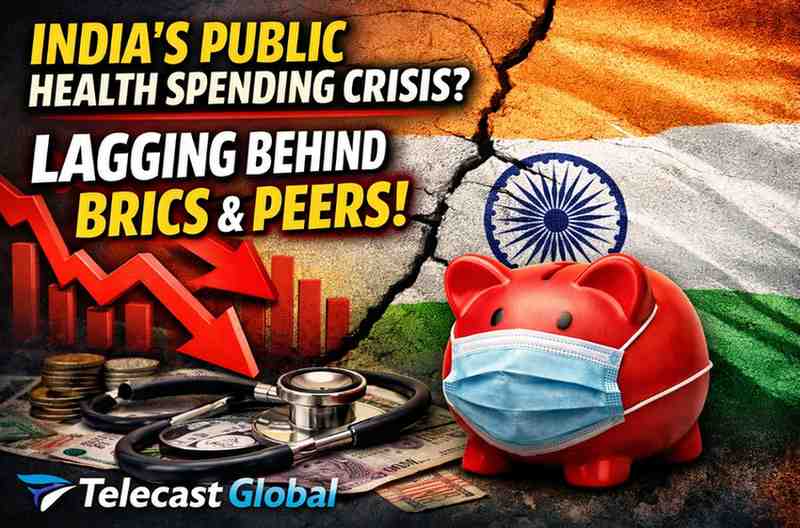
India public health spending has emerged as a critical fault line in today’s policy and economic debates, especially as the country positions itself as a global growth engine. Despite lessons from COVID-19 and ambitious commitments under the National Health Policy 2017, government healthcare investment continues to lag dangerously behind targets. While states are stretching their budgets, the Union government’s declining share signals deeper structural issues—centralisation, misallocated cesses, and weak fiscal prioritisation. In an era of rising non-communicable diseases, ageing populations, and global health shocks, underfunding public healthcare is no longer just a social concern—it is an economic and strategic vulnerability. – Telecast Global
India Public Health Spending vs Budget 2025: Why Targets Keep Slipping
India public health spending continues to underperform against its own policy promises, and Budget 2025 has only reinforced a hard truth: healthcare remains a secondary fiscal priority despite loud political rhetoric. The National Health Policy (NHP) 2017 set a clear, measurable goal—raise public health expenditure to 2.5% of GDP by 2025. Yet, as Budget 2025-26 data shows, the Union government’s contribution has stagnated at around 0.29% of GDP, far below even the interim target of 1% .
The first reason targets keep slipping is budgetary prioritisation driven by political visibility. Roads, railways, ports, and direct cash transfers deliver quick, tangible electoral returns. Public health, by contrast, is a slow-burn investment—its benefits show up as avoided crises, not ribbon-cutting moments. In fiscal decision-making, this makes India public health spending an easy casualty when resources are tight or political capital must be spent elsewhere.
Second, Budget 2025 reflects a deeper problem of fiscal centralisation without fiscal responsibility. While states have gradually increased their health spending—from about 0.67% of GDP in 2017–18 to over 1.1% by 2025–26—the Centre has reduced both its direct expenditure and its transfers to states under Centrally Sponsored Schemes . This imbalance weakens cooperative federalism and leaves states carrying the burden without adequate support. In effect, India public health spending growth is happening despite the Centre, not because of it.
A third factor is the misuse of the Health and Education Cess (HEC). Budget documents suggest that cess collections, instead of supplementing healthcare funding, are increasingly substituting for core budgetary allocations. In 2023–24, only about one-fourth of the HEC was actually spent on health, undermining the very logic of earmarked taxation . This accounting sleight of hand allows headline numbers to look stable while real spending power quietly erodes—another reason India public health spending targets appear met on paper but fail in practice.
Fourth, Budget 2025 exposes the absence of a legally binding, time-bound financing roadmap. The NHP 2017 articulated ambitious GDP-based targets but stopped short of mandating annual milestones backed by law. Without statutory compulsion, health allocations remain vulnerable to yearly negotiations and shifting political winds. Predictably, when competing demands arise—defence, infrastructure, subsidies—India public health spending is postponed “just one more year.”
Finally, the continued dominance of the private healthcare narrative shapes budget thinking. Policymakers increasingly assume that insurance schemes and private hospitals will fill gaps left by public underinvestment. Budget 2025 leans on this logic, strengthening insurance-based approaches while underfunding primary care systems. The result is higher out-of-pocket expenditure and deeper inequality—directly contradicting the core objectives of the NHP.
In plain terms, India public health spending targets keep slipping not due to lack of awareness, but due to deliberate fiscal choices. Until health is treated as an economic investment—on par with infrastructure or defence—Budget exercises will continue to fall short, and policy promises will remain aspirational rather than achievable.
Post-COVID Reality: How Falling Central Health Funding Impacts Healthcare Systems
India public health spending in the post-COVID era tells an uncomfortable story—one of fading urgency after a once-in-a-century shock. During the pandemic, healthcare briefly moved to the centre of national consciousness. Emergency allocations increased, systems were stretched but strengthened, and there was widespread acknowledgment that chronic underinvestment had left India dangerously exposed. Yet, as the crisis receded, so did fiscal commitment. The Union government’s health expenditure declined from 0.37% of GDP in 2020–21 to about 0.29% in 2025–26, a reversal that defines the post-COVID policy reality .
This decline in India public health spending has direct consequences for healthcare systems, beginning with weakened preparedness. COVID-19 exposed gaps in disease surveillance, hospital capacity, oxygen supply chains, and human resources. Instead of institutionalising emergency gains, falling central funding has slowed investments in public health infrastructure, epidemiological intelligence, and workforce expansion. The message to the system is clear: crisis response is temporary, long-term strengthening is optional.
One of the most visible impacts is on primary healthcare, the backbone of any resilient system. Health and Wellness Centres, envisioned under the National Health Policy 2017 as hubs for preventive and promotive care, require sustained central support for staffing, diagnostics, and medicines. As India public health spending from the Centre contracts, states are forced to stretch limited resources, often prioritising curative services over prevention. This creates a dangerous cycle where diseases are treated late and at higher cost—both fiscally and socially.
Falling central funding also deepens inter-state inequality in healthcare outcomes. Wealthier states can compensate with higher own-tax revenues, while poorer and high-burden states depend heavily on Union transfers. The reduction in central health transfers—from nearly 76% a decade ago to about 43% recently—has eroded states’ capacity to respond to post-COVID health challenges . In practice, India public health spending cuts widen regional disparities, undermining the promise of universal health coverage.
Another systemic impact is the growing reliance on out-of-pocket expenditure. As public systems struggle, households turn to private providers for diagnostics, medicines, and hospitalisation. This is particularly damaging in the post-COVID context, where non-communicable diseases, mental health conditions, and long-COVID complications are rising. Lower India public health spending means higher financial risk for families, pushing millions closer to poverty despite economic growth.
There is also a strategic dimension policymakers often overlook. Post-COVID, global health security has become a key geopolitical concern. Countries are investing heavily in public health capacity, domestic pharmaceutical ecosystems, and pandemic preparedness. India, despite its pharmaceutical strength, risks falling behind if India public health spending remains stagnant. A weak public health system limits India’s ability to act as a regional health leader or respond swiftly to future global shocks.
In blunt terms, the post-COVID rollback in central health funding signals institutional amnesia. India public health spending has slipped not because risks have disappeared, but because political attention has shifted. The cost of this retreat will not be immediate headlines—but slower growth, higher inequality, and a healthcare system perpetually one crisis away from collapse.
State Governments Carry the Load as Fiscal Centralisation Deepens
India public health spending today reveals a quiet but consequential shift in fiscal responsibility—from the Centre to the states. While national policy narratives often highlight cooperative federalism, budgetary realities tell a different story. Over the past decade, state governments have steadily increased their health expenditure, even as the Union government has reduced its relative contribution. This growing imbalance has made states the primary shock absorbers of India’s healthcare needs, stretching their fiscal capacity in an environment of deepening centralisation .
The numbers are telling. State health spending has risen from roughly 0.67% of GDP in 2017–18 to about 1.1% by 2025–26, reflecting genuine effort and political will at the sub-national level. In contrast, the Union government’s health spending has declined to around 0.29% of GDP, far below its own stated targets under the National Health Policy 2017 . As a result, India public health spending growth is being driven almost entirely by states, not by coordinated national leadership.
This shift would be manageable if states had commensurate fiscal autonomy. They do not. Fiscal centralisation has intensified through reduced tax devolution flexibility, tighter borrowing limits, and shrinking discretionary transfers. Most critically, the Union’s share of health transfers to states under Centrally Sponsored Schemes has fallen sharply—from nearly 76% in 2014–15 to about 43% by 2024–25 . In plain terms, states are being asked to do more for healthcare with less central support, even as their revenue-raising powers remain constrained.
For frontline healthcare delivery, this has serious consequences. States fund and manage primary health centres, district hospitals, health workers, and disease-control programmes. As India public health spending responsibility shifts downward, states are forced to make hard trade-offs—between salaries and infrastructure, between preventive care and emergency services. Wealthier states can partly absorb these pressures, but poorer and high-burden states cannot. The result is widening regional inequality in healthcare access and outcomes, directly undermining the goal of universal health coverage.
Fiscal centralisation also weakens accountability. When outcomes deteriorate, blame is diffused between the Centre and states. The Union retains policy control and narrative dominance, while states shoulder operational costs and public dissatisfaction. This asymmetric arrangement allows India public health spending shortfalls at the central level to escape sustained scrutiny, even though central decisions shape the overall fiscal environment.
There is a structural irony here. Public health is constitutionally a state subject, yet national targets, flagship schemes, and international commitments are driven by the Centre. Without adequate funding flows, this mismatch creates what economists call an “unfunded mandate.” States are expected to deliver national health ambitions without national-level financial backing. Over time, this erodes both service quality and trust in public institutions—an invisible but dangerous cost of skewed India public health spending.
Looking ahead, deeper fiscal centralisation without shared responsibility is unsustainable. Healthcare systems thrive on predictability, not ad-hoc adjustments. Unless the Centre reverses course—by restoring transfers, committing to its GDP targets, and treating states as genuine partners—India public health spending will remain uneven, fragile, and politically convenient to neglect. The burden on states may keep the system afloat for now, but it is not a foundation on which a resilient national healthcare system can be built.
Health Cess Controversy: Are Earmarked Funds Quietly Replacing Real Spending?
India public health spending increasingly hinges on a fiscal tool that was meant to strengthen healthcare—but may now be distorting it: the Health and Education Cess (HEC). Introduced with the promise of generating dedicated resources for social sectors, the cess was supposed to add to government health budgets. Instead, recent data suggests it is quietly replacing real spending, allowing core health allocations to stagnate while headline figures appear respectable .
At the heart of the controversy lies a simple question: is the cess being used as a supplement or a substitute? Evidence points firmly to the latter. In 2023–24, only around 25% of total Health and Education Cess collections were actually allocated to health, with the remainder absorbed elsewhere in the fiscal system . This practice undermines the original intent of the cess and weakens the credibility of India public health spending commitments.
From a budgetary perspective, the problem is subtle but serious. When cess revenues are counted toward overall health expenditure, governments can claim stable or marginally rising allocations without increasing baseline budgetary support. In effect, cess funds plug gaps created by stagnant core spending. This accounting manoeuvre creates the illusion of fiscal responsibility while masking real underinvestment. For a sector as sensitive as healthcare, such opacity is not just bad economics—it is bad governance.
The impact on healthcare systems is tangible. Core budget allocations fund long-term investments: hospitals, medical colleges, workforce training, disease surveillance, and primary care networks. Cess-based funding, by contrast, is often discretionary and less predictable. When India public health spending relies heavily on earmarked cesses rather than stable budget lines, planning horizons shrink. States and implementing agencies are forced into short-term thinking, delaying structural reforms in favour of immediate survival.
There is also a federal dimension to the health cess controversy. Unlike shared taxes, cess collections are not devolved to states under Finance Commission formulas. This centralises control over health-related resources even as states shoulder the bulk of healthcare delivery. As a result, India public health spending through cesses can actually weaken state capacity, especially in poorer regions that depend on predictable transfers. What looks like increased central effort may, in practice, deepen fiscal asymmetry.
Politically, the cess offers convenience. Raising or reallocating cess revenues attracts less public scrutiny than increasing direct budgetary expenditure. It allows policymakers to signal commitment to health without confronting harder choices—such as reallocating funds from infrastructure or defence. Over time, this normalises a culture where India public health spending is managed through financial workarounds rather than principled prioritisation.
From an economic standpoint, the substitution effect is dangerous. Healthcare investments yield long-term productivity gains by reducing disease burden and out-of-pocket expenditure. When cess funds merely replace existing spending, these gains are delayed or diluted. The opportunity cost is enormous: higher household medical expenses, lost workdays, and increased inequality—costs that rarely appear in budget speeches but weigh heavily on the economy.
In plain terms, the health cess controversy exposes a trust deficit. Citizens pay an earmarked tax believing it strengthens healthcare for the poor. When that money quietly fills holes in routine budgets, the social contract weakens. India public health spending cannot afford such credibility erosion. Without transparency and a clear rule that cess revenues must add to, not replace, core allocations, earmarked funding risks becoming a fiscal fig leaf—useful for optics, harmful for outcomes.
If healthcare is truly a national priority, cess-based financing must be reformed or ring-fenced with strict accountability. Otherwise, India public health spending will continue to look healthier on paper than it is on the ground—a dangerous illusion in a country still grappling with post-pandemic realities and rising health risks.
Global Comparison Shock: Why India’s Health Spending Lags Peers and BRICS Nations
India public health spending looks especially stark when placed against global benchmarks, and the comparison is not flattering. Despite being one of the world’s fastest-growing major economies, India’s per capita public health expenditure remains among the lowest globally. According to the data, India spends far less on public healthcare than not only advanced economies, but also several developing peers and fellow BRICS nations . This gap exposes a fundamental mismatch between India’s economic ambitions and its social investment priorities.
Start with the neighbourhood comparison. Countries like Bhutan and Sri Lanka—far smaller economies with limited fiscal space—spend 2.5 to 3 times more per capita on public healthcare than India. Thailand and Malaysia spend nearly 10 times more, while BRICS nations such as Brazil, Russia, and China outspend India by 14–15 times per capita . These are not marginal differences; they represent entirely different philosophies of governance. In relative terms, India public health spending signals restraint where peers signal commitment.
One reason for this divergence lies in how health is framed within national development models. In many peer economies, public healthcare is treated as productive infrastructure—akin to roads or power grids—because it underpins workforce productivity and social stability. In India, health is still largely viewed as a welfare expense rather than an economic investment. This mindset keeps India public health spending low, even as evidence mounts that poor health outcomes directly slow growth and raise inequality.
Another factor is the over-reliance on private healthcare. India’s vast private health sector often masks the weakness of public investment in international comparisons. Policymakers argue that private provision fills gaps, justifying lower public spending. But globally, strong private healthcare systems coexist with robust public funding—not replace it. In India’s case, low India public health spending pushes costs onto households, resulting in high out-of-pocket expenditure and medical impoverishment, a pattern far less pronounced in peer nations.
Fiscal structure also plays a role. Many comparator countries have ring-fenced health financing mechanisms—dedicated health taxes, insurance pools, or legally mandated spending floors. India lacks such enforceable safeguards. Targets like spending 2.5% of GDP on health remain aspirational, not binding. Without institutional guarantees, India public health spending becomes vulnerable to annual budget trade-offs that peers have already insulated against.
The global comparison is particularly alarming in the post-COVID context. Countries that increased health spending after the pandemic are investing in disease surveillance, mental health, ageing populations, and climate-linked health risks. India, by contrast, has seen a decline in central health spending post-pandemic, widening the gap just as global standards are rising . This divergence risks locking India into a low-investment equilibrium while others move ahead.
Strategically, the implications go beyond healthcare. India aspires to be a global manufacturing hub, a demographic dividend story, and a regional leader. None of these ambitions are compatible with chronically low India public health spending. An unhealthy workforce is less productive, more vulnerable to shocks, and costlier to sustain through emergency interventions.
In blunt terms, the global comparison shock is a warning, not an embarrassment. India is not poor—it is under-investing by choice. Until India public health spending rises to match at least peer benchmarks, claims of inclusive growth and global leadership will rest on a fragile foundation. The numbers make it clear: the gap is not about capacity; it is about priority.
About The Author









Leave a Reply