

Table of Contents
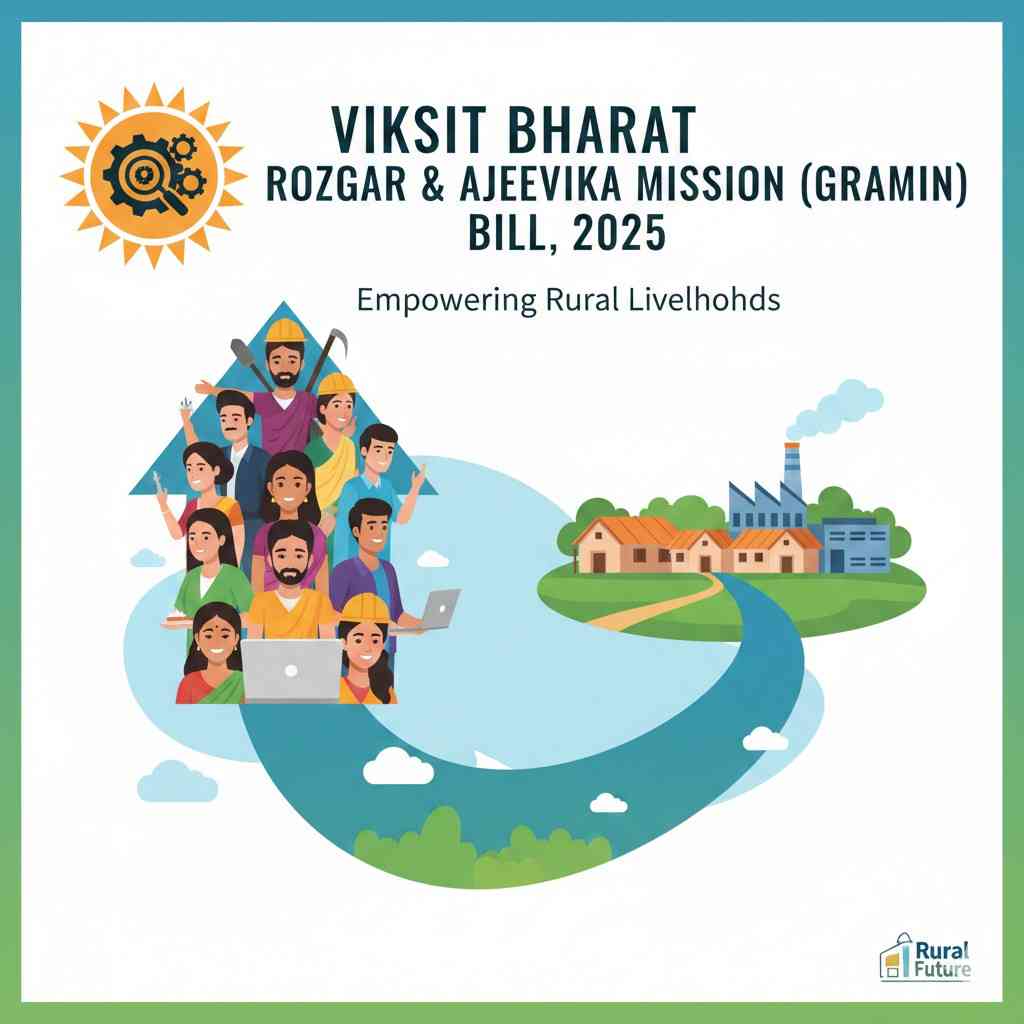
Viksit Bharat Rozgar & Ajeevika Mission Bill, 2025 marks a decisive shift in India’s rural employment strategy. Introduced by the Ministry of Rural Development as an upgrade to the Mahatma Gandhi National Rural Employment Guarantee Act, 2005 (MGNREGA), the Bill reorients rural employment from a rights-based, demand-driven welfare model to a budget-capped, supply-driven framework aligned with the vision of Viksit Bharat @2047. With rural poverty declining sharply over the past decade, the proposed law reflects an attempt to move beyond distress relief toward productivity-linked employment, planned asset creation, and long-term livelihood security.
Key Provisions of the Viksit Bharat–Guarantee for Rozgar and Ajeevika Mission Bill, 2025
The Viksit Bharat–Guarantee for Rozgar and Ajeevika Mission (Gramin) Bill, 2025 introduces a structurally redesigned rural employment framework, reflecting the government’s intent to recalibrate welfare delivery in line with evolving rural economic conditions. While it retains the language of employment “guarantee,” the Bill redefines how, where, and under what conditions this guarantee operates.
Statutory Wage Employment Guarantee
At its core, the Bill provides a legal entitlement of 125 days of wage employment per rural household per financial year to adult members willing to undertake unskilled manual work. This marks a numerical expansion over the 100-day guarantee under MGNREGA, signalling continuity in commitment to rural employment. However, unlike the earlier model where entitlement was universal and demand-driven, this guarantee is embedded within a more controlled and planned framework, reshaping the nature of the right itself.
Conditional and Non-Universal Coverage
A major departure from MGNREGA lies in the conditional application of the scheme. Employment will be available only in rural areas notified by the Union Government, rather than across all rural India. This selective notification converts the guarantee from a universal safety net into a targeted intervention. While the rationale aligns with declining poverty levels and reduced distress in many regions, it also raises concerns about exclusion errors and the weakening of rural households’ ability to demand employment during sudden economic shocks.
Bottom-Up Planning via Viksit Gram Panchayat Plans (VGPPs)
The Bill mandates the preparation of Viksit Gram Panchayat Plans (VGPPs) using spatial and digital technologies. These plans will be consolidated upward—from the Gram Panchayat to the Block, District, and State levels—ensuring multi-tiered coordination. Crucially, VGPPs are to be integrated with the PM Gati Shakti National Master Plan, linking rural employment works with broader infrastructure and logistics planning. This represents a clear shift from ad-hoc asset creation toward strategic, productivity-linked public works, addressing long-standing criticisms of asset redundancy under MGNREGA.
Centrally Sponsored Scheme Structure and Fiscal Rebalancing
The Bill restructures the programme as a Centrally Sponsored Scheme (CSS) with a revised 60:40 Centre–State cost-sharing ratio for most States, a significant increase from the earlier 10% State contribution under MGNREGA. Only North-Eastern States and Himalayan States/UTs retain the 90:10 pattern. Additionally, annual State-wise allocations will be determined by the Union Government based on objective parameters, limiting States’ flexibility to scale up expenditure in response to local distress. This marks a decisive tilt toward fiscal discipline and central oversight, but simultaneously weakens the cooperative federal character of rural employment provisioning
Flexibility During Agricultural Seasons
To prevent labour shortages during peak agricultural periods, the Bill empowers States to pause the programme for up to 60 days in a financial year during sowing and harvesting seasons. This provision reflects a pragmatic recognition of rural labour-market dynamics, aligning public employment with agricultural productivity rather than competing with it.
Unemployment Allowance Provision
Despite the shift toward supply-side control, the Bill retains an accountability mechanism by mandating unemployment allowance payments by State Governments if employment is not provided within 15 days of demand. However, given the conditional coverage and capped allocations, the practical enforceability of this provision remains uncertain.
Key Issues Hindering Effective Rural Growth and Employment in India
Despite two decades of large-scale public employment interventions, rural India continues to face deep structural challenges that limit sustainable growth and meaningful job creation. The limitations of existing frameworks, particularly MGNREGA, are not accidental but rooted in broader economic, demographic, and environmental shifts reshaping rural livelihoods.
Dominance of Low-Quality and Low-Productivity Employment
Rural employment in India remains overwhelmingly informal and low-value. According to the Periodic Labour Force Survey (PLFS) 2022–23, nearly 45% of rural workers are self-employed, primarily in agriculture and allied activities. However, this self-employment is often not entrepreneurial in nature; instead, it reflects disguised unemployment, where multiple workers depend on the same small landholding with marginal productivity. Such employment generates subsistence-level incomes, offers no social security, and fails to absorb India’s growing rural workforce into higher-value economic activities. This structural stagnation has made income diversification and productivity enhancement central policy challenges.
Fiscal and Operational Stress Under MGNREGA
While MGNREGA has served as a crucial safety net, its open-ended, demand-driven design has increasingly strained public finances and administrative capacity. Reports by the Comptroller and Auditor-General of India (CAG) have repeatedly flagged systemic issues, including chronic delays in wage payments, frequent fund exhaustion, and the accumulation of pending liabilities carried forward across financial years. These operational bottlenecks erode worker confidence, weaken the credibility of the employment guarantee, and undermine the very rights-based framework on which MGNREGA was built. As rural distress patterns become more localized rather than universal, the fiscal sustainability of an uncapped national programme has come under growing scrutiny.
Persistent Skill Mismatch in Rural Workforce
India’s rural skilling ecosystem has struggled to translate training into stable employment. National Skill Development Corporation (NSDC) assessments reveal that many rural skilling programmes suffer from poor alignment with local market demand. Training is often standardized, supply-driven, and disconnected from regional economic realities, resulting in low placement rates and high post-placement attrition. This mismatch not only wastes public resources but also creates frustration among rural youth, who remain trapped between declining agricultural opportunities and inaccessible formal-sector jobs. Without integrating skilling with local infrastructure creation, services, and value chains, rural employment programmes risk becoming symbolic rather than transformative.
Rising Climate Vulnerability and Employment Volatility
Climate change has emerged as a force multiplier of rural insecurity. The IPCC Sixth Assessment Report (AR6) underscores that agriculture-dependent livelihoods are among the most climate-exposed globally. Increasing frequency of droughts, floods, heatwaves, and erratic rainfall has intensified income volatility for rural households, disrupting cropping cycles and seasonal employment patterns. Climate shocks not only reduce farm output but also limit the effectiveness of traditional public works, which are often reactive rather than resilience-focused. This vulnerability demands employment strategies that build durable assets, enhance climate adaptation, and reduce dependence on rainfall-sensitive livelihoods.
The Structural Takeaway
Together, these challenges reveal a deeper truth: rural India’s employment crisis is no longer just about the absence of work, but about the absence of productive, resilient, and future-ready work. Addressing this requires moving beyond temporary wage relief toward integrated planning, fiscal predictability, skill-market convergence, and climate-sensitive asset creation—precisely the policy space the new Bill seeks to occupy.
Measures to Further Strengthen Rural Growth and Employment in India
For rural employment reforms to deliver lasting outcomes, policy shifts must be supported by complementary structural measures. Employment guarantees alone cannot generate sustainable growth unless they are embedded within a broader ecosystem of skills, enterprise development, institutional capacity, and climate resilience.
Strengthening Convergence Across Rural Development Schemes
One of India’s persistent governance gaps has been the siloed functioning of rural development programmes. Effective convergence between DAY–NRLM, DDU-GKY, and PM Vishwakarma can transform short-term wage employment into durable livelihood pathways. While wage programmes provide income stability, skilling initiatives must simultaneously equip workers for higher-value activities. Linking Self-Help Groups (SHGs) with skill training, affordable credit, and market access can help rural households transition from casual labour to self-employment and micro-enterprises. Such convergence ensures continuity—from employment to skill formation to entrepreneurship—rather than fragmented interventions.
Promoting Rural Non-Farm Employment
With agriculture’s capacity to absorb labour steadily declining, the expansion of rural non-farm employment is indispensable. Rural MSMEs, agro-processing units, handicrafts, construction services, and repair-based enterprises offer significant employment potential. Cluster-based development models, supported by Common Facility Centres (CFCs), can reduce entry barriers for small producers by providing shared infrastructure, technology, and quality certification. Improved rural logistics, warehousing, and last-mile connectivity are equally critical to integrate rural enterprises into national and global value chains. Without this diversification, rural employment will remain trapped in low-productivity agriculture.
Building Climate-Resilient Rural Livelihoods
Climate volatility has made livelihood security increasingly fragile. Investments in climate-smart agriculture, watershed development, afforestation, and drought-proofing measures can generate employment while strengthening ecological resilience. Renewable energy-based livelihoods—such as solar pump maintenance, decentralized power generation, and bio-energy—offer new income streams independent of monsoon cycles. Embedding resilience-building works into rural employment planning ensures that public spending simultaneously creates jobs and reduces long-term vulnerability to climate shocks.
Empowering Panchayati Raj Institutions (PRIs)
Decentralisation remains central to effective rural development. Strengthening Panchayati Raj Institutions through genuine devolution of funds, functions, and functionaries can significantly improve programme responsiveness. Local governments are best positioned to identify area-specific employment needs, seasonal labour dynamics, and asset priorities. However, devolution must be accompanied by systematic capacity building, data access, and administrative autonomy. Empowered PRIs can enhance planning quality, reduce implementation delays, and strengthen social accountability mechanisms at the grassroots level.
Leveraging Digital and Financial Inclusion
Digital infrastructure has become a force multiplier for rural growth. Expanding Direct Benefit Transfers (DBT), digital wage payments, rural broadband connectivity, and interoperable financial platforms can reduce leakages and improve delivery efficiency. Access to affordable credit through SHGs, Farmer Producer Organisations (FPOs), and digital lending platforms can unlock rural entrepreneurship and investment. Digital literacy, when combined with financial inclusion, enables rural workers to access markets, government services, and skill opportunities previously beyond their reach.
The Strategic Imperative
Ultimately, strengthening rural growth and employment requires moving from isolated interventions to a systems-based approach—one that links wages with skills, infrastructure with markets, and employment with resilience. Only through such integration can rural India generate productive, stable, and future-ready livelihoods.
Conclusion: Evaluating the Viksit Bharat Rozgar & Ajeevika Mission Bill, 2025
The Viksit Bharat–Guarantee for Rozgar and Ajeevika Mission (Gramin) Bill, 2025 reflects a clear recognition that India’s rural economy has changed. Declining poverty levels, evolving labour markets, and rising climate risks demand a shift from pure distress relief toward productivity-driven employment. In this sense, the reform aligns with India’s long-term developmental vision and the transition from welfare dependency to economic empowerment.
However, the move away from a universal, demand-driven employment guarantee also carries real risks. Conditional coverage, capped allocations, and greater fiscal burden on States may weaken income security for the poorest and most vulnerable households, particularly during economic shocks or climate-induced disruptions. If not carefully implemented, the reform could dilute the protective floor that MGNREGA once provided.
The way forward lies in balance, not abandonment—preserving the right to work as a safety net while simultaneously creating durable, climate-resilient assets and diversified livelihood opportunities. Only a calibrated model that combines social protection with productivity can ensure that rural transformation remains inclusive and aligned with SDG 1 (No Poverty) and SDG 8 (Decent Work).
1. What is the objective of the VB–G RAM G Bill, 2025?
The objective of the Viksit Bharat–Guarantee for Rozgar and Ajeevika Mission (Gramin) Bill, 2025 is to recalibrate India’s rural employment framework by transitioning from an open-ended, demand-driven welfare model to a budget-capped, supply-driven programme.
The Bill aims to align rural employment generation with long-term development priorities by linking wage work to planned asset creation, productivity enhancement, and sustainable livelihoods, in line with the Viksit Bharat @2047 vision.
2. How many days of wage employment are guaranteed per rural household under the VB–G RAM G Bill, 2025?
The VB–G RAM G Bill, 2025 provides a statutory guarantee of 125 days of unskilled wage employment per rural household per financial year to adult members willing to undertake manual work.
3. What are Viksit Gram Panchayat Plans (VGPPs)?
Viksit Gram Panchayat Plans (VGPPs) are bottom-up development plans prepared at the Gram Panchayat level using spatial and digital technologies. These plans are aggregated at the Block, District, and State levels and integrated with the PM Gati Shakti National Master Plan to ensure coordinated, infrastructure-linked and productivity-oriented rural development.
About The Author










Leave a Reply