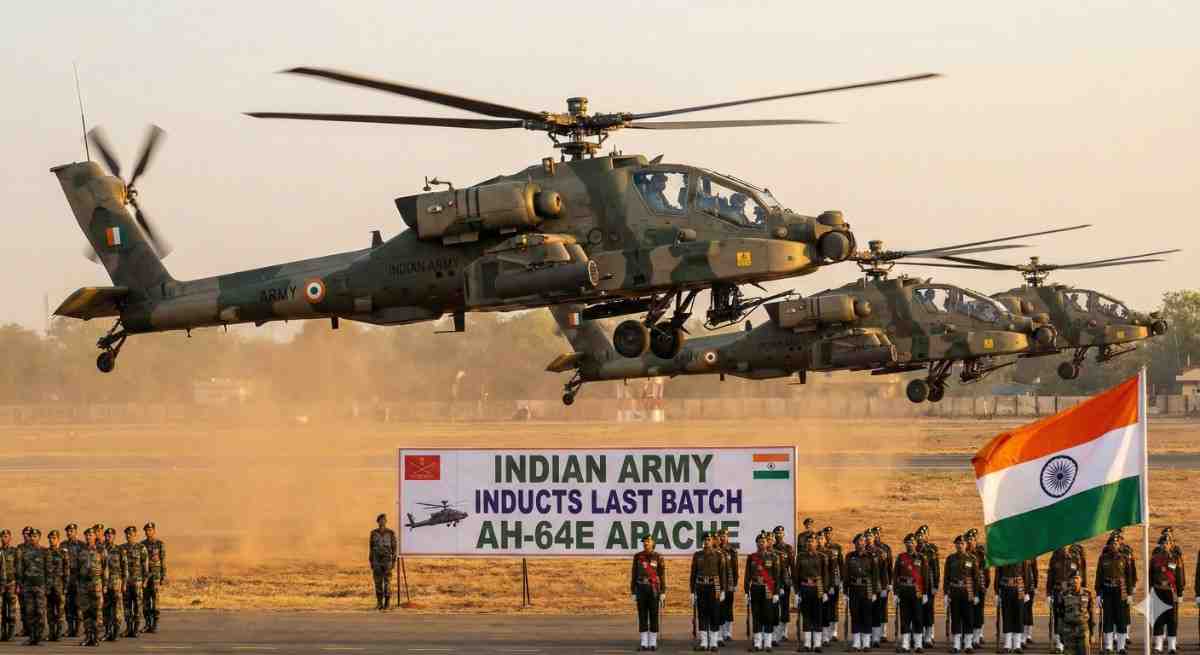
Indian Army Apache AH-64E helicopters
Table of Contents
Indian Army Apache AH-64E helicopters mark a decisive leap in India’s battlefield capability and military preparedness. With the Army receiving the final batch of these advanced attack helicopters, a long-planned modernization effort has now reached operational maturity. Designed for precision strikes, high-altitude warfare, and all-weather combat, the Apache significantly enhances the Army’s offensive reach along sensitive borders. At a time of persistent tensions with China and Pakistan, this induction strengthens deterrence, improves close air support for ground forces, and reflects India’s evolving approach to modern, technology-driven warfare.
Why Indian Army Apache AH-64E Helicopters Are a Game-Changer
The Apache AH-64E isn’t just another helicopter added to the Indian Army’s inventory—it’s a straight-up shift in how the Army fights, deters, and dominates on the modern battlefield. Think of it as less “supporting actor” and more “main character energy” in India’s attack aviation story.
First, let’s talk lethality. The AH-64E is designed purely for combat—no compromises. Its 30mm chain gun, Hellfire missiles, and advanced rockets give the Army the ability to destroy tanks, bunkers, air defence systems, and troop concentrations with surgical precision. In plain terms: if something threatens Indian forces on the ground, the Apache can neutralize it fast, hard, and from a safe distance. This matters especially in limited-war or high-intensity conflict scenarios where speed and precision decide outcomes.
Second, the Apache dramatically upgrades night and all-weather warfare. Wars today don’t pause for fog, darkness, or bad weather—and neither does the AH-64E. Its Longbow fire-control radar, night vision sensors, and advanced targeting systems allow it to identify and engage targets without exposing itself. For the Indian Army, this is huge. Whether it’s a cold night in Ladakh or low visibility along the western front, the Apache ensures that Indian troops aren’t fighting blind.
Now let’s get real about high-altitude operations—India’s biggest strategic headache. Operating attack helicopters in mountainous terrain isn’t easy; thin air kills performance. The AH-64E is among the few platforms globally proven to operate effectively at high altitudes. This makes it especially relevant after the lessons of eastern Ladakh, where mobility, firepower, and rapid response became critical. The Apache gives the Army a tool that can respond quickly across rugged terrain where tanks and artillery struggle.
Another major shift is Army-controlled air power. Earlier, attack helicopters were largely under the Air Force. With the Apache squadrons now directly with the Army Aviation Corps, coordination improves massively. Ground commanders get immediate access to close air support without bureaucratic lag. This is old-school military wisdom done right—air power directly tied to ground maneuver. Faster decisions, tighter integration, better battlefield outcomes. Simple.
Then there’s network-centric warfare. The AH-64E isn’t flying solo—it’s digitally connected. It can share real-time battlefield data with drones, ground units, and command centers. This turns it into a flying sensor-and-shooter platform, not just a gunship. In future conflicts, information dominance matters as much as firepower, and the Apache delivers both.
Finally, the Apache sends a clear deterrence signal. Induction of such a platform tells adversaries that India isn’t reactive—it’s prepared. It raises the cost of misadventure across borders and strengthens India’s posture in a tense neighbourhood.
Bottom line? The Apache AH-64E gives the Indian Army speed, precision, survivability, and dominance. It blends modern tech with classic battlefield principles—hit hard, hit first, and protect your soldiers. Old-school strategy, new-age muscle. And honestly, that combo never goes out of style.
From Contract to Combat: The Journey of Indian Army Apache AH-64E Helicopters
The story of India’s Apache AH-64E induction is not an overnight flex—it’s a slow, strategic grind that reflects how modern military capability is actually built. Paperwork first, firepower later. Very old-school, very necessary.
The journey began in 2015, when India signed a government-to-government deal with the United States to acquire 22 Apache AH-64E helicopters for the Indian Air Force. At that time, the Apache was already battle-tested in conflicts across Iraq and Afghanistan, earning a reputation as one of the deadliest attack helicopters ever built. India wasn’t buying hype—it was buying proven performance.
But the real turning point came later. As India reassessed its warfighting needs—especially after recurring border tensions and the changing nature of land warfare—it became clear that the Indian Army needed its own dedicated attack helicopter fleet. Ground commanders required direct, immediate air support, not routed through another service. This led to a separate 2020 deal for six Apache AH-64E helicopters specifically for the Indian Army, marking a doctrinal shift in how India views close air support.
Then came the delays—because defence procurement is never smooth sailing. Supply chain disruptions, COVID-19, and manufacturing bottlenecks in the US slowed deliveries. Critics made noise. Armchair generals panicked. But this is where patience matters. Defence platforms aren’t smartphones—you don’t rush them without consequences.
Training was happening quietly in parallel. Indian Army pilots and ground crews were trained in the US and in India to operate and maintain one of the most complex rotary-wing platforms in the world. Apache operations demand elite-level skill—sensor fusion, weapons integration, and coordinated battlefield engagement. This wasn’t just induction; it was capability absorption.
By 2023–24, deliveries gained momentum. Apache helicopters were inducted into Army Aviation units, integrated with ground formations, and tested across diverse terrains. This is the unglamorous but crucial phase—doctrine writing, joint exercises, communication protocols, and real-world simulations. Combat power isn’t created when hardware arrives; it’s created when people master it.
The final batch delivery now completes this journey from contract to combat readiness. What makes this moment significant isn’t the number—six helicopters won’t change the world overnight—but the signal of completion. The Army now has a fully inducted, operational Apache unit with trained crews, logistics pipelines, and command integration in place.
This journey also reflects a broader shift in India’s defence mindset. Instead of platform-by-platform buying, India is moving toward role-based capability building. The Apache fits into a larger ecosystem—drones, artillery, ISR assets, and networked command systems. It’s not standing alone; it’s plugging into a bigger warfighting picture.
There’s also a diplomatic angle. The Apache deal strengthened India–US defence cooperation, improved interoperability, and reinforced India’s position as a trusted defence partner. In geopolitics, hardware talks—loudly.
In the end, the Apache induction story is about discipline. Years of planning, negotiation, training, and testing—so that when the moment comes, the machine works and the soldier survives. Not flashy. Not viral. Just effective.
That’s how real military power is built.
Boosting Firepower Along Critical Frontiers: China and Pakistan Factor
Let’s not dance around it—India doesn’t induct attack helicopters for parades. The Apache AH-64E’s arrival is tightly linked to the two-front reality India lives with every single day: Pakistan on the west and China in the north. Different terrain, different doctrines, same bottom line—credible, instant firepower matters.
Start with the Pakistan front. Along the western border and the Line of Control, conflict scenarios are usually fast, sharp, and localized. Think infiltration attempts, armoured thrusts, or limited conventional escalations under the nuclear overhang. This is exactly where the Apache shines. With its ability to detect, track, and destroy armoured vehicles and fortified positions, the AH-64E gives the Indian Army a lethal edge in short-notice, high-intensity engagements. Tanks moving at night? Neutralized. Forward posts causing trouble? Taken out with precision. The message is simple: any misadventure will be met with overwhelming force, fast.
Now shift focus to China—and the terrain flips the game entirely. High-altitude, extreme weather, narrow valleys, and long logistics chains define the Line of Actual Control. After the eastern Ladakh standoff, one lesson became crystal clear: India needs rapid, flexible firepower that can move faster than ground forces in mountains. The Apache fits this role almost perfectly. Its high-altitude performance, combined with advanced sensors, allows it to support troops deployed in remote areas where artillery and armour have serious limitations.
What really matters here is deterrence through visibility. When adversaries know that Indian Army formations are backed by attack helicopters capable of precision strikes in mountains, it raises the cost of any aggressive move. Apaches don’t just fight wars—they help prevent them by making escalation unattractive.
Another critical factor is response time. Along both fronts, time is the difference between control and chaos. The Apache enables rapid reaction to emerging threats—whether it’s a sudden infiltration, armoured concentration, or a standoff that risks spiraling. This reduces India’s dependence on slower, centralized air support and puts combat power directly in the hands of ground commanders.
The Apache also integrates well with surveillance drones and ground-based sensors, creating a layered battlefield picture. This is especially relevant against China, which emphasizes information warfare and surveillance-heavy tactics. Matching that with networked attack platforms ensures India isn’t reacting blind.
There’s also a psychological dimension—often underrated, but very real. The presence of attack helicopters along sensitive sectors boosts troop morale and reinforces confidence at the tactical level. Soldiers fight better when they know powerful backup is literally hovering overhead.
Importantly, this induction doesn’t signal recklessness. India’s approach remains defensive, restrained, and doctrine-driven. The Apache strengthens deterrence without lowering the threshold for conflict. That balance is crucial in a region where escalation risks are high.
In short, whether it’s Pakistan’s quick-trigger western front or China’s slow-burn, high-altitude pressure tactics, the Apache AH-64E gives India a flexible, credible, and survivable combat edge. It’s a quiet warning to adversaries—and a loud reassurance to Indian soldiers—that the Army is ready for whatever comes next.
Army vs Air Force Apaches: What Changes With Army Control?
On paper, a helicopter is just a helicopter. In reality, who controls it changes everything. The shift of Apache AH-64E helicopters from exclusive Air Force operation to direct Indian Army control is one of the most important—yet least flashy—reforms in India’s military structure. And yes, it matters a lot.
Earlier, attack helicopters were primarily operated by the Indian Air Force (IAF). This made sense in a classic air-power doctrine where all flying assets stayed under one command. But modern battlefields don’t reward neat organizational charts—they reward speed, integration, and local decision-making. That’s where the Army-controlled Apache becomes a game-changer.
Under Army control, Apaches are embedded directly with ground formations. This means attack helicopter units train, plan, and deploy alongside infantry and armoured units—not as external support, but as part of the same combat ecosystem. When ground commanders spot an emerging threat, they no longer have to route requests through multiple layers. The response is faster, cleaner, and tactically sharper.
This shift dramatically improves close air support (CAS) effectiveness. CAS is not about flying high and dropping weapons—it’s about understanding ground realities, terrain, troop movement, and enemy behaviour in real time. Army pilots work closely with ground units, speak the same operational language, and rehearse joint maneuvers regularly. The result? Fewer delays, better target selection, and reduced risk of friendly fire.
Another big change is doctrinal clarity. The Air Force’s primary focus remains air superiority, strategic strikes, and air defence—rightfully so. Attack helicopters, on the other hand, are tactical battlefield assets. Placing them under the Army aligns role with responsibility. No overlap, no confusion, no tug-of-war during crises.
Training cycles also benefit. Army aviation units train specifically for terrain-focused missions—mountains, deserts, riverine belts—based on the formations they support. This specialization enhances mission readiness, especially along sensitive borders. It’s the old-school principle of “train as you fight,” executed with modern platforms.
Critically, this is not a downgrade for the Air Force. The IAF continues to operate its own Apache squadrons and retains full control over broader air campaigns. What’s changed is balance, not rivalry. In fact, clearer asset ownership reduces inter-service friction and improves joint planning at higher command levels.
There’s also a logistical upside. Maintenance, spares planning, and operational availability improve when platforms are tailored to specific formations rather than stretched across multiple roles. Army-controlled Apaches can be forward-deployed more easily, enhancing responsiveness in crisis situations.
Strategically, this move reflects India’s slow but steady evolution toward theatre-style thinking—where assets are allocated based on operational needs, not service prestige. It’s pragmatic, not political.
Bottom line: putting Apaches under Army control brings airpower closer to the soldier, tightens the kill chain, and speeds up battlefield decision-making. It’s not about who flies the helicopter—it’s about who fights with it. And on the modern battlefield, that distinction can decide outcomes.
What Comes Next: Attack Helicopters, Indigenous Push, and Future Warfare
The induction of the Apache AH-64E isn’t the end of India’s attack helicopter story—it’s the bridge between old certainties and future warfare. What comes next will define whether India remains a buyer of elite platforms or becomes a builder of sustained combat power. Spoiler: the direction is clear, even if the road is long.
First, let’s address the elephant in the hangar—numbers. Six Army Apaches add capability, but future conflicts will demand scale. High-intensity wars burn assets fast. India will need a mix of imported excellence and indigenous volume to stay credible across two fronts. The Apache sets the benchmark; the future must meet it at home.
That’s where the Light Combat Helicopter (LCH) Prachand enters the picture. Designed specifically for India’s terrain, the LCH is optimized for high-altitude warfare, exactly where future flashpoints are most likely. It may not match the Apache in sheer sensor sophistication today, but it offers something equally important: availability, adaptability, and sovereignty. No foreign supply chain panic during a crisis. No political fine print.
The real future lies in combined helicopter doctrine—heavy attack platforms like the Apache for deep, high-value strikes, and indigenous helicopters like LCH for sustained battlefield presence. One delivers precision shock; the other provides persistent combat support. Old-school military balance, modern execution.
But helicopters alone won’t dominate future wars. The battlefield is evolving fast. Manned–unmanned teaming is the next frontier. Attack helicopters will increasingly operate alongside armed drones, loitering munitions, and surveillance UAVs. The Apache’s network-centric design already fits this model, acting as a command-and-control node rather than just a shooter. Future Indian platforms must be built with this reality baked in—not added later as jugaad.
Another key shift is data-driven warfare. Sensors, electronic warfare, cyber resilience, and AI-assisted targeting will matter as much as missiles and guns. Attack helicopters will need to survive in contested airspace filled with air defences, jamming, and counter-drone systems. Survivability—not just firepower—will define relevance.
Organisationally, India is also moving toward integrated theatre commands, where assets are assigned based on geography and mission, not service boundaries. Army-controlled attack helicopters fit neatly into this vision. Faster decisions, clearer chains of command, and more lethal joint operations.
There’s also a cultural change underway. The Indian military is slowly shifting from platform obsession to capability ecosystems. The Apache is respected not because it’s American, but because it delivers results. The same standard will now be applied to indigenous systems—and that’s a healthy sign.
In the end, the Apache AH-64E marks a transition point. It strengthens India’s present while shaping its future. If India blends imported precision with indigenous resilience and embraces networked, joint warfare, its attack helicopter force won’t just react to threats—it will dominate them.
Traditional principles. Modern tools. Clear intent.
That’s how future wars are won.
About The Author