

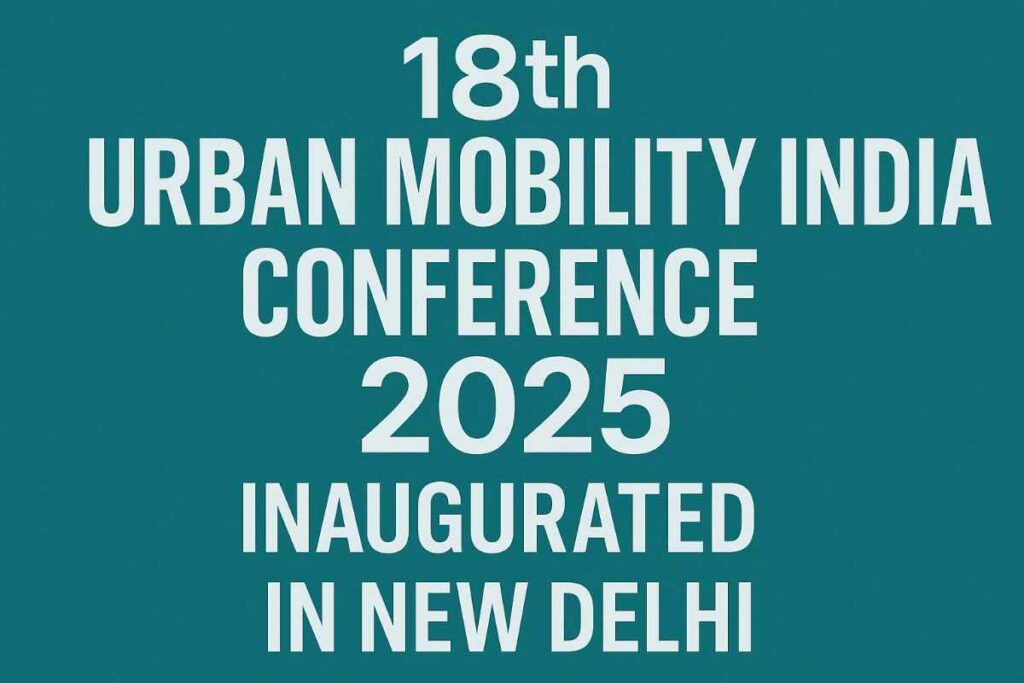
The 18th Urban Mobility India (UMI) Conference 2025 was inaugurated in New Delhi, bringing together policymakers, urban planners, researchers, and transport experts from across the country. Organized by the Ministry of Housing and Urban Affairs (MoHUA), this annual event serves as a vital platform to discuss innovations, challenges, and future strategies in urban mobility. The 2025 edition focuses on sustainable, inclusive, and technology-driven urban transport solutions that align with India’s Smart Cities Mission and climate goals. With a spotlight on electric mobility, multimodal integration, and digital innovation, the conference sets the roadmap for India’s next decade of urban transformation.
The Vision and Objectives of the Urban Mobility India Conference 2025
The 18th Urban Mobility India (UMI) Conference 2025, held in New Delhi, carries a vision that’s not just about improving transportation—it’s about transforming how cities move, live, and grow. As India’s urban population expands rapidly, the need for sustainable, efficient, and inclusive mobility systems has never been greater. UMI 2025 stands as a powerful reminder that mobility isn’t just about vehicles—it’s about people, accessibility, and the future of cities.
1.1 Vision: “Green Mobility, Clean Future”
The central vision of UMI 2025 revolves around “Green Mobility, Clean Future.” This phrase isn’t just a slogan—it defines India’s commitment to achieving net-zero emissions in urban transport, promoting eco-friendly technologies, and ensuring mobility for all. The conference highlights how India aims to shift from a car-centric model to a people-first urban transport ecosystem.
The long-term vision includes:
- Making urban transport systems sustainable, energy-efficient, and inclusive.
- Encouraging public transport, cycling, and pedestrian-friendly cities.
- Integrating electric and digital mobility for smoother intercity and intracity travel.
- Reducing carbon footprints through innovation, policy, and public awareness.
UMI 2025 emphasizes that sustainability in transport isn’t just an environmental choice—it’s an economic necessity. Cleaner cities mean reduced health costs, better productivity, and improved quality of life.
1.2 The Broader Purpose Behind UMI
Since its inception in 2008, the Urban Mobility India Conference has served as a knowledge-sharing platform under the Ministry of Housing and Urban Affairs (MoHUA). Its purpose is simple but powerful — to bridge the gap between policy and practice in urban mobility.
Each year, experts from across India and the world come together to:
- Exchange research findings and global best practices.
- Showcase innovative transport technologies and solutions.
- Encourage collaboration among central, state, and local governments.
- Motivate startups, private players, and NGOs to participate in mobility development.
The UMI Conference also acts as a policy incubator, helping shape India’s National Urban Transport Policy (NUTP) through discussions and recommendations that emerge from these sessions.
1.3 Core Objectives of UMI 2025
Let’s break down the five core objectives that guide this year’s conference:
(a) Promoting Sustainable Urban Transport
UMI 2025 emphasizes sustainable modes like electric buses, metro systems, e-rickshaws, cycling tracks, and pedestrian zones.
The goal is to reduce dependency on private vehicles and promote shared, clean, and efficient transport options.
This objective also aligns with the United Nations Sustainable Development Goal (SDG 11) — “Sustainable Cities and Communities.” By promoting public transport and clean mobility, UMI contributes directly to building livable and eco-conscious cities.
(b) Enhancing Policy Frameworks and Governance
Another major objective is to help governments strengthen urban mobility policies.
UMI 2025 discusses frameworks to:
- Streamline urban transport governance between central and state agencies.
- Encourage data-driven decision-making through digital platforms.
- Support public-private partnerships (PPP) in transport infrastructure.
Through structured dialogues, policymakers are encouraged to adopt evidence-based planning, ensuring that every rupee invested translates into measurable mobility improvements.
(c) Integrating Technology and Innovation
UMI 2025 places strong emphasis on digital transformation.
From AI-based traffic management to real-time transit apps and mobility-as-a-service (MaaS) platforms, the event showcases how tech can revolutionize commuting.
The objective is not just to innovate but to make these technologies accessible and affordable across Tier-2 and Tier-3 cities, ensuring digital inclusivity.
(d) Encouraging Private Sector Participation
Public mobility is no longer just a government responsibility.
The private sector—startups, electric vehicle manufacturers, and logistics companies—play a crucial role. UMI 2025 aims to bridge the public-private divide, fostering collaboration in:
- EV infrastructure (charging stations, battery swapping)
- Smart ticketing systems
- Urban logistics and delivery solutions
- Mobility data analytics
This creates a synergic model where government regulation meets private innovation.
(e) Strengthening Capacity Building and Research
A standout focus of UMI 2025 is capacity building—training urban planners, engineers, and local government officials to manage modern mobility systems.
Workshops, technical sessions, and case studies from across India highlight how human capacity is just as vital as infrastructure.
The Institute of Urban Transport (India), a key partner in UMI, also supports universities and research bodies to publish new insights into transport design, sustainability, and behavioral trends.
1.4 The Conference as a Think Tank for Future Mobility
UMI 2025 acts as a think tank, shaping how India’s mobility ecosystem will evolve in the next decade. The sessions are designed to address real-world urban transport challenges such as:
- Traffic congestion in megacities like Delhi, Mumbai, and Bengaluru.
- First- and last-mile connectivity gaps in metro and bus networks.
- The environmental impact of increasing vehicle ownership.
- The inclusion of women, elderly, and differently-abled citizens in mobility planning.
By fostering these discussions, the conference doesn’t just talk about mobility—it actively influences policies and investments that will define India’s transport landscape for years to come.
1.5 UMI 2025 and India’s Global Commitments
India’s participation in international climate and urban development forums—like COP30 and the Global Mobility Summit—aligns perfectly with the themes of UMI 2025.
The conference reiterates India’s commitment to the Paris Climate Agreement by promoting cleaner fuels, low-emission zones, and electrification of public transport.
Moreover, UMI 2025 connects India’s goals with the G20 New Delhi Declaration, which emphasizes sustainable urbanization and green infrastructure.
In short, the event positions India not just as a follower, but as a leader in sustainable urban transport on the global stage.
1.6 The Human-Centric Vision of UMI 2025
Beyond the policies and technology, UMI 2025 emphasizes one crucial aspect — mobility must serve people first.
The conference advocates for inclusive planning where every citizen, regardless of income or ability, can move freely, safely, and affordably.
This human-centric approach promotes:
- Safe infrastructure for pedestrians and cyclists.
- Gender-sensitive urban transport design.
- Affordable fare systems for low-income commuters.
- Smart accessibility solutions for senior citizens and differently-abled persons.
In essence, UMI 2025 envisions transport not as a privilege, but as a right.
1.7 Conclusion: A Blueprint for Urban Transformation
The vision and objectives of UMI 2025 form the backbone of India’s urban mobility revolution. It’s more than a conference—it’s a national movement towards creating greener, smarter, and more connected cities.
With its focus on sustainability, inclusivity, and innovation, UMI 2025 is setting the tone for the “New Urban India” — one where every journey counts, every citizen matters, and every city moves toward a cleaner, smarter tomorrow.
Key Themes and Highlights of the Urban Mobility India Conference 2025
The 18th Urban Mobility India (UMI) Conference 2025, inaugurated in New Delhi, stood out as one of the most forward-thinking editions in the event’s history. Organized by the Ministry of Housing and Urban Affairs (MoHUA), it brought together policymakers, urban planners, industry leaders, academicians, and innovators from across India and beyond.
With the theme “Mobility for All: Sustainable, Smart, and Inclusive”, UMI 2025 served as a roadmap for how Indian cities can move beyond traffic congestion and pollution towards a greener, tech-driven, and people-first mobility future.
2.1 The Core Theme: Mobility for All
The central theme — “Mobility for All” — captured the essence of India’s vision for inclusive development. The conference emphasized that mobility isn’t just about infrastructure, but equal access to opportunities, services, and economic growth.
India’s cities, from metros like Delhi to emerging smart cities like Indore or Surat, face similar challenges: overcrowded roads, air pollution, poor last-mile connectivity, and lack of safe pedestrian spaces.
The sessions at UMI 2025 explored how integrated transport planning, digital solutions, and citizen participation can solve these issues at scale.
The main takeaway?
“A city’s progress isn’t measured by the number of cars it holds — but by how easily people can move.”
2.2 Highlight 1: Electric Mobility Takes Center Stage ⚡
One of the biggest highlights of UMI 2025 was its strong focus on electric mobility (e-mobility).
From electric buses and autos to battery-swapping networks and EV charging corridors, the event showcased India’s transition to clean energy transport.
Key takeaways from the e-mobility sessions included:
- Faster EV Adoption Policy: MoHUA announced enhanced incentives for state governments adopting EV fleets in urban transport.
- Public Transport Electrification: Plans to convert 30% of all city buses to electric by 2030.
- EV Infrastructure Push: Collaboration between government and private companies to set up nationwide charging grids.
- Battery Recycling Initiatives: Focus on circular economy principles for sustainable e-waste management.
This theme resonated with India’s broader climate goals — reducing oil dependence, cutting carbon emissions, and improving urban air quality.
The conference also featured live demos of electric two-wheelers, smart charging kiosks, and solar-powered parking bays — all attracting massive attention.
2.3 Highlight 2: Smart and Digital Mobility 💡
The digital revolution in urban transport was another dominant theme.
The UMI 2025 showcased how data, AI, and IoT can make city travel smoother, safer, and more predictable.
Sessions on “Smart Mobility through Digital Transformation” explored:
- AI-Based Traffic Management Systems reducing congestion in major cities.
- Mobility-as-a-Service (MaaS) apps integrating buses, metros, and e-rickshaws on a single digital platform.
- Smart ticketing and contactless payments across transport modes.
- Real-time public transport data accessible through mobile apps for route planning.
Cities like Bengaluru, Delhi, and Pune presented success stories of data-driven transport systems that use GPS, sensors, and analytics to monitor fleet movement and optimize routes.
Experts also highlighted how digital twins and GIS-based planning can help simulate future traffic flows — helping planners make smarter investments.
2.4 Highlight 3: Inclusive Mobility for All Sections of Society 👩🦽
UMI 2025 wasn’t just about technology — it was about people.
The conference featured powerful discussions on gender, accessibility, and affordability in urban mobility.
Key takeaways:
- Universal Access: Designing stations, buses, and streets that are friendly for differently-abled and elderly citizens.
- Women’s Safety in Mobility: Implementing smart surveillance, emergency alert systems, and female-staffed transport services.
- Affordable Transport Passes: Introducing monthly “mobility passes” for students, daily wage workers, and low-income groups.
- Gender-Sensitive Design: Urban spaces designed keeping women’s travel patterns in mind — safer lighting, wider sidewalks, better connectivity.
This section of the conference reinforced that mobility is a social equalizer, and every citizen deserves equal access to movement, regardless of income or ability.
2.5 Highlight 4: Urban Infrastructure and Multimodal Integration 🏗️
The UMI 2025 conference placed strong emphasis on multimodal integration — connecting all transport systems into one unified network.
In simple terms:
“Metro + Bus + Bike + Walk = One Seamless Journey.”
Major policy updates and highlights:
- Development of urban transport hubs integrating metro, bus, and rail networks.
- Promotion of Transit-Oriented Development (TOD) to reduce travel distances between home, work, and recreation.
- Pedestrian-first street designs and cycling corridors to reduce vehicle dependence.
- Focus on last-mile connectivity through shared mobility and e-rickshaws.
Infrastructure sessions also showcased Smart City projects like Ahmedabad’s BRTS, Delhi’s integrated metro-feeder network, and Kochi’s water metro — all models of multimodal harmony.
2.6 Highlight 5: Green and Climate-Resilient Mobility 🌱
In sync with global climate goals, UMI 2025 dedicated multiple panels to green mobility and climate resilience.
Discussions revolved around:
- Low-emission zones and congestion pricing models.
- Expansion of non-motorized transport (NMT) like cycling and walking.
- Adoption of biofuels and hydrogen-based mobility solutions.
- Integration of urban forests, green corridors, and eco-roofs in city planning.
Experts from NITI Aayog and MoHUA unveiled India’s Urban Climate Action Framework, ensuring every city transport project now includes a carbon impact assessment.
The clear message was that mobility policies of the future must balance efficiency, equity, and ecology.
2.7 Highlight 6: Innovation Pavilion and Startup Showcase 🚀
UMI 2025 celebrated innovation like never before with a dedicated pavilion for startups and innovators.
Over 80 startups and tech firms displayed solutions in electric mobility, AI traffic management, shared mobility, and transport analytics.
Some of the most talked-about projects included:
- A drone-based traffic monitoring system.
- A solar-powered EV charging cube developed by a Delhi startup.
- Smart helmets linked with rider safety apps.
- Blockchain-enabled ticketing systems for transit transparency.
The pavilion proved that India’s startup ecosystem is not just following trends—it’s defining the future of global urban mobility.
2.8 Highlight 7: International Collaboration and Knowledge Exchange 🌏
UMI 2025 also strengthened India’s global partnerships. Delegations from countries like Japan, Germany, Singapore, and the Netherlands shared case studies on:
- Metro network planning.
- Sustainable logistics.
- Smart traffic control centers.
- Public transport funding models.
These collaborations pave the way for joint ventures, technology transfers, and policy dialogues — ensuring India’s cities evolve with global best practices.
A special roundtable titled “Global South Cities: Shared Mobility for Shared Futures” emphasized how developing countries can collaborate to create low-cost, high-impact transport models.
2.9 Highlight 8: Awards and Recognitions 🏆
One of the most exciting moments of the conference was the UMI Awards for Excellence in Urban Transport.
Cities and organizations were honored for outstanding contributions in categories like:
- Best Urban Transport Project
- Best Green Mobility Initiative
- Best Innovation in Public Transport
- Best City for Non-Motorized Mobility
Cities like Pune, Surat, Indore, and Kochi received special recognition for their consistent work in implementing clean, efficient, and citizen-friendly transport models.
2.10 Conclusion: From Vision to Action
UMI 2025 proved to be more than a conference — it was a national mobility movement.
The key themes and highlights reflect India’s unstoppable drive toward decarbonized, digitized, and democratized transport systems.
Each session, each announcement, and each innovation showcased that India’s future of mobility is already taking shape — greener, smarter, and more inclusive than ever before.
By the end of the event, one thing was clear: the journey toward sustainable urban mobility isn’t optional anymore — it’s inevitable.
Innovations Showcased at the Urban Mobility India Conference 2025
The 18th Urban Mobility India (UMI) Conference 2025 wasn’t just a platform for policy talks — it was a showcase of innovation in motion. From electric buses gliding silently across test tracks to AI dashboards controlling real-time traffic, the event proved that India’s cities are finally stepping into the age of smart, sustainable mobility.
Urban mobility today isn’t about just moving faster — it’s about moving smarter, cleaner, and more inclusively. UMI 2025 made one thing clear: India’s next transport revolution will be driven by technology, sustainability, and people-first innovation.
3.1 Electric Mobility: Powering the Clean Transport Revolution ⚡
The backbone of India’s mobility transformation is electrification — and UMI 2025 showed how deep this shift has gone.
Electric vehicles (EVs) are no longer niche; they’re becoming the mainstream mode for both public and private transport.
Key innovations showcased:
- Electric Bus Fleets: Cities like Delhi, Surat, and Pune presented fully operational electric bus models with range-optimized batteries and real-time diagnostics.
- Battery Swapping Networks: Indian startups introduced ultra-fast battery swap stations, cutting charging time from hours to just a few minutes.
- Solar-Powered Charging Points: A big leap in sustainability — solar grids integrated with EV chargers, reducing dependence on coal-based power.
- e-Auto 2.0 Models: Lightweight, smart-metered e-rickshaws with built-in GPS and digital fare systems for Tier-2 and Tier-3 cities.
The government also unveiled the Urban Electric Transport Mission (UETM 2025–2030) — aiming to electrify 30% of India’s public transport fleet and establish 1 lakh public charging points nationwide.
These innovations aren’t just eco-friendly — they’re economically smart, cutting long-term operational costs while improving urban air quality.
3.2 AI and Data-Driven Smart Mobility Systems 🧠
UMI 2025 gave center stage to the power of Artificial Intelligence (AI) and data analytics in transforming transport.
In cities that choke under traffic chaos, AI is emerging as the ultimate urban hero.
Key innovations include:
- AI-Based Traffic Control: Delhi and Bengaluru showcased pilot projects using machine learning algorithms that analyze live camera feeds and adjust signal timings dynamically, reducing idle times and congestion by 25–30%.
- Predictive Maintenance Systems: City bus operators are now using AI tools to predict breakdowns and optimize fuel/electricity usage, extending vehicle lifespan.
- Smart Parking Solutions: IoT-based parking sensors that guide drivers to empty spots, cutting parking search time and congestion.
- Dynamic Route Optimization: Apps that analyze real-time traffic, weather, and commuter data to suggest the fastest, least-polluting routes.
These AI systems turn cities into living, thinking networks, where every bus, road, and signal “talks” to each other — creating an ecosystem of seamless movement.
3.3 Mobility-as-a-Service (MaaS): The Future of City Travel 🚍📱
Another showstopper at UMI 2025 was Mobility-as-a-Service (MaaS) — the idea that one digital platform can integrate every mode of transport — metro, bus, taxi, bike, e-rickshaw — and offer one unified ticketing system.
India’s first “One City, One Ticket” pilot was launched for Delhi, integrating DMRC, DTC, and app-based mobility operators into a single payment and scheduling platform.
MaaS makes commuting:
- Frictionless: No more juggling multiple apps or tickets.
- Affordable: Dynamic pricing ensures cost efficiency.
- Personalized: AI tracks your travel patterns to suggest faster routes.
With UMI 2025’s push, MaaS is now being tested in Indore, Kochi, and Lucknow, marking a huge step towards digitally connected cities.
The vision? A future where your phone becomes your ticket to any mode, anywhere in the city.
3.4 Green Infrastructure and Climate-Sensitive Design 🌿
Sustainability isn’t just about electric vehicles — it’s also about how cities are built. UMI 2025’s “Green Urban Infrastructure” sessions highlighted how cities can be redesigned to promote eco-friendly transport.
Some of the coolest innovations include:
- Green Corridors: Tree-lined cycling and walking tracks that absorb carbon and lower city temperatures.
- Eco-Roof Bus Shelters: Solar panels on bus stops powering lights and display systems.
- Permeable Roads: New materials that allow rainwater to seep in, preventing floods while supporting sustainable drainage.
- Urban Forest Mobility Zones: Cities like Pune and Bhopal announced projects to combine biodiversity with mobility infrastructure.
These ideas make cities not just cleaner, but healthier and more livable, aligning with India’s “LiFE Mission” — Lifestyle for Environment.
3.5 Autonomous and Connected Mobility 🚗🤖
While still in early stages, UMI 2025 showcased India’s ambition in autonomous mobility.
Several Indian startups and universities displayed prototypes of self-driving shuttles designed for controlled environments like campuses and tech parks.
Highlights include:
- 5G-Enabled Smart Vehicles: Connected cars communicating with smart traffic systems for collision avoidance.
- Vehicle-to-Infrastructure (V2I) Communication: Pilot projects in Gurugram and Hyderabad where vehicles receive live updates about traffic lights, road hazards, and parking availability.
- Autonomous Last-Mile Pods: Small electric pods designed for urban campuses and airports — built in collaboration with IIT Delhi and startups.
These futuristic solutions might take years for mainstream rollout, but they set the foundation for autonomous mobility ecosystems — where human error and congestion are minimized.
3.6 Urban Logistics and Last-Mile Innovations 📦🚴
A big innovation push came from urban freight and logistics — the often-ignored yet essential part of city transport.
UMI 2025 highlighted how sustainable logistics can reduce emissions and improve efficiency.
Cool innovations showcased:
- Electric Cargo Bikes: Compact, high-torque e-bikes for last-mile delivery, especially in crowded market areas.
- Micro-Distribution Hubs: Decentralized urban warehouses to cut long delivery routes.
- Night-Time Delivery Systems: Pilot projects in Pune and Delhi using EV fleets to decongest daytime roads.
- Drone-Based Deliveries: Demonstrations of drones delivering medical supplies and emergency goods in partnership with India Post and startups.
These innovations show how sustainability meets practicality, ensuring commerce flows smoothly without choking cities.
3.7 Digital Twins and Smart City Integration 🏙️💻
One of the more futuristic concepts discussed was Digital Twins — virtual replicas of cities used for simulation and planning.
Imagine being able to test a new metro line or flyover in a digital version of Delhi before building it in the real one — that’s exactly what these tools do.
Cities like Pune and Surat are developing digital twins for:
- Traffic flow simulations.
- Flood and pollution modeling.
- Urban design impact analysis.
Integrating these tools with Smart City dashboards allows planners to predict urban chaos before it happens, saving crores in future damage and redesign costs.
3.8 Startups and Innovation Labs: India’s Mobility Brainpower 🚀
India’s youth and startups stole the show at UMI 2025.
From AI-based route analytics to smart helmets and EV retrofitting kits, the Innovation Pavilion proved that homegrown tech is reshaping mobility.
A few standout innovations:
- GreenRide App: A Jaipur-based app integrating cycle rentals, EV autos, and public transport under one digital ecosystem.
- ReVolt Systems: A startup offering retrofitting kits that convert petrol scooters to electric in just 2 hours.
- UrbanEye AI: A platform using drone imagery and machine vision for traffic heatmap analysis.
To boost these ideas, MoHUA announced the creation of Urban Mobility Innovation Labs in 10 smart cities to mentor startups and pilot projects directly with city administrations.
3.9 Public Awareness and Behavior Change Campaigns 👥
UMI 2025 recognized that innovation isn’t just about machines — it’s also about mindset.
Public awareness campaigns are being designed to make citizens active participants in sustainability.
The “Smart Move India” campaign encourages:
- Citizens to prefer public or shared transport over personal cars.
- Awareness on eco-driving and vehicle maintenance for emission reduction.
- Incentives for people adopting cycling and walking habits.
Behavioral innovation — though often underrated — is what ensures that these technologies actually work in real life.
3.10 Conclusion: India’s Smart Mobility Decade Has Begun 🚦
The innovations presented at the UMI Conference 2025 make one thing crystal clear — India is no longer playing catch-up.
From AI and electric buses to green urban design and mobility apps, the country is leading a revolution in sustainable transport.
As these technologies scale and policies align, India’s urban mobility will soon reflect what every citizen dreams of — cleaner air, safer roads, faster commutes, and smarter cities.
The message from UMI 2025 echoed across every hall:
“The future of transport isn’t just electric — it’s intelligent, inclusive, and Indian.”
Government Initiatives and Policy Announcements from the Urban Mobility India Conference 2025
The 18th Urban Mobility India (UMI) Conference 2025 wasn’t just a platform for discussion — it was a stage for India’s boldest mobility reforms and policy announcements yet.
Led by the Ministry of Housing and Urban Affairs (MoHUA), the conference unveiled a set of new initiatives aimed at transforming India’s cities into smart, sustainable, and inclusive mobility ecosystems.
From national EV missions to new funding models and green transport policies, the government made it clear: urban transport is now a central pillar of India’s development vision.
4.1 A New Era of Urban Mobility Governance 🇮🇳
In his keynote address, the Union Minister for Housing and Urban Affairs announced that India has officially entered a “Decade of Urban Mobility” (2025–2035) — a focused period of reforms, funding, and innovation to reimagine how 1.4 billion Indians move.
Key governance reforms include:
- Formation of a National Urban Mobility Mission (NUMM) under MoHUA to coordinate transport policy across all Indian cities.
- Creation of Unified Metropolitan Transport Authorities (UMTAs) in every metro city to integrate metro, bus, e-rickshaw, and private operators under one policy umbrella.
- Setting up Urban Mobility Research Cells in partnership with leading IITs and NITs to provide data, analytics, and R&D support to city governments.
The idea is simple: move away from fragmented, city-specific approaches and adopt a coordinated, national framework for sustainable mobility planning.
4.2 Urban Electric Transport Mission (UETM 2025–2030) ⚡
One of the most groundbreaking announcements at UMI 2025 was the launch of the Urban Electric Transport Mission (UETM) — a five-year national program designed to accelerate the electrification of public transport.
Key Targets of UETM 2025–2030:
- Electrify 30% of all city buses and 20% of three-wheelers by 2030.
- Establish 1 lakh public EV charging points across 500 cities.
- Introduce “Green Corridors” for electric vehicles in 50 smart cities.
- Provide direct fiscal incentives to states adopting e-bus fleets under the new FAME III (Faster Adoption and Manufacturing of Hybrid and Electric Vehicles) policy.
The mission also promotes battery recycling, EV component localization, and skill training for EV maintenance.
This policy represents India’s most ambitious clean transport commitment to date, directly contributing to the nation’s Net-Zero 2070 climate goal.
4.3 National Non-Motorized Transport (NMT) Policy 🚶♂️🚴♀️
Recognizing that sustainable cities depend as much on walking and cycling as they do on technology, MoHUA also announced the National Non-Motorized Transport (NMT) Policy 2025.
Highlights:
- Mandates that at least 30% of all new urban roads include dedicated footpaths and cycle tracks.
- Provides urban local bodies (ULBs) funding incentives for pedestrian-friendly designs.
- Introduces “Safe School Routes” projects to ensure children can walk or cycle safely.
- Promotes cycle-sharing programs integrated with city metro and bus systems.
This policy marks a shift from “vehicle-centric” planning to “people-centric” mobility, giving India’s streets back to its citizens.
As the minister aptly said:
“A truly smart city isn’t one with more cars — it’s one where people can walk safely.”
4.4 Smart Mobility Infrastructure Fund (SMIF) 💰
To back these policies financially, the government unveiled the Smart Mobility Infrastructure Fund (SMIF) — a ₹25,000 crore national fund to support sustainable urban transport projects.
Fund Priorities Include:
- Building multimodal transit hubs connecting metro, bus, and rail networks.
- Expanding electric bus depots and charging infrastructure.
- Financing AI-driven traffic control centers for major metros.
- Supporting pilot projects for green freight and hydrogen mobility.
The SMIF operates in collaboration with NITI Aayog, World Bank, and ADB, ensuring both domestic and international financing for urban transport innovations.
This move ensures that money is no longer a bottleneck for city-level innovation — it’s an enabler.
4.5 Green Urban Mobility Innovation Challenge 🌱
Building on India’s Startup India momentum, MoHUA announced the “Green Urban Mobility Innovation Challenge 2025” — a national competition to identify and fund the best homegrown mobility startups.
What It Offers:
- ₹100 crore funding pool for startups working in electric mobility, AI transport systems, and clean logistics.
- Access to incubation support through the new Urban Mobility Innovation Labs in 10 smart cities.
- Pilot project opportunities with city governments.
This initiative sends a clear message — the government doesn’t just want to regulate innovation, it wants to co-create it.
Several young founders at the event praised this move as a “turning point” that could help Indian startups lead global transport tech.
4.6 National Mobility Data Integration Platform (NMDIP) 💾
Data is the backbone of smart transport. To ensure every city can plan better, MoHUA introduced the National Mobility Data Integration Platform (NMDIP) — a first-of-its-kind central database connecting all urban transport systems across India.
Key Functions:
- Collects real-time data from metros, buses, parking sensors, and traffic cameras.
- Enables cities to forecast traffic trends and plan infrastructure accordingly.
- Allows app developers to build Mobility-as-a-Service (MaaS) solutions using open data APIs.
- Helps identify high-emission zones and prioritize electric routes.
In short, NMDIP turns India’s chaotic transport data into a goldmine of insights — helping planners make evidence-based decisions rather than relying on guesswork.
4.7 Public-Private Partnership (PPP) Boost 🔗
Recognizing that sustainable mobility requires private innovation, the government announced a revamped PPP framework under UMI 2025.
This includes:
- Incentives for private bus operators to shift to EV fleets.
- Tax breaks for companies setting up EV charging or hydrogen refueling stations.
- Long-term concessions for tech startups managing digital ticketing or parking platforms.
- PPP urban freight models integrating private logistics players for last-mile delivery optimization.
By blending public accountability with private efficiency, this model aims to bring speed, innovation, and scalability to India’s transport sector.
4.8 Skill Development and Capacity Building Programs 👩🏫
A major bottleneck in mobility reform has always been skilled manpower. To tackle this, MoHUA announced a new Urban Mobility Capacity Building Framework under which:
- Training programs will be launched in collaboration with IIT Delhi, SPA, and NIUA for transport engineers, planners, and administrators.
- New courses on EV maintenance, transport analytics, and sustainable planning will be introduced in polytechnic and technical colleges.
- A National Fellowship for Urban Transport Research will support young professionals pursuing innovation in sustainable mobility.
The aim is to create a generation of mobility managers who understand the intersection of technology, policy, and sustainability.
4.9 Gender and Accessibility Commitments 👩🦽
The government also took a historic step by incorporating gender equality and universal access into its urban mobility charter.
Under the new guidelines:
- Every new transport project must undergo a “Gender and Accessibility Audit.”
- Cities will receive incentives for female-staffed transport operations and panic-button-enabled buses.
- Priority seating, ramps, and audible navigation systems will become mandatory standards for all metro and bus projects.
This is a huge leap toward making Indian mobility safer and more inclusive, especially for women, the elderly, and differently-abled citizens.
4.10 Global Partnerships and Climate Financing 🌏
Finally, the government announced a wave of international partnerships to strengthen funding and knowledge exchange.
Collaborations were signed with:
- Germany’s GIZ for low-emission transport corridor development.
- Japan International Cooperation Agency (JICA) for metro expansion and smart ticketing.
- World Bank and ADB for climate-finance-backed mobility projects.
In addition, India proposed forming a “Global South Urban Mobility Alliance” — a forum of developing nations to share affordable transport innovations and climate-friendly solutions.
4.11 Conclusion: From Policy to Progress
UMI 2025 proved that India isn’t just making speeches — it’s laying down solid frameworks for action.
Through missions like UETM, funding tools like SMIF, and digital initiatives like NMDIP, the government has created an ecosystem where innovation can thrive, sustainability can scale, and cities can breathe again.
This is not just a set of policies — it’s a national mobility revolution in motion.
By 2030, India aims to emerge as a global model for urban mobility — clean, connected, inclusive, and proudly Indian.
The Road Ahead: Insights from the Urban Mobility India Conference 2025 on India’s Urban Transport Future
The 18th Urban Mobility India (UMI) Conference 2025 wasn’t just an event — it was a statement of intent. It declared to the world that India’s urban transport future has arrived, powered by innovation, inclusion, and sustainability.
As the conference closed, one message echoed through every session, every panel, and every discussion:
“By 2030, Indian cities won’t just move — they’ll move intelligently, cleanly, and together.”
So what does this road ahead look like? Let’s map it out — the trends, the challenges, and the unstoppable vision shaping India’s mobility beyond 2030.
5.1 The 2030 Vision: Connected, Clean, Inclusive Cities 🌆
By 2030, India’s urban landscape is expected to look drastically different. With nearly 600 million people living in cities, the demand for transport will double — but how that demand is met will define the success of the nation’s development model.
The Government of India’s Urban Mobility Vision 2030, outlined at UMI 2025, rests on three pillars:
- Sustainability – reducing emissions and promoting eco-friendly transport.
- Smart Technology – integrating AI, data, and automation into mobility planning.
- Social Inclusion – ensuring mobility for every citizen, regardless of income or ability.
This vision moves beyond the idea of infrastructure — it’s about accessibility, affordability, and accountability in urban transport.
By 2030, the goal is to make every Indian city a “15-Minute City” — where people can access work, school, healthcare, and leisure within 15 minutes of travel, using safe and sustainable modes.
5.2 The Rise of Electric and Green Cities ⚡🌱
Electric mobility will lead India’s transport story in the next decade. The Urban Electric Transport Mission (UETM) is set to make electric buses, autos, and shared fleets the backbone of city mobility.
By 2030, we can expect:
- Over 30% of public transport vehicles to be electric.
- Widespread solar-powered EV charging networks.
- Zero-emission zones in all metro cities.
- Hydrogen-powered buses on intercity routes.
Green cities like Pune, Surat, and Indore are already piloting low-carbon transport corridors, integrating urban greenery with mobility infrastructure.
The government’s Net-Zero Transport Framework ensures that by 2040, Indian cities could become carbon-neutral mobility zones.
This isn’t just an environmental shift — it’s an economic revolution.
Green mobility creates jobs, reduces oil imports, and improves public health — it’s the definition of “growth that gives back.”
5.3 The Digital Backbone: India’s Smart Mobility Grid 🛰️
In 2030 and beyond, the success of India’s transport won’t be measured just by roads and metros — but by data.
The National Mobility Data Integration Platform (NMDIP) will connect every bus, metro, and cab in real-time, forming a Smart Mobility Grid across Indian cities.
This will allow for:
- Dynamic route optimization based on traffic, weather, and passenger demand.
- Predictive maintenance for buses and metros.
- AI-driven emergency response systems for accidents and congestion.
- Personalized mobility planning apps that merge all modes into one digital ecosystem.
By 2030, every Indian city will essentially become a “living digital network,” where sensors, vehicles, and commuters continuously interact for maximum efficiency.
Imagine this: you book a ride on an app, and it auto-schedules the nearest electric feeder bus, syncs your metro entry, and even suggests a shared e-bike for the last mile — all powered by AI.
That’s the India 2030 experience UMI 2025 envisioned.
5.4 Integrated Multimodal Mobility: One Journey, Many Modes 🚉🚌🚴♂️
India’s biggest urban challenge has always been fragmentation — separate systems for buses, metros, and local transport that don’t talk to each other.
By 2030, that problem is set to disappear.
The roadmap unveiled at UMI 2025 includes:
- Unified Ticketing Systems across cities — one smart card or app for all modes.
- Seamless transfer stations connecting metro, rail, bus, and non-motorized transport (NMT).
- Mobility-as-a-Service (MaaS) apps providing real-time, end-to-end trip planning.
- Shared mobility hubs integrating EV rentals, parking, and charging zones.
The goal is clear — no mode should compete; all should complement.
The result: faster commutes, less congestion, and better accessibility for all.
5.5 Inclusive and Gender-Safe Urban Mobility 👩🦽👩🔧
The future of India’s mobility isn’t just green — it’s inclusive.
By 2030, accessibility and safety will no longer be “features”; they’ll be fundamental rights of commuters.
The Gender and Accessibility Charter for Mobility, announced at UMI 2025, ensures that:
- All transport infrastructure is barrier-free and universally accessible.
- Women-led transport services and female safety audits become standard in every city.
- Cities provide safe, affordable mobility options for students, senior citizens, and the differently-abled.
By 2030, India aims to achieve 100% inclusive design compliance in all new urban transport projects — ensuring every citizen can move freely, safely, and with dignity.
5.6 Financing the Future: Mobility Economy 2.0 💸
The government’s Smart Mobility Infrastructure Fund (SMIF) will continue to drive innovation, but India is also preparing to attract private and international investments into its transport revolution.
By 2030, mobility will no longer be just a public service — it will be a thriving economic sector, contributing significantly to India’s GDP.
We’ll see:
- Public-private partnerships (PPPs) expanding EV infrastructure.
- Mobility startups scaling to unicorn levels.
- Carbon-credit-linked investments funding green infrastructure.
- Global climate financing supporting Indian city projects.
Essentially, urban mobility will transform from a cost center into a profit engine, fueling economic growth while cutting emissions.
5.7 Challenges Ahead: The Reality Check 🚧
No transformation comes without roadblocks.
Despite huge progress, India faces challenges that need constant focus:
- Funding gaps for Tier-2 and Tier-3 city projects.
- Coordination issues between central, state, and city agencies.
- Land acquisition delays for metro and road projects.
- Behavioral resistance among citizens to adopt public or shared transport.
- Rapid urbanization, which can outpace infrastructure development.
However, the difference now is momentum and political will.
With continuous innovation, capacity building, and digital tools, India is better equipped than ever to tackle these challenges head-on.
5.8 The Global Stage: India as a Mobility Leader 🌍
By 2030, India is poised to become a global hub for sustainable urban mobility solutions.
Through platforms like UMI, G20, and the proposed Global South Urban Mobility Alliance, India is leading conversations on affordable green transport for developing nations.
Our success in electric buses, digital ticketing, and multimodal integration is already being studied by countries across Asia and Africa.
This leadership isn’t about showing off — it’s about sharing knowledge and building a global ecosystem where sustainable mobility is the norm, not the exception.
5.9 The 2040 Outlook: Beyond Sustainability, Toward Regeneration 🔮
Looking beyond 2030, India’s urban mobility will move from sustainable to regenerative.
That means:
- Roads that generate energy through solar panels.
- Autonomous public transport fleets managed by AI.
- Cities designed to absorb more carbon than they emit.
- Integration of urban forests and blue-green corridors into every mobility plan.
By 2040, the concept of “traffic jams” could be a thing of the past — replaced by intelligent, adaptive networks that self-regulate and prioritize clean, equitable movement.
5.10 Conclusion: India’s Journey Has Just Begun 🇮🇳
The Road Ahead for India’s Urban Transport is filled with challenges — but even more, with unprecedented opportunity.
From electric buses to AI-driven routes, from gender-safe mobility to carbon-neutral design — India is redefining what urban mobility means for the developing world.
The 18th UMI Conference 2025 will be remembered not just for what was discussed, but for what it ignited — a decade-long transformation that will reshape how India moves, breathes, and grows.
By 2030 and beyond, when the world looks for inspiration in sustainable transport, it won’t look to the West —
it’ll look right here, at India.
The road ahead isn’t easy — but it’s ours.
And India is driving it full speed, sustainably and smartly.
Copyright © All rights reserved. | Plateform Design by Rajesh Kumar Meena.
- 150 Years of Vande Mataram: Celebrating India’s Anthem of Freedom and Unity
- National Cancer Awareness Day 2025 – India’s Fight Against Cancer
- Strengthening Strategic Ties: India–Belgium Relations Hold the Third Round of Foreign Office Consultations in Brussels
About The Author





Telecast Global : India Skill Development: 5 Key Highlights Praised by New Zealand Minister Todd McClay
[…] Urban Mobility India Conference 2025: Shaping the Future of Sustainable Urban Transport in India […]