

Table of Contents
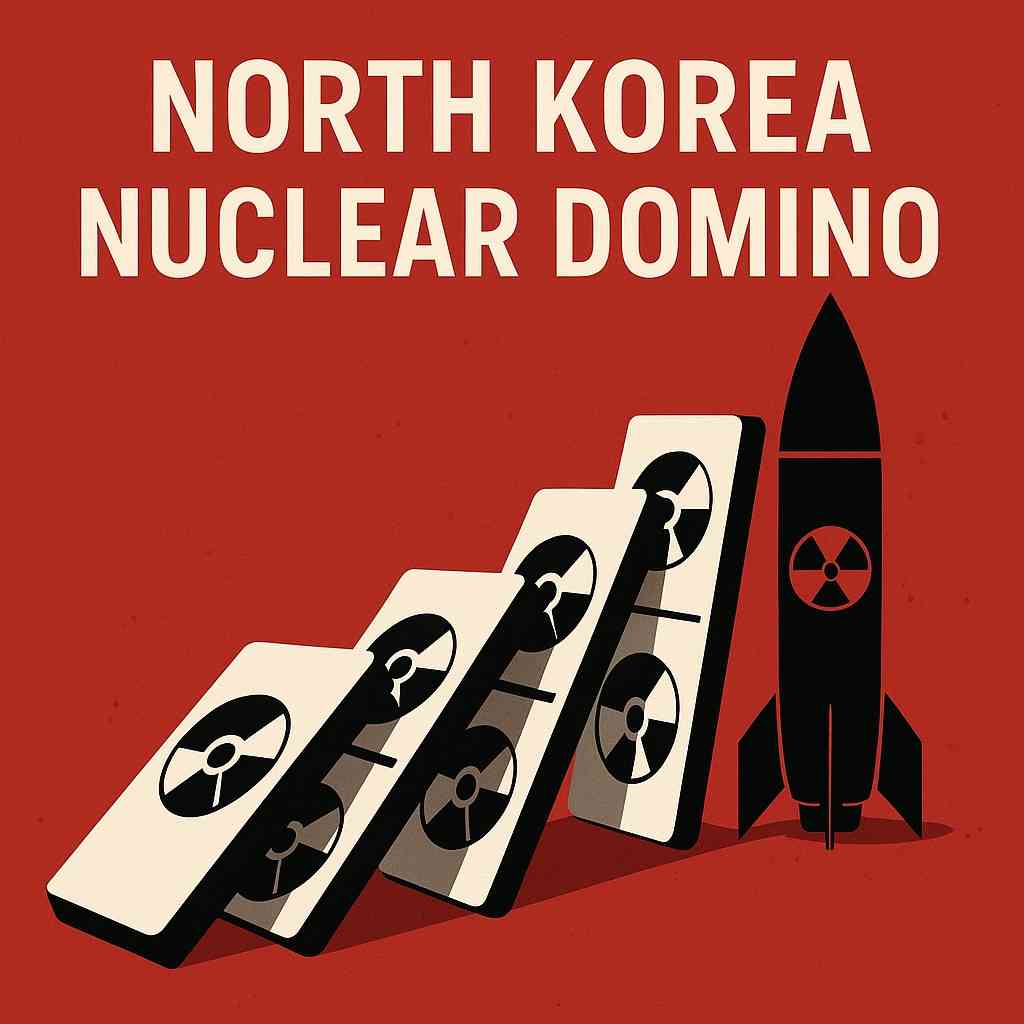
North Korea nuclear domino concerns have intensified after Pyongyang warned that the US approval of South Korea’s nuclear-powered submarine ambitions could trigger a chain reaction across East Asia. The statement, released through state media, accuses Washington and Seoul of destabilising the region through their latest security cooperation fact sheet. As alliances tighten and military technologies advance, the balance of power in East Asia is entering a new and unpredictable phase. This article breaks down the reactions, the strategic motives behind these moves, and the broader implications for global security.
North Korea Nuclear Domino: Pyongyang’s Reaction Explained
North Korea’s reaction to the United States supporting South Korea’s ambition to develop nuclear-powered submarines isn’t just another loud headline from Pyongyang — it’s a strategic message packaged as a warning. When North Korean state media labels this move as the beginning of a “nuclear domino phenomenon,” it’s signalling two things: fear of being outmatched and an opportunity to justify its own nuclear expansion.
From Pyongyang’s perspective, US backing for Seoul’s nuclear submarine programme feels like a direct attempt to tilt the military balance of the Korean Peninsula. North Korea already believes it is encircled by American allies — Japan, South Korea, and Taiwan maintaining close ties with Washington. So, when the US publishes a joint fact sheet with South Korea highlighting security cooperation, Pyongyang treats it as proof that Washington is tightening this circle even more.
But the phrase “nuclear domino” goes beyond simple irritation. It reflects a bigger concern: if South Korea gets nuclear-powered capabilities, other countries in the region might feel pressured to upgrade their military technology as well. Japan could revisit its long-standing nuclear restrictions. Taiwan could deepen strategic ties with the US. Even Australia — already part of the AUKUS nuclear submarine programme — adds to the anxiety. North Korea frames this as a chain reaction, a cascade where one nuclear step triggers others.
Now, let’s be real — North Korea also uses this situation to justify its own nuclear policy. Pyongyang has long argued that its nuclear arsenal is defensive, necessary because of perceived US “hostility.” When it sees South Korea inching closer to advanced nuclear technology, even if not nuclear weapons, it seizes the moment to portray itself as the victim responding to outside pressure. It’s a classic narrative: “We’re only reacting to provocations.” This messaging lets the Kim regime validate future missile tests, submarine development, or even new nuclear doctrines.
North Korea’s criticism also carries a diplomatic angle. By calling the US–South Korea fact sheet a destabilising act, Pyongyang attempts to divide Washington and Seoul. It wants South Korea to second-guess its reliance on the US, especially when domestic debates in Seoul about nuclear armament are already heating up. Pyongyang knows that stirring public fear can complicate South Korea’s decision-making. The more uncertainty it creates, the more room it has to maneuver.
Another layer of Pyongyang’s frustration stems from timing. North Korea has been testing new submarine-launched ballistic missiles (SLBMs) and improving its underwater capabilities. If South Korea gets nuclear-powered submarines, it would make detection easier for Seoul and harder for Pyongyang to operate in the region. A nuclear-powered submarine can stay submerged for months, track enemy vessels silently, and respond instantly — something North Korea currently cannot match.
Ultimately, North Korea’s “nuclear domino” claim is about maintaining strategic relevance. Pyongyang hates the idea of being overshadowed by Seoul’s rising military capability and Washington’s unwavering support. By sounding the alarm, North Korea turns a regional security adjustment into a global warning.
In Pyongyang’s eyes, this is not just a submarine project — it’s a threat to its military doctrine, a challenge to its deterrence, and a spark that could reshape East Asia’s entire nuclear landscape.
What the US–South Korea Joint Fact Sheet Means for the North Korea Nuclear Domino Effect
The US–South Korea joint fact sheet released last week may look like a routine diplomatic document, but don’t let the formal packaging fool you — it’s basically a roadmap showing how deeply Washington and Seoul are syncing their security, defense, and economic strategies. And North Korea is freaking out because this fact sheet quietly strengthens the US–South Korea alliance in ways that directly hit Pyongyang’s strategic insecurities.
At its core, the fact sheet outlines areas of advanced cooperation: defence technologies, supply chains, cybersecurity, emerging weapons systems, trade policies, and extended deterrence. Extended deterrence is the big phrase here — it’s Washington’s promise that US nuclear, missile, and conventional forces will safeguard South Korea. For Seoul, that’s reassurance. For Pyongyang, it’s a nightmare because it deepens American involvement right at its doorstep.
One of the most telling parts of the document is the mention of supporting South Korea’s long-term defence modernization, which includes interest in advanced naval capabilities. While the fact sheet does not explicitly approve nuclear-powered submarines, Washington’s supportive tone signals a political green light. And in geopolitics, a political nod often carries as much weight as an official approval. That’s why North Korea immediately linked this to a “nuclear domino” effect — the momentum is enough to create regional ripples.
On the economic side, the fact sheet tightens cooperation on semiconductor supply chains, AI, and clean energy. This might look unrelated to military issues, but in today’s world, tech dominance is national security. When the US and South Korea coordinate on strategic industries, they reduce their dependence on China. That shift alone irritates Beijing — and, by extension, Pyongyang.
Another crucial layer is missile defence. The document reinforces the US–South Korea alliance on intelligence sharing, missile tracking systems, and joint exercises. These are designed to respond to North Korean missile launches, which have become disturbingly frequent. For Pyongyang, this is like being told the world is installing more CCTV cameras aimed directly at it. It limits North Korea’s space for strategic ambiguity — and Kim Jong-un hates being predictable.
One quiet but powerful message in the fact sheet is continuity. Washington is signalling that even though global politics keep shifting — Russia-Ukraine conflict, China-Taiwan tensions, Middle East instability — the US commitment to South Korea isn’t fading. That’s important because North Korea’s strategy often bets on American distraction. This document tells Pyongyang: “Sorry, not happening.”
There’s also a domestic angle for Seoul. South Korea has been debating whether it needs its own nuclear weapons. This fact sheet is designed to calm those discussions by offering stronger US guarantees. Ironically, Pyongyang’s aggressive behaviour is what sparked that debate in the first place.
So what does the fact sheet actually mean? Simple: the US and South Korea are locking in a tighter partnership across military, technological, and economic fronts. It’s not just about submarines. It’s about a long-term alliance designed to counter North Korea, manage China, and maintain stability in East Asia. North Korea sees this as a direct threat — and that’s why it’s shouting so loudly.
South Korea’s Push for Nuclear-Powered Submarines and the North Korea Nuclear Domino Angle
South Korea’s interest in nuclear-powered submarines isn’t some sudden flex — it’s the result of years of security pressure, regional power shifts, and Seoul’s desire to take more control over its own defence. On the surface, it looks like a high-tech military upgrade. But dig a little deeper, and you’ll see a much bigger story: South Korea is trying to future-proof itself in a neighbourhood that gets more unpredictable every year.
First, let’s talk about the North Korea factor, because honestly, that’s the biggest driver. North Korea has been aggressively improving its submarine-launched ballistic missile (SLBM) programme. These missiles are harder to detect, can be fired from underwater, and allow Pyongyang to strike without giving early warning. South Korea’s diesel-electric submarines are good, but they can’t stay submerged for long. Nuclear-powered submarines would allow Seoul to track, monitor, and counter North Korean subs more effectively — staying underwater for months instead of days. For South Korea, that’s not luxury; that’s survival.
The second motive is regional competition. China’s navy is expanding rapidly, and Japan already operates some of the world’s most advanced submarines. Australia is joining the nuclear submarine club through AUKUS. In Asia, naval power equals influence, and influence equals leverage. South Korea doesn’t want to be left behind in a region where oceans matter as much as borders.
Then comes the strategic autonomy angle. South Korea relies heavily on the United States for defence, including nuclear deterrence. But as global politics shift — US elections, changing priorities, unpredictable foreign policy cycles — Seoul wants a backup plan. Nuclear-powered submarines give South Korea its own long-range, stealthy capability. They act like insurance: even if political winds change, the country won’t be left exposed.
There’s also the technological pride factor. South Korea is already a global powerhouse in shipbuilding, electronics, and advanced defence technology. Building a nuclear-powered submarine would be a massive milestone, putting the country in an elite group of nations with cutting-edge naval engineering. This isn’t just about national security; it’s about national prestige.
Energy and logistics also play a role. Nuclear submarines don’t need frequent refuelling and can operate silently for long periods. In a conflict, speed and stealth decide who gets the first move. And in peacetime, these submarines can patrol broader areas — not just the Korean Peninsula, but the wider Indo-Pacific. For a country that depends heavily on sea routes for trade and energy supply, protecting maritime lanes is a must.
Finally, rising geopolitical uncertainty makes the timing ideal. The US supporting South Korea’s interest — even indirectly — gives Seoul political legitimacy to push the idea forward. China’s assertiveness in the South China Sea, North Korea’s nonstop missile testing, and Russia’s unpredictable behaviour all push South Korea toward stronger, more independent defence tools.
So when South Korea says it wants nuclear-powered submarines, it’s not about prestige alone or copying global trends. It’s a calculated move to secure its future in a region where silence underwater speaks louder than diplomacy above it. Nuclear submarines offer South Korea endurance, deterrence, and confidence — all things that matter when your neighbourhood is one trigger away from crisis.
How This Powershift Impacts East Asian Security Amid the North Korea Nuclear Domino Warning
The moment South Korea moves even an inch toward nuclear-powered submarines — and the US gives a nod of approval — the entire East Asian security map shifts. This isn’t a minor military adjustment. It’s a structural change with consequences for every country in the region, from Japan to China to North Korea. Think of it like the region’s security Jenga tower: you pull out one powerful block, and everyone starts panicking about how to keep their own tower from collapsing.
Let’s start with Japan, the country that always treads carefully because of its pacifist constitution. Tokyo is already investing heavily in advanced defence systems, missile capabilities, and upgrades to its Self-Defense Forces. If South Korea is stepping into nuclear-powered submarine territory, Japan will feel pressure — politically and militarily — to match or counter that capability. Even if Japan doesn’t pursue nuclear tech directly, it will escalate its defence spending, expand its naval fleet, and strengthen ties with the US. And trust me, Pyongyang doesn’t want to see a more muscular Japan.
China, meanwhile, sees this as a direct challenge. Beijing has been expanding its naval reach across the South China Sea and Western Pacific to dominate regional waterways. A South Korea with nuclear-powered subs — backed by the US — threatens China’s freedom to operate unchallenged. Nuclear subs can track Chinese vessels, monitor submarine routes, and gather critical intelligence. The result? China tightens pressure on Taiwan, accelerates its own naval buildup, and becomes far more suspicious of US-led alliances. Basically, this move adds fuel to an already tense US–China rivalry.
Now come the smaller but strategically important players — Taiwan, the Philippines, Vietnam, and Australia. Taiwan is watching closely because it depends heavily on US security guarantees. If the US supports nuclear-powered subs in South Korea, Taiwan sees that as reassurance that Washington is willing to strengthen allies in the region. The Philippines and Vietnam, stuck in territorial disputes with China, may also lean more heavily toward the US for military cooperation when they see Korea and Japan stepping up.
And of course, at the centre of this chaos sits North Korea, the loudest but most insecure actor. Pyongyang understands that nuclear-powered submarines close South Korea’s strategic gap. That means fewer blind spots for Seoul and fewer opportunities for North Korea to sneak submarines undetected. So what does North Korea do? Exactly what you’d expect — more missile tests, more threats, more “we will respond with strength” statements. The powershift forces Pyongyang to double down on deterrence.
Another underrated impact is alliance strengthening. The US, Japan, South Korea, and Australia are now quietly forming a stronger defence network. Joint exercises increase. Weapons sharing becomes smoother. Intelligence cooperation deepens. This isn’t a formal alliance like NATO, but the behaviour? Pretty similar. And China and North Korea absolutely hate that.
The powershift also reshapes deterrence. For decades, the US was the only big military anchor in East Asia. Now, countries like South Korea and Japan are taking stronger independent steps. This adds new layers to regional strategy — more submarines underwater, more radar systems above, and more coordination between US allies.
At the end of the day, South Korea’s submarine ambition isn’t a local military upgrade — it’s a move that recalibrates East Asia’s entire security architecture. Everyone adjusts, everyone reacts, and the region becomes even more tightly wound. Peace hangs on thin threads — and every new technology brings both security and risk.
The Road Ahead: Global Outcomes Shaped by the North Korea Nuclear Domino Concern
As South Korea edges closer to developing nuclear-powered submarines — and the United States openly supports its defence modernisation — the global response will shape the future of East Asian geopolitics. What happens next isn’t just about military hardware. It’s about diplomacy, alliances, deterrence, and how major powers decide to navigate a region that’s becoming the centre of global tension.
One of the biggest outcomes we’re likely to see is heightened diplomatic pressure. China and North Korea will use every international forum available — from the UN to regional platforms — to condemn US-backed military upgrades. Beijing will frame this as Washington destabilising Asia, while Pyongyang will push the “nuclear domino” narrative to justify its own weapons development. Expect louder statements, more aggressive warnings, and a fresh wave of propaganda.
Meanwhile, the United States will double down on alliance reassurance. Washington knows that a stable South Korea and Japan are essential for checking China. So the US will likely expand joint drills, intelligence sharing, and maritime patrols. The Pentagon may even station more advanced weapons in the region to show it isn’t backing down. This is classic deterrence — reassuring allies while signalling strength to adversaries.
We’ll also see South Korea step further into regional leadership. With nuclear submarines on the horizon and public support for stronger defence growing, Seoul will become more assertive diplomatically. Expect stronger ties with Japan, closer trilateral cooperation with the US, and deeper involvement in Indo-Pacific strategies. South Korea won’t stay in the passenger seat anymore — it’s clearly shifting toward co-pilot.
On the military front, North Korea’s response is the most predictable — and the most dangerous. To maintain relevance, Pyongyang will ramp up missile tests, SLBM experiments, and possibly unveil new nuclear doctrines. Every time the US strengthens its presence or South Korea upgrades its defence, North Korea reacts with some dramatic move to remind the world it’s still a nuclear power. This back-and-forth will keep the region on edge.
China’s military response will be quieter but more calculated. Beijing is unlikely to directly confront South Korea, but it will accelerate naval expansions, increase submarine patrols, and deepen its security cooperation with Russia. China will also try to pressure Seoul economically, knowing South Korea depends heavily on Chinese trade. This blend of soft coercion and military signalling is Beijing’s favourite playbook.
Another possible outcome is the subtle rise of mini-alliances in the Indo-Pacific. Not formal treaties, but deeper, more flexible defence partnerships. Think Japan–South Korea–US naval drills, Australia–South Korea maritime cooperation, and closer coordination between Taiwan and US-led networks. These “unofficial coalitions” can reshape regional order without paperwork.
Finally, the biggest long-term outcome is the shift in deterrence psychology. For decades, East Asia relied on US power alone to maintain balance. Now, regional players like South Korea and Japan are taking more responsibility. This creates a multi-layer deterrence system: US strength on top, regional power in the middle, and local capabilities at the base. It’s stronger, but it’s also more complex — and complexity always brings risk.
The road ahead will be tense, interconnected, and full of moments where diplomacy and military strategy collide. But one thing is clear: the decision to pursue nuclear-powered submarines has pushed East Asia into a new era — one where every move echoes across continents, and every country must rethink what security really means.
BBC News – North Korea & East Asia
Reuters – Asia Security Updates
About The Author









Leave a Reply