

Table of Contents
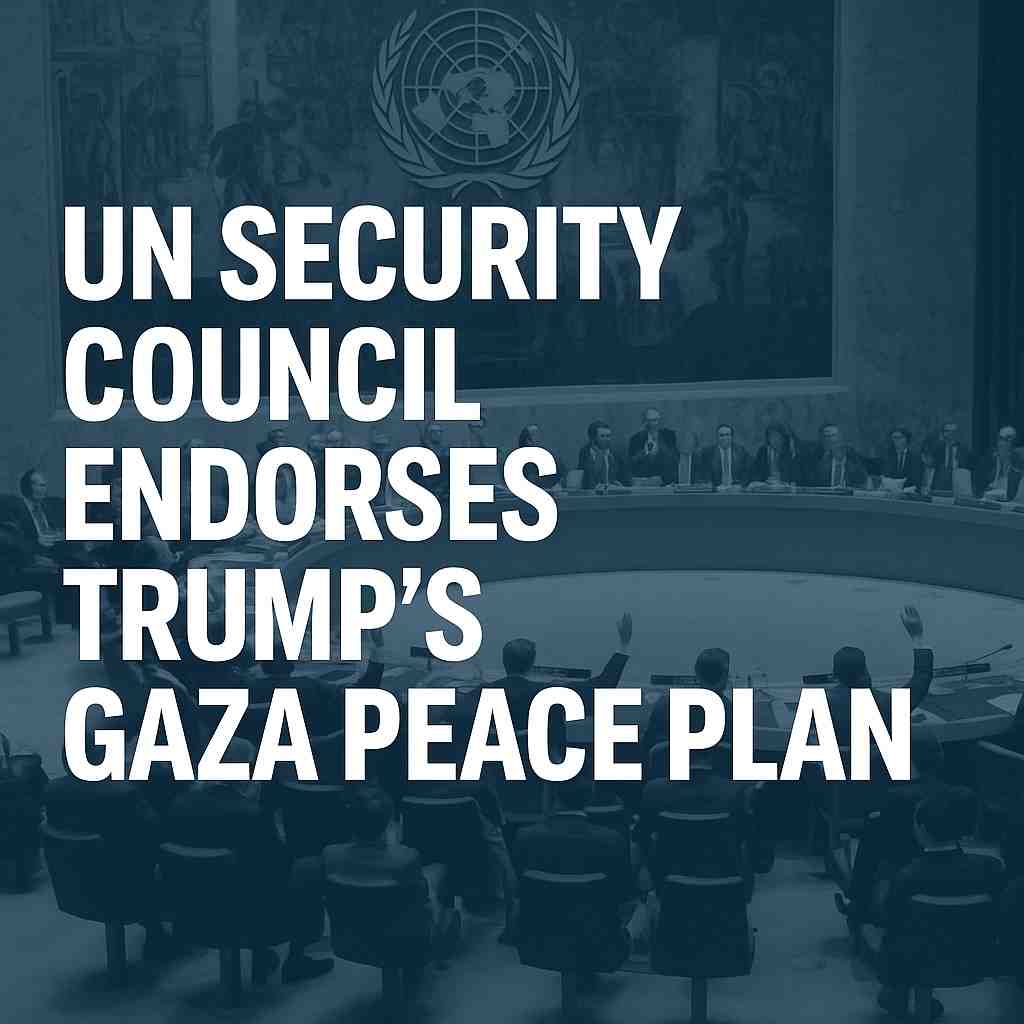
The UN Security Council has officially backed US President Donald Trump’s Gaza peace plan, marking a major diplomatic moment in the long-standing Israel–Palestine conflict. With 13 members voting in favour and Russia and China abstaining, the resolution gives global legitimacy to Washington’s proposal to deploy an international stabilization force, initiate a structured ceasefire, and form a transitional committee led by Palestinian technocrats. Supporters argue that the plan injects fresh momentum into a stagnant peace process, while critics remain cautious about its execution and long-term implications. As the region watches closely, the world debates whether this marks a genuine breakthrough or another temporary halt.
What the UNSC Resolution Means for the Gaza Peace Process
The UN Security Council’s endorsement of Trump’s Gaza peace plan marks a significant turning point in international engagement with the Israel–Palestine conflict. The 13–2 vote — with Russia and China choosing to abstain rather than block the resolution — shows that the majority of global powers are willing to give the American proposal a chance. This alone signals a shift from previous years, where competing geopolitical interests often paralyzed the Security Council from taking a unified stance on Middle Eastern issues. The approval essentially gives Washington’s roadmap international legitimacy, transforming it from a US-led idea into a globally recognized framework for action.
At its core, the resolution outlines three major priorities: reducing active violence, creating a pathway to political dialogue, and establishing conditions for long-term regional stability. For Gaza — a region battered by repeated conflicts, internal divisions, and economic collapse — the endorsement offers a rare moment of diplomatic clarity. The plan’s emphasis on an internationally supervised stabilization force introduces a new security architecture, aiming to prevent further escalations while maintaining humanitarian access. For civilians living in Gaza, this has the potential to lower immediate risks and create breathing space after years of unrest.
Politically, the resolution positions the US as the primary driver of the next phase of negotiations. While Washington has traditionally maintained close ties with Israel, the fact that the plan calls for Palestinian technocrats to form a transitional committee suggests an attempt at balance. This committee would be responsible for coordinating governance, economic rehabilitation, and contacts with international agencies. By empowering non-partisan Palestinian experts instead of political factions, the UN hopes to reduce internal conflicts and focus on institutional rebuilding — something Gaza desperately needs.
However, the resolution’s implications are not universally positive or straightforward. Critics argue that Trump’s plan, despite its global backing, may overlook deeper structural issues such as territorial disputes, political representation, and the longstanding demand for Palestinian statehood. Some fear that the pressure to implement rapid security changes — especially the disarmament of Hamas — could lead to fresh tensions if not handled with extreme caution and local engagement. Russia and China’s abstention reflects this skepticism; they are signaling concern without obstructing the process.
For Israel, the resolution offers a sense of diplomatic victory and international support for its security concerns. For the Palestinian Authority in the West Bank, it presents both an opportunity and a challenge — an opportunity to reassert political relevance, but a challenge because not all Palestinian groups may accept the framework. For Hamas, the plan directly threatens their armed influence, meaning resistance is likely.
In short, this UNSC resolution doesn’t magically solve the conflict, but it does reset the table. It introduces a structured, internationally backed approach that attempts to move the process away from cycles of violence and toward negotiations grounded in security, governance, and humanitarian recovery. Whether this becomes a genuine step toward peace or just another temporary bandage will depend on how responsibly all parties handle the next phase.
The Role and Mandate of the International Stabilization Force
One of the most defining features of the newly endorsed Gaza peace plan is the proposal to deploy an International Stabilization Force (ISF) — a multinational security mechanism tasked with restoring order, preventing renewed conflict, and enabling humanitarian operations in the region. The UNSC’s approval gives this force not just legitimacy but also a clearly defined mandate, signalling that the international community is ready to take a more hands-on role in Gaza’s fragile security environment.
At its core, the ISF is designed to function as a buffer between warring sides and as a protective shield for civilians. Gaza has endured years of instability driven by political divisions, militant activity, and recurring clashes. Local security institutions are fragmented, and trust between communities is extremely low. Against this backdrop, relying solely on domestic policing structures is unrealistic. The ISF aims to fill this gap temporarily, ensuring that key areas remain secure while political processes unfold in parallel.
The mandate begins with ceasefire monitoring, a critical first step. For any peace plan to work, fighting must stop — not just in principle but in practice. The ISF will document violations, deploy observers across conflict-prone zones, and provide real-time assessments to both the UN and parties involved. This creates a layer of transparency that has historically been missing in the region’s ceasefire arrangements. When all sides know they’re being watched by neutral international personnel, the temptation to escalate reduces.
Another major responsibility includes protecting humanitarian corridors. Gaza’s population relies heavily on external aid for food, medical supplies, and reconstruction materials. Past conflicts have repeatedly disrupted these lifelines. The ISF would escort aid convoys, patrol designated routes, and ensure that hospitals, shelters, and aid warehouses remain outside the line of fire. If implemented effectively, this can significantly reduce civilian suffering and restore a degree of normalcy.
Perhaps the most sensitive part of the mandate relates to assisting with the disarmament process, especially concerning Hamas. The ISF is not expected to carry out direct disarmament operations — that would risk escalating tensions — but rather to supervise, verify, and support mechanisms created by the transitional Palestinian technocratic committee. Their role would be more oversight-driven than enforcement-heavy, ensuring that any disarmament moves are transparent, accountable, and in line with the agreed framework.
Beyond security, the ISF will also help stabilize governance structures by securing key government buildings, border crossings, and public infrastructure. This is crucial because Gaza’s administrative functions have often been disrupted by violence. If ministries, courts, and local councils can operate safely, it sets the foundation for broader political and economic reforms.
Still, deploying an international force into Gaza is not without controversy. Some Palestinians fear it could feel like foreign occupation, while Israel worries about coordination challenges. There are also concerns about the force becoming a target for militant attacks. Success will depend heavily on how inclusive, neutral, and transparent the ISF’s operations are — and whether local communities feel protected rather than controlled.
In essence, the International Stabilization Force is meant to act as a temporary guardian, not a permanent authority. Its purpose is to create a security environment where diplomacy, reconstruction, and governance reforms can finally take root. If it manages to strike the right balance, it could become one of the most meaningful international interventions in Gaza’s recent history.
Disarmament of Hamas: Challenges and Controversies
The disarmament of Hamas stands at the center of the Gaza peace plan — and honestly, it’s the section that will make or break the entire roadmap. While the UN Security Council’s endorsement gives the proposal global legitimacy, turning this specific element into reality is far more complex than putting it on paper. Hamas isn’t just an armed group; it’s a political actor, a symbol of resistance for many Palestinians, and a deeply embedded force within Gaza’s social fabric. Asking it to surrender weapons triggers emotional, political, and security tensions that no committee or international force can resolve overnight.
The biggest challenge begins with legitimacy. Any armed group disarms only when it believes the political structure replacing its power is credible and sustainable. Right now, Hamas doesn’t see the Palestinian Authority, the US, or the broader international system as entities it can trust with Gaza’s future. In their eyes, weapons are not just tools — they’re bargaining chips and security guarantees. Without a comprehensive political settlement, expecting unilateral disarmament is unrealistic.
Another major issue is internal Palestinian rivalry. Hamas’s military power isn’t just aimed at Israel; it also cements its authority against the Palestinian Authority (PA) in the West Bank. Disarming would weaken Hamas internally, making the PA or external actors more influential in Gaza. This fuels fear that the process isn’t just about peace with Israel, but also about reshaping Palestinian politics in ways Hamas sees as threatening. That’s why even “partial disarmament” or “weapons management” proposals face stiff resistance.
Then there’s the matter of regional influence. Hamas operates with political and military links to actors like Iran, Qatar, and Turkey. These relationships complicate the disarmament narrative because Hamas isn’t isolated — it’s part of a broader strategic web. If Iran believes disarming Hamas undermines its influence in the Middle East, it may quietly encourage resistance. So the challenge isn’t just on the ground in Gaza; it’s also in diplomatic corridors from Tehran to Ankara.
In practical terms, the process itself is incredibly messy. Gaza is full of underground tunnels, hidden stockpiles, improvised rocket factories, and decentralized militant cells. Even if Hamas leadership agreed on paper, enforcing it would require deep coordination, international supervision, and community acceptance. Militant splinter groups may refuse to comply, creating the risk of renewed violence. And if the International Stabilization Force is seen as overstepping, local resentment could turn into active resistance.
Long-standing controversies also shape how Palestinians and the global community perceive the idea. Supporters argue that disarmament is essential to break Gaza’s cycle of conflict and create conditions for reconstruction and political stability. Israel sees it as non-negotiable — without it, they believe any peace plan collapses instantly. Critics, however, fear that disarmament without parallel political concessions risks turning Gaza into an area controlled by external actors, undermining Palestinian autonomy.
Ultimately, the controversy isn’t simply about removing weapons; it’s about power, trust, identity, and the future governance of Gaza. Unless disarmament is paired with genuine political inclusion, economic recovery, and security guarantees for all sides, it risks becoming the biggest friction point in the peace plan. The world is watching closely because this single issue could either unlock a new chapter for Gaza — or stall the entire process before it even gets underway.
Formation of a Transitional Committee of Palestinian Technocrats
One of the most interesting — and honestly, most hopeful — components of the Gaza peace plan is the proposal to create a Transitional Committee of Palestinian Technocrats. This committee is supposed to serve as the administrative backbone of Gaza during the transition period, bridging the gap between conflict and stable governance. Unlike previous political setups that were dominated by faction-based agendas, this committee aims to rely on professionals rather than politicians. That alone signals a major shift in how Gaza’s future is being imagined.
The idea behind using technocrats is simple: put experts in charge of essential sectors like health, finance, reconstruction, infrastructure, and security coordination. People who know how to run systems efficiently — not party loyalists or individuals aligned with political power struggles. In a region where governance has often been overshadowed by factional rivalry, technocrats bring a sense of neutrality and competence. For Gaza’s 2 million residents, this could finally mean functional public services without political interference.
But forming this committee is far from straightforward. The first big question is selection. Who gets to pick these technocrats? The UN? The Palestinian Authority (PA)? Local civil society groups? Or a combination of all three? If the committee is perceived as handpicked by external powers or dominated by one Palestinian faction, its credibility will collapse instantly. Gazans need to feel represented, not managed. So the process must be transparent, inclusive, and insulated from political agendas.
Another challenge is balancing local legitimacy and international approval. The committee needs people who understand Gaza’s local realities — its economy, its social networks, and its humanitarian needs — but it also needs to be trusted by global donors and agencies. Reconstruction funds won’t flow unless there is confidence in the committee’s integrity and oversight. This makes selecting individuals with clean, professional records absolutely crucial.
The committee’s responsibilities are massive. It would coordinate with the International Stabilization Force to maintain security around key government institutions, ensure continuity of public services, and begin rebuilding administrative systems damaged by years of conflict. On top of that, it must create frameworks for elections, negotiate with humanitarian agencies, and set the stage for long-term political dialogue. Essentially, it becomes the temporary government without actually being a government — a balancing act that requires both authority and restraint.
Of course, not everyone is happy about this idea. Hamas views the committee with suspicion, fearing it could sideline their influence. The Palestinian Authority in the West Bank supports the concept but also worries that technocrats might weaken their political legitimacy if they perform too well. And some ordinary Gazans fear that “technocrats” might just be another way to bring in foreign-aligned elites with little accountability.
Still, if done right, the Transitional Committee could be the fresh start Gaza desperately needs. By removing factional competition from the immediate governance space, it allows experts to focus on repairing infrastructure, restoring public trust, and stabilizing the day-to-day lives of civilians. This isn’t a permanent fix, but it’s a bandwidth-creating move — a way to calm the system long enough for deeper political solutions to take shape.
In many ways, this committee represents the heart of the peace plan: a belief that stability begins with good governance, not just ceasefires. Whether it succeeds will depend on cooperation, transparency, and how well it navigates Gaza’s deeply layered political landscape.
Global Reactions and the Road Ahead for Middle East Diplomacy
The UN Security Council’s endorsement of Trump’s Gaza peace plan triggered a wave of global reactions — some supportive, some skeptical, and some straight-up cautious. And honestly, that mixed response pretty much reflects the reality of Middle Eastern diplomacy: nothing is ever universally accepted, but every move ripples across the whole region. With 13 members voting in favour and two abstentions, the resolution has become a talking point not just in diplomatic circles but across regional capitals from Tel Aviv to Ankara to Riyadh.
Let’s start with the United States, which obviously sees this as a major diplomatic win. Washington is framing the vote as proof that the world is ready to adopt “new” and “practical” frameworks instead of clinging to deadlocked negotiations of the past. For the US, this isn’t just about Gaza; it’s also about reasserting leadership in the Middle Eastern peace process, something they feel they lost over recent years. The endorsement gives the US leverage, credibility, and momentum — all valuable currency in global politics.
Israel, on the other hand, has responded positively but cautiously. Israeli officials view the disarmament clause as crucial and appreciate the push for a technocratic Palestinian committee that could reduce Hamas’s political influence. But Israel’s biggest concern remains security. If the International Stabilization Force fails to keep militant groups in check, Israel fears they’ll be back to square one. So while they welcome the resolution, they’re watching every detail like a hawk.
Meanwhile, the Palestinian Authority (PA) is in a complicated place — it’s supportive of international engagement but also wary of losing political relevance. The PA sees a chance to regain leadership in Gaza but knows that public distrust, internal divisions, and competition with Hamas make the path tough. They’re trying to position themselves as the legitimate partners for peace without being seen as endorsing an externally dictated plan.
Hamas, unsurprisingly, rejects the resolution outright. From their perspective, the plan threatens their political and military position. They argue that disarmament without guarantees of sovereignty is unacceptable. And let’s be real: no militant organisation simply gives up power because a committee somewhere said so.
Regionally, reactions vary. Saudi Arabia, the UAE, and Egypt have cautiously welcomed the move, seeing it as a potential opening for long-term stability — something they desperately want for economic and political reasons. Turkey and Iran, however, view the plan as an attempt to sideline their regional influence and weaken Hamas, an ally in various forms. Their skepticism is loud and intentional.
Beyond the immediate responses, the resolution raises the big question: What does this mean for the future of Middle East diplomacy? The honest answer is that it’s both an opportunity and a test.
If the plan works — even partially — it sets a new template for conflict zones: technocratic governance, international stabilization forces, and structured disarmament mechanisms backed by global institutions. It could become a model for future crises.
But if it collapses, it could deepen distrust, empower hardliners, and convince regional players that diplomacy is just theatre with no real outcomes.
So the road ahead is long, messy, and full of political potholes. But for the first time in a while, there’s a structured path forward — and in the Middle East, that alone counts as progress.
1. United Nations – Security Council Resolutions
2. U.S. Department of State – Middle East Peace Initiatives
About The Author








Leave a Reply