

Table of Contents
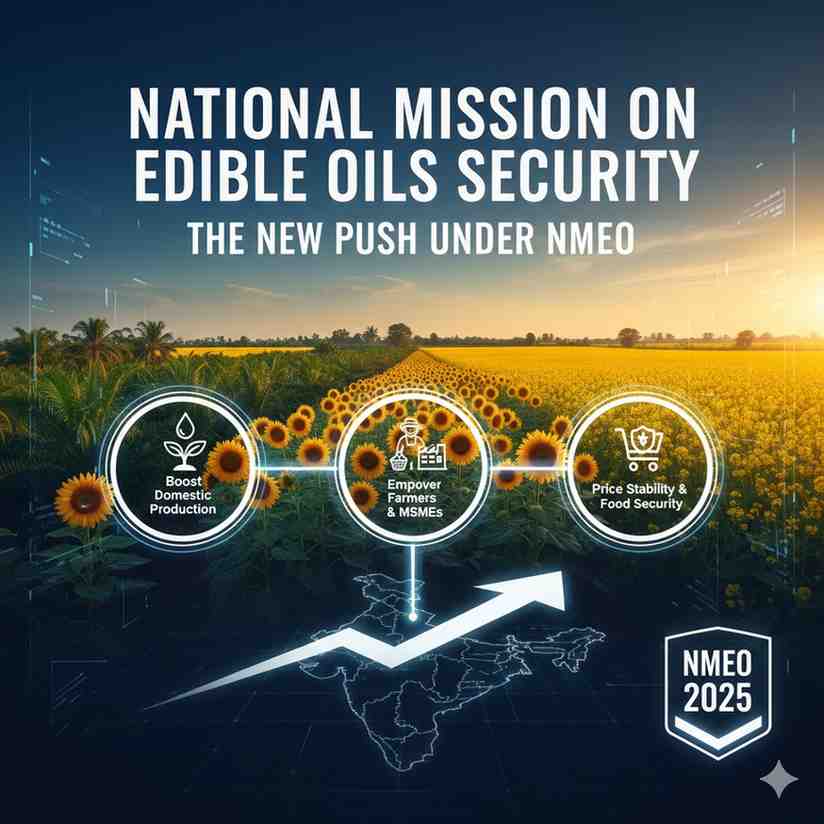
India is finally done playing catch-up in the edible oils game. With import dependence hitting 56% in 2023–24, the government has rolled out a stronger, sharper National Mission on Edible Oils (NMEO) — powered by NMEO-Oil Palm (2021) and NMEO-Oilseeds (2024). The mission isn’t just about producing more oil; it’s about reclaiming strategic self-reliance, boosting farmers’ income, modernising cultivation practices, and reducing that massive edible-oil import bill. Recent policy tweaks, tech-driven interventions, and state-level expansions show that India is gearing up for a long-awaited transformation in this sector.
What is the National Mission on Edible Oils – Oil Palm (NMEO-OP)?
India knew it couldn’t keep relying on imported edible oils forever, so in 2021 the government rolled out the National Mission on Edible Oils – Oil Palm (NMEO-OP) as a Centrally Sponsored Scheme. Backed with a hefty outlay of ₹11,040 crore, this mission is basically India saying, “Let’s grow our own oil instead of burning money on imports.” The plan? Expand oil palm cultivation massively, boost domestic crude palm oil (CPO) production, and create a stable income pathway for farmers in strategic regions.
One of the biggest breakthroughs under NMEO-OP is Price Assurance, something Indian farmers have been demanding for ages. For the first time, the government introduced a Viability Price (VP) — a safety net that shields farmers when international palm oil prices crash. It’s a simple promise: even if global markets fluctuate, farmers won’t take the hit. This move alone pushes confidence back into the sector.
The mission also goes big on financial incentives. Subsidies for planting material shot up dramatically — from ₹12,000/ha to ₹29,000/ha — making it way cheaper for farmers to start new plantations. Add to that improved maintenance support and a ₹250 per plant assistance for rejuvenating older gardens, and you get a policy that actually makes long-term cultivation viable.
But NMEO-OP isn’t randomly expanding; it’s strategically targeted. The mission prioritises the North-Eastern states — regions with high rainfall and climate suitability — and strengthens existing hubs in Andhra Pradesh and Telangana, which already shoulder the bulk of India’s oil palm production. Basically, the government isn’t just planting blindly; it’s building regional ecosystems.
The Targets: Ambitious but Necessary
The mission comes with a crystal-clear roadmap:
- Expand oil palm area to 6.5 lakh hectares by 2025–26
- Produce 11.20 lakh tonnes of CPO by 2025–26
- Scale up to a massive 28 lakh tonnes by 2029–30
- Maintain consumption at 19 kg per person annually until 2025–26
Given India’s edible oil demand is skyrocketing every year, these targets are not optional — they’re survival mode.
Where Do We Stand Today?
Progress has been steady. As of November 2025, NMEO-OP has covered 2.50 lakh hectares, pushing India’s overall oil palm area to 6.20 lakh hectares. Production numbers tell the real story: CPO output has doubled in a decade — from 1.91 lakh tonnes in 2014–15 to 3.80 lakh tonnes in 2024–25.
Sure, India still has miles to go before it breaks its heavy dependence on palm oil imports, but NMEO-OP has clearly shifted the momentum. The mission is modernising cultivation, reducing risks, and giving farmers a stable, future-proof opportunity.
In short: NMEO-OP isn’t just a scheme. It’s India rewriting its edible oil story — slowly, steadily, but in the right direction.
What is the National Mission on Edible Oils – Oilseeds (NMEO-OS)?
If NMEO-Oil Palm is the government’s long game, then the National Mission on Edible Oils – Oilseeds (NMEO-OS) is the backbone of India’s push toward real edible oil independence. Approved in 2024 and running till 2030–31, this mission is designed for one core purpose: make India self-sufficient in edible oils, once and for all. With our import bills shooting up every year, this mission basically tells the world, “Thanks, but we’ll handle our own oils now.”
NMEO-OS focuses on nine major oilseed crops — think mustard, groundnut, soybean and the other usual legends of Indian agriculture — while also boosting oil extraction from secondary sources like cottonseed, rice bran, coconut and Tree-Borne Oilseeds. This two-pronged approach is important because India doesn’t just need more seeds; it needs more efficient extraction across the board.
The Mission’s Core Strategy: Fixing the Basics
The biggest bottleneck in India’s oilseed sector has always been the massive yield gap. Farmers grow plenty, but not nearly as much as they could with better seeds, updated tech and scientific practices. NMEO-OS wants to close that gap fast — by aggressively pushing high-yielding varieties, modern cultivation techniques, and innovative technologies through cooperatives, FPOs and private partners.
Another smart move: expanding oilseed cultivation without eating into food security crops. The mission promotes oilseed farming in rice and potato fallow lands, encourages intercropping, and backs this shift with demonstrations, quality seed systems, and targeted incentives. Basically, it’s about using the land we already have more intelligently rather than stretching farmers thin.
But none of this works unless farmers can sell what they grow. So NMEO-OS sets out to strengthen market access, improve local processing, and increase returns from secondary oil sources. When farmers make more money, adoption skyrockets — simple economics.
The Targets: Big, Bold, and Necessary
The numbers under NMEO-OS may look ambitious, but honestly, India needs them:
- Oilseed area to jump from 29 million ha (2022–23) to 33 million ha by 2030–31
- Primary oilseed production to rise from 39 million tonnes to 69.7 million tonnes
- 40 lakh hectares to be added through fallow land utilisation and intercropping
- Combined with NMEO-OP, India aims to produce 25.45 million tonnes of edible oil by 2030–31, covering about 72% of domestic demand
If these targets land even halfway, India’s edible oil trade deficit will shrink dramatically.
The Implementation Engine: Women-Led, Tech-Enabled
One of the coolest parts of NMEO-OS is how it relies on Self-Help Groups, especially Krishi Sakhis, acting as Community Agriculture Service Providers (CASP). These women are the grassroots powerhouse — training farmers, solving field-level issues, delivering inputs and collecting on-ground data.
Their field updates sync directly into the Krishi Mapper platform, giving policymakers real-time insights into what’s happening at the farm level. This is the kind of tech-enabled governance India has been needing for decades.
Conclusion
India’s edible oil story has always been a mix of high demand and heavy dependence — but the National Mission on Edible Oils (NMEO) finally gives the country a structured path out of that cycle. Through its twin pillars, NMEO-Oil Palm and NMEO-Oilseeds, the mission doesn’t just chase production numbers; it rebuilds the entire value chain from the ground up. Whether it’s expanding oil palm in climate-suitable regions, pushing high-yield oilseed varieties, tapping secondary oil sources, or empowering women-led SHGs with tech tools — the approach is targeted, practical and long overdue.
By aiming to meet 72% of domestic edible oil demand by 2030–31, NMEO ( National Mission on Edible Oils ) isn’t just reducing import bills. It’s strengthening rural livelihoods, stabilising farmer incomes, and aligning agriculture with the nation’s broader Atmanirbhar Bharat vision. The mission also plays a quiet but crucial role in nutritional security, ensuring India can sustainably meet the edible oil needs of its growing population without relying excessively on volatile global markets.
Yes, challenges remain — from climate risks to market fluctuations — but the momentum is clearly shifting. With consistent implementation, strong farmer participation, and tech-enabled monitoring, India is positioning itself to rewrite its edible oil future.
In short, NMEO marks a turning point: a move from dependence to capability, from vulnerability to resilience. And if the mission stays on track, by 2030–31 India won’t just be producing more edible oil — it’ll be owning its place in the global agri-economy with confidence.
About The Author







Leave a Reply