

Table of Contents
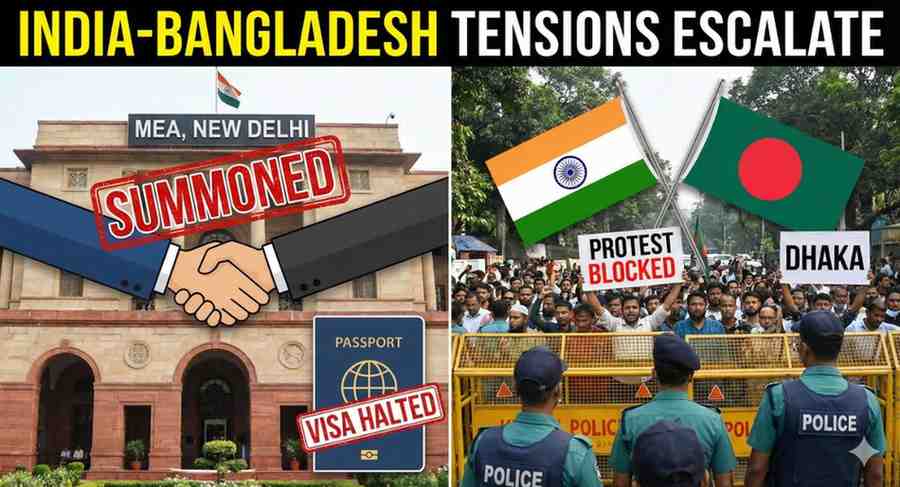
India Bangladesh diplomatic tensions have surfaced sharply following a sequence of tightly coordinated actions by New Delhi, including the Ministry of External Affairs summoning the Bangladeshi High Commission, the temporary closure of visa application centres, and police intervention to halt a protest march. These developments mark a notable shift in the tone of bilateral engagement between two traditionally close neighbours. While official channels continue to emphasize cooperation and stability, the recent moves point to deeper strategic signaling, domestic security considerations, and recalibration of diplomatic boundaries. Understanding this episode requires looking beyond headlines to the evolving dynamics shaping India–Bangladesh relations today.
India Bangladesh Diplomatic Tensions: Why the MEA Summoned the Bangladeshi High Commission
When the Ministry of External Affairs (MEA) summons a foreign High Commission, it’s never routine paperwork. It’s diplomacy’s version of a raised eyebrow—polite on the surface, serious underneath. India calling in the Bangladeshi High Commission signals that New Delhi wanted to convey displeasure directly, formally, and on record. No press conferences, no megaphones—just straight, old-school diplomatic signaling.
The immediate trigger lies in a sequence of recent developments that India views as crossing a red line. While both countries publicly emphasize friendship and cooperation, New Delhi has been increasingly sensitive about issues related to security, public order, and actions that could inflame public sentiment or strain bilateral trust. Summoning the High Commission allows India to seek explanations, register objections, and clearly communicate expectations without escalating the matter into a public diplomatic spat.
This move also reflects India’s preference for institutional diplomacy over public confrontation. Instead of issuing sharp statements through the media, the MEA chose a closed-door approach. That tells you two things: first, India wants accountability; second, it still wants to keep the relationship repairable. In diplomatic language, this is pressure with restraint—not a breakdown, but definitely a warning.
Another key factor is domestic stability. Any development that has spillover effects on protests, public order, or sensitive political narratives is taken seriously by the Indian state. The MEA’s action sends a message that foreign missions are expected to operate within diplomatic norms and avoid actions—direct or indirect—that could complicate internal security or law-and-order situations. This is standard practice globally, but India is being extra firm given the current regional climate.
There’s also a regional strategy angle here. India’s neighborhood policy has increasingly emphasized predictability and reciprocity. Bangladesh occupies a crucial place in India’s eastern security architecture—border management, counter-terror cooperation, connectivity projects, and trade corridors all hinge on mutual trust. By summoning the High Commission quickly, India signals that it will not allow ambiguity or misunderstandings to fester, especially with a close neighbor.
Importantly, this step should not be read as hostility toward Bangladesh itself. Diplomatic summons are often corrective, not punitive. They are meant to reset boundaries, clarify positions, and prevent escalation. The fact that communication remained within official diplomatic channels suggests New Delhi still sees value in dialogue and expects Dhaka to respond responsibly.
Finally, the timing matters. With elections, regional instability, and global geopolitical churn, India is in no mood for avoidable friction on its borders. The MEA’s action fits into a broader pattern: assertive diplomacy backed by calm messaging. Say less publicly, convey more privately—and make sure the point lands.
In short, the MEA summoning the Bangladeshi High Commission was not a dramatic rupture, but it was far from symbolic. It was a calculated reminder that while India values partnership, it also expects clarity, restraint, and respect for diplomatic norms. Old-school diplomacy, firm tone, zero noise—and that’s exactly how New Delhi likes to play it.
Visa Centres Shut Down: What the Suspension Means for People-to-People Ties
Closing visa centres might look like a technical or temporary administrative step, but in diplomacy, nothing is ever just technical. When visa services are suspended, the real impact isn’t on governments—it’s on ordinary people. Students, patients, business travelers, families, and tourists suddenly find themselves stuck in limbo. And that’s precisely why this move carries weight far beyond paperwork.
India and Bangladesh share one of South Asia’s most people-centric relationships. Millions of Bangladeshis travel to India every year for medical treatment, education, religious visits, tourism, and trade. India, for its part, has long projected itself as an accessible neighbor—especially through liberal visa regimes and multiple visa application centres across Bangladesh. Shutting these centres, even temporarily, sends a clear signal: something is not right.
From a diplomatic lens, visa suspensions are a pressure tool without being openly confrontational. They don’t violate treaties, they don’t require dramatic statements, but they are immediately felt. Governments notice because citizens complain. That’s the point. New Delhi is essentially saying: cooperation at the diplomatic level directly affects convenience at the people-to-people level.
The biggest immediate fallout is in medical travel. Indian hospitals are a major destination for Bangladeshi patients, particularly for specialized treatments. Visa disruptions don’t just delay travel—they can delay care. Similarly, students waiting for admissions, exam schedules, or semester deadlines suddenly face uncertainty. These are soft-power pillars India has carefully built over decades, and pausing them—even briefly—is a strong move.
At the same time, this decision reflects India’s growing emphasis on security vetting and administrative control. Visa centres are high-volume, high-sensitivity operations. During periods of diplomatic tension or heightened security concerns, tightening or pausing visa processing is a globally accepted response. India is not inventing a new playbook here—it’s following a well-established one.
What makes this moment significant is the contrast with the past. Even during difficult phases, India–Bangladesh people-to-people exchanges were rarely interrupted. The suspension suggests that New Delhi wants Dhaka to understand that goodwill cannot be taken for granted. Friendly relations come with responsibilities on both sides.
That said, this is not a shutdown of ties—it’s a temporary pause, and that distinction matters. India has avoided language that suggests a long-term freeze. No visas revoked en masse, no sweeping travel bans—just a calibrated slowdown. This leaves room for quick normalization if diplomatic concerns are addressed.
For Bangladesh, the message is subtle but sharp: bilateral relations are not only about high-level meetings and joint statements; they are also about how everyday interactions are managed. For India, the move reinforces a broader trend—using administrative levers as strategic signals while keeping escalation under control.
In the long run, people-to-people ties are resilient. Shared history, geography, and daily interaction can’t be undone by a few closed counters. But moments like this act as stress tests. They reveal how diplomacy, security, and public sentiment intersect—and how quickly the effects travel from conference rooms to common citizens.
Bottom line? Visa centre closures are never random. They are diplomacy with consequences. Quiet, controlled, and effective—and that’s exactly why New Delhi chose this route.
Protest March Halted by Police: Law, Order, and Political Messaging
When a protest march is stopped by the police, it’s never just about traffic control or crowd management. It’s about who gets to set the narrative in public spaces. In this case, the decision to halt the march fits squarely into India’s long-standing approach: maintain law and order first, sort out diplomacy through institutions—not the streets.
From the state’s perspective, protest marches linked to sensitive foreign policy issues are high-risk. They can spiral fast—one slogan turns into ten, one banner into a headline, and suddenly a diplomatic issue becomes a domestic flashpoint. Indian authorities are acutely aware of how quickly public demonstrations can be amplified through social media, creating pressure that limits diplomatic maneuvering. Stopping the march early was a preventive move, not a reactive one.
There’s also a legal dimension here. The right to protest in India is not absolute; it is subject to reasonable restrictions in the interest of public order, security, and sovereignty. Courts have consistently upheld the state’s authority to regulate assemblies when there is a credible risk of disruption or escalation. Seen through this lens, the police action aligns with established legal practice rather than exceptional overreach.
Politically, the message is layered. Domestically, the state is signaling that foreign relations are not a free-for-all debate on the streets. India prefers diplomacy through official channels—MEA desks, not megaphones. Allowing emotionally charged protests tied to a neighboring country could harden positions, inflame public sentiment, and reduce room for diplomatic correction. New Delhi clearly wants to keep the temperature down.
At the same time, the move sends an indirect signal outward. By preventing protests from escalating, India demonstrates to Bangladesh that it is not encouraging public hostility or mass mobilization against Dhaka. This matters. In diplomacy, controlling domestic optics is part of responsible state behavior. The police action reinforces the idea that the Indian state—not activist groups—sets the tone of bilateral engagement.
There’s also a strategic communication angle. In today’s environment, protests are instantly globalized. A march in one city can become international news within minutes, often stripped of nuance. By stopping the protest, authorities effectively blocked the creation of viral images that could have complicated diplomatic efforts or forced both governments into defensive postures.
Critics may frame the move as suppression, but the broader context matters. This wasn’t a blanket ban on dissent; it was a targeted intervention during a sensitive diplomatic moment. India has historically allowed protests on a wide range of issues, but it draws firmer lines when national security, foreign missions, or international relations are involved. That’s not unique to India—it’s standard statecraft.
Ultimately, the halted protest highlights how law and order function as tools of political signaling. The police weren’t just enforcing rules; they were preserving diplomatic space. By keeping the streets calm, the government ensured that dialogue could continue behind closed doors without being hijacked by public theatrics.
In short, stopping the protest march was less about silencing voices and more about controlling escalation. Old-school governance logic applies here: handle diplomacy with diplomats, maintain order on the ground, and don’t let street politics dictate foreign policy. In an era of instant outrage, that restraint is intentional—and strategic.
Bigger Picture: How This Episode Fits Into India–Bangladesh Relations
To understand why this episode matters, you have to zoom out. India–Bangladesh relations aren’t built on one meeting, one protest, or one diplomatic summons. They’re built on decades of cooperation, shared history, and hard-nosed realism. That’s exactly why recent tensions stand out—not because the relationship is collapsing, but because both sides know how much is at stake.
Since 2014 especially, ties have been among the most stable in India’s neighborhood. The Land Boundary Agreement, deep counter-terror cooperation, growing trade, cross-border connectivity, power-sharing deals, and cultural exchanges created a rare success story in South Asia. Bangladesh became a textbook example of how India prefers to manage its neighborhood: steady engagement, minimal drama, maximum mutual benefit.
So when friction appears, New Delhi reacts quickly. That’s what this episode reflects—not panic, but damage control. Summoning the High Commission, suspending visa services, and tightly managing protests all point to one objective: prevent a manageable issue from snowballing into a trust deficit.
At a strategic level, Bangladesh is critical to India’s Act East Policy. Access to the Northeast, regional connectivity to Southeast Asia, and stable borders all depend on Dhaka. India simply cannot afford prolonged instability or diplomatic misalignment with Bangladesh. That reality explains the calibrated nature of India’s response—firm, but reversible.
Domestic politics on both sides also matter. Bangladesh is navigating its own political transitions and internal pressures, while India is operating in a hyper-sensitive environment where border security, national sentiment, and foreign influence are under constant scrutiny. When domestic politics heat up, foreign policy often feels the aftershocks. This episode sits right at that intersection.
There’s also a trust-management dimension. Good bilateral relationships aren’t tested when things go well—they’re tested when something goes wrong. India’s actions suggest it expects its concerns to be taken seriously and addressed through formal channels, not ignored or deflected. At the same time, it has avoided language or actions that would publicly embarrass Dhaka, keeping the door open for course correction.
Another layer is the regional and global context. South Asia is under pressure—from great power competition to supply chain realignments and security anxieties. India is increasingly intolerant of unpredictability in its immediate neighborhood. Stability is no longer just desirable; it’s strategic. Any development that introduces uncertainty, even unintentionally, is likely to trigger swift responses.
What’s important is what didn’t happen. No downgrading of diplomatic relations. No recall of envoys. No harsh public rhetoric. No suspension of long-term cooperation frameworks. That restraint tells you this episode is being treated as a course correction, not a confrontation.
In the bigger picture, this moment fits into a mature but evolving relationship—one where India is more assertive about boundaries, and Bangladesh is expected to factor Indian sensitivities more carefully. Friendship, in New Delhi’s current worldview, comes with clarity and consequences.
Bottom line: this isn’t a rupture; it’s a reminder. India–Bangladesh relations remain strong, but they’re no longer on autopilot. Both sides are being nudged to recalibrate, communicate better, and keep short-term tensions from damaging a partnership that’s too important to fail.
What Comes Next: Diplomatic Fallout, De-escalation, or Strategic Reset?
Now comes the real test. The immediate drama has passed—summons issued, visa centres paused, protests contained. What remains is the aftertaste. And in diplomacy, how you handle the after matters more than the incident itself. The road ahead for India–Bangladesh relations likely sits somewhere between de-escalation and a quiet strategic reset, rather than a loud fallout.
Let’s be clear: a full-blown diplomatic rupture is highly unlikely. Both New Delhi and Dhaka are too interdependent—and too experienced—to let a manageable episode spiral out of control. Trade volumes are high, security cooperation is deep, and regional stability demands coordination. Burning bridges would hurt both sides, and both know it.
The most probable short-term outcome is controlled de-escalation. Behind the scenes, diplomatic channels will stay active. Clarifications will be exchanged, assurances quietly offered, and the temperature gradually lowered. If this phase goes smoothly, visa services can reopen, and the issue will fade from headlines—classic South Asian diplomacy, resolved without fanfare.
But here’s the catch: even if things cool down, they won’t go back to being exactly the same. This episode has already nudged the relationship toward a more transactional and clearly bounded phase. India is signaling that goodwill is not unconditional anymore. Cooperation will continue, but with sharper expectations around conduct, sensitivity, and predictability.
For Bangladesh, the lesson is equally clear. India today is less tolerant of ambiguity, especially when domestic stability, public sentiment, or security optics are involved. Friendly ties don’t mean flexible red lines. Future engagements—official or unofficial—will likely be calibrated more carefully to avoid triggering similar responses.
There’s also the possibility of a strategic reset, not in hostility, but in tone. Expect more structured engagement, fewer informal assumptions, and tighter coordination on sensitive matters. This is the evolution of a relationship moving from comfort to caution—not a downgrade, but a maturation.
Internationally, both sides will want to project calm. Neither country benefits from external actors misreading this moment as instability in the eastern subcontinent. Quiet resolution strengthens credibility; prolonged tension invites unwanted attention. That’s another reason why escalation is improbable.
What about domestic politics? That’s the wildcard. If internal pressures rise on either side, they could slow normalization. But even then, the architecture of cooperation—security, trade, connectivity—acts as a stabilizer. Too many systems are intertwined to allow long-term drift.
So what comes next? No fireworks. No dramatic apologies. Just measured diplomacy, subtle recalibration, and a reminder that in today’s geopolitics, even close neighbors have to keep their lines crisp.
In essence, this moment is a checkpoint. India has asserted its expectations. Bangladesh now decides how it responds. If handled smartly, this episode won’t weaken the relationship—it will sharpen it. And in international relations, clarity is often more valuable than comfort.
About The Author








Leave a Reply