

Table of Contents
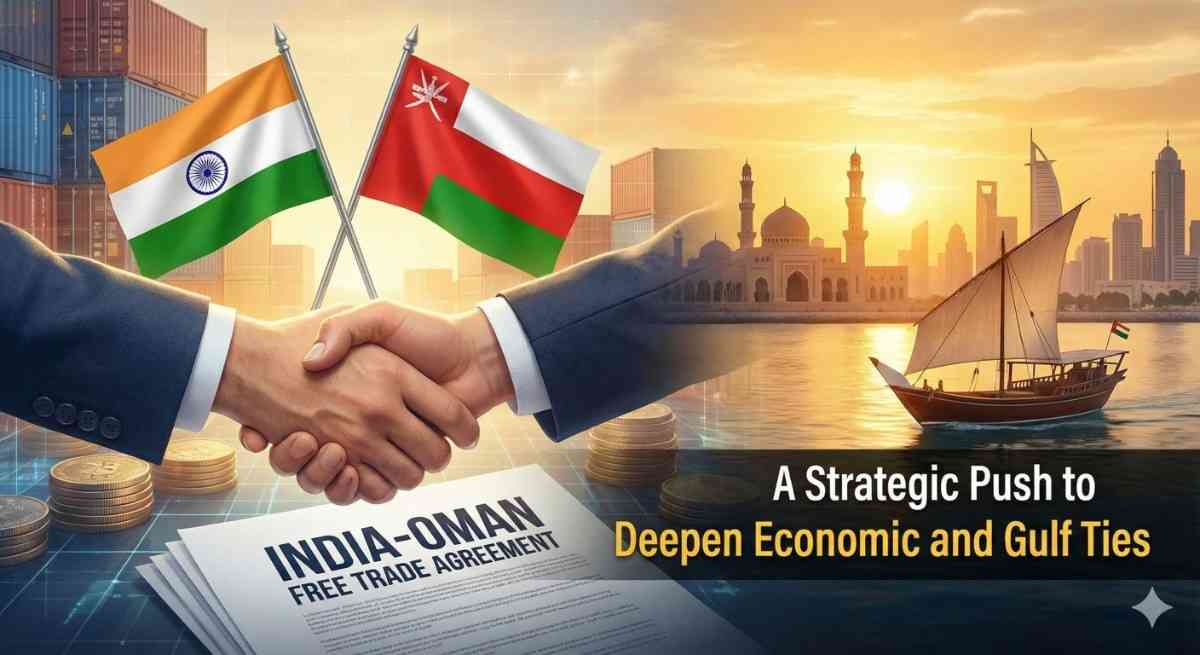
India Oman Free Trade Agreement negotiations are gaining momentum as both countries seek to deepen economic cooperation amid shifting global trade dynamics. The proposed agreement marks a strategic step in India’s broader Gulf outreach, aiming to enhance trade in energy, manufacturing, and services while strengthening investment and supply-chain linkages. For India, Oman offers strategic maritime access and energy security, while Oman views India as a long-term partner for economic diversification under Vision 2040. As talks progress, the FTA reflects a pragmatic blend of economic ambition, regional strategy, and long-term geopolitical alignment.
Why the India Oman Free Trade Agreement Matters Right Now
The timing of the India Oman Free Trade Agreement (FTA) isn’t accidental—it’s strategic, overdue, and honestly, kind of inevitable. The global trade order is messy right now. Supply chains are being redrawn, protectionism is creeping back, and countries are scrambling to lock in reliable partners. In that chaos, India and Oman finding common ground makes total sense.
First, zoom out. India is aggressively expanding its FTA footprint—UAE, Australia, EFTA, negotiations with the UK and EU—and the Gulf is a clear priority. Oman, though smaller than Saudi Arabia or the UAE, punches above its weight geopolitically. It sits at the mouth of the Strait of Hormuz, one of the world’s most critical energy chokepoints. Any serious Indian Gulf strategy without Oman is like building a house and forgetting the foundation.
From India’s perspective, the FTA is about diversification and resilience. India’s exports still face tariff and non-tariff barriers in many Gulf markets. An FTA with Oman can reduce duties, simplify customs procedures, and give Indian goods—especially engineering products, textiles, pharmaceuticals, food items, and IT services—a smoother entry into the region. At a time when India wants to boost exports to hit ambitious trade targets, Oman becomes a gateway, not just a destination.
For Oman, the urgency is economic transformation. Muscat is pushing hard to reduce its dependence on oil revenues under Vision 2040. It needs foreign investment, technology, skilled manpower, and access to large consumer markets. India ticks all those boxes. An FTA can help Oman attract Indian manufacturing firms, logistics players, and service-sector investments into its special economic zones like Duqm—turning Oman into a regional hub linking Asia, Africa, and the Middle East.
Energy is another big reason this agreement matters now. India already imports crude oil and LNG from Oman, and cooperation is expanding into green hydrogen, renewables, and clean energy supply chains. An FTA can institutionalise this relationship, provide long-term predictability, and encourage joint ventures at a time when energy security and energy transition are both national priorities.
There’s also a geopolitical layer—quiet but powerful. Oman is known for its balanced, non-confrontational diplomacy. In a region often marked by rivalries, Oman acts as a stabiliser. Strengthening economic ties with such a partner helps India safeguard its interests in the Gulf without getting entangled in regional tensions. Trade here supports diplomacy, and diplomacy protects trade. Old-school statecraft, still undefeated.
Finally, the India–Oman FTA matters because it aligns perfectly with India’s broader foreign policy shift—from transactional engagements to long-term strategic partnerships. This isn’t just about lowering tariffs; it’s about embedding India deeper into Gulf supply chains, securing maritime interests, and creating durable economic interdependence.
Bottom line: this FTA isn’t a headline-grabber like India–EU talks, but it’s smart, timely, and high-impact. The kind of move that doesn’t scream today—but delivers for decades.
Key Sectors Set to Gain: Energy, Manufacturing, and Services
If the India–Oman Free Trade Agreement actually lands the way negotiators intend, three sectors are about to eat well: energy, manufacturing, and services. And no, this isn’t the usual “win-win” jargon—these gains are grounded in hard economics, geography, and timing.
Energy sits right at the top. India and Oman already share a mature energy relationship, with Oman supplying crude oil and LNG to India. The FTA can take this beyond buyer–seller dynamics into long-term strategic collaboration. Reduced tariffs, clearer investment rules, and stable regulatory frameworks can encourage Indian public and private players to invest directly in Oman’s upstream and downstream energy sectors.
More importantly, the future play is green energy. Oman is emerging as a serious hub for green hydrogen and renewable energy, thanks to its geography and policy push. India, racing to decarbonise without slowing growth, needs diversified clean energy partnerships. An FTA can fast-track joint ventures, technology transfer, and long-term supply contracts—critical at a time when energy security and climate commitments are colliding.
Manufacturing is where the FTA’s multiplier effect really kicks in. Indian manufacturers—especially in engineering goods, automobiles and auto components, steel, aluminium, textiles, chemicals, and pharmaceuticals—stand to gain from reduced tariffs and easier market access. Oman’s strategic location allows Indian firms to use it as a production and re-export base to the Gulf, East Africa, and even Europe. Special Economic Zones like Duqm offer tax incentives, port connectivity, and industrial infrastructure that align neatly with India’s “Make in India” and export-led growth goals. For Oman, this brings in capital, jobs, and industrial diversification; for India, it means global value chain integration without overdependence on a single region. Old-school trade logic, modern execution.
Then there’s the services sector, India’s quiet superpower. IT and IT-enabled services, fintech, healthcare, education, logistics, and professional services are all poised to benefit. Oman’s economy is digitising, its population is young, and its demand for skilled services is rising. An FTA can ease visa regimes, professional recognition, and cross-border service delivery—areas where Indian firms consistently punch above their weight. Healthcare collaboration, in particular, has massive upside, with Indian hospitals, telemedicine providers, and pharma companies finding a receptive market in Oman.
Logistics and maritime services also deserve a shout-out. With ports like Duqm and Sohar gaining prominence, Indian shipping, port management, and supply-chain companies can plug directly into Gulf trade routes. This fits perfectly with India’s broader push for maritime connectivity in the Indian Ocean region.
In simple terms, the India–Oman FTA doesn’t bet on one sector—it builds an ecosystem. Energy secures the present, manufacturing scales the economy, and services future-proof the partnership. That’s not luck. That’s design.
Strategic Significance: Oman’s Role in India’s Gulf and Indo-Pacific Vision
To really get why the India–Oman Free Trade Agreement matters, you have to stop looking at it like a trade deal and start seeing it as strategy with receipts. Oman isn’t just another Gulf partner for India—it’s a geographic and diplomatic sweet spot that fits perfectly into India’s Gulf outreach and its wider Indo-Pacific vision.
Start with the map. Oman sits right next to the Strait of Hormuz, through which nearly a fifth of the world’s oil passes. For an energy-hungry country like India, this isn’t trivia—it’s survival math. Stable relations with Oman help India safeguard its energy lifelines and ensure uninterrupted maritime trade. Unlike flashier regional powers, Oman plays a calm, balanced role in Gulf politics. It avoids bloc rivalries, maintains dialogue with all sides, and values strategic autonomy. That makes it an ideal partner for India, which follows a similar non-aligned-but-engaged approach.
Now layer in the Indo-Pacific angle. India’s Indo-Pacific vision isn’t just about the eastern oceans or countering China—it’s about secure sea lanes, resilient supply chains, and trusted partners across the Indian Ocean Region (IOR). Oman’s ports—especially Duqm—are emerging as key nodes in this network. For India, Duqm offers logistical depth beyond the crowded choke points and an opportunity to anchor commercial and strategic presence in the western Indian Ocean. An FTA strengthens this by encouraging Indian investment in ports, logistics, ship repair, and industrial infrastructure.
There’s also a quiet but important security dimension. India and Oman already conduct joint military exercises and cooperate on maritime security. Economic interdependence through an FTA reinforces this trust. Trade creates stakes, and stakes create stability. It’s the old rule of geopolitics: countries that trade deeply are less likely to drift apart strategically.
From a Gulf perspective, Oman acts as a bridge—between India and the wider GCC, and between Asia and Africa. Strengthening ties with Oman allows India to deepen its regional footprint without triggering anxieties that sometimes accompany engagement with larger Gulf players. It’s a low-drama, high-impact partnership. No chest-thumping. Just steady influence.
The FTA also aligns with India’s push for strategic diversification. In a world where overdependence on any single trade route or partner is risky, Oman offers optionality—alternate logistics, diversified energy sources, and diplomatic balance. That’s gold in today’s fragmented global order.
Bottom line: Oman isn’t a side character in India’s foreign policy story. It’s a strategic anchor. The India–Oman FTA turns geography into leverage, diplomacy into durability, and economic ties into long-term strategic alignment. Quiet moves. Serious impact.
Challenges in Negotiations: Market Access, Rules of Origin, and Balance
Let’s be real—no Free Trade Agreement is ever just handshakes and photo-ops. Behind the diplomatic smiles, the India–Oman FTA negotiations are grinding through some very real friction points. And honestly, that’s a good thing. Tough negotiations usually mean the deal actually matters.
The first big hurdle is market access. India wants deeper and faster tariff reductions for its labour-intensive exports—textiles, garments, engineering goods, pharmaceuticals, food products, and services. Oman, on the other hand, is cautious about opening up sensitive domestic sectors too quickly. Like many Gulf economies, it wants to protect local industries and employment while still attracting foreign investment. Striking the right balance between openness and protection is tricky. If India feels the access offered is too shallow, the FTA loses punch. If Oman opens up too fast, domestic pushback becomes inevitable. Classic trade tension—nothing new, but never easy.
Then comes the nerdy but crucial part: Rules of Origin (RoO). This is where FTAs live or die. Oman is part of broader Gulf and global supply chains, and India is wary of third-country goods—especially from East Asia—entering the Indian market through Oman by exploiting low tariffs. India wants strict and transparent RoO norms to ensure that only genuinely Omani-origin goods get FTA benefits. Oman, meanwhile, prefers flexible rules to attract global manufacturers to set up production and use its territory as a re-export base. The challenge is designing rules that prevent misuse without killing investment incentives. Too strict, and businesses walk away. Too loose, and the FTA becomes a loophole factory.
Trade balance concerns add another layer. India generally runs trade deficits with energy-exporting Gulf countries. While Oman is not a mega energy exporter, hydrocarbons still dominate its exports. India will want assurances that the FTA doesn’t widen the deficit without boosting Indian exports and investments. Oman, for its part, wants predictable access to the Indian market for energy, petrochemicals, and minerals. Balancing these interests requires smart sequencing—front-loading gains for both sides rather than letting one partner dominate early.
Services and labour mobility are another sensitive zone. India is pushing for easier movement of professionals and better recognition of qualifications. Oman supports skilled migration but remains careful due to domestic employment policies and localisation goals. Reconciling India’s services strength with Oman’s workforce priorities is politically delicate.
Bottom line: these challenges aren’t deal-breakers—they’re deal-shapers. If negotiators get market access right, lock in credible rules of origin, and maintain economic balance, the India–Oman FTA can be both ambitious and sustainable. Rushed deals age badly. Well-negotiated ones last decades.
What Lies Ahead: Timeline, Expectations, and Long-Term Impact
So where does the India–Oman Free Trade Agreement actually go from here? Short answer: cautiously forward, eyes wide open. Long answer? This is one of those deals where speed matters, but precision matters more.
On the timeline, both sides are clearly interested in moving faster than usual. Recent diplomatic engagements and negotiation rounds suggest a political push to conclude talks sooner rather than later, ideally within the next negotiation cycle. But don’t expect overnight miracles. Sensitive issues—especially rules of origin, services mobility, and investment protections—take time to iron out. A realistic expectation is a phased agreement, where early harvest measures (tariff cuts on select goods, cooperation frameworks) come first, followed by deeper commitments. That’s the grown-up way to do FTAs, not the headline-chasing one.
In terms of expectations, policymakers should keep them grounded. This FTA won’t suddenly double trade volumes in a year, and that’s okay. What it can do is reduce friction, lower costs, and create predictability—three things businesses love more than flashy announcements. Indian exporters should expect smoother customs procedures, better access to Omani markets, and clearer investment rules. Omani stakeholders can expect stronger Indian investment inflows, technology partnerships, and integration into Indian-led supply chains.
The long-term impact is where this agreement really shines. Over time, the India–Oman FTA can reshape trade patterns in the western Indian Ocean region. Oman could emerge as a preferred hub for Indian companies targeting the Gulf and Africa, while India strengthens its role as a manufacturing and services partner for Oman’s economic diversification. Energy cooperation—especially in green hydrogen and renewables—could move from pilot projects to large-scale commercial reality.
Strategically, the FTA deepens trust. Economic interdependence creates diplomatic ballast—it stabilises relationships even when global politics gets choppy. For India, this supports its Indo-Pacific and Indian Ocean strategy by anchoring a reliable partner near key maritime routes. For Oman, it reinforces strategic autonomy by diversifying partnerships beyond traditional powers.
People-to-People Ties and the Indian Diaspora: The Human Backbone of India–Oman Relations
Behind the trade figures, negotiation tables, and strategic maps, the India–Oman relationship rests on something far more durable—people. Any discussion on the India–Oman Free Trade Agreement is incomplete without acknowledging the deep-rooted people-to-people ties that have quietly sustained this partnership for decades.
Indians form one of the largest and most trusted expatriate communities in Oman. From construction workers and technicians to doctors, engineers, teachers, and business owners, the Indian diaspora plays a critical role in Oman’s economy. Unlike many migration corridors marked by tension, the India–Oman labour relationship has been relatively stable and respectful. This trust matters. FTAs don’t operate in a vacuum; they function best where social acceptance and cultural familiarity already exist.
The FTA can significantly institutionalise these human connections. Provisions related to services, professional mobility, skill recognition, and temporary movement of workers can bring predictability and legal clarity for Indian professionals. For Oman, this ensures access to a skilled and reliable workforce aligned with its Vision 2040 goals, particularly in healthcare, education, IT, logistics, and energy management. For India, it means better protection and opportunities for its citizens abroad—something voters and policymakers care deeply about.
Education and knowledge exchange are another underappreciated pillar. Indian educational institutions, ed-tech platforms, and vocational training providers are increasingly active in the Gulf. An FTA can encourage collaboration in skill development, technical training, and capacity building—helping Oman upskill its youth while opening new markets for Indian institutions. This is soft power with real economic returns.
Cultural ties also grease the wheels of economic cooperation. Centuries-old maritime links between India’s western coast and Oman have created shared commercial traditions and mutual familiarity. Indian food, festivals, and films are part of everyday life in Oman, making Indian brands and services more culturally accessible. That familiarity reduces transaction costs in ways no policy document ever can.
Remittances add another layer of economic significance. Money sent home by Indian workers supports millions of families and contributes to India’s foreign exchange inflows. By stabilising employment conditions and expanding service-sector opportunities, the FTA indirectly strengthens this financial lifeline—quietly but consistently.
In the long run, these people-to-people ties act as shock absorbers. When global markets wobble or geopolitics turns unpredictable, relationships anchored in human trust tend to hold. That’s why this dimension isn’t sentimental—it’s strategic.
Bottom line: trade agreements may be signed by governments, but they are sustained by people. In the case of India and Oman, the human foundation is already strong. The FTA simply gives it structure, protection, and room to grow.
About The Author







Leave a Reply