

Table of Contents
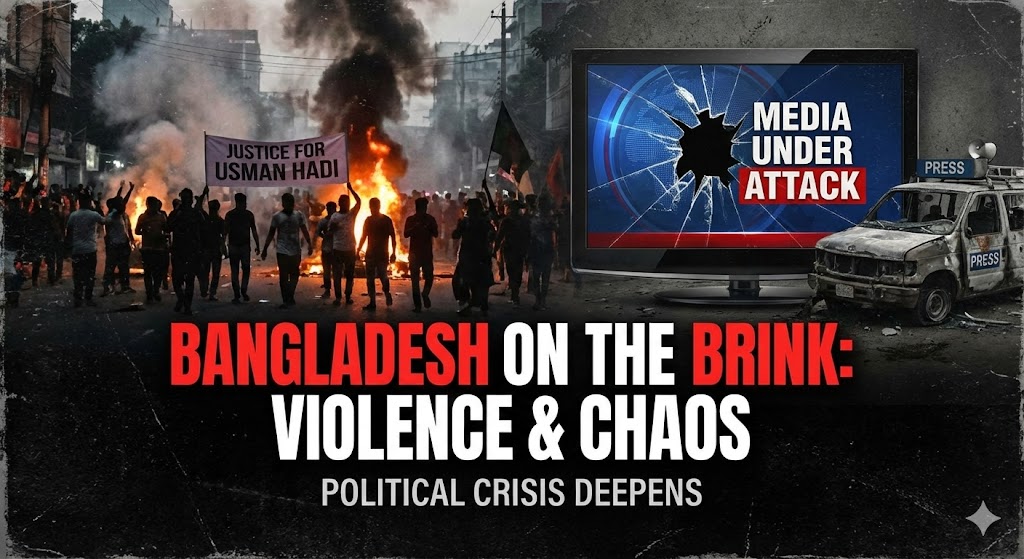
Usman Hadi death has shaken Bangladesh at a moment when the country was already walking a fragile democratic tightrope. The assassination of the young political activist and protest leader triggered widespread unrest, exposing deep social, religious, and institutional fault lines. What followed was a disturbing chain of events—mob lynching of a Hindu man, arson attacks on major newspaper offices, targeted killings of journalists, and vandalism of political and historical symbols. As protests intensify and law enforcement struggles to contain violence, the crisis has cast a dark shadow over the upcoming February elections, raising serious concerns about stability, justice, and democratic survival.
Usman Hadi Death: Who He Was and Why His Assassination Changed Bangladesh Politics
Sharif Usman bin Hadi wasn’t just another political name in Bangladesh’s crowded protest space—he was a symbol of the post-2024 political rupture. Young, articulate, and unapologetically ideological, Sharif Usman bin Hadi rose to prominence during the July–August 2024 student-led uprising that ultimately dismantled the long-standing rule of Sheikh Hasina. In a country where politics has long been dominated by aging elites and dynastic loyalties, Hadi represented a generational break—raw, restless, and deeply polarising.
A lecturer by profession and a political writer by instinct, Hadi served as the national spokesperson of Inqilab Manch, a right-wing Islamist platform that gained traction after the collapse of the Awami League government. His writings and speeches blended cultural nationalism with sharp critiques of secular authoritarianism, earning him both devoted followers and dangerous enemies. Love him or loathe him, one thing was clear: Hadi mattered.
That’s exactly why his assassination sent shockwaves through Bangladesh.
On December 12, in broad daylight, Hadi was shot point-blank while campaigning in Dhaka’s Bijoynagar area. The CCTV footage—clinical, fast, chilling—showed a professional hit. Helmets on. Close range. Clean escape. This wasn’t random violence; it was a message killing. Six days later, after being flown to Singapore for treatment, Hadi succumbed to his injuries. The timing couldn’t have been worse—or more explosive.
Hadi’s death struck at the heart of Bangladesh’s already fragile transition under the interim administration led by Muhammad Yunus. With national elections scheduled for February, his killing instantly destabilised the political environment. Supporters saw him as a martyr of the revolution; opponents feared his legacy would radicalise street politics further. Both sides were right.
What makes Hadi’s assassination particularly consequential is what followed. His death acted as a spark in a room full of fuel—triggering mob violence, minority targeting, attacks on media institutions, and assaults on political symbols. In societies already polarised, assassinations don’t end movements; they mutate them. Hadi’s killing transformed him from a controversial leader into “Shaheed Usman Hadi,” a rallying cry that now transcends his actual political programme.
There’s also a darker implication. If a high-profile figure like Hadi can be eliminated in the capital, in daylight, what does that say about the state’s capacity—or willingness—to protect political actors? The message to other emerging leaders is brutal: visibility equals vulnerability.
In historical terms, Bangladesh has seen this movie before. Political assassinations have repeatedly altered its trajectory—from Sheikh Mujibur Rahman in 1975 to later waves of targeted killings. Hadi’s death fits uncomfortably into that legacy, threatening to normalise violence as a political tool once again.
Bottom line: Usman Hadi’s assassination matters not just because of who he was, but because of what his death unlocked—a volatile mix of grief, rage, and unresolved power struggles. Whether Bangladesh can contain that fallout will decide whether this transition leads to democratic renewal—or another cycle of blood and breakdown.
Usman Hadi Death Fallout: Mob Violence and Minority Targeting in Bangladesh
If Usman Hadi’s assassination lit the fuse, the lynching of a Hindu man showed just how fast Bangladesh’s streets could descend into medieval brutality. In Bhaluka, near Mymensingh, the killing of Dipu Chandra Das wasn’t just another riot-related death—it was a chilling reminder of how mob justice, religious hysteria, and political chaos can combine into something far uglier.
According to reports from BBC Bangla, Dipu, a garment factory worker living in a rented room, was accused by locals of making derogatory remarks about Islam’s Prophet. That accusation alone was enough. No verification. No police inquiry. No due process. A mob dragged him out, beat him mercilessly, hung his naked body from a tree, and set it on fire—while chants of “Allahu Akbar” echoed in the background. This wasn’t spontaneous anger. This was performative violence.
What makes this incident especially disturbing is how normalised such killings are becoming in moments of political instability. Bangladesh has laws. Bangladesh has courts. Bangladesh has police stations. Yet in that moment, none of it mattered. The mob became judge, jury, and executioner—because it could.
Police arrived later, controlled the situation, and sent the body to Mymensingh Medical College Hospital for post-mortem. But as of reporting, no FIR had been registered immediately, and the victim’s family hadn’t even been traced. That silence speaks volumes. In cases like these, justice doesn’t just move slowly—it often never moves at all.
This wasn’t an isolated eruption. Minority communities—especially Hindus—have historically been soft targets during political churn in Bangladesh. Every major transition, from coups to caretaker governments, has seen a spike in attacks on minorities. The pattern is depressingly consistent: political anger finds an easier outlet in religious scapegoating. Minorities pay the price for power struggles they have no role in.
The timing matters too. The lynching occurred amid nationwide protests following Hadi’s death, when law enforcement was stretched thin and political messaging had turned incendiary. Rumours spread faster than facts. Social media videos inflamed emotions. Once the crowd decides someone is “guilty,” survival becomes impossible.
The interim government led by Muhammad Yunus strongly condemned the killing, stating that “there is no place for such violence in the new Bangladesh.” The words were right. The question is whether action will follow. Condemnations don’t deter mobs—arrests, convictions, and consequences do.
This lynching wasn’t just about Dipu Chandra Das. It sent a message to every minority citizen: your safety is conditional. In an election-bound country already fractured by ideology, that message is lethal. When religious accusations become weapons, democracy doesn’t just weaken—it corrodes from the inside.
Blunt truth? A state that cannot protect its most vulnerable during crisis is a state flirting with collapse. Bangladesh isn’t there yet—but incidents like this show how close the edge really is.
Usman Hadi Death and Press Under Fire: Attacks on Media Houses and Journalists
When mobs start attacking newsrooms, it’s no longer just political unrest—it’s a direct assault on truth itself. In the aftermath of Usman Hadi’s death, Bangladesh crossed that dangerous line. Two of the country’s most influential media houses—The Daily Star and Prothom Alo—became targets of organised mob violence, exposing how fragile press freedom has become during this so-called democratic transition.
Late Thursday night, protesters forcibly entered the Dhaka offices of The Daily Star, vandalising property and setting parts of the building on fire. Around 25 journalists were trapped inside as thick smoke filled the newsroom. The situation turned so dire that reporter Jaima Islam posted a desperate message on Facebook saying she couldn’t breathe and feared she would die inside the building. That post alone should shame the state—but shame doesn’t stop mobs.
Journalists were eventually rescued, but the damage was already done. Both The Daily Star and Prothom Alo were forced to suspend print publication the next day, with digital operations also disrupted. For a country that claims to be moving toward a “new Bangladesh,” silencing newspapers through arson is about as old-school authoritarian as it gets.
This wasn’t random rage. These media houses have long been accused by radical groups of being “pro–Awami League,” “Indian-friendly,” or “anti-Islamic”—labels that have increasingly become death warrants in Bangladesh’s polarised ecosystem. When politics radicalises, journalism becomes the first casualty.
The violence didn’t stop at buildings. Veteran editor Nurul Kabir, head of the New Age newspaper, was threatened when he arrived at The Daily Star office and attempted to reason with the attackers. His reward? Intimidation and violent threats. That moment summed up the new rulebook: ask questions, and you become the enemy.
Even more chilling was the murder of journalist Imdadul Haque Milan in Khulna. Shot dead by assailants on motorcycles while sitting at a tea stall, Milan was the president of the Shaluah Press Club. The hit was clean, fast, and professional—eerily similar to Hadi’s assassination. No arrests. No identified suspects. Just another journalist silenced.
Let’s be blunt: this isn’t accidental chaos. When journalists are attacked during political upheaval, it serves two purposes—to suppress inconvenient narratives and to spread fear across the media ecosystem. Smaller outlets, freelancers, and regional reporters get the message loud and clear: stay quiet or stay unsafe.
Bangladesh has a long history of press under pressure, but what makes this moment alarming is the absence of red lines. Newsrooms burned. Reporters trapped. Editors threatened. A journalist killed. And all of it happening while elections are weeks away.
The interim government condemned the attacks, promising protection and investigations. But condemnation without swift arrests only fuels impunity. In volatile transitions, mobs test the state’s limits. So far, the response has been reactive, not deterrent.
A democracy without a free press isn’t a democracy—it’s a performance. And right now, Bangladesh’s press isn’t just under pressure; it’s under siege. If journalists can’t report safely, voters won’t vote informed. And when information dies, manipulation takes its place.
That’s the real danger here—not just broken buildings, but a broken information spine.
Usman Hadi Death Sparks Symbolic Violence: Awami League Offices, Mujib’s Home, and Campuses
When protests stop targeting policies and start targeting symbols, you know the conflict has entered a far more dangerous phase. After Usman Hadi’s death, Bangladesh didn’t just witness street violence—it saw a systematic assault on the country’s political memory and institutional identity. From party offices to historic homes to university campuses, the message was blunt: the old order must burn.
The most visible targets were offices of the Awami League, once the most dominant political force in the country. Party offices in Rajshahi and multiple other districts were vandalised, torched, and looted. Furniture smashed. Documents burned. Flags torn down. These weren’t clashes between rival groups—these were one-sided acts of erasure, aimed at removing Awami League’s physical presence from public space.
But the violence didn’t stop at party infrastructure. Protesters also attacked the Dhaka residence of Sheikh Mujibur Rahman, the founding father of the nation and a near-sacred figure in Bangladesh’s state narrative. This house—already attacked twice in 2024—was vandalised again, signalling something deeper than anger at a political party. It marked a direct challenge to Bangladesh’s foundational mythos.
Historically, attacking Mujib’s symbols has always been a red line. Crossing it isn’t just political rebellion; it’s ideological rebellion. For decades, Bangladeshi politics revolved around competing interpretations of Mujib’s legacy. Now, a new generation seems less interested in reinterpretation—and more interested in outright rejection.
The arson attack on the house of former education minister Mohibul Hasan Chowdhury further underscored this shift. These weren’t random properties; they were nodes of the previous power structure, deliberately chosen to send a warning. The aim wasn’t persuasion. It was intimidation.
Perhaps the most telling development unfolded at University of Dhaka. At Sheikh Mujibur Rahman Hall—one of the university’s most prominent residential halls—organisers unilaterally replaced its name with “Shaheed Usman Hadi Hall” at midnight, plastering posters to cement the change. No university process. No academic debate. Just symbolic takeover.
Campuses have always been political incubators in Bangladesh, but this move crossed from activism into institutional capture. Naming is power. When students rename buildings overnight, it reflects not just grief, but a belief that revolutionary legitimacy overrides democratic procedure.
This is where radicalisation creeps in quietly. Today it’s renaming halls. Tomorrow it’s deciding who belongs on campus—and who doesn’t. History shows that when political movements begin rewriting symbols without consent, pluralism becomes collateral damage.
The interim administration led by Muhammad Yunus condemned the violence and vandalism, urging restraint. But here’s the uncomfortable truth: symbolic violence is harder to police than street clashes. You can deploy forces to protect buildings, but you can’t easily contain ideological rage once it’s unleashed.
What’s happening now isn’t random destruction—it’s a revolutionary purge of symbols, driven by a generation that sees the old political order as illegitimate, corrupt, and beyond reform. Whether that energy reshapes Bangladesh or tears it further apart depends on what comes next.
Because when statues fall, offices burn, and campuses radicalise, the question is no longer who is in power—it’s what kind of country survives afterward.
Usman Hadi Death Before Elections: Can Bangladesh Stabilise Ahead of February 12?
With just weeks to go before polling day, Bangladesh is attempting something brutally difficult: holding national elections in the middle of grief, rage, and institutional shock. The February 12 vote—announced by the Bangladesh Election Commission under Chief Election Commissioner AMM Nasiruddin—was supposed to mark a clean democratic reset after years of authoritarian drift. Instead, it’s shaping up to be one of the most fragile elections in the country’s history.
The backdrop is ugly. A high-profile political assassination. Mob lynching of a minority citizen. Newsrooms set on fire. Journalists shot dead. Political offices torched. University campuses hijacked symbolically. And street protests swelling at intersections like Shahbagh. Elections don’t happen in a vacuum—and right now, Bangladesh’s political atmosphere is oxygen-poor.
At the centre of the transition sits the interim government led by Muhammad Yunus, a globally respected figure trying to stabilise a deeply polarised state. Yunus has condemned the violence, promised swift justice, announced compensation for victims’ families, and ordered manhunts for attackers. On paper, it’s the right response. On the ground, the clock is ticking faster than the state’s ability to restore trust.
One core challenge is legitimacy. The Awami League, historically the country’s largest party, is barred from contesting. Its registration was suspended in 2025, and many of its senior leaders remain jailed or sidelined. Supporters argue this clears the field for a “new Bangladesh.” Critics warn it creates a representation vacuum—elections without a major stakeholder rarely calm societies; they inflame them.
Then there’s the security dimension. If mobs can lynch, burn offices, and attack diplomats—as seen in the stone-pelting at the Indian mission—how safe will polling stations be? The advisory issued to Indian nationals highlights a wider concern: when foreign missions feel threatened, internal stability is already compromised.
The assassination of Usman Hadi looms large over the electoral narrative. For his supporters, the election is now a referendum on justice. For rivals, it’s a test of whether street power will override ballots. Martyrdom politics can mobilise voters—but it can also justify intimidation, boycotts, and post-result unrest.
History isn’t encouraging. Bangladesh’s past elections during periods of transition—especially after coups—have often been marred by violence, contested outcomes, or long-term instability. The absence of trust between institutions, parties, and citizens makes even fair processes appear suspect.
Still, writing Bangladesh off would be lazy. The country has surprised before. Civil society remains vocal. Students are politically engaged. The election commission has pledged neutrality. And ordinary Bangladeshis, exhausted by cycles of upheaval, want normalcy more than slogans.
The real question isn’t whether Bangladesh can hold elections on February 12—it probably will. The harder question is whether those elections will heal or harden the fractures now visible across society.
Stability won’t come from ballot boxes alone. It will require swift justice for violence, protection for minorities and journalists, restraint from protest leaders, and credibility from the state. Without that, February 12 risks becoming not a democratic milestone—but another flashpoint.
Bangladesh is at a crossroads. What happens next will decide whether this transition becomes a foundation—or a fault line.
About The Author








Leave a Reply