

Table of Contents
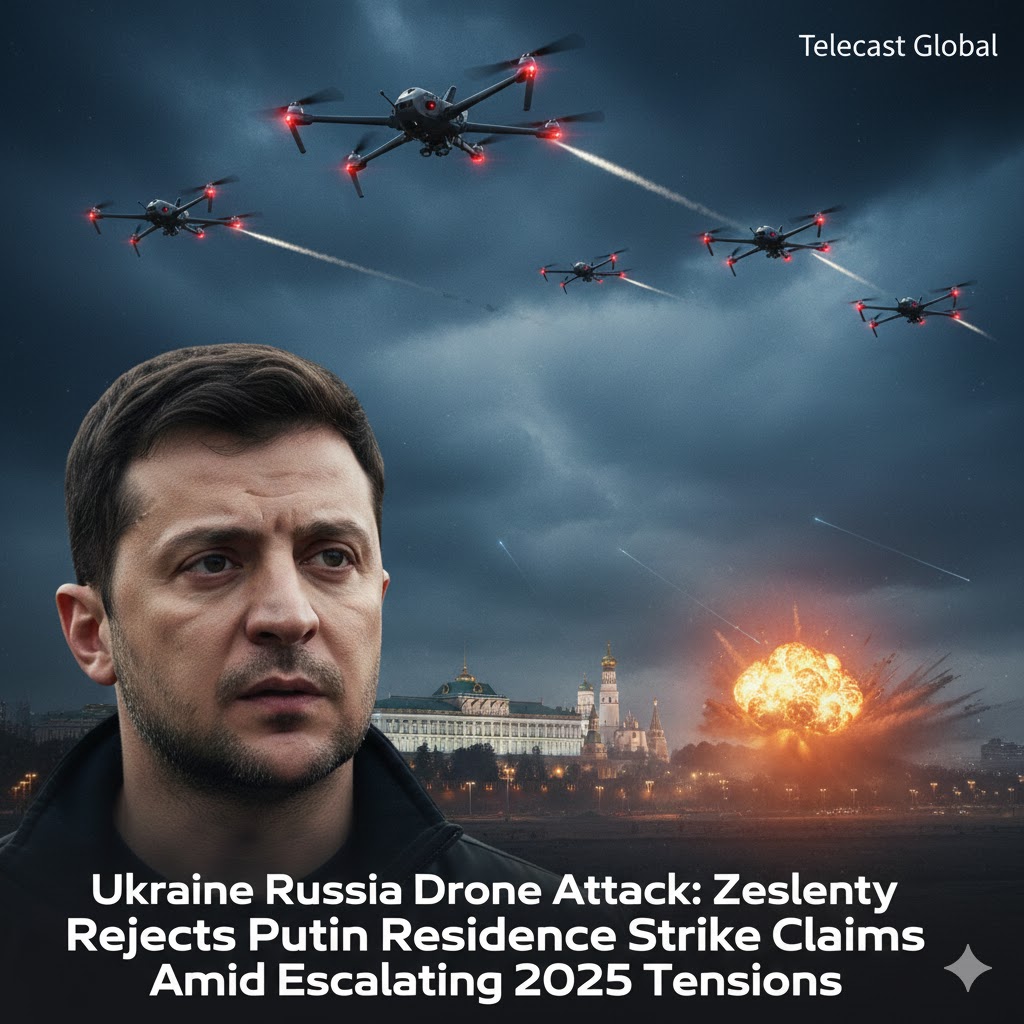
The Ukraine Russia drone attack narrative took a dramatic turn after Moscow accused Kyiv of targeting President Vladimir Putin’s Novgorod residence—an allegation flatly denied by Volodymyr Zelensky, who called it outright propaganda. With no visual proof released and tensions already razor-thin, this episode highlights how modern warfare in 2025 isn’t just fought with missiles and drones, but with information, timing, and global optics. As leaders like Narendra Modi and Donald Trump weigh in, the incident reflects a broader shift toward narrative-driven conflict shaping diplomacy, deterrence, and public opinion worldwide.
Ukraine Russia Drone Attack Allegations: What Moscow Claimed and What’s Missing
The Ukraine Russia drone attack narrative exploded after Moscow made a high-stakes claim: that Ukraine attempted a large-scale drone strike on President Vladimir Putin’s official residence in Russia’s Novgorod region. According to Russian officials, this was not a minor provocation but a coordinated operation involving 91 long-range drones launched over two consecutive nights. Russian air defense systems, they said, intercepted and destroyed all incoming drones before any damage could occur.
On paper, the allegation sounds dramatic enough to justify escalation. In practice, the Ukraine Russia drone attack claim raises more questions than answers.
First, the evidence gap is impossible to ignore. Russia has not released any visual proof—no radar footage, no debris images, no intercepted drone videos. In an era where even minor battlefield incidents are instantly broadcast on Telegram and state media, this silence is glaring. For analysts tracking the Ukraine Russia drone attack discourse, the lack of corroborating material significantly weakens Moscow’s position.
Second, ambiguity surrounds the most critical detail: Was Putin even there? Russian authorities have not confirmed whether the president was present at the Novgorod residence at the time of the alleged attack. This omission matters. Targeting a symbolic site is very different from attempting to strike a head of state. Without clarity, the Ukraine Russia drone attack allegation floats in a strategic gray zone—serious enough to alarm, vague enough to avoid accountability.
Russian Foreign Minister Sergey Lavrov labeled the incident a “terrorist act” and warned of retaliation, signaling that Moscow is framing the Ukraine Russia drone attack claim as justification for future military responses. This framing follows a familiar pattern: assert aggression, claim moral high ground, and prepare domestic and international audiences for escalation.
From a 2025 warfare perspective, this fits neatly into Russia’s broader information strategy. Modern conflicts are no longer just about battlefield gains—they’re about controlling the narrative cycle. A high-profile Ukraine Russia drone attack allegation shifts attention away from Russia’s own strikes on Ukrainian infrastructure and puts Kyiv on the defensive in global media.
What’s also missing is third-party verification. No independent international body, satellite provider, or neutral state has confirmed the Ukraine Russia drone attack claim. Given the density of surveillance assets over European Russia, this absence is telling. When real incidents occur, leaks happen. Analysts talk. Images surface. None of that has happened here.
This doesn’t automatically mean the claim is fabricated—but it does mean it remains unproven. And in geopolitics, unproven claims are tools, not truths.
Ultimately, the Ukraine Russia drone attack allegation appears less about what happened in Novgorod and more about shaping the strategic environment ahead. It sends signals to domestic audiences, pressures Western partners, and lays rhetorical groundwork for retaliation. Until concrete evidence emerges, the story remains incomplete—and in modern warfare, what’s missing often matters more than what’s said.
Zelensky’s Denial and the Rise of Information Warfare in 2025 Conflicts
The Ukraine Russia drone attack narrative didn’t just trigger military speculation—it ignited a full-blown information war, and Volodymyr Zelensky moved fast to shut it down. Calling Russia’s claims “complete lies,” Zelensky publicly rejected the allegation that Ukraine targeted President Putin’s Novgorod residence, framing it as deliberate propaganda rather than a battlefield event. In 2025, that distinction matters more than ever.
Zelensky’s response wasn’t accidental or emotional—it was strategic. In modern conflicts, controlling the first counter-narrative is critical. The Ukraine Russia drone attack claim, if left unanswered, could harden international opinion against Kyiv, justify Russian escalation, and blur the moral clarity Ukraine has carefully built since 2022. Zelensky understood that silence would be interpreted as uncertainty.
This is where information warfare comes into play. Unlike traditional propaganda, today’s information warfare is fast, decentralized, and algorithm-driven. Claims don’t need proof to spread; they just need repetition. By branding the Ukraine Russia drone attack allegation as a fabricated excuse for future strikes on Kyiv, Zelensky flipped the script—casting Russia not as a victim, but as a narrative aggressor.
Crucially, Zelensky tied the claim to past patterns. He reminded global audiences that Moscow has repeatedly used alleged “provocations” to justify missile and drone strikes on Ukrainian government buildings. In that context, the Ukraine Russia drone attack story starts to look less like an isolated incident and more like a setup. This framing resonates in 2025, when policymakers are increasingly skeptical of unverifiable claims used to legitimize force.
The timing also matters. With fragile peace discussions, security guarantees, and US political recalibration all in play, the Ukraine Russia drone attack narrative lands at a moment when perception could influence policy decisions. Zelensky’s denial wasn’t just for public opinion—it was aimed squarely at diplomats, defense planners, and allied governments weighing their next move.
Another key layer is platform choice. Zelensky issued his denial directly on X, bypassing traditional press channels. That’s textbook 2025 conflict communication: leader-to-public, unfiltered, immediate. In contrast, Russia’s claim relied on official statements without evidence—effective domestically, weaker internationally. In the information war surrounding the Ukraine Russia drone attack, speed and credibility outweighed authority.
What we’re seeing is a broader shift in how wars are fought. Drones may dominate the skies, but narratives dominate outcomes. A single Ukraine Russia drone attack allegation can shape sanctions debates, arms transfers, and diplomatic urgency—if left uncontested. Zelensky’s sharp denial reflects an understanding that wars are now fought simultaneously on battlefields, timelines, and newsfeeds.
In 2025, information warfare isn’t a side effect of conflict—it is the conflict. And the Ukraine Russia drone attack episode shows that whoever controls the story often controls the consequences.
From Novgorod to Kyiv: How Drone Warfare Is Redefining Red Lines
The Ukraine Russia drone attack controversy around Novgorod is not just another flashpoint—it’s a marker of how drone warfare is fundamentally rewriting the rules of conflict in 2025. Once, red lines were clear: borders mattered, leadership residences were largely off-limits, and escalation followed predictable ladders. Today, drones have blurred all of that.
At the heart of the debate is distance and deniability. Long-range drones make geography almost irrelevant. Whether it’s Novgorod deep inside Russia or Kyiv under constant aerial threat, the Ukraine Russia drone attack discourse shows how states now perceive vulnerability everywhere. Drones don’t need air superiority, formal declarations, or even confirmed attribution to shift strategic calculations. Just the possibility of a strike is enough.
For Moscow, alleging a Ukraine Russia drone attack on a presidential residence serves a dual purpose. First, it signals that no location is safe, even symbolic ones tied to state authority. Second, it attempts to redraw red lines by implying that Ukraine has crossed into targeting leadership-linked sites—something traditionally considered escalatory. Even without proof, the claim itself changes the conversation.
Kyiv, on the other hand, understands the trap. President Volodymyr Zelensky’s denial reflects a clear strategic choice: Ukraine does not want drone warfare to be framed as assassination-adjacent or symbolic terror. In the Ukraine Russia drone attack narrative, accepting that framing would risk alienating partners who support Ukraine on the basis of defense, not provocation.
What makes drone warfare uniquely destabilizing is its ambiguity. A missile launch is obvious. A drone swarm is murky. Was it reconnaissance? Psychological pressure? A failed strike? Or pure fiction? The Ukraine Russia drone attack claim thrives in this ambiguity, where facts lag behind headlines and reactions come before verification.
From Kyiv’s perspective, the real red line being crossed isn’t physical—it’s narrative. Russia has repeatedly used alleged drone threats to justify strikes on Ukrainian cities, power grids, and government buildings. Seen through that lens, the Ukraine Russia drone attack allegation looks less like a warning and more like pretext-building. In modern warfare, pretexts are weapons too.
There’s also a technological escalation at play. As drones become cheaper, smarter, and longer-range, states are recalibrating what counts as an act of war. Is an intercepted drone equivalent to a missile strike? Does intent matter more than impact? The Ukraine Russia drone attack debate highlights how international law and deterrence theory are lagging behind technology.
Even leadership symbolism is changing. A president’s residence used to represent inviolability. Now, merely naming it as a target—even hypothetically—signals psychological reach. For Vladimir Putin, invoking a threat to Novgorod reinforces a siege narrative for domestic audiences. For Ukraine, rejecting the Ukraine Russia drone attack claim is about preserving legitimacy and strategic restraint.
Ultimately, drone warfare has erased the comfort of clear thresholds. From Novgorod to Kyiv, red lines are no longer lines—they’re shifting zones of perception. And in 2025, the Ukraine Russia drone attack episode proves that what might have happened can be just as destabilizing as what actually did.
Global Reactions: Modi, Trump, and the Diplomacy vs Deterrence Divide
The Ukraine Russia drone attack allegation didn’t stay confined to Eastern Europe—it rippled straight into global power centers, exposing a sharp divide between diplomacy-first and deterrence-first worldviews. As soon as the claim surfaced, international reactions made one thing clear: in 2025, how leaders respond to a crisis can matter as much as the crisis itself.
Indian Prime Minister Narendra Modi took the most traditional—and arguably the most stabilizing—position. Without endorsing either side’s version of events, Modi emphasized restraint and dialogue, urging all parties to avoid actions that could derail peace efforts. This response aligns with India’s long-standing strategic culture: avoid entanglement, promote diplomacy, and position itself as a responsible global stabilizer. In the context of the Ukraine Russia drone attack, Modi’s message was clear—claims and counterclaims must not become excuses for escalation.
This diplomatic posture reflects a broader trend in Global South politics. Many countries view the Ukraine Russia drone attack narrative less as a standalone incident and more as another reminder of how quickly great-power conflicts can spiral. For them, deterrence-heavy responses threaten global economic stability, energy security, and supply chains—costs they end up paying without having a seat at the table.
Contrast that with the reaction from US President Donald Trump, which leaned heavily toward deterrence and personal diplomacy. Trump publicly stated that President Putin himself had informed him of the alleged Ukraine Russia drone attack, and he expressed anger over what he described as an unacceptable targeting of a leader’s residence. While Trump stopped short of calling for immediate retaliation, his tone suggested that some actions—real or perceived—cross unspoken red lines.
This difference is crucial. Where Modi focused on process, Trump focused on provocation. The Ukraine Russia drone attack allegation, in Trump’s framing, wasn’t just a security issue; it was a question of respect, boundaries, and signaling strength. That approach resonates with deterrence logic: respond firmly to discourage future threats, even when evidence is incomplete.
Together, these reactions expose a widening fault line in global crisis management. One camp believes restraint prevents escalation; the other believes restraint invites it. The Ukraine Russia drone attack controversy became a testing ground for this divide, especially at a time when international institutions struggle to enforce norms or verify claims quickly.
Another layer is audience targeting. Modi’s statement was aimed at the international community and emerging economies, reinforcing India’s image as a voice of balance. Trump’s comments were aimed at both domestic voters and strategic rivals, reinforcing an image of toughness and personal influence over global leaders. In both cases, the Ukraine Russia drone attack served as a narrative vehicle rather than a fully established fact.
What’s striking is what’s missing: unified global messaging. No coordinated response, no collective demand for evidence, no shared red lines. That fragmentation itself is a strategic outcome. In 2025, conflicting reactions to incidents like the Ukraine Russia drone attack create space for ambiguity—and ambiguity benefits those willing to exploit it.
Ultimately, the diplomacy vs deterrence divide isn’t theoretical anymore. It’s playing out in real time, shaped by how leaders interpret and react to contested events. And the Ukraine Russia drone attack episode shows that in today’s world, global reactions can either cool a crisis—or quietly push it closer to the edge.
Security Guarantees, NATO Anxiety, and Why Peace Talks Remain Fragile
At the core of the Ukraine Russia drone attack controversy lies a deeper, unresolved problem: trust. Drones, allegations, and denials are surface-level symptoms. The real illness is the absence of credible security guarantees—and that’s exactly why peace talks in 2025 remain so fragile.
President Volodymyr Zelensky has been blunt on this front. He has made it clear that any peace deal without long-term, enforceable security guarantees is meaningless. In response to recent diplomatic proposals, Zelensky revealed that the US discussed a 15-year security guarantee for Ukraine. His counter? Not enough. Ukraine wants 50 years. That demand may sound extreme, but through Kyiv’s lens, it’s shaped by experience. Every pause without protection has historically preceded another attack. The Ukraine Russia drone attack narrative only reinforces that fear.
From Ukraine’s perspective, unverified allegations like the Ukraine Russia drone attack are dangerous because they can be weaponized to derail negotiations. A single claim—proven or not—can reset the escalation clock. That’s why Kyiv insists that peace cannot rest on goodwill alone; it must be backed by hard guarantees that survive leadership changes, election cycles, and shifting global priorities.
This is where NATO anxiety enters the equation. Russia has repeatedly drawn a hard red line against any North Atlantic Treaty Organization presence in Ukraine. For Moscow, NATO isn’t a security framework—it’s a threat vector. Allegations like the Ukraine Russia drone attack help reinforce the Kremlin’s narrative that Ukraine is acting recklessly under Western influence, thereby justifying resistance to compromise.
For Russia, the problem with security guarantees is leverage. Strong, long-term guarantees reduce Moscow’s ability to apply pressure later. That’s why Russia prefers ambiguity—frozen conflicts, unclear borders, and disputed narratives. In this environment, claims such as the Ukraine Russia drone attack function as strategic fog, keeping negotiations unstable and options open.
Meanwhile, Western powers are stuck in the middle. Offering ironclad guarantees risks escalation with Russia; offering weak guarantees risks Ukraine’s collapse—or at least its refusal to sign. This deadlock explains why peace talks hover permanently “close,” yet never cross the finish line. The Ukraine Russia drone attack controversy illustrates how easily momentum can be lost when trust is already brittle.
Another complicating factor is verification. Peace requires mechanisms—monitors, observers, enforcement triggers. But when even high-profile incidents like the alleged Ukraine Russia drone attack cannot be independently verified, confidence in any future monitoring regime erodes. If facts themselves are contested, how do you enforce compliance?
Add to this Russia’s insistence on controlling territories like Zaporizhzhia and its nuclear power plant, and the talks become even more precarious. Ukraine sees territorial concessions without guarantees as surrender-by-delay. Russia sees guarantees without concessions as strategic defeat. The Ukraine Russia drone attack claim sits uncomfortably inside this standoff, amplifying mistrust on both sides.
In the end, peace talks remain fragile because the incentives are misaligned. Ukraine wants permanence. Russia wants flexibility. NATO wants deterrence without direct war. And every disputed incident—especially one as charged as the Ukraine Russia drone attack—pushes all sides further from consensus.
In 2025, the tragedy is not that peace is impossible. It’s that without credible security guarantees, peace is simply too risky to trust.
About The Author











Leave a Reply