

Table of Contents
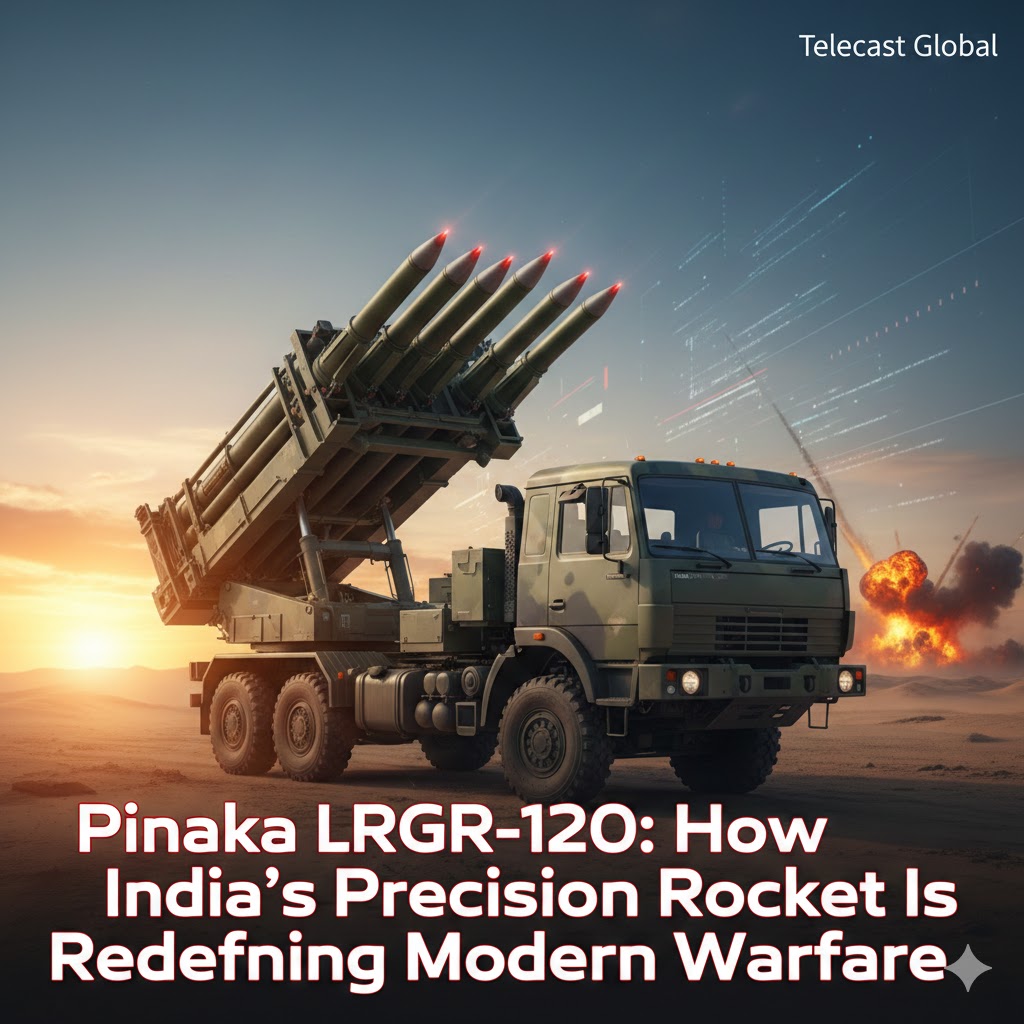
India’s successful test of the Pinaka Long Range Guided Rocket (LRGR-120) marks a major leap in its conventional strike capabilities. Conducted by Defence Research and Development Organisation at the Integrated Test Range in Odisha, the trial demonstrated high accuracy, extended reach, and battlefield readiness. With a strike range of 120 km and satellite-aided precision guidance, the LRGR-120 strengthens India’s ability to neutralise deep enemy targets without crossing borders. At a time of heightened tensions along the LoC and LAC, this development fits squarely into India’s push for self-reliance, rapid response warfare, and credible deterrence in a volatile regional security environment. – Telecast Global
What Is the Pinaka LRGR-120 and How It Upgrades India’s Existing Rocket Artillery?
The Pinaka LRGR-120 (Long Range Guided Rocket) is the most advanced version of India’s indigenous Pinaka rocket artillery system and a major leap in modern battlefield firepower. Developed by the Defence Research and Development Organisation, the Pinaka LRGR-120 transforms India’s traditional area-saturation rocket system into a precision-strike weapon capable of hitting targets up to 120 kilometres away with high accuracy.
Unlike earlier Pinaka variants, the Pinaka LRGR-120 is a guided rocket, equipped with an advanced navigation system that combines Inertial Navigation System (INS) with satellite-based updates. This guidance allows the Pinaka LRGR-120 to make mid-course and terminal corrections, significantly reducing Circular Error Probability and ensuring accurate strikes against high-value enemy targets.
What makes the Pinaka LRGR-120 especially impactful is that it upgrades India’s existing rocket artillery without requiring new launch platforms. The rocket can be fired from current in-service Pinaka launchers, enabling the Indian Army to operate rockets of 40 km, 75 km, and 120 km range from the same system. This flexibility enhances operational readiness while keeping logistics and training costs low.
In contrast to unguided rockets that rely on volume fire, the Pinaka LRGR-120 allows the Indian Army to conduct precision warfare, targeting command centres, logistics bases, and strategic infrastructure deep inside enemy territory—while remaining within Indian borders. This capability is particularly relevant in modern conflict scenarios where escalation control and accuracy matter as much as firepower.
The successful testing of the Pinaka LRGR-120 at the Integrated Test Range in Odisha confirmed its accuracy, range, and battlefield reliability, firmly establishing it as a cornerstone of India’s evolving rocket artillery doctrine
From Kargil to Precision Warfare: The Evolution of the Pinaka Rocket System
The story of the Pinaka rocket system is basically the story of how India learned, adapted, and leveled up its battlefield thinking—without copying anyone blindly. From the brutal lessons of the 1999 Kargil War to today’s precision-driven combat doctrine, Pinaka has evolved from a raw firepower tool into a sophisticated force multiplier.
Back in the late 1980s, India realised a hard truth: it could not indefinitely depend on imported artillery systems like the Russian Grad (BM-21). Terrain diversity, supply constraints, and the need for rapid deployment demanded a homegrown multi-barrel rocket launcher tailored for Indian conditions. This is where the Pinaka programme was born under the leadership of the Defence Research and Development Organisation.
Kargil: Pinaka’s Baptism by Fire
Pinaka entered public consciousness during the Kargil War (1999)—and not quietly. In high-altitude terrain where conventional artillery struggled, Pinaka batteries unleashed intense, rapid salvos on enemy positions dug into mountain ridges. The system’s ability to fire 12 rockets in under a minute made it ideal for neutralising entrenched targets across wide areas.
The takeaway from Kargil was simple but powerful: massive firepower delivered quickly can change battlefield momentum. Pinaka proved its reliability, mobility, and psychological impact. But it also exposed limitations—most notably, lack of precision and dependence on volume rather than accuracy.
Post-Kargil Reforms and Doctrinal Shift
After 1999, India’s military planning began shifting from attrition-based warfare to technology-enabled, limited-conflict scenarios. This was especially relevant under the nuclear overhang in South Asia, where escalation control matters as much as firepower.
Pinaka Mk-I (38–40 km range) and later Mk-II (up to 75–90 km) were steps in this evolution. Range increased, reliability improved, and integration with modern fire-control systems began. Yet, these were still largely area weapons—effective, but blunt.
By the mid-2010s, global conflicts made one thing clear: precision wasn’t optional anymore. It was decisive.
The Precision Turn: Guided Pinaka and LRGR-120
This is where the latest evolution—guided Pinaka variants and the LRGR-120—changes the game. With INS and satellite guidance, Pinaka is no longer just about saturating grid squares. It’s about hitting specific targets: command posts, logistics hubs, radar installations, and staging areas deep inside enemy territory.
The recently tested LRGR-120, with its 120 km strike range, marks the culmination of this transition. It allows the Indian Army to strike deep without crossing borders, aligning perfectly with India’s post-2016 emphasis on calibrated, non-escalatory responses .
From Platform to Ecosystem
Another quiet but critical evolution is structural. Pinaka today is not a standalone launcher—it’s a networked artillery ecosystem. Automated fire-control systems, command vehicles, loader-cum-replenishment vehicles, and multiple rocket types make it adaptable to varied missions.
This aligns directly with India’s Integrated Battle Groups (IBG) concept, where speed, coordination, and precision define success.
Why This Evolution Matters
From Kargil’s brute-force necessity to today’s precision warfare reality, Pinaka’s journey mirrors India’s strategic maturity. It shows a military that respects battlefield tradition but isn’t stuck in it—upgrading systems, doctrines, and thinking without losing operational pragmatism.
Same DNA. Smarter execution. That’s how legacy weapons stay relevant in modern wars.
Why the 120 km Guided Rocket Matters Amid LoC and LAC Security Challenges
The successful induction of the Pinaka LRGR-120 isn’t just a tech headline—it’s a strategic response to India’s most persistent security headaches: the Line of Control (LoC) with Pakistan and the Line of Actual Control (LAC) with China. These aren’t conventional borders; they’re volatile, heavily militarised fault lines where escalation control matters as much as raw firepower. The 120 km guided rocket fits that reality almost too perfectly.
First, range changes behaviour. A 120 km strike envelope allows the Indian Army to hold deep enemy assets at risk without crossing the border. That’s huge. Along the LoC, it means logistics hubs, artillery concentrations, and command nodes can be targeted while staying firmly on Indian soil—reducing political risk while increasing military pressure. Along the LAC, where terrain, altitude, and weather already complicate operations, long-range precision fire offsets mobility constraints and minimizes exposure of troops.
Second, precision equals restraint. Modern conflicts—especially under nuclear overhang—reward states that can respond hard but measured. The LRGR-120’s INS plus satellite guidance drastically lowers Circular Error Probability, which means fewer rockets for the same effect and far less collateral damage. This matters on the LoC, where civilian areas sit uncomfortably close to military targets, and on the LAC, where infrastructure is sparse but strategically vital. Precision lets India hit what matters—no more, no less.
Third, standoff capability strengthens deterrence. Deterrence today isn’t about the biggest bang; it’s about credible, usable options. The LRGR-120 gives commanders a rung on the escalation ladder between conventional artillery and strategic missiles. It complicates adversary planning by forcing dispersal, camouflage, and constant movement—raising their costs before a shot is even fired. That’s deterrence doing its job.
Fourth, terrain reality. The LAC is high-altitude, logistics-heavy, and unforgiving. Moving heavy artillery forward is slow and risky. A longer-range rocket fired from depth reduces dependence on forward deployments while maintaining fire dominance. On the western front, the LoC’s broken terrain and forested pockets favor quick, accurate strikes over prolonged barrages. The LRGR-120 adapts to both theaters without changing platforms—same launchers, smarter munitions.
Fifth, doctrine alignment. Since 2016, India’s military thinking has leaned toward calibrated responses—swift, precise, and limited in scope. The LRGR-120 slots neatly into this doctrine. It complements Integrated Battle Groups, shortens kill chains, and integrates cleanly with automated fire-control systems. In other words, it’s not a one-off weapon; it’s part of a system-of-systems approach being built by the Defence Research and Development Organisation and the Army together.
Finally, signaling matters. Every successful test sends a message—to adversaries, allies, and domestic industry. It signals readiness without provocation, capability without theatrics. In tense, crowded theaters like the LoC and LAC, that balance is rare—and valuable.
Bottom line: the 120 km guided rocket matters because it expands options while narrowing risks. In today’s border realities, that’s the difference between reacting and controlling the fight.
Pinaka and Atmanirbhar Bharat: India’s Defence Manufacturing Breakthrough
Pinaka and Atmanirbhar Bharat: India’s Defence Manufacturing Breakthrough
The Pinaka rocket system is more than a battlefield asset—it is one of the clearest proof points that Atmanirbhar Bharat in defence is no longer a slogan, but an operating reality. From design tables to firing ranges, Pinaka represents how India has learned to build, test, scale, and export complex weapon systems largely on its own terms.
At the centre of this effort is the Defence Research and Development Organisation, which led the Pinaka programme not as a one-off project, but as a long-term capability pipeline. Instead of importing a finished system, India chose the harder route: indigenous design, iterative testing, and continuous upgrades. The recent successful test of the 120 km Long Range Guided Rocket (LRGR-120) is the payoff of that approach .
What makes Pinaka especially significant is how much of it is Indian, not just on paper but in practice. Core subsystems—rocket motors, warheads, guidance packages, fire-control software, and launcher integration—have all been developed within India’s defence R&D ecosystem. Institutions like ARDE, HEMRL, RCI, and DRDL worked in parallel, creating depth rather than dependency. This distributed innovation model is exactly what defence self-reliance demands.
Equally important is the role of Indian industry. Unlike earlier eras where public sector units dominated everything, Pinaka has brought private players into serious defence manufacturing. Companies such as Economic Explosives Limited (EEL) have contributed to pre-production and scaling, proving that Indian firms can meet military-grade quality, reliability, and timelines. This matters because wars aren’t fought with prototypes—they’re fought with mass-produced, maintainable systems.
The manufacturing impact goes beyond a single rocket system. Pinaka has helped build supply chains, skilled manpower, testing infrastructure, and quality assurance frameworks that spill over into other defence programmes. Once a country learns how to manufacture precision-guided rockets, it gains confidence—and competence—to do more. That’s how defence ecosystems mature.
There’s also a strategic resilience angle. Indigenous production means supply security during crises. Sanctions, export controls, or geopolitical pressure lose much of their bite when spares, upgrades, and ammunition are produced domestically. In a prolonged standoff scenario—whether on the LoC or the LAC—that reliability is as important as range or accuracy.
From a cost perspective, Pinaka is a quiet disruptor. Compared to imported missile systems, guided rockets offer a favourable cost-to-effect ratio. They are cheaper per unit, easier to stockpile, and flexible across missions. For a country managing both continental threats and budget constraints, that balance is crucial.
Finally, Pinaka has turned India from a buyer into a seller. Its export to Armenia and interest from multiple regions show that indigenously built systems can compete globally on performance and price. Defence exports are not just about revenue; they are about strategic partnerships and long-term influence. Pinaka strengthens both.
In short, Pinaka embodies what defence self-reliance should look like: credible technology, scalable manufacturing, operational relevance, and export potential. It proves that India doesn’t need to choose between capability and autonomy anymore—it can build both, together.
Exports, Diplomacy, and Deterrence: How Pinaka Is Boosting India’s Global Defence Profile
Exports, Diplomacy, and Deterrence: How Pinaka Is Boosting India’s Global Defence Profile
Pinaka’s rise from a domestic artillery system to an export-ready weapon is quietly reshaping India’s position in the global defence ecosystem. This isn’t just about selling rockets; it’s about how capability, credibility, and consistency combine to create strategic influence. The recent success of the 120 km LRGR-120 test strengthens that narrative by proving that India can design, produce, and upgrade complex strike systems end-to-end .
Start with exports—the most visible signal. India’s delivery of Pinaka systems to Armenia marked a turning point. For decades, Indian defence exports were modest and often peripheral. Pinaka changed that by offering a combat-proven, cost-effective, and scalable solution at a time when many countries are rethinking supply chains and reducing dependence on traditional suppliers. The appeal is simple: reliable performance without political strings.
That last bit matters. Defence exports are diplomacy by other means. When a country buys Pinaka, it isn’t just purchasing hardware—it’s entering a long-term relationship involving training, spares, upgrades, and doctrine alignment. This creates durable partnerships, especially with mid-sized militaries that need credible firepower but don’t want to be locked into great-power rivalries. Pinaka fits neatly into that niche.
Deterrence is the next layer. Exporting advanced artillery sends a message—not of aggression, but of maturity. It tells the world that India’s defence industry has crossed a threshold: from licensed production to original, competitive design. The LRGR-120’s precision guidance, extended range, and compatibility with existing launchers demonstrate an understanding of modern warfare that global buyers respect. Deterrence isn’t only about what you deploy at home; it’s also about how others perceive your technological ceiling.
There’s also a standards effect. As more countries operate Pinaka, India gains soft power in shaping operational norms, maintenance practices, and future upgrades. Over time, this builds interoperability and influence—exactly how established arms exporters consolidate their footprint. It’s slow, unglamorous work, but it’s how defence diplomacy actually functions.
Crucially, Pinaka’s export success reinforces domestic confidence. Programmes led by the Defence Research and Development Organisation now carry proof that indigenous systems can compete internationally, not just satisfy domestic requirements. That confidence feeds back into R&D, encouraging bolder designs—longer ranges, better guidance, smarter integration. The rumoured work on even higher-range variants sits within this virtuous cycle.
Cost credibility is another underrated factor. Many countries want precision fires but can’t afford expensive missile inventories. Pinaka offers a middle path: high-impact capability at manageable cost. In an era of stretched defence budgets and frequent conflicts, that value proposition travels well.
Finally, optics matter. Each successful test, each export delivery, quietly reshapes how India is seen—from a large arms importer to a reliable security partner. That shift supports India’s broader strategic goals: deeper ties in West Asia, Africa, Eastern Europe, and Southeast Asia; diversified partnerships; and a stronger voice in global security conversations.
Bottom line: Pinaka is doing three jobs at once. It strengthens India’s deterrence at home, builds diplomatic leverage abroad, and signals that Indian defence manufacturing has arrived on the global stage—not loudly, but convincingly.
About The Author












Leave a Reply