Electronic Skin Technology: Robots That Feel Pain in 2025
Table of Contents
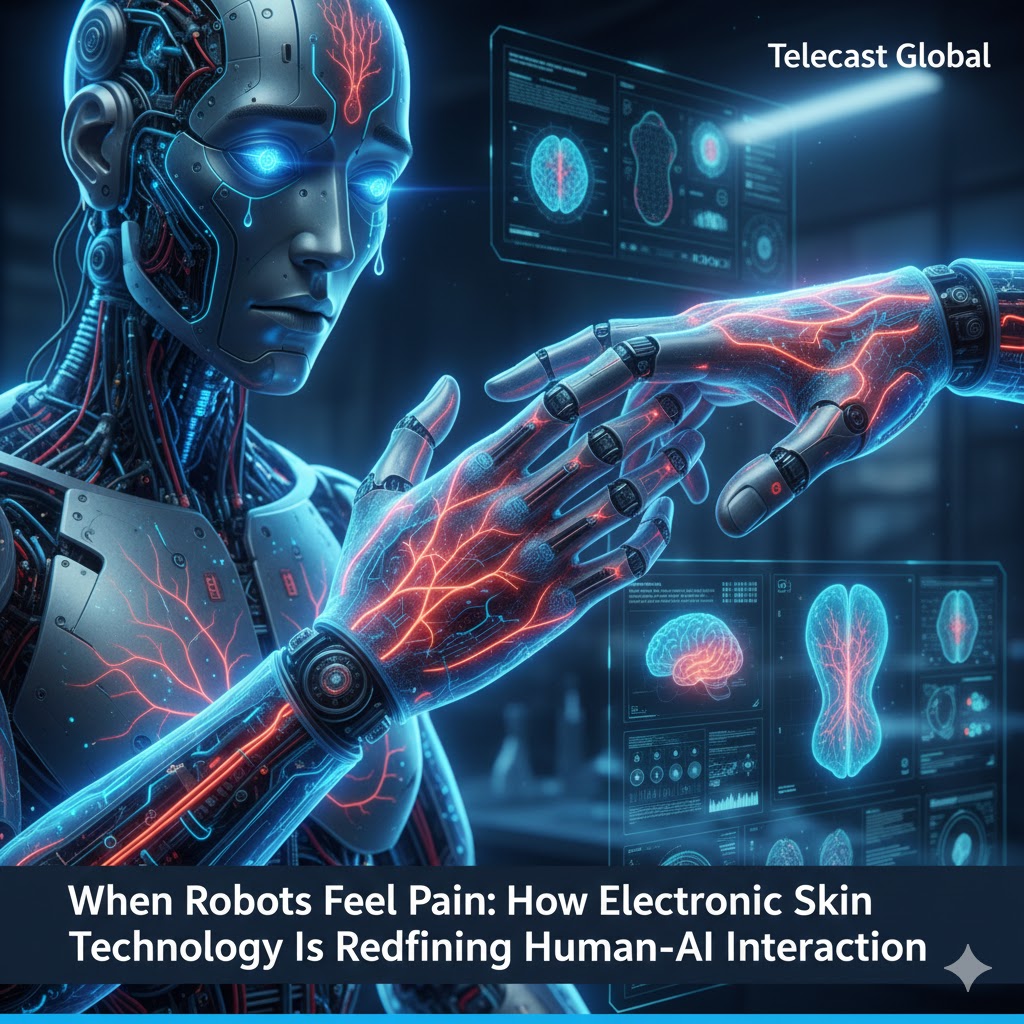
Electronic Skin Technology is no longer science fiction—it’s rapidly becoming a cornerstone of next-generation robotics. In a major breakthrough, Chinese researchers have developed a neuro-inspired electronic skin that allows robots to sense touch, pressure, and even pain, triggering reflex-like responses similar to humans. As 2025 accelerates the adoption of AI-powered service robots in healthcare, elder care, manufacturing, and hazardous environments, this innovation directly addresses safety and trust concerns. By mimicking the human nervous system, this technology marks a decisive shift from rigid automation to responsive, human-aware machines built for real-world interaction.
Electronic Skin Technology and the Rise of Neuro-Inspired Robotics in 2025
Electronic Skin Technology is fast becoming the backbone of neuro-inspired robotics in 2025, marking a clear shift from rule-based machines to systems that behave more like living organisms. For decades, robots followed commands blindly—efficient, yes, but dangerously unaware of their surroundings. That old-school rigidity simply doesn’t cut it anymore in a world where robots are stepping out of factories and into homes, hospitals, and public spaces. The demand today is simple and unforgiving: robots must sense, judge, and react in real time.
This is where Electronic Skin Technology enters the picture like a seasoned veteran, not a flashy rookie. Inspired by the human nervous system, this technology converts physical stimuli—pressure, heat, sharp contact—into electrical signals, much like our skin sends signals to the brain. But the real leap in 2025 is not sensing alone; it’s reflexive intelligence. Instead of routing every signal to a central processor, advanced electronic skin allows robots to make split-second decisions locally. Touch something dangerously hot? Pull back immediately. No cloud call. No delay. Just instinct.
Neuro-inspired robotics thrives on this principle. Engineers are deliberately moving away from centralized AI-only decision-making and embracing distributed intelligence models. Why? Because biology figured this out millions of years ago. Humans don’t wait for conscious thought to withdraw a hand from fire. Similarly, robots equipped with Electronic Skin Technology now execute reflex actions without burdening their main AI core. In 2025, this architecture is becoming a design standard rather than an experimental feature.
Industry trends back this shift strongly. With global labor shortages, aging populations, and rising workplace safety regulations, robots are expected to work with humans, not behind safety cages. Electronic Skin Technology enables that coexistence. A robot that can feel excessive force won’t crush fragile objects—or worse, human fingers. That’s not just innovation; that’s liability control, and industries understand this painfully well.
Another reason neuro-inspired robotics is booming in 2025 is energy efficiency. Constant data transmission to central processors drains power and slows reaction time. Localized sensory processing—enabled by electronic skin—reduces computational load and increases operational lifespan. In plain terms: smarter reactions, lower costs. CFOs love it as much as engineers do.
There’s also a philosophical shift underway. Robotics in 2025 is no longer obsessed with raw strength or speed. Sensitivity, adaptability, and situational awareness are the new gold standards. Electronic Skin Technology aligns perfectly with this mindset. It doesn’t make robots “emotional,” despite the hype—but it makes them context-aware, which is far more valuable.
Let’s be honest: robots that can’t feel damage won’t survive in unpredictable environments. Whether it’s elder-care assistance, collaborative manufacturing, or disaster-response robotics, pain perception isn’t a luxury—it’s a survival mechanism. Neuro-inspired robotics, powered by Electronic Skin Technology, represents a return to fundamentals: learn from nature, respect limits, and react fast. In 2025, this isn’t the future anymore. This is the baseline.
Pain-Sensing Robots: Why Reflex-Based AI Matters for Human Safety
Pain-sensing robots are no longer a novelty experiment—they are a direct response to a hard truth the robotics industry learned the slow way: intelligence without reflex is dangerous. In 2025, as robots increasingly work side-by-side with humans, reflex-based AI powered by Electronic Skin Technology has become essential for human safety, not optional innovation.
Traditional robots operate on a command–process–act loop. That system works fine inside fenced factory cages, but it breaks down in real-world human environments. A delayed response of even a few milliseconds can mean crushed fingers, burns, or serious injury. Reflex-based AI solves this problem by bypassing overthinking. Just like the human nervous system, it enables immediate action before conscious processing kicks in.
Electronic Skin Technology plays the central role here. By embedding pressure, temperature, and damage sensors directly into a robot’s surface, the robot doesn’t just detect contact—it understands its severity. Light pressure? Continue task. Sudden sharp force or heat spike? Immediate withdrawal. This distinction is the difference between safe collaboration and lawsuits waiting to happen.
In 2025, safety regulators across manufacturing, healthcare, and logistics are tightening standards for human–robot interaction. Robots must now demonstrate not only functional accuracy but harm avoidance behavior. Reflex-based AI backed by Electronic Skin Technology provides exactly that. It allows robots to limit force automatically, reduce grip strength, and stop motion instantly when unsafe thresholds are crossed—without waiting for central AI approval.
Healthcare is where this matters most. Service robots assisting elderly patients, lifting individuals, or helping with mobility must handle fragile human bodies. A rigid robot arm with no pain awareness is a risk, plain and simple. Pain-sensing robots equipped with Electronic Skin Technology can detect excessive pressure on skin or joints and adjust in real time. That capability transforms robots from mechanical helpers into trusted assistants.
Industrial environments tell a similar story. In collaborative manufacturing, humans and robots share workspaces. Accidental contact is inevitable. Reflex-based AI ensures the robot reacts faster than human reaction time, reducing injury severity. This is why leading manufacturers in 2025 are shifting budgets from pure vision-based AI to tactile intelligence systems using Electronic Skin Technology. Cameras can see danger—but skin can feel it.
There’s also a psychological angle people underestimate. Humans instinctively trust machines that respond naturally to harm. When a robot pulls back after hitting something sharp, workers perceive it as aware and safer. That trust increases adoption, improves productivity, and lowers resistance to automation. Electronic Skin Technology indirectly solves a social acceptance problem the industry struggled with for years.
From a technical standpoint, reflex-based AI reduces system overload. Constantly routing sensory data to a central processor increases latency and failure risk. Local reflex loops—enabled by Electronic Skin Technology—keep reactions fast even if higher-level AI systems lag or fail. In safety-critical scenarios, redundancy saves lives.
Let’s be blunt: a robot that can’t sense pain will eventually cause it. In 2025, pain-sensing robots represent a maturity milestone for AI and robotics. Reflex-based intelligence isn’t about making robots “feel”—it’s about making them responsible. And responsibility, in a human world, starts with safety.
From Labs to Hospitals: Electronic Skin Technology in Healthcare and Elder Care
Electronic Skin Technology has quietly crossed a critical threshold in 2025: it’s moved from controlled lab demos into real hospital corridors and elder-care facilities. And frankly, it couldn’t have arrived at a better time. Aging populations, overworked medical staff, and rising care costs have pushed healthcare systems to the brink. Robots are stepping in—but only because they’re finally learning the oldest rule in caregiving: be gentle.
In hospitals, robots now assist with patient mobility, medication delivery, vitals monitoring, and rehabilitation support. But here’s the catch—human bodies are fragile, unpredictable, and emotionally sensitive. A robot that applies the wrong pressure, even unintentionally, can cause injury. This is exactly where Electronic Skin Technology changes the game. By giving robots tactile awareness—pressure, temperature, and force thresholds—they can adjust grip strength and movement in real time. Not after damage happens. Before it happens.
Elder care is even more unforgiving. In 2025, millions of seniors live alone or in assisted facilities with limited staff. Robots help with daily tasks like standing up, walking support, or transferring from bed to wheelchair. Without Electronic Skin Technology, these tasks are accidents waiting to happen. With it, robots can sense resistance, discomfort, or sudden imbalance and immediately compensate. That reflex-based response isn’t fancy AI—it’s basic caregiving instinct, finally engineered into machines.
What makes Electronic Skin Technology especially valuable in healthcare is localized decision-making. Hospitals are noisy, chaotic environments. Network delays, software updates, or cloud interruptions are realities, not edge cases. A robot relying solely on centralized AI is a liability. Electronic skin allows immediate reflex responses at the hardware level—pull back, reduce force, stop movement—without waiting for system-wide confirmation. In medical settings, milliseconds matter.
There’s also a hygiene and durability advantage that doesn’t get enough attention. Modern electronic skin systems are modular and replaceable. If a section is damaged or contaminated, it can be swapped out quickly without taking the entire robot offline. For hospitals obsessed with uptime and sanitation, this is gold. Electronic Skin Technology isn’t just smart—it’s practical, which is why administrators are approving budgets for it in 2025.
Emotionally, patients respond better to robots that behave naturally. When a robot “reacts” to excessive force or withdraws after accidental contact, patients instinctively feel safer. Trust improves compliance, cooperation, and overall care outcomes. Electronic Skin Technology doesn’t make robots compassionate—but it makes them non-threatening, which is half the battle in healthcare adoption.
From an industry standpoint, governments and insurers are now paying attention. Safety certifications for medical robots increasingly demand tactile intelligence and harm-avoidance mechanisms. In plain language: robots without Electronic Skin Technology will struggle to get approvals. The market is drawing a line, and it’s not subtle.
Let’s not romanticize this. Robots won’t replace nurses or caregivers. But in 2025, they are becoming reliable assistants—and reliability begins with safety. Electronic Skin Technology is the reason robots can finally touch patients without fear.
From research labs to hospital wards, this technology has earned its place the hard way—by respecting the human body.
Smart Manufacturing and Hazard Zones: Industrial Impact of Pain-Responsive Robots
In 2025, smart manufacturing isn’t about faster robots—it’s about safer ones. Factories have learned the hard way that speed without awareness is expensive, dangerous, and politically indefensible. This is where Electronic Skin Technology has become a serious industrial upgrade, not a buzzword. Pain-responsive robots are redefining how machines operate in factories, mines, chemical plants, and other high-risk environments where mistakes cost fingers, lives, and lawsuits.
Traditional industrial robots were built like tanks—strong, repetitive, and oblivious. They worked behind cages for a reason. But modern manufacturing demands collaboration. Humans and robots now share the same workspace, assembling delicate components, handling irregular materials, and adapting on the fly. Without Electronic Skin Technology, that setup is a safety nightmare. With it, robots can instantly detect abnormal force, sharp contact, or heat exposure and react before damage escalates.
Pain-responsive behavior changes everything. A robot equipped with Electronic Skin Technology doesn’t just “stop” when something goes wrong—it adjusts intelligently. Grip pressure reduces when resistance increases. Arms retract when unexpected contact occurs. Motion slows automatically in risky zones. These reflexes happen locally, without waiting for central AI decisions. In industrial safety, that difference is the gap between a near-miss and a fatal incident.
Hazard zones are where this technology truly earns its paycheck. In mining, chemical handling, nuclear maintenance, and high-temperature manufacturing, robots face environments that degrade materials fast. Electronic Skin Technology allows robots to sense structural damage to themselves—cuts, tears, overheating—and withdraw before catastrophic failure. A robot that feels “pain” survives longer, protects surrounding workers, and reduces costly downtime.
From a business perspective, pain-responsive robots are a compliance dream. Workplace safety regulations in 2025 are stricter, and enforcement is less forgiving. Companies deploying robots with Electronic Skin Technology can demonstrate proactive harm-prevention measures. Insurance premiums drop. Legal exposure shrinks. Productivity stays high without turning factories into obstacle courses of safety barriers.
There’s also a quality-control advantage people overlook. In precision manufacturing—electronics, automotive interiors, aerospace components—too much force ruins products. Electronic Skin Technology enables robots to sense micro-level pressure changes, ensuring consistent handling without crushing or deforming materials. Less waste, fewer defects, and better margins. That’s not innovation poetry—that’s operational math.
Another underrated benefit is worker psychology. Humans trust machines that behave predictably and safely. When a robot reacts instantly to accidental contact, workers stop seeing it as a threat and start treating it like a tool. That trust accelerates adoption of automation instead of resistance, strikes, or sabotage. In 2025, labor acceptance matters as much as technical capability.
Let’s be blunt: smart manufacturing doesn’t tolerate dumb machines anymore. Pain-responsive robots powered by Electronic Skin Technology represent a return to industrial common sense—learn from feedback, protect assets, and avoid unnecessary harm.
In hazardous environments, survival depends on reflex. In factories, success depends on safety. Electronic Skin Technology delivers both—and that’s why it’s becoming the new industrial baseline.
Human-Robot Trust in the AI Era: How Electronic Skin Technology Changes Interaction
In the AI era, trust is the real currency—and robots have historically been terrible at earning it. People don’t fear intelligence; they fear unpredictable force. That’s why Electronic Skin Technology is quietly transforming human–robot interaction in 2025. It gives robots something they always lacked: behavior that feels reasonable. When machines respond to contact the way humans expect, trust follows naturally.
For years, robotics focused on vision, speech, and decision-making. Useful, yes—but incomplete. Humans judge safety through touch and reaction. A robot that doesn’t flinch when it bumps into you feels wrong at a gut level. Electronic Skin Technology fixes that mismatch. When a robot recoils from sharp pressure, reduces grip when resistance increases, or pauses when heat spikes, people instinctively read those signals as awareness. Not emotion—awareness. And awareness is the foundation of trust.
In 2025, robots are no longer hidden behind barriers. They assist shoppers, help patients, work alongside technicians, and support elders at home. In these spaces, trust isn’t built through instruction manuals; it’s built through micro-interactions. Electronic Skin Technology enables thousands of small, correct responses every day—each one reinforcing the idea that the robot understands boundaries. Over time, that consistency reshapes human perception from “dangerous machine” to “reliable assistant.”
There’s a practical side to this psychology. Workers cooperate more willingly with robots that demonstrate harm avoidance. Patients comply better with robotic assistance when movements feel cautious and adaptive. Elderly users, especially, are more comfortable when robots respond gently to unexpected contact. Electronic Skin Technology doesn’t just improve safety—it improves acceptance, which directly affects adoption rates.
From an AI design standpoint, this marks a philosophical correction. The industry is realizing that intelligence without sensory humility creates social friction. Electronic Skin Technology introduces limits—pressure thresholds, pain signals, reflexive withdrawal—that tell humans the robot won’t push past safe boundaries. That restraint is reassuring. In fact, many users report greater trust in robots that occasionally stop or pull back than in ones that move flawlessly but rigidly.
Another critical factor is transparency of behavior. When a robot reacts immediately to excessive force, people understand why it moved. No black-box mystery. Electronic Skin Technology creates visible cause-and-effect interactions that humans intuitively grasp. That clarity matters in an age where AI skepticism is growing and public tolerance for opaque systems is shrinking.
Regulators and policymakers are also watching closely. Trust is now considered a safety metric. Robots designed for public or personal spaces increasingly require tactile intelligence to meet approval standards. In other words, Electronic Skin Technology is becoming a prerequisite for social permission, not just technical performance.
Let’s be honest: humans don’t need robots to feel emotions—but we absolutely need them to respect pain. Electronic Skin Technology bridges that gap. It doesn’t humanize robots in a sentimental way; it civilizes them.
In the AI era, trust isn’t programmed through words or faces. It’s earned through touch, reaction, and restraint. And that’s exactly where Electronic Skin Technology changes everything.
About The Author