

Table of Contents
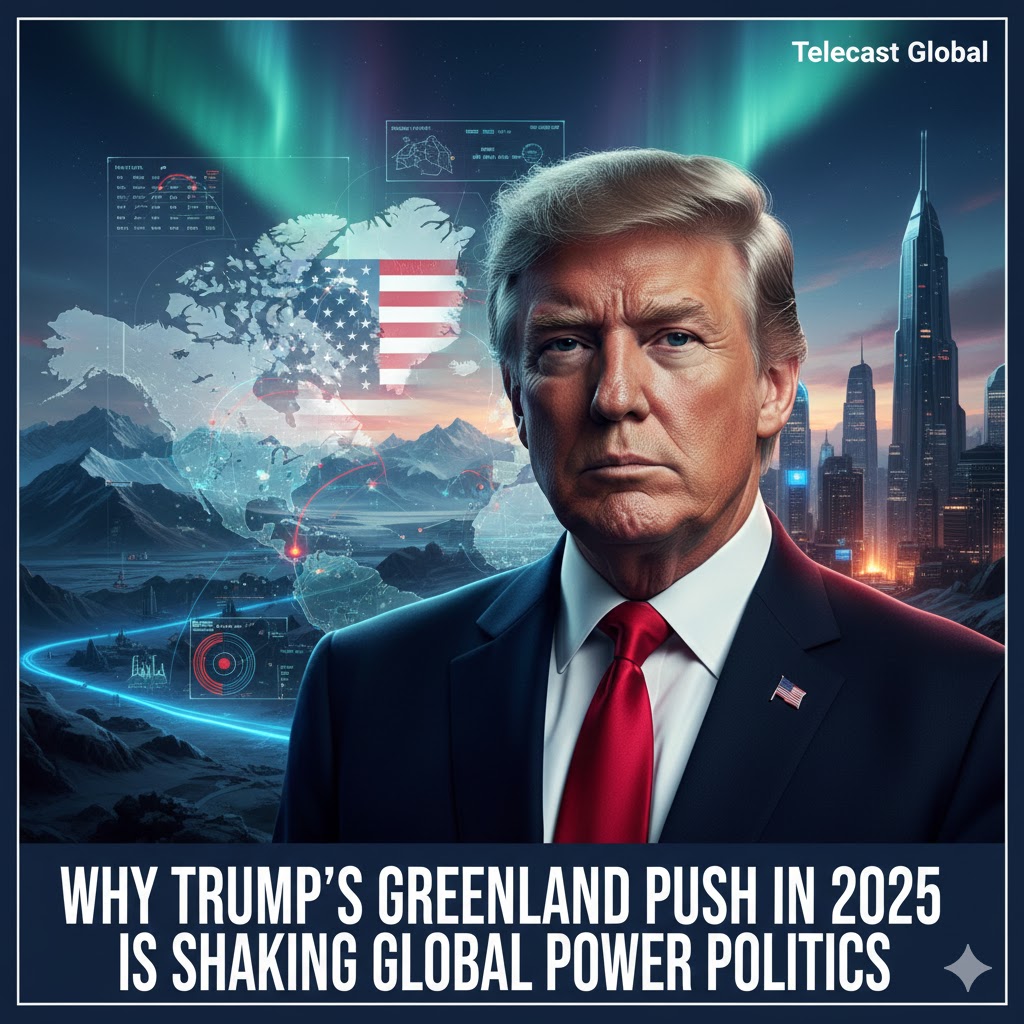
In 2025, global geopolitics has entered a blunt, no-nonsense phase—and the Trump Greenland Claim 2025 captures that reality perfectly. As Washington escalates military intervention in Venezuela, President Donald Trump’s renewed insistence on acquiring Greenland has alarmed Europe, rattled NATO allies, and reignited debates over sovereignty, Arctic dominance, and resource security. Denmark’s sharp response and Greenland’s firm rejection underline a growing global pushback against unilateral power plays. With climate change opening Arctic routes and rare-earth minerals becoming strategic assets, Greenland is no longer just ice and geography—it’s a chessboard square in a rapidly hardening world order.
Trump Greenland Claim 2025 and the Return of Territorial Power Politics
The Trump Greenland Claim 2025 is not an isolated headline—it’s a loud signal that old-school territorial power politics are back in fashion. For a brief post–Cold War moment, the world pretended borders were settled, sovereignty was sacred, and economic interdependence would tame geopolitical ambition. That illusion is now officially over. Trump’s renewed push to bring Greenland under U.S. control shows how geography, resources, and raw power are once again driving global strategy.
At its core, the Trump Greenland Claim 2025 reflects a worldview where territory equals security. Greenland’s Arctic location places it at the crossroads of North America, Europe, and emerging polar shipping routes. As melting ice opens new sea lanes and exposes untapped reserves of rare earth minerals, Greenland has transformed from a frozen afterthought into a strategic prize. Trump’s blunt assertion that the U.S. “absolutely” needs Greenland for national security revives a logic straight out of the 19th and early 20th centuries—control the land, control the future .
What makes the Trump Greenland Claim 2025 especially significant is its timing. Just days after Washington’s military intervention in Venezuela and the arrest of President Nicolás Maduro, European capitals began drawing uncomfortable parallels. The message was unmistakable: if the U.S. is willing to use force in Latin America, verbal pressure on a Danish autonomous territory no longer feels theoretical. Power politics today isn’t about formal annexation paperwork—it’s about pressure, signaling, and making weaker actors constantly calculate risk.
This shift marks a clear break from the diplomatic language that dominated the 1990s and 2000s. Back then, territorial expansion was considered taboo among major powers—something associated with failed states or rogue regimes. Now, under the Trump Greenland Claim 2025, territorial ambition is being repackaged as “national security necessity.” It’s a familiar trick from history: when norms become inconvenient, redefine them.
Denmark’s sharp rebuttal—calling the idea of U.S. control over Greenland “absurd”—shows how destabilizing this mindset is for alliances. NATO was built on mutual defense, not mutual intimidation. Yet the Trump Greenland Claim 2025 places allies in an awkward position: publicly aligned, privately anxious. Greenland’s own leadership has been equally firm, emphasizing that the island is not for sale and that its future will not be decided by foreign strongmen or social media theatrics .
Zoom out, and the pattern becomes clearer. From Russia’s actions in Ukraine, to China’s posture in the South China Sea, to America’s renewed interest in Greenland, territorial power politics are no longer an exception—they’re the trend. The Trump Greenland Claim 2025 fits neatly into this global regression, where strength is measured less by rules followed and more by lines pushed.
History never really disappears; it waits. And in 2025, it’s back with a map, a compass, and very little patience for diplomatic niceties.
Arctic Security, NATO Allies, and Denmark’s Strategic Dilemma
The Trump Greenland Claim 2025 has pushed Denmark into one of the most uncomfortable strategic positions any U.S. ally has faced in recent years. On paper, Denmark and the United States are close NATO partners, bound by shared security commitments and decades of cooperation. In reality, Trump’s aggressive rhetoric on Greenland has exposed the fragile limits of alliance politics when raw national interest takes center stage.
At the heart of Denmark’s dilemma is Arctic security. Greenland sits at a critical military crossroads linking North America and Europe, hosting key radar installations and acting as an early-warning shield in the Arctic. As global warming accelerates ice melt, the Arctic is no longer a frozen buffer—it is a contested strategic theater. The Trump Greenland Claim 2025 reframes this reality in blunt terms: whoever controls Greenland controls Arctic access, surveillance, and future military logistics.
For Denmark, rejecting the Trump Greenland Claim 2025 is not just about sovereignty—it’s about precedent. If a NATO superpower can openly pressure an ally over territory under the banner of “national security,” the alliance’s moral foundation weakens. Danish Prime Minister Mette Frederiksen’s unusually sharp response, calling the idea “absurd” and urging Washington to stop threatening a historical ally, reflects more than diplomatic irritation. It reflects fear that NATO norms are being quietly rewritten .
Greenland’s autonomous status complicates matters further. While it remains part of the Kingdom of Denmark, Greenland governs its internal affairs and has been steadily asserting its political identity. Recent laws limiting foreign property ownership signal a clear message: Greenland is wary of becoming an economic or strategic pawn. The Trump Greenland Claim 2025, amplified by symbolic social media posts and offhand remarks, directly clashes with Greenland’s desire for dignity, agency, and long-term self-determination .
From NATO’s perspective, this tension is deeply uncomfortable. The alliance is already under strain—from Ukraine, from internal burden-sharing disputes, and from diverging threat perceptions. The Trump Greenland Claim 2025 adds another fracture line, forcing allies to quietly ask an unsettling question: what happens when the biggest guarantor of collective security becomes a source of strategic anxiety?
Denmark’s strategic response has been cautious but firm. Officials have emphasized increased Arctic defense investments and closer cooperation with the U.S., subtly countering Trump’s claim that Denmark is incapable of securing Greenland. This is classic alliance management—reassure the partner, defend the red line, avoid escalation. But the fact that such balancing is even necessary shows how destabilizing the Trump Greenland Claim 2025 really is.
In the end, Denmark’s predicament reflects a broader truth about 2025 geopolitics. Alliances still matter, but they are no longer shields against pressure from within. Arctic security has become too valuable, too strategic, and too resource-rich to remain insulated from power politics. And for NATO allies like Denmark, the challenge now is simple but brutal: defend sovereignty without provoking the very partner meant to protect it.
Rare Earth Minerals, Climate Change, and the New Arctic Gold Rush
If territory is the stage, resources are the prize—and the Trump Greenland Claim 2025 makes far more sense once rare earth minerals enter the picture. Beneath Greenland’s ice and rock lies a strategic jackpot: rare earth elements essential for electric vehicles, wind turbines, advanced weapons systems, semiconductors, and AI infrastructure. In 2025, control over these materials is no longer an economic advantage—it’s a national security imperative.
Climate change is the great accelerator here. As Arctic ice retreats, Greenland is becoming more accessible for mining, shipping, and infrastructure development. Routes once locked in ice for most of the year are now seasonally open, lowering extraction and transport costs. The Trump Greenland Claim 2025 aligns perfectly with this reality: the U.S. is looking ahead, not at today’s ice, but at tomorrow’s supply chains. Whoever gets in early shapes the rules, the partnerships, and the leverage.
What makes Greenland especially attractive is the global rare earth imbalance. China currently dominates rare earth processing, a fact that has made Western governments deeply uneasy. From Washington’s perspective, reducing dependence on Beijing is non-negotiable. The Trump Greenland Claim 2025 reframes Greenland as a solution—an alternative source located within the Western security ecosystem. This is not about owning land for prestige; it’s about securing inputs for the next industrial and military revolution.
Denmark and Greenland see the same minerals, but through a very different lens. For them, the “new Arctic gold rush” carries serious risks. Large-scale mining threatens fragile ecosystems, indigenous livelihoods, and long-term sustainability. Greenland’s recent move to restrict foreign property ownership is a clear signal that it does not want to become a resource colony dressed up as a strategic partner . The Trump Greenland Claim 2025, by contrast, treats these concerns as secondary to strategic urgency.
This clash reveals a deeper tension in 2025 geopolitics: climate change creates opportunity for powerful states, but vulnerability for smaller ones. Melting ice turns remote regions into bargaining chips. The Trump Greenland Claim 2025 sits squarely in this contradiction—using climate-driven access to justify geopolitical pressure, while sidestepping the environmental and social costs borne locally.
History offers an uncomfortable parallel. Gold rushes have never been polite affairs. They attract capital, power, and ambition—and they rarely benefit local populations in the long run. The Arctic version is no different, except the stakes are higher and the tools more sophisticated. Rare earths replace gold, climate change replaces railroads, and strategic necessity replaces manifest destiny.
Strip away the rhetoric, and the message of the Trump Greenland Claim 2025 is blunt: the Arctic is open for business, and the strongest players intend to shape it. Whether that future is cooperative or coercive will define not just Greenland’s fate, but the moral direction of global resource politics in the decades ahead.
Venezuela Intervention Fallout and Why Greenland Feels the Shockwaves
The Trump Greenland Claim 2025 cannot be separated from Washington’s dramatic military intervention in Venezuela. Power politics don’t operate in silos; they travel fast, cross borders, and reshape perceptions. When the United States moved decisively against Caracas—detaining President Nicolás Maduro and signaling indefinite control over Venezuelan governance and oil resources—it sent a global message: American power is back in its most unapologetic form. Greenland felt that message almost immediately.
From a European standpoint, the Venezuela operation changed the risk calculus overnight. Until then, the Trump Greenland Claim 2025 could be dismissed as rhetorical muscle-flexing—provocative, yes, but negotiable. Venezuela proved otherwise. If Washington was willing to deploy force in Latin America, the idea that pressure on a small Arctic territory might escalate no longer sounded far-fetched. Denmark’s alarm wasn’t ideological; it was practical .
This is how geopolitical shockwaves work. One intervention rewrites expectations everywhere else. Greenland’s leaders, watching events unfold thousands of miles away, saw a troubling pattern: regime change justified by “security,” resource control framed as “stability,” and sovereignty reduced to a talking point. The Trump Greenland Claim 2025 suddenly looked less like a debate and more like a warning.
Symbolism mattered too. Social media posts depicting Greenland draped in U.S. flag colors—posted just as Venezuela’s leadership was being flown to New York—were not subtle. In geopolitics, symbolism is never accidental. For Greenland, these gestures reinforced fears that strategic messaging had replaced diplomatic restraint. As Greenland’s prime minister bluntly stated, nations are governed by law and respect, not by memes or intimidation .
The Venezuela episode also exposed a deeper shift in American doctrine under Trump’s second term. Instead of multilateral consensus or prolonged negotiations, Washington is signaling preference for decisive action and post-facto justification. In that environment, the Trump Greenland Claim 2025 becomes part of a broader pattern: identify a strategic asset, assert necessity, apply pressure, and let others adjust.
For Denmark and NATO allies, the fallout is deeply unsettling. Alliances are built on predictability. Venezuela shattered that predictability. If intervention can happen quickly, with minimal international consultation, then verbal threats over Greenland carry heavier weight. The Trump Greenland Claim 2025 thus forces allies to prepare not just for diplomatic friction, but for scenarios once considered unthinkable among partners.
There’s also a credibility problem. When Washington frames Venezuela as a security threat due to drugs, instability, and resources, then uses similar language—“we absolutely need it”—for Greenland, the parallels become impossible to ignore. The Trump Greenland Claim 2025 borrows its logic directly from the Venezuela playbook: strategic interest overrides political sensitivity.
Ultimately, Greenland feels the shockwaves because power today is performative. Every action is watched, replayed, and recalculated elsewhere. Venezuela was not just a regional operation; it was a global signal flare. And in 2025’s tense geopolitical climate, Greenland heard it loud and clear.
International Law vs Strongman Diplomacy in a Fragmenting World Order
The Trump Greenland Claim 2025 sits squarely at the fault line between international law and the resurgence of strongman diplomacy. For decades, the global order rested—at least in theory—on clear principles: territorial integrity, self-determination, and respect for sovereignty. These norms were not perfect, but they provided guardrails. In 2025, those guardrails are bending, and sometimes breaking.
Under international law, Greenland’s status is unambiguous. It is an autonomous territory within the Kingdom of Denmark, with its own elected government and the right to shape its future. Any change in sovereignty would require consent—not pressure, not persuasion by force, and certainly not unilateral claims. Yet the Trump Greenland Claim 2025 challenges this framework by reframing legality as a secondary concern to “national security necessity.”
This is the essence of strongman diplomacy: when rules become inconvenient, power redefines legitimacy. Trump’s blunt language—“we absolutely need it”—is not accidental. It bypasses legal nuance and speaks directly to strength, urgency, and inevitability. The Trump Greenland Claim 2025 follows a familiar pattern seen globally: Russia in Ukraine, China in the South China Sea, and now the U.S. testing the limits of alliance-bound restraint. Different actors, same method.
What makes this moment especially destabilizing is who is doing it. When smaller or authoritarian states bend international law, the system absorbs the shock. When a leading architect of the post-war order does it, the entire structure weakens. The Trump Greenland Claim 2025 doesn’t just pressure Denmark and Greenland—it signals to the world that norms are optional if power is sufficient.
Greenland’s leadership has responded by invoking precisely what strongman politics dismisses: law, respect, and international rules. Their message has been consistent and calm—this is not a matter of intimidation or symbolism; it is a matter of rights . Denmark’s appeal to alliance values and legal boundaries reflects the same instinct: preserve the system before it erodes further.
Yet the uncomfortable truth is that international law has always relied on enforcement by powerful states. When those states choose selective obedience, law becomes fragile. The Trump Greenland Claim 2025 exposes this vulnerability. It asks a brutal question the world would rather avoid: what happens when power stops pretending to follow rules?
In a fragmenting world order, strongman diplomacy thrives on uncertainty. It tests reactions, probes resistance, and normalizes escalation. The Trump Greenland Claim 2025 may not end in annexation, but it has already achieved something significant—it has shifted the conversation from “can this be done?” to “how far can pressure go?”
History offers a sobering lesson. Orders don’t collapse overnight; they erode claim by claim, exception by exception. In 2025, the clash between international law and strongman diplomacy is no longer theoretical. It’s unfolding in real time—on maps, in alliances, and in places like Greenland that suddenly find themselves at the center of the world’s next big test.
About The Author








Leave a Reply