

Table of Contents
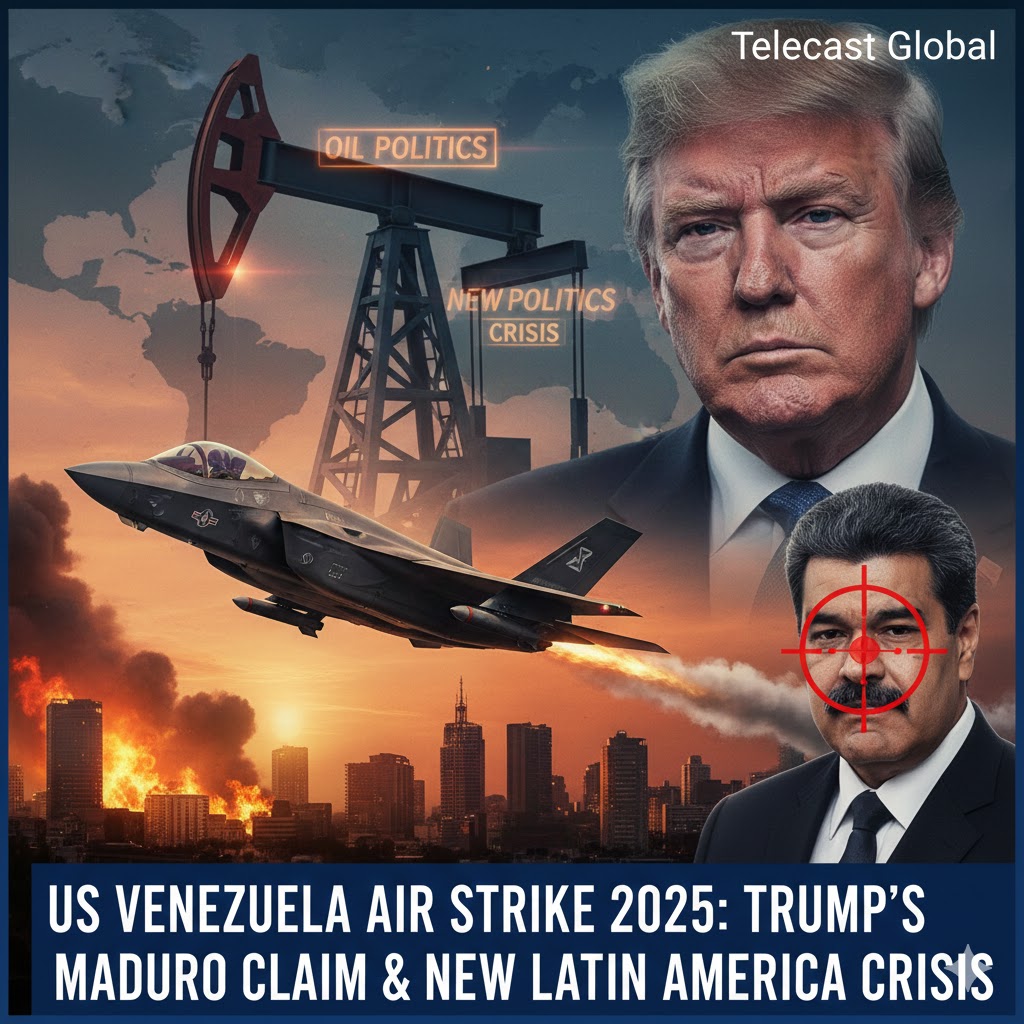
The US Venezuela Air Strike 2025 marks one of the most explosive geopolitical escalations in recent Latin American history. According to reports, coordinated U.S. military attacks on Caracas and strategic Venezuelan assets were followed by former President Donald Trump’s dramatic claim of arresting President Nicolás Maduro. This development arrives at a time when global energy markets remain fragile, U.S. elections shape foreign policy narratives, and international law faces repeated stress tests. Beyond military action, the episode revives long-standing tensions over oil nationalization, regime change politics, and America’s interventionist legacy—making Venezuela a central arena in 2025’s shifting world order.
US Venezuela Air Strike 2025 and the Return of Regime-Change Doctrine
The US Venezuela Air Strike 2025 is not just another episode of military escalation—it signals the unmistakable return of America’s regime-change doctrine, a strategy many believed had been quietly shelved after the costly lessons of Iraq, Libya, and Afghanistan. What unfolded in Caracas and other strategic Venezuelan locations reflects a familiar pattern: military pressure combined with political messaging aimed at delegitimizing a sitting government and accelerating its collapse.
At the heart of the US Venezuela Air Strike 2025 lies a long-standing ideological playbook. Washington has historically justified such actions under banners like “restoring democracy,” “counter-narcotics operations,” or “protecting regional stability.” Yet, as the file data shows, the air strikes targeted core military, communication, and logistical hubs, not drug cartels hiding in jungles. This is classic regime-disruption behavior—cripple command centers, create internal panic, and force leadership isolation.
What makes the US Venezuela Air Strike 2025 especially telling is its political timing. The claims by Donald Trump that President Nicolás Maduro had been arrested—even without independent verification—served a strategic purpose. Regime-change doctrine thrives not only on bombs, but on narrative warfare. Declare the leader “gone,” and the state machinery begins to wobble, allies hesitate, and opposition forces gain confidence.
From a historical lens, this doctrine is nothing new. The United States used similar frameworks in Panama (1989), Iraq (2003), and Libya (2011). The outcomes were consistent: short-term tactical success, followed by long-term instability. The US Venezuela Air Strike 2025 follows this lineage almost textbook-style—air dominance, leadership delegitimization, sanctions, and diplomatic pressure working in tandem.
Oil remains the unspoken driver beneath the rhetoric. Venezuela holds the world’s largest proven petroleum reserves, and regime-change logic has often intersected with energy security. In a 2025 world grappling with volatile oil prices, disrupted shipping lanes, and post-Ukraine energy realignments, Venezuela’s resources regain strategic urgency. The US Venezuela Air Strike 2025 cannot be separated from this economic reality, no matter how loudly humanitarian justifications are amplified.
Another defining feature of the US Venezuela Air Strike 2025 is the erosion of multilateral restraint. There was no clear UN mandate, no congressional declaration of war, and significant dissent within U.S. political circles themselves. This unilateral posture reflects a broader 2025 trend: powerful states increasingly bypass global institutions when they become inconvenient. Regime-change doctrine thrives in such an environment, where power outweighs process.
In blunt terms, the US Venezuela Air Strike 2025 marks a return to old habits dressed in modern language. It suggests that despite decades of global backlash, regime-change remains a tempting shortcut for Washington when diplomacy feels slow and sanctions feel insufficient. History, however, is an unforgiving teacher—and it has rarely been kind to this doctrine.
Trump’s Maduro Arrest Claim: Election Politics or Strategic Messaging?
When Donald Trump publicly claimed that Venezuelan President Nicolás Maduro had been arrested and removed from the country, the statement sent shockwaves far beyond Caracas. In the context of the US Venezuela Air Strike 2025, this claim was less about factual confirmation and more about strategic political communication—a calculated move blending election optics with psychological warfare.
First, let’s call it straight: in modern geopolitics, narratives move faster than missiles. The US Venezuela Air Strike 2025 was still unfolding when Trump’s declaration surfaced. No independent verification, no allied confirmation, no visual proof—yet the message was loud and clear. The goal wasn’t immediate credibility; it was instant perception shaping. Declare Maduro “captured,” and you project dominance, inevitability, and control—classic tools of strategic messaging.
From an election standpoint, the timing matters. Trump’s political brand thrives on strength, decisiveness, and disruption. By tying himself directly to the US Venezuela Air Strike 2025, he positioned the episode as evidence of tough leadership—especially appealing to voters who view U.S. foreign policy through a law-and-order or national-interest lens. Whether the claim was accurate almost becomes secondary in an election-driven media cycle; what sticks is the image of action.
But this wasn’t just domestic theatre. Internationally, the arrest claim functioned as psychological pressure. Regime stability depends heavily on perception—among military commanders, bureaucrats, and foreign allies. In the context of the US Venezuela Air Strike 2025, suggesting that Maduro was already neutralized could encourage defections, hesitation within Venezuelan institutions, and silence from regional supporters who suddenly fear backing a “fallen” leader.
This tactic has precedent. Similar messaging was used during U.S. interventions in Iraq and Panama, where leadership removal was announced or implied early to accelerate collapse from within. The US Venezuela Air Strike 2025 shows that this playbook hasn’t been retired—only updated for the social media age. Platforms now amplify strategic claims globally within minutes, bypassing traditional diplomatic caution.
There’s also a legal and institutional angle. By framing Maduro’s arrest as a fait accompli, Trump’s claim sidestepped uncomfortable questions: Was there congressional approval? Was international law followed? Was this an act of war? In the shadow of the US Venezuela Air Strike 2025, bold declarations can drown out procedural scrutiny—at least temporarily.
Still, there’s risk. If such claims unravel, credibility erodes—both domestically and globally. Allies grow cautious, adversaries become defiant, and neutral states harden their skepticism. Strategic messaging works best when reality eventually catches up. If it doesn’t, the US Venezuela Air Strike 2025 risks being remembered not just as a military escalation, but as a case study in overplayed political theater.
Bottom line: Trump’s Maduro arrest claim was likely both election politics and strategic messaging—a two-front maneuver. In 2025’s hyper-connected world, power isn’t just projected through force; it’s projected through belief. The US Venezuela Air Strike 2025 proves that controlling the story is now as critical as controlling the skies.
Oil, Sanctions, and Energy Security: Why Venezuela Still Matters in 2025
At the core of the US Venezuela Air Strike 2025 lies an old truth that never went out of fashion: oil still shapes global power. Strip away the rhetoric of democracy, drugs, and human rights, and Venezuela’s strategic relevance in 2025 becomes painfully clear. This is a country sitting on the largest proven oil reserves on the planet, and in a fractured global energy order, that fact alone makes it impossible to ignore.
Venezuela’s importance has actually grown, not diminished, in recent years. After the Ukraine war reshaped global energy flows, Western nations scrambled to diversify away from Russian oil. Sanctions on Iran remain tight, Middle Eastern supply routes are vulnerable, and OPEC politics are increasingly unpredictable. In this environment, Venezuela represents a sanctioned giant waiting to be unlocked. The US Venezuela Air Strike 2025 must be read against this backdrop of energy insecurity.
Sanctions have been Washington’s preferred tool for years, but by 2025 their limits are obvious. Despite crippling restrictions, Venezuela’s government has survived, adapted, and rerouted oil exports through shadow fleets and alternative buyers. Sanctions weakened the economy—but they did not deliver regime change. The US Venezuela Air Strike 2025 signals a shift from economic pressure to hard power leverage, suggesting frustration with sanctions fatigue.
Energy markets are watching closely. Any disruption in Venezuelan oil infrastructure—ports, refineries, pipelines—has ripple effects far beyond Latin America. Even rumors tied to the US Venezuela Air Strike 2025 inject volatility into oil prices, insurance premiums, and shipping routes. In a world already balancing inflation and slowing growth, energy shocks are politically toxic. That’s why Venezuela still matters.
There’s also the question of ownership and control. Venezuela nationalized its oil industry decades ago, pushing out major Western firms. For U.S. energy interests, the issue has never been just access—but who sets the rules. A friendly government in Caracas could reopen doors for American companies, stabilize supply, and reduce reliance on rivals. The US Venezuela Air Strike 2025 revives the long-standing tension between sovereign control and global capital.
From a geopolitical angle, Venezuela has aligned itself with non-Western power centers, including Russia, China, and Iran. Energy cooperation sits at the heart of these relationships. In 2025’s increasingly multipolar world, oil-rich states are strategic prizes. The US Venezuela Air Strike 2025 therefore doubles as a signal—not just to Caracas, but to rival blocs—that Washington is willing to reassert influence where energy and alignment intersect.
Critically, this also explains why Venezuela refuses to fold. Oil is leverage. As long as Venezuela controls its reserves, it retains bargaining power—even under pressure. That’s why sanctions alone failed, and why escalation followed. The US Venezuela Air Strike 2025 reflects the harsh reality that energy security debates no longer stay in boardrooms; they spill into military planning.
In blunt terms, Venezuela matters in 2025 because the world still runs on oil, and power still follows energy flows. Until that changes, events like the US Venezuela Air Strike 2025 will keep repeating—under different slogans, but driven by the same fuel.
International Law, UN Reactions, and the Global South’s Response
The US Venezuela Air Strike 2025 has reopened one of the most uncomfortable debates in global politics: does international law still restrain great powers, or has it become optional? As missiles struck Venezuelan targets and political claims flew faster than confirmations, the legal and moral foundations of the post–World War II international order came under renewed strain.
From a strictly legal standpoint, the US Venezuela Air Strike 2025 sits on shaky ground. The United Nations Charter permits the use of force only in cases of self-defense or with explicit authorization from the UN Security Council. Neither condition was clearly met. Venezuela had not launched an armed attack on the United States, and no Security Council resolution sanctioned military action. This legal vacuum is precisely why the strikes triggered immediate diplomatic unease—even among countries traditionally aligned with Washington.
At the center of the institutional response stands the United Nations. Venezuela’s demand for an emergency Security Council meeting was predictable—and strategically sound. Even if veto politics prevent binding action, forcing the issue onto the UN stage reframes the US Venezuela Air Strike 2025 from a “security operation” into a question of global legality. For smaller and mid-sized states, this distinction matters deeply.
The reaction from the Global South has been particularly telling. Across Latin America, Africa, and parts of Asia, the strikes were viewed through a familiar lens: selective enforcement of international norms. Many countries remember interventions that promised stability but delivered chaos. To them, the US Venezuela Air Strike 2025 looks less like law enforcement and more like power politics—where sovereignty is respected only when convenient.
Countries with histories of colonialism or external intervention are especially sensitive to these patterns. For them, Venezuela is not just a country under fire; it’s a precedent. If regime legitimacy can be challenged militarily without multilateral approval, then no resource-rich, politically defiant state is truly safe. That fear explains why several Global South governments, even those critical of Caracas, avoided endorsing the US Venezuela Air Strike 2025.
There’s also the issue of narrative control. Washington framed its actions around security threats and criminal allegations, while Caracas framed them as imperial aggression. In the absence of an impartial international investigation, both narratives compete in a polarized global arena. The US Venezuela Air Strike 2025 thus highlights a deeper crisis: international law lacks enforcement mechanisms when major powers choose defiance.
Ironically, this erosion of legal norms may accelerate the very multipolarity the United States seeks to manage. As trust in Western-led institutions weakens, Global South nations increasingly hedge—strengthening regional blocs, diversifying alliances, and questioning the neutrality of global governance. The US Venezuela Air Strike 2025 reinforces the belief that international law protects the powerful more reliably than the principled.
In cold terms, the response to the US Venezuela Air Strike 2025 shows that while international law still exists on paper, its authority depends on political will. For the Global South, this episode is less about Venezuela alone and more about a system where rules bend under pressure. And once that perception hardens, rebuilding trust becomes far harder than launching air strikes.
Latin America on Edge: Regional Stability After the US Venezuela Air Strike 2025
The US Venezuela Air Strike 2025 has pushed Latin America into a familiar but deeply uncomfortable position: watching a major power intervene militarily in the region while neighbors brace for fallout they did not choose. For a continent with a long memory of coups, proxy wars, and external pressure, the strikes didn’t just hit Venezuelan targets—they shook regional stability.
Latin America’s immediate concern after the US Venezuela Air Strike 2025 is spillover. Venezuela shares borders with Colombia and Brazil, has deep economic and migration links across the region, and sits along critical Caribbean shipping routes. Any prolonged instability risks triggering refugee surges, border militarization, and internal security stress in already-fragile states. These are not theoretical fears; they are lived experiences from past crises in the region.
Colombia, in particular, finds itself in a tight spot. Historically aligned with Washington yet geographically exposed, Bogotá must balance diplomatic caution with domestic pressure. Public reactions across Latin America suggest a clear pattern: even governments critical of Caracas are uneasy with unilateral military action. The US Venezuela Air Strike 2025 revives fears that Latin America could once again become an arena where external rivalries override regional consensus.
Another destabilizing factor is political polarization. Left-leaning governments view the US Venezuela Air Strike 2025 as confirmation of interventionist intent, strengthening anti-U.S. rhetoric and regional solidarity narratives. Right-leaning administrations, meanwhile, face a credibility dilemma—support Washington openly and risk domestic backlash, or distance themselves and strain strategic ties. Either way, regional cohesion takes a hit.
Economically, uncertainty is poison. Latin America is still recovering from post-pandemic debt, inflation pressures, and slowing growth. The US Venezuela Air Strike 2025 injects new risk into trade, energy cooperation, and investor confidence. Markets dislike instability, and investors remember that political crises in one country often ripple outward—especially when energy and shipping lanes are involved.
Security dynamics are also shifting. The normalization of force as a policy tool raises alarms among regional militaries and diplomats alike. If the US Venezuela Air Strike 2025 becomes an accepted precedent, it weakens long-standing regional principles of non-intervention and sovereignty, cornerstones of Latin American diplomacy since the Cold War. That erosion encourages hedging—closer ties with alternative global powers and stronger regional defense postures.
Perhaps the most dangerous consequence is psychological. Latin America has spent decades trying to move beyond the identity of a “backyard” in global geopolitics. The US Venezuela Air Strike 2025 reopens old wounds and reinforces the belief that regional autonomy remains conditional. Once that sentiment spreads, cooperation with U.S.-led initiatives—on security, trade, or climate—becomes harder to sustain.
In blunt terms, the US Venezuela Air Strike 2025 has left Latin America on edge because it threatens predictability. Stability in this region depends less on ideology and more on restraint. When restraint disappears, history tends to repeat itself—and Latin America knows that story far too well.
About The Author










Leave a Reply