

Table of Contents
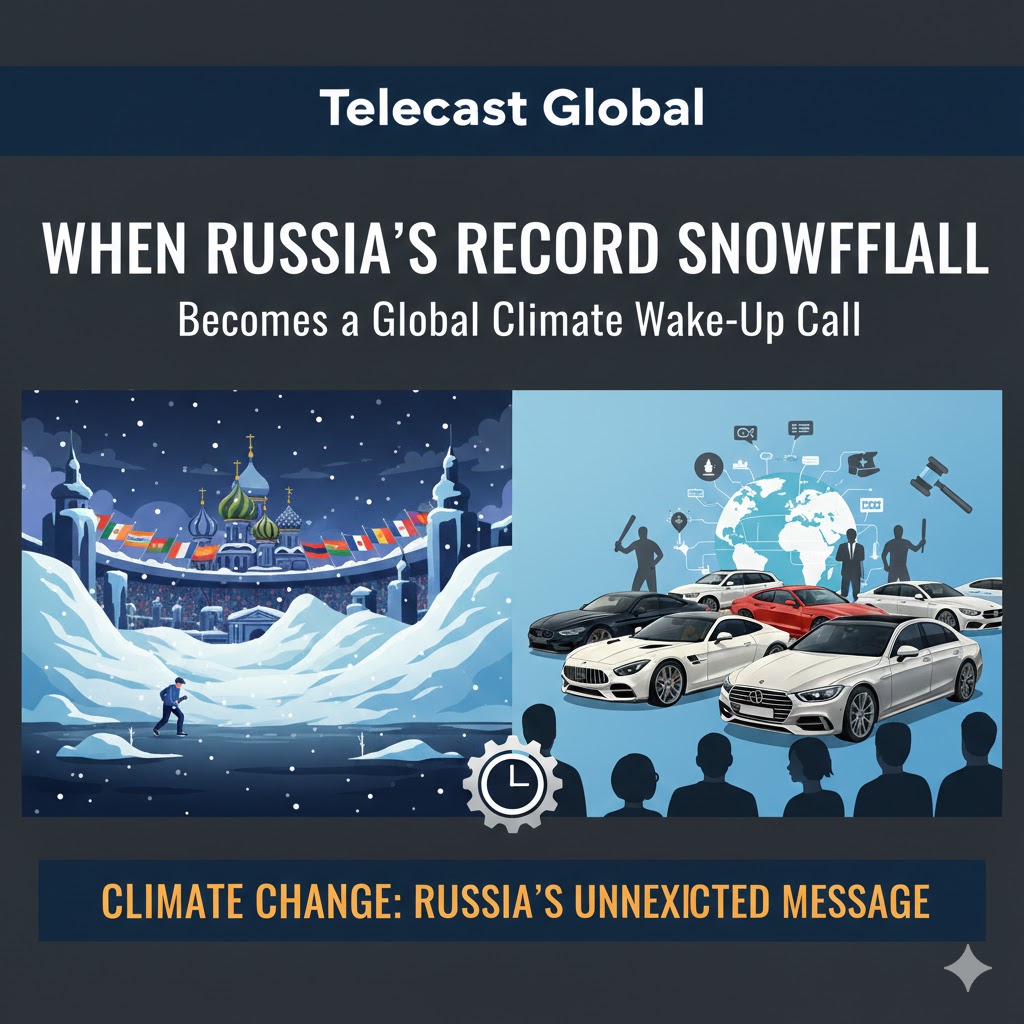
Russia record snowfall climate change is no longer just a dramatic headline—it is a loud warning echoing across the global climate system. Russia breaking a 146-year snowfall record, from Moscow to the remote Kamchatka Peninsula, exposes how extreme weather events are accelerating in intensity and unpredictability. What once looked like a regional winter anomaly now aligns perfectly with today’s climate science, geopolitics, and economic disruption patterns. As the world moves toward 2026, such events are shaping infrastructure planning, disaster preparedness, energy security, and climate negotiations. This snowfall isn’t about cold alone—it’s about a warming planet behaving in dangerous, unexpected ways
How Russia’s 146-Year Snowfall Record Fits Into the Global Climate Crisis
Russia record snowfall climate change is not a contradiction—it is a textbook example of how a warming planet behaves in complex, often counter-intuitive ways. The 146-year snowfall record broken across Russia, from Moscow to the Kamchatka Peninsula, fits squarely into the global climate crisis narrative that scientists have been warning about for over two decades. This is not “just a harsh winter.” It is climate instability in action.
At the core of Russia record snowfall climate change lies a simple but uncomfortable truth: warmer oceans produce more moisture. As global temperatures rise, oceans—especially the Pacific—hold greater amounts of water vapor. When this moisture-laden air collides with extremely cold Arctic and sub-Arctic air masses over Russia, the result is not rain, but relentless, record-breaking snow. Climate change doesn’t eliminate cold; it supercharges the atmosphere that delivers precipitation.
What makes this snowfall historically significant is not only its volume but its persistence. In Kamchatka, snowfall equivalent to several months accumulated in just days, leaving homes buried, vehicles trapped, and entire towns functionally immobilized. Such compression of weather events—more intensity in less time—is a defining marker of the global climate crisis. Russia record snowfall climate change mirrors similar patterns seen elsewhere: flash floods in Europe, heat domes in North America, and prolonged droughts followed by sudden deluges in Asia.
Globally, climate systems are losing balance. The jet stream, once relatively stable, is now weakening and wobbling due to rapid Arctic warming. This allows cold polar air to plunge southward while warm air surges north, creating extreme contrasts. Russia sits directly in this collision zone. The snowfall crisis aligns with broader scientific consensus that climate change destabilizes long-standing atmospheric circulation patterns rather than shifting them gently.
From a geopolitical lens, Russia record snowfall climate change also matters because Russia is a major energy supplier, agricultural producer, and Arctic stakeholder. Disrupted transport, power failures, and damaged infrastructure ripple outward—affecting supply chains, fuel markets, and food prices far beyond Russian borders. Climate extremes are no longer local problems; they are global economic stress tests.
Critically, this event dismantles the outdated argument that climate change only means “more heat.” The reality is harsher: climate change means more extremes—hotter heatwaves, colder cold snaps, heavier rainfall, and deeper snow. Russia’s snowfall record reinforces that the crisis is about volatility, not temperature averages. Stability—the foundation of modern civilization—is what’s disappearing.
As the world looks toward 2026, Russia record snowfall climate change serves as a warning shot. Infrastructure built for predictable seasons is failing. Emergency systems designed for rare events are being used constantly. Governments that still treat climate change as a future issue are already behind the curve.
In short, Russia’s 146-year snowfall record is not an anomaly—it is evidence. Evidence that the global climate crisis is accelerating, reshaping weather norms, and forcing humanity to confront a reality where “once-in-a-century” events are becoming routine
Kamchatka’s Extreme Snowfall and the New Pattern of Weather Volatility
Russia record snowfall climate change is most dramatically visible in Kamchatka, a region that has long been accustomed to harsh winters yet was still caught off guard by the sheer scale and speed of this snowfall. Kamchatka receiving months’ worth of snow in just a few days is not a random freak event—it reflects a new global pattern of weather volatility driven by climate disruption. What makes this case important is that Kamchatka is not a soft-climate zone; it is a hardened region now facing conditions beyond its historical norms.
Traditionally, Kamchatka’s winters followed a predictable rhythm: steady snowfall spread across months, allowing communities, infrastructure, and emergency systems to adapt gradually. This time, that rhythm collapsed. Snowfall intensity spiked abruptly, overwhelming roads, homes, power lines, and emergency services. This compression of weather—more impact in less time—is one of the clearest fingerprints of Russia record snowfall climate change.
Climate scientists increasingly emphasize that volatility, not averages, defines the modern climate era. Rising global temperatures load the atmosphere with energy and moisture. When this unstable system encounters cold zones like Kamchatka, it releases that energy violently—in the form of extreme snowfall. In simple terms, the weather no longer unfolds; it detonates. This explains why Kamchatka saw doors buried, vehicles swallowed, and residents digging tunnels just to step outside their homes.
What’s crucial here is the frequency pattern. This snowfall was not an isolated storm followed by calm. Multiple cyclonic systems arrived back-to-back, leaving no recovery window. Snow didn’t have time to melt, compact, or be cleared before the next system hit. This stacking effect is now common worldwide—from back-to-back heatwaves in Southern Europe to repeated flooding in South Asia. Russia record snowfall climate change fits directly into this global rhythm of relentless extremes.
Kamchatka’s geography amplified the damage. Sitting between the Pacific Ocean and the Sea of Okhotsk, with mountainous terrain, the region is a textbook example of orographic intensification. Moist air is forced upward, cools rapidly, and releases snow in extraordinary quantities. Climate change doesn’t create these geographic features—but it weaponizes them. Increased ocean warmth means more moisture feeding these systems, turning natural geography into a risk multiplier.
From a global risk perspective, Kamchatka matters because it challenges a dangerous assumption: that regions “used to” extreme weather are safe from climate shocks. They are not. Adaptation thresholds exist everywhere, and Kamchatka crossed one this winter. That’s a sobering lesson for cold regions across Canada, Northern Europe, and Central Asia. Russia record snowfall climate change shows that experience with harsh climates does not guarantee resilience in an era of destabilized weather systems.
Economically and strategically, such volatility strains governments. Snow removal costs surge, infrastructure maintenance budgets explode, and emergency responses stretch thin. Over time, this volatility erodes long-term planning. Roads designed for historical snowfall averages fail. Power systems buckle. Insurance models collapse. These are not abstract climate debates—they are governance and economic stability issues.
Looking ahead to 2026, Kamchatka’s snowfall stands as a warning sign. Climate volatility is becoming the new normal. Events are faster, heavier, and harder to manage. Russia record snowfall climate change is not about one remote peninsula—it is about a world where weather no longer plays by the old rules.
In essence, Kamchatka’s extreme snowfall confirms a hard truth: climate change is not linear. It is chaotic. And in that chaos, volatility—not temperature—has become the real threat to modern society
From Transport Chaos to Power Failures: Economic Impact of Climate Extremes
Russia record snowfall climate change is not just a meteorological headline—it is an economic stress test unfolding in real time. When transport networks freeze, power systems collapse, and cities grind to a halt, the true cost of climate extremes becomes visible. Russia’s record-breaking snowfall has exposed how deeply modern economies depend on stable, predictable weather—and how vulnerable they become when that stability disappears.
Transport disruption is the first and most immediate economic casualty. Across Moscow and the far eastern regions, roads became impassable, rail schedules collapsed, and flights were repeatedly canceled. Logistics chains—already fragile in a post-pandemic, geopolitically tense world—took another hit. When goods cannot move, factories slow, retail shelves thin out, and inflationary pressure quietly builds. Russia record snowfall climate change shows how a weather event in one country can ripple through regional and global supply systems.
Power failures reveal a deeper layer of vulnerability. Heavy snow combined with strong winds damaged transmission lines and substations, leaving large populations without electricity. Heating systems—critical in extreme cold—were strained or shut down. For households, this meant discomfort and risk. For businesses, it meant lost productivity, equipment damage, and operational shutdowns. Energy infrastructure designed for “normal extremes” is now facing conditions outside its design logic. That gap carries a direct economic price.
Public finances take a double hit. On one side, governments must pour money into emergency response: snow clearance, disaster relief, military and civil defense deployment, and infrastructure repair. On the other side, tax revenue falls as businesses close temporarily and economic activity slows. Russia record snowfall climate change underlines a harsh reality—climate extremes don’t just cause damage; they drain state capacity over time.
Urban economies are particularly exposed. Cities depend on synchronized systems: transport, power, communications, water, and healthcare. When snow buries roads and damages power lines simultaneously, the entire urban ecosystem stutters. Workers can’t reach offices, services fail, and productivity drops sharply. Multiply this across weeks rather than days, and the losses become structural rather than temporary.
Insurance and risk pricing are another silent casualty. Extreme snowfall events push insurers toward higher premiums or outright withdrawal from high-risk regions. This raises costs for homeowners, businesses, and local governments. In the long run, Russia record snowfall climate change forces a recalibration of what is considered “insurable.” When extreme events become frequent, the economic safety net starts to tear.
There’s also a strategic economic angle. Russia is a key player in global energy, minerals, and agriculture. Disruptions in extraction regions, transport corridors, or export infrastructure don’t stay domestic problems. Energy markets react, commodity prices fluctuate, and trade partners feel the shockwaves. Climate extremes are now embedded in geopolitical risk calculations.
Looking toward 2026, the lesson is blunt: climate extremes are no longer rare shocks—they are recurring costs. Russia record snowfall climate change demonstrates that economies built on historical weather assumptions are mispriced and underprepared. Adaptation is no longer an environmental choice; it is an economic necessity.
In the end, transport chaos and power failures are not side effects—they are the bill coming due. And as climate volatility accelerates, that bill is only going to get larger
Why Russia’s Snow Disaster Matters for Global Climate Policy Before 2026
Russia record snowfall climate change has shifted from being a regional emergency to a global policy signal. When a country with Russia’s geographic scale, cold-climate experience, and infrastructure depth is overwhelmed by snowfall, it sends a clear message to policymakers worldwide: existing climate frameworks are lagging behind reality. This disaster is not just about response failure—it is about policy gaps that become dangerous as 2026 approaches.
For years, global climate policy has focused heavily on heat-centric narratives—heatwaves, melting glaciers, rising sea levels. While valid, this focus has unintentionally sidelined cold-region extremes. Russia record snowfall climate change forces a recalibration. Climate policy must now explicitly account for intensified winters, heavy snow loads, and cold-weather infrastructure resilience. Otherwise, nations will continue planning for yesterday’s climate instead of tomorrow’s volatility.
This event also exposes the limits of adaptation without coordination. Russia mobilized emergency services, machinery, and administrative capacity, yet the scale of disruption persisted. That reality matters for global climate negotiations because it undercuts the idea that wealthy or resource-rich nations can “adapt their way out” of climate risk alone. Russia record snowfall climate change strengthens the argument for shared climate financing, data exchange, and early-warning systems across borders.
Ahead of 2026, climate diplomacy is increasingly tied to national security. Snow disasters disrupt energy grids, transport corridors, and food logistics—critical assets in geopolitical stability. Russia’s experience shows that extreme weather can weaken strategic resilience just as effectively as traditional security threats. This adds urgency to integrating climate risk into defense planning, Arctic governance, and energy security discussions at international forums.
There is also a credibility factor. Climate policy often struggles with public buy-in due to perceptions of abstract or distant risk. Events like this cut through skepticism. When citizens see doors buried, cities immobilized, and power systems failing, climate change becomes tangible. Russia record snowfall climate change offers policymakers a rare moment where scientific warnings align visibly with lived experience—an opportunity that smart governance should not waste.
From a regulatory standpoint, this disaster pressures governments to revisit building codes, transport standards, and energy infrastructure rules. Snow-load assumptions, maintenance cycles, and emergency thresholds all require updating. Global climate policy before 2026 must move beyond emission targets alone and enforce resilience benchmarks. Otherwise, mitigation success will still coexist with economic and humanitarian disruption.
International climate forums leading up to 2026 will increasingly debate “loss and damage.” Russia’s snowfall adds a cold-climate dimension to this debate. It reinforces that climate harm is not limited to vulnerable tropical nations—it affects high-latitude, industrialized states as well. Russia record snowfall climate change strengthens the moral and practical case for inclusive global climate mechanisms.
Ultimately, this snow disaster matters because it compresses timelines. What was once considered a long-term risk has arrived early and aggressively. Policymakers now face a shrinking window to align climate commitments with real-world extremes.
As 2026 approaches, Russia record snowfall climate change stands as a policy stress signal: adapt faster, coordinate deeper, or prepare for repeated systemic shocks. Climate politics is no longer about distant futures—it is about immediate governance under pressure
What This Record Snowfall Tells Us About the Future of Extreme Weather
Russia record snowfall climate change is not a one-off anomaly—it is a preview. A preview of how extreme weather will behave in the coming years: sharper, faster, heavier, and far less predictable. The breaking of a 146-year snowfall record is not just a historical milestone; it is a directional signal pointing toward the future of global weather systems under climate stress.
The first lesson is intensity compression. Extreme weather is no longer spread gently across seasons—it is being squeezed into shorter, more destructive timeframes. Kamchatka receiving months of snow in days illustrates how future extremes will overwhelm systems before societies can react. Russia record snowfall climate change confirms that response time is shrinking, and reaction-based governance will increasingly fail.
Second, extremes will defy intuition. Many still associate climate change only with heat, drought, and melting ice. The reality is harsher and more complex. A warmer planet holds more moisture, and when that moisture meets cold air, it fuels extreme snowfall. This paradox will become common. Russia record snowfall climate change shows that future weather will routinely contradict public expectations, making communication and preparedness harder.
Third, volatility will replace stability as the defining climate feature. The old model—predictable winters, manageable summers, known seasonal cycles—is breaking down. Instead, weather will swing violently between extremes. One year of abnormal warmth may be followed by record cold or snow. Russia record snowfall climate change fits a global pattern where variability, not averages, drives damage.
Infrastructure stress is another unavoidable conclusion. Roads, power grids, buildings, and transport systems are designed around historical climate norms. When those norms collapse, failure becomes systemic rather than isolated. This snowfall demonstrated how even cold-adapted regions can exceed their resilience thresholds. Russia record snowfall climate change warns that future extremes will expose hidden fragilities everywhere.
The economic signal is equally clear. Extreme weather will increasingly behave like a recurring tax on economies—draining public budgets, disrupting productivity, and inflating insurance costs. These are not temporary losses; they accumulate year after year. Russia record snowfall climate change suggests that nations failing to price climate risk correctly will face long-term economic erosion.
From a societal perspective, psychological adaptation will lag behind physical reality. Communities accustomed to “rare disasters” will face repeated shocks. Trust in institutions may weaken if responses consistently fall short. Extreme weather, once seen as exceptional, will become routine—yet never normal. This tension will shape public discourse well beyond 2026.
Looking ahead, the most sobering takeaway is this: extreme weather will not arrive evenly or politely. It will arrive asymmetrically, violently, and often in places that believed they were prepared. Russia record snowfall climate change proves that experience with harsh climates does not equal immunity in a destabilized world.
In essence, this snowfall is not about Russia’s past—it is about the planet’s future. A future where extremes intensify, recovery windows shrink, and adaptation becomes a continuous process rather than a one-time fix. If this event teaches one lesson, it is that extreme weather is no longer a forecast—it is a permanent condition of the climate era we are entering
About The Author








Leave a Reply