

Table of Contents
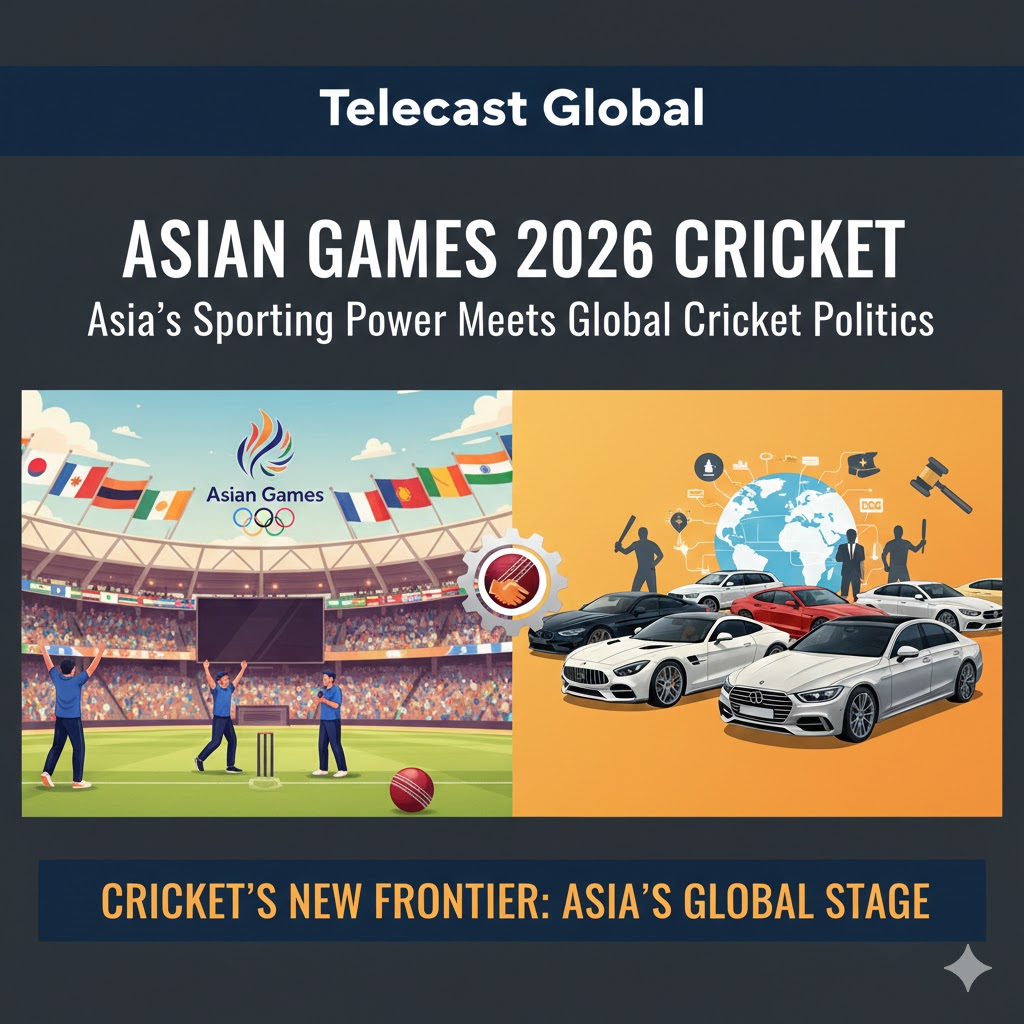
Asian Games 2026 Cricket is no longer just a sporting schedule update—it reflects Asia’s growing influence over global cricket and multi-sport events. With official dates announced, T20 format confirmed, and international status continuing after the 2023 breakthrough, cricket’s role in the Asian Games has matured into a serious competitive platform. Hosted in Japan, a non-traditional cricket nation, the 2026 edition aligns perfectly with today’s global sports trends: expansion into new markets, youth-driven T20 popularity, and preparation for cricket’s anticipated Olympic return. The Asian Games are now shaping cricket’s future, not merely accommodating it.
How Asian Games 2026 Cricket Reflects Asia’s Rising Control Over World Cricket
Asian Games 2026 Cricket is more than a continental tournament—it is a mirror reflecting Asia’s growing authority over the global cricket ecosystem. For decades, world cricket followed a Euro-centric administrative legacy, but the balance of power has quietly, steadily, and now decisively shifted eastward. The 2026 Asian Games make that shift impossible to ignore.
Start with the basics: where the money is, the power follows. Asia today drives global cricket revenues through broadcasting, sponsorships, fan engagement, and digital consumption. India alone contributes a massive share of the international cricket economy, while nations like Pakistan, Bangladesh, Sri Lanka, and Afghanistan add depth, competitiveness, and passionate audiences. Asian Games 2026 Cricket consolidates this reality by placing cricket at the center of Asia’s biggest multi-sport event, not as a side attraction, but as a medal-defining competition.
The decision to continue cricket in the T20 format is another clear signal. T20 is not just a format; it is Asia’s export to world cricket. It aligns with modern attention spans, commercial viability, and youth participation. By showcasing T20 at a prestigious event like the Asian Games, Asian Games 2026 Cricket reinforces Asia’s leadership in defining how cricket evolves rather than how it preserves tradition for tradition’s sake.
Equally important is legitimacy. When cricket returned to the Asian Games in 2023 with international status, it crossed a psychological barrier. No longer were these matches seen as exhibition games or diluted contests. That status is being carried forward into Asian Games 2026 Cricket, proving that Asian cricket boards now possess the influence to ensure recognition, rankings relevance, and competitive seriousness. This is quiet power—but it’s real power.
Hosting the Games in Japan adds another strategic layer. Asia is no longer content with cricket thriving only in traditional strongholds. Asian Games 2026 Cricket is being used as a tool of expansion—into new markets, new audiences, and new infrastructure zones. This is exactly how global sports empires are built: first dominance, then diffusion. Cricket is following that script under Asian leadership.
There is also a geopolitical undertone. Multi-sport events have always been soft-power instruments, and Asia understands this well. By embedding cricket deeply into the Asian Games framework, Asian Games 2026 Cricket strengthens Asia’s collective bargaining position in global sporting forums. This has direct implications for future scheduling power, revenue negotiations, and even Olympic inclusion pathways.
Finally, consider talent pipelines. Asian nations are producing younger, fitter, and tactically smarter cricketers at scale. The Asian Games provide exposure without the pressure cooker of bilateral politics. Asian Games 2026 Cricket becomes a proving ground where future international stars are shaped, tested, and recognized—on Asia’s terms.
In blunt terms, the world no longer dictates cricket to Asia. Asia dictates cricket to the world. Asian Games 2026 Cricket is not causing that shift—it is confirming it, formalizing it, and putting a medal stamp on it. And once power becomes institutionalized, it rarely goes backward.
T20 Format, Youth Power, and the Commercial Evolution of Multi-Sport Events
The rise of the T20 format is not an accident—it is a calculated response to how modern audiences consume sport. Asian Games 2026 Cricket sits right at the center of this transformation, proving that multi-sport events are no longer driven only by tradition or legacy, but by relevance, revenue, and reach. In today’s sports economy, attention is currency, and T20 is the format that prints it.
At its core, T20 cricket matches the rhythm of the younger generation. Shorter games, faster results, constant momentum, and instant gratification—this is exactly how Gen Z and millennial audiences engage with entertainment. By embedding T20 into Asian Games 2026 Cricket, organizers are aligning a historic multi-sport platform with contemporary viewing habits. This is not dilution of sport; it is survival through adaptation.
Youth power is the real engine behind this shift. Across Asia, cricket participation at junior and grassroots levels is exploding, largely because T20 lowers entry barriers. Matches fit into tighter schedules, skills develop faster, and players gain exposure earlier. Asian Games 2026 Cricket amplifies this effect by giving young athletes a high-pressure, international-stage experience without forcing them through the long grind of traditional formats first. That is smart ecosystem design.
Commercially, the logic is brutally clear. Sponsors want eyeballs. Broadcasters want predictable time slots. Digital platforms want highlight-friendly content. T20 delivers all three—and multi-sport events desperately need them. Events like the Asian Games now compete not just with other sports, but with streaming platforms, gaming, and short-form content. Asian Games 2026 Cricket strengthens the Games’ commercial attractiveness by offering a product that advertisers and broadcasters actually fight over.
This also marks a philosophical shift in how multi-sport events define “prestige.” Earlier, prestige came from endurance, length, and exclusivity. Today, prestige comes from global relevance and monetization potential. The inclusion of T20 in Asian Games 2026 Cricket signals that the Asian Games are no longer allergic to modern sports economics—they are embracing it. That alone keeps the event future-proof.
There is another layer most people miss: scheduling efficiency. T20 allows organizers to pack competitive depth into limited timeframes without compromising quality. This makes cricket a practical fit within crowded multi-sport calendars. Asian Games 2026 Cricket benefits from this efficiency, ensuring cricket remains a medal sport without logistical chaos. That practicality increases the chances of cricket staying permanently embedded in future editions.
Importantly, T20 does not weaken cricket’s credibility in multi-sport settings—it strengthens it. The format rewards athleticism, tactical intelligence, and adaptability, all qualities that resonate with the Olympic-style sporting ethos. Asian Games 2026 Cricket thus positions cricket as a modern, dynamic sport that belongs alongside athletics, swimming, and football—not as an outlier clinging to outdated structures.
In blunt commercial terms, T20 makes cricket valuable to the Asian Games, and the Asian Games make T20 cricket institutionally powerful. That is a mutually reinforcing loop. Asian Games 2026 Cricket is proof that youth appeal and commercial logic now drive the evolution of multi-sport events—and anyone resisting that reality is simply negotiating with irrelevance.
Why Japan Hosting Asian Games 2026 Cricket Signals Strategic Sports Expansion
When a non-traditional cricket nation like Japan becomes the stage for Asian Games 2026 Cricket, it is not coincidence—it is strategy. Global sports growth today is no longer about strengthening only existing markets; it is about intelligent expansion. Japan hosting cricket at the Asian Games represents Asia’s most calculated move yet to turn cricket from a regional obsession into a truly pan-Asian sport.
Japan’s selection sends a clear message: cricket does not need historical roots to grow; it needs institutional backing, infrastructure, and visibility. By placing Asian Games 2026 Cricket in Japan, Asian sporting authorities are testing a proven expansion model—use a mega multi-sport event to introduce a high-engagement sport to a new audience under the umbrella of national pride and global attention. This is the same playbook used successfully by football, basketball, and even athletics in emerging markets.
From an infrastructure perspective, this move matters deeply. Hosting cricket requires pitches, training facilities, broadcast readiness, and officiating expertise. Asian Games 2026 Cricket forces long-term investment in these areas within Japan. Infrastructure once built rarely disappears. That alone ensures cricket survives beyond the closing ceremony. Strategic expansion is not about one tournament—it is about permanent capacity creation, and Japan fits that long-term vision perfectly.
There is also a cultural angle. Japanese sports culture values discipline, precision, and technique—qualities cricket naturally rewards. By showcasing Asian Games 2026 Cricket in Japan, organizers are aligning the sport with a society already receptive to structured, skill-based competition. This increases the chances that cricket finds not just viewers, but participants. Expansion succeeds when spectators turn into players.
Commercially, Japan offers something Asia’s traditional cricket nations cannot: access to new sponsors, multinational brands, and technologically advanced broadcasting ecosystems. Asian Games 2026 Cricket benefits from Japan’s corporate environment, where global brands seek association with international events. This diversifies cricket’s revenue base, reducing overdependence on a few dominant markets and strengthening the sport’s financial resilience.
There is also a geopolitical undertone worth acknowledging. Sports expansion often mirrors diplomatic intent. By integrating cricket into a Japanese-hosted Asian Games, Asian Games 2026 Cricket becomes a soft-power bridge between South Asia, East Asia, and Southeast Asia. It positions cricket as a unifying Asian sport rather than a subcontinental one. That shift in perception is crucial for long-term global recognition.
Most importantly, this move future-proofs cricket’s multi-sport relevance. Expansion into nations like Japan strengthens the case for cricket’s continued inclusion in major international events. Asian Games 2026 Cricket thus becomes a proof-of-concept: if cricket can succeed in Japan, it can succeed anywhere. That argument carries weight far beyond Asia.
In plain terms, Japan hosting Asian Games 2026 Cricket is not about comfort—it is about ambition. It signals that Asian cricket leadership is thinking ten years ahead, not ten matches ahead. And in modern sports, those who plan expansion early end up controlling the map later.
India’s Gold Standard Performance and Its Impact on Asian Cricket Politics
India’s performance in recent editions of the Asian Games has done more than win medals—it has rewritten the political grammar of Asian cricket. Asian Games 2026 Cricket enters the spotlight with India already positioned as the undisputed benchmark. When a nation dominates both men’s and women’s competitions, as India did previously, it stops being just a participant and becomes the reference point against which all others are measured.
This “gold standard” status reshapes power dynamics. In Asian cricket politics, influence is earned through performance as much as administration. India’s success has strengthened its voice in determining formats, scheduling preferences, and competitive structures for Asian Games 2026 Cricket. Quietly, this creates alignment across Asian boards: what suits India often becomes the default model, not because of coercion, but because results validate the approach.
Another critical impact lies in normalization. India’s full-strength participation in earlier Asian Games erased the notion that these tournaments are secondary or symbolic. Asian Games 2026 Cricket benefits from that shift in perception. Once the region’s strongest team treats the event seriously, others are forced to follow. Competitive seriousness is contagious, and India’s approach has raised the floor of Asian cricket competition.
There is also a developmental ripple effect. India’s depth allows it to field competitive squads even while managing packed international calendars. This sends a strong message: multi-sport events and elite cricket can coexist. For Asian boards still struggling with player pipelines, Asian Games 2026 Cricket becomes a blueprint rather than a burden. India’s model demonstrates how strong domestic systems translate into multi-format dominance.
Politically, this dominance influences selection and qualification debates. When India consistently delivers quality, viewership, and credibility, its presence becomes essential to the tournament’s stature. Asian Games 2026 Cricket therefore naturally orbits around India’s participation, increasing India’s leverage in broader Asian cricket decision-making—whether openly acknowledged or not.
Equally important is the women’s game. India’s leadership in women’s cricket has accelerated Asia’s collective progress. By winning and professionalizing the space, India has pushed other nations to invest, reform, and compete. Asian Games 2026 Cricket will reflect this shift, with women’s matches no longer treated as side events but as equal contributors to medals, viewership, and prestige.
There is, of course, tension. Dominance breeds aspiration, but also resistance. India’s gold standard challenges other Asian powers to respond—not politically, but competitively. That is healthy. Asian Games 2026 Cricket thus becomes a pressure cooker where rivalry sharpens standards rather than fractures alliances.
In straightforward terms, India has turned performance into political capital. Asian Games 2026 Cricket will not just showcase that capital—it will multiply it. In Asian cricket today, medals speak louder than meetings, and India’s medal count has made its voice impossible to ignore.
Asian Games 2026 Cricket as a Launchpad for the 2028 Olympics Vision
The conversation around cricket’s Olympic future has shifted from “if” to “how,” and Asian Games 2026 Cricket sits at the heart of that transition. Multi-sport legitimacy is the final barrier cricket must cross to secure a permanent place in the Olympic ecosystem, and the Asian Games function as the most credible testing ground outside the Olympics themselves. What happens in 2026 will echo far beyond Asia.
First, scale matters. The Asian Games are the world’s largest multi-sport event after the Olympics. When cricket thrives here, it proves that the sport can coexist with complex scheduling, shared infrastructure, and diverse audiences. Asian Games 2026 Cricket offers hard evidence that cricket fits seamlessly into the Olympic-style model—compact format, high engagement, and clear medal narratives.
The T20 format plays a decisive role in this Olympic alignment. Olympic sports demand time efficiency, universal appeal, and broadcast-friendly structures. Asian Games 2026 Cricket reinforces T20 as cricket’s most Olympic-ready version. Short matches, decisive outcomes, and high-intensity action check every box Olympic planners care about. This is not theory—it is practical demonstration.
Equally important is competitive balance. The Asian Games bring together established powers and emerging nations on the same stage. Asian Games 2026 Cricket showcases that cricket is no longer limited to a handful of dominant teams. Competitive diversity strengthens the case for Olympic inclusion, as the Games prioritize global representation alongside excellence.
There is also governance credibility at stake. For the Olympics, consistency and recognition matter as much as popularity. Asian Games 2026 Cricket continues the momentum of internationally recognized matches, standardized rules, and transparent competition structures. That institutional maturity is exactly what Olympic decision-makers expect before admitting any sport.
Youth visibility cannot be overstated. The Olympics are fundamentally about inspiring the next generation. Asian Games 2026 Cricket places young cricketers in a multi-sport environment where national colors matter more than franchise loyalties. That shift—from league identity to national identity—aligns cricket more closely with Olympic values.
Commercial optics matter too, even if no one says it out loud. Successful execution of Asian Games 2026 Cricket sends a powerful signal to broadcasters, sponsors, and global federations: cricket delivers numbers without disrupting the ecosystem. The Olympics may celebrate ideals, but they survive on sustainability. Cricket’s performance at the Asian Games strengthens that business case.
In essence, Asian Games 2026 Cricket is a rehearsal—measured, observed, and evaluated. It tests logistics, audience response, competitive structure, and international coordination in one controlled environment. If cricket passes this test, the road to 2028 looks less like a debate and more like a formality.
Put simply, the Asian Games are not warming up for cricket—cricket is warming up for the Olympics. And Asian Games 2026 Cricket is the proving ground where that future is being quietly but decisively shaped.
About The Author








Leave a Reply