

Table of Contents
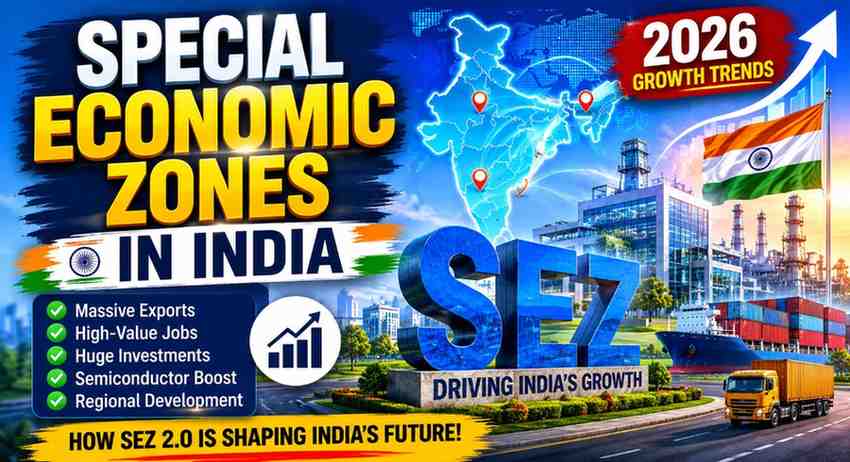
Special Economic Zones in India have emerged as one of the most influential drivers of the country’s export-led growth strategy in 2026. The recent approval of two new SEZs in Puducherry highlights how India is expanding industrial infrastructure, attracting investments, and creating employment opportunities beyond traditional economic hubs. At a time when global supply chains are shifting, semiconductor manufacturing is gaining strategic importance, and governments are competing for foreign investment, India’s SEZ ecosystem is undergoing a major transformation. With SEZ 2.0 reforms, digital governance, export incentives, and decentralized industrial development, these zones are becoming critical engines of economic growth and competitiveness.
Why the Two New Puducherry SEZs Mark a Turning Point for Regional Economic Development
The notification of two new Special Economic Zones (SEZs) in Puducherry represents far more than a routine industrial policy decision. It signals a strategic shift in India’s approach toward regional economic development, decentralized industrialization, and export-led growth. At a time when states and Union Territories are competing to attract investments amid changing global supply chains, these new SEZs position Puducherry as an emerging economic hub within South India. The development aligns closely with India’s 2026 vision of creating diversified growth centers beyond traditional metropolitan regions.
One of the most significant aspects of this initiative is the establishment of India’s first SEZ developed by an Urban Local Body (ULB). The IT and ITES-focused SEZ at Thattanchavady, developed by the Oulgaret Municipality, breaks new ground in economic governance. Traditionally, large industrial zones have been promoted by state governments, central agencies, or private developers. However, empowering a municipal body to lead such a project demonstrates increasing confidence in local governance institutions and their ability to drive economic transformation. This innovative model could inspire cities across India to take a more active role in attracting investments and generating employment opportunities.
The economic impact of the project is expected to be substantial. With a proposed investment of approximately Rs 725 crore and an estimated creation of 3,500 direct and indirect jobs, the new IT/ITES SEZ can significantly strengthen Puducherry’s knowledge economy. As digital services, artificial intelligence, cloud computing, and business process management continue to expand globally, the region is well-positioned to attract technology-driven enterprises seeking cost-effective locations with skilled talent pools. The project therefore supports both employment generation and long-term economic diversification.
Equally important is the Multi-Sector SEZ being developed by the Pondicherry Industrial Promotion Development and Investment Corporation (PIPDIC) at Karasur village. Unlike sector-specific industrial parks, a multi-sector SEZ encourages a diverse mix of manufacturing and service industries. This diversification reduces dependence on a single industry and strengthens economic resilience. In the current global environment, where supply chain disruptions and geopolitical uncertainties have become common, diversified industrial ecosystems offer greater stability and sustainable growth prospects.
The timing of these developments is particularly relevant. Global companies are increasingly pursuing supply chain diversification strategies under the “China Plus One” approach. India has emerged as a major beneficiary of this trend, attracting investments in electronics, semiconductors, renewable energy equipment, pharmaceuticals, and digital services. The new Puducherry SEZs provide ready-to-use infrastructure, regulatory ease, and export-oriented facilities that can help the region capture a share of this growing investment inflow. By integrating into global value chains, Puducherry can strengthen its role in India’s broader economic growth story.
Another critical dimension is the strengthening of the Tamil Nadu, Andaman and Puducherry (TAP) economic corridor. The document highlights that large-scale projects in this region are contributing significantly to regional development. Improved industrial infrastructure, logistics connectivity, and export capabilities can transform the TAP region into a major economic growth engine for southern India. Such regional clusters often create multiplier effects, stimulating growth in transportation, real estate, education, retail, and supporting industries.
The new SEZs also reinforce India’s export-led growth strategy. SEZs are designed to provide businesses with world-class infrastructure, tax incentives, and simplified regulatory frameworks that enhance competitiveness in international markets. As India aims to expand its share of global exports and achieve ambitious economic targets over the coming decade, emerging regional hubs like Puducherry will play an increasingly important role in driving export performance.
Perhaps the most transformative aspect of these projects is their emphasis on decentralized industrialization. Historically, economic growth in India has been concentrated in a limited number of metropolitan centers. The Puducherry SEZ initiative demonstrates how smaller cities and local governments can become catalysts for investment, innovation, and job creation. This approach aligns with contemporary development thinking, which advocates balanced regional growth rather than excessive concentration of economic activity in a few urban centers.
As India advances toward its vision of becoming a developed economy, the two new Puducherry SEZs serve as a powerful example of how regional development, local governance, export competitiveness, and industrial modernization can work together. Their success could establish a blueprint for future Special Economic Zones in India, making them a defining feature of the country’s economic transformation in 2026 and beyond.
How SEZ 2.0 Reforms Are Transforming India’s Export and Manufacturing Ecosystem
The evolution of Special Economic Zones in India has entered a new phase with the emergence of the SEZ 2.0 framework. As global trade patterns shift, supply chains become more complex, and nations compete aggressively for investment, India is modernizing its Special Economic Zone ecosystem to remain globally competitive. SEZ 2.0 is not merely a policy update; it represents a comprehensive effort to transform Special Economic Zones in India into engines of exports, manufacturing growth, technological innovation, and large-scale employment generation.
The original SEZ model played a crucial role in boosting exports and attracting foreign direct investment. However, over time, several challenges emerged, including underutilized land, changing global trade rules, evolving World Trade Organization (WTO) regulations, and increased competition from manufacturing hubs across Asia. Recognizing these challenges, the Government of India initiated reforms aimed at making Special Economic Zones in India more flexible, efficient, and aligned with contemporary economic realities.
One of the most important developments under SEZ 2.0 is the government’s effort to move beyond the traditional “export island” approach. The recommendations of the Baba Kalyani Committee emphasized transforming SEZs into Employment and Economic Enclaves (3Es), focusing not only on exports but also on job creation, domestic value addition, and stronger integration with the broader economy. This shift recognizes that sustainable economic growth requires stronger linkages between SEZs and local industries, suppliers, and labor markets.
A key pillar of SEZ 2.0 is regulatory simplification. Businesses operating within Special Economic Zones in India benefit from streamlined approval mechanisms, reduced bureaucratic hurdles, and single-window clearances. In today’s fast-moving business environment, investors prioritize speed, transparency, and ease of doing business. By reducing administrative complexities, SEZ reforms improve India’s attractiveness as a destination for both domestic and international investors.
Another major reform is the introduction of more flexible domestic market access. Traditionally, SEZs were heavily export-oriented, limiting the ability of units to sell products within India’s domestic market. Under the revised framework, eligible SEZ units can sell a prescribed portion of their output in the Domestic Tariff Area (DTA) at concessional customs duty rates. This change improves capacity utilization, allows businesses to achieve economies of scale, and enhances the commercial viability of manufacturing operations.
The semiconductor industry illustrates how Special Economic Zones in India are adapting to future economic priorities. In 2025, SEZ regulations were amended to relax land encumbrance norms and minimum area requirements for semiconductor manufacturing projects. This reform reflects India’s strategic ambition to become a major player in the global semiconductor supply chain. As geopolitical tensions and supply chain disruptions encourage countries to diversify chip production, India is positioning itself as an attractive destination for advanced manufacturing investments.
SEZ 2.0 also strengthens export competitiveness through integration with the Remission of Duties and Taxes on Exported Products (RoDTEP) scheme. By neutralizing embedded taxes and levies, exporters operating within Special Economic Zones in India can compete more effectively in international markets. Such measures are particularly important when global manufacturers carefully evaluate cost structures before selecting production locations.
The impact of these reforms is already visible in India’s export performance. According to the latest data, operational SEZs generated exports exceeding Rs 11.70 lakh crore during 2025-26 up to December 2025, reflecting an impressive 32% year-on-year growth. This remarkable performance demonstrates the continued importance of Special Economic Zones in India as drivers of foreign exchange earnings and international trade expansion.
Investment inflows also highlight the success of the evolving SEZ framework. India currently has 368 notified SEZs that have attracted investments worth approximately Rs 8 lakh crore. Such large-scale capital inflows contribute significantly to infrastructure development, industrial expansion, and technological advancement. As more sectors gain access to specialized SEZ policies, investment opportunities are expected to increase further.
Employment generation remains another major strength of the SEZ ecosystem. More than 31.73 lakh people have benefited through direct and indirect employment opportunities created by these zones. As India seeks to harness its demographic dividend, Special Economic Zones in India are becoming increasingly important for creating high-quality jobs across manufacturing, logistics, technology, engineering, and professional services sectors.
The services sector continues to be a standout performer. While manufacturing growth has been gradual in some regions, SEZs remain the backbone of India’s IT and IT-enabled services exports. The rapid growth of artificial intelligence, cloud computing, cybersecurity, digital consulting, and business process outsourcing is creating fresh opportunities for SEZ-based enterprises. As digital transformation accelerates globally, India’s services-focused SEZs are well-positioned to capture increasing demand from international markets.
Looking ahead, SEZ 2.0 has the potential to redefine India’s industrial landscape. By combining export promotion, manufacturing competitiveness, technology-driven growth, and regulatory efficiency, the reforms are creating a more dynamic and future-ready ecosystem. As global businesses continue searching for resilient supply chains and investment-friendly destinations, Special Economic Zones in India are emerging as critical pillars supporting the country’s ambition to become a leading manufacturing and export powerhouse in the coming decade.
Semiconductor Manufacturing, Global Supply Chains, and the New Role of SEZs in 2026
The global economy is undergoing a profound transformation as countries race to secure critical technologies, strengthen supply chain resilience, and reduce dependence on concentrated manufacturing hubs. At the center of this transformation lies the semiconductor industry, often referred to as the backbone of the digital economy. From smartphones and electric vehicles to artificial intelligence systems, defense equipment, and advanced medical devices, semiconductors power nearly every modern technology. In this rapidly evolving landscape, Special Economic Zones in India are acquiring a new strategic role that extends far beyond traditional export promotion.
The Covid-19 pandemic, geopolitical tensions, and disruptions in global logistics exposed the vulnerabilities of highly concentrated semiconductor supply chains. For decades, semiconductor manufacturing remained heavily concentrated in a few countries and regions. As a result, governments worldwide began prioritizing supply chain diversification and technological self-reliance. This global shift has created a historic opportunity for India to position itself as an alternative manufacturing destination, and Special Economic Zones in India are becoming a key part of that strategy.
Recognizing the strategic importance of semiconductors, the Government of India introduced significant reforms to make SEZs more attractive for high-tech manufacturing. One of the most notable changes came through amendments to the SEZ Rules in 2025, which relaxed land encumbrance requirements and minimum area norms for semiconductor-focused projects. These reforms were specifically designed to facilitate the establishment of specialized semiconductor manufacturing zones capable of attracting large-scale domestic and foreign investments.
The significance of these reforms cannot be overstated. Semiconductor fabrication facilities require substantial capital investments, sophisticated infrastructure, uninterrupted power supply, advanced logistics networks, and streamlined regulatory approvals. By offering duty-free imports, tax incentives, and simplified administrative procedures, Special Economic Zones in India provide an environment that reduces operational costs and improves investment viability. Such advantages are crucial in a highly competitive global industry where companies evaluate multiple countries before deciding where to establish manufacturing facilities.
The emergence of the “China Plus One” strategy has further strengthened India’s position. Global corporations are increasingly seeking alternative production locations to diversify risk and ensure continuity in supply chains. India, with its large domestic market, growing technological capabilities, skilled workforce, and supportive policy framework, has become an attractive destination for these investments. In this context, Special Economic Zones in India serve as gateways for integrating the country into global semiconductor and electronics value chains.
The role of semiconductors extends beyond economic growth. Today, semiconductor production is closely linked to national security, technological sovereignty, and strategic competitiveness. Countries that possess strong semiconductor ecosystems enjoy greater control over critical technologies used in telecommunications, defense systems, artificial intelligence, aerospace, and advanced manufacturing. By promoting semiconductor-focused industrial clusters, Special Economic Zones in India contribute directly to the country’s long-term strategic and technological ambitions.
Another major advantage of semiconductor-oriented SEZs is their ability to create high-value employment opportunities. Unlike traditional manufacturing sectors that primarily generate low-skilled jobs, semiconductor facilities require engineers, technicians, researchers, software specialists, and highly trained professionals. As India seeks to become a global innovation hub, Special Economic Zones in India can help develop advanced technical talent while creating a robust ecosystem of suppliers, startups, research institutions, and technology companies.
The growth of artificial intelligence in 2026 further amplifies the importance of semiconductor manufacturing. AI applications require powerful computing infrastructure, advanced processors, and specialized chips capable of handling complex workloads. The rapid expansion of AI-driven industries worldwide has significantly increased demand for semiconductors. Consequently, countries capable of participating in semiconductor production are likely to enjoy substantial economic and technological advantages over the coming decade. By aligning SEZ policies with semiconductor growth, India is positioning itself to benefit from this AI-driven demand surge.
In addition to semiconductors, Special Economic Zones in India are increasingly supporting broader electronics manufacturing ecosystems. Components used in smartphones, electric vehicles, renewable energy systems, data centers, and industrial automation technologies often depend on integrated semiconductor supply chains. The development of such ecosystems creates multiplier effects that attract ancillary industries, logistics providers, design centers, and research facilities, thereby enhancing regional economic development.
Global investors are also paying close attention to government initiatives that improve ease of doing business and export competitiveness. Measures such as the integration of the RoDTEP scheme with SEZ operations help reduce embedded taxes and improve global competitiveness. These policy improvements make Special Economic Zones in India increasingly attractive for multinational corporations seeking reliable production bases for both domestic and international markets.
The success of newly notified semiconductor-focused SEZs in states such as Gujarat and Karnataka demonstrates the growing momentum behind India’s semiconductor ambitions. These developments indicate that SEZs are no longer viewed solely as export-processing hubs. Instead, they are evolving into strategic economic zones that support innovation, advanced manufacturing, technology development, and global supply chain integration.
As the world enters an era defined by artificial intelligence, digital transformation, and technological competition, the role of Special Economic Zones in India is expanding dramatically. Their ability to attract semiconductor investments, strengthen supply chain resilience, foster innovation, and generate high-skilled employment positions them as critical pillars of India’s industrial and economic strategy. In 2026 and beyond, these zones will play a decisive role in determining how successfully India integrates into the next generation of global manufacturing and technology networks.
Decentralized Industrialization: Why Local Governments Are Becoming Growth Catalysts
For decades, industrial development in India was largely driven by the Central Government, state-level industrial corporations, and large private investors. While this model helped create major economic centers, it also resulted in uneven regional development, with investment and employment opportunities concentrated in a few metropolitan regions. In 2026, however, a new development paradigm is emerging. Decentralized industrialization is gaining momentum, and local governments are increasingly becoming active participants in economic transformation. The recent establishment of a municipality-led Special Economic Zone in Puducherry is a landmark example of this shift and demonstrates how Special Economic Zones in India are evolving beyond traditional governance structures.
One of the most significant aspects of the newly notified Puducherry SEZ is that it has been developed by the Oulgaret Municipality, making it the first SEZ in India to be developed by an Urban Local Body (ULB). This represents a historic milestone because it expands the role of local governance from service delivery and urban management to strategic economic development. Traditionally, municipal bodies focused on infrastructure maintenance, sanitation, and local administration. The Puducherry initiative illustrates how local governments can now directly participate in attracting investments, creating jobs, and supporting industrial growth.
The rise of decentralized industrialization reflects broader economic realities. Investors today often seek locations that offer not only policy incentives but also responsive governance, efficient local infrastructure, and faster decision-making. Local governments possess a better understanding of regional strengths, workforce availability, land utilization patterns, and community needs. As a result, they are increasingly capable of designing development strategies tailored to local economic conditions. This localized approach enhances the effectiveness of Special Economic Zones in India and supports more balanced regional growth.
The success of decentralized industrialization is particularly important for smaller cities and emerging economic regions. Historically, major investments were concentrated in metropolitan areas such as Mumbai, Bengaluru, Chennai, Delhi, and Hyderabad. While these cities remain economic powerhouses, excessive concentration has created challenges including congestion, rising real estate costs, infrastructure stress, and environmental pressures. By empowering local governments to promote industrial development, Special Economic Zones in India can help distribute economic opportunities more evenly across the country.
Employment generation is one of the most immediate benefits of this approach. The IT and ITES SEZ developed by the Oulgaret Municipality is expected to generate approximately 3,500 direct and indirect jobs. Beyond the immediate workforce employed within the zone, industrial projects create multiplier effects across transportation, housing, retail, education, healthcare, hospitality, and other service sectors. As local governments actively participate in economic planning, they can ensure that industrial development aligns with local employment needs and workforce development initiatives.
Another advantage of decentralized industrialization is the ability to strengthen regional economic ecosystems. Local governments can coordinate more effectively with educational institutions, skill development centers, startups, and small businesses operating within their jurisdictions. This creates stronger linkages between industry and local communities. Such integration is essential for ensuring that the benefits of Special Economic Zones in India extend beyond export growth and investment statistics to include inclusive and sustainable development outcomes.
The growing importance of regional economic corridors further reinforces the case for local government participation. The Puducherry SEZ projects are expected to contribute significantly to the development of the Tamil Nadu, Andaman and Puducherry (TAP) region. Economic corridors thrive when multiple stakeholders—including municipal bodies, state governments, private enterprises, and local communities—work together to improve connectivity, logistics, and industrial infrastructure. Decentralized governance models help facilitate this collaboration while ensuring that development priorities reflect local realities.
Technology is also enabling local governments to become more effective economic actors. Digital governance platforms, GIS-based planning systems, smart city initiatives, and online approval mechanisms have improved administrative efficiency across many Indian municipalities. These tools reduce bureaucratic delays, improve transparency, and enhance investor confidence. As India advances its Digital India and Smart Cities missions, local governments are gaining the technological capabilities necessary to support modern industrial ecosystems and strengthen Special Economic Zones in India.
The emphasis on decentralized industrialization also aligns with India’s broader vision of cooperative and competitive federalism. States and local governments increasingly compete to attract investments by improving infrastructure, streamlining regulations, and promoting innovation-friendly environments. This healthy competition encourages administrative reforms and creates a more dynamic business climate. When municipalities successfully develop industrial projects, they demonstrate that economic growth is no longer limited to state capitals or major metropolitan regions.
Global trends further support this transformation. Around the world, regional development strategies increasingly emphasize place-based growth models, where local institutions play a central role in economic planning. Investors often prefer regions with strong local governance because such regions can respond more quickly to emerging opportunities and challenges. The municipal-led SEZ model in Puducherry positions Special Economic Zones in India at the forefront of this global trend toward decentralized economic development.
Perhaps the most important implication of this shift is that it democratizes economic growth. Rather than relying solely on top-down development initiatives, decentralized industrialization empowers local communities to participate in shaping their economic future. By giving municipalities a direct role in investment promotion, infrastructure development, and job creation, India is creating a more inclusive model of growth that can reduce regional disparities while accelerating national development.
As the country moves toward its long-term economic ambitions, Special Economic Zones in India will increasingly serve as platforms for local innovation, entrepreneurship, and industrial expansion. The success of the Puducherry experiment could inspire municipalities across the nation to take a more active role in economic planning, making decentralized industrialization one of the defining development trends of 2026 and beyond.
Can Special Economic Zones in India Drive the Next Decade of Jobs, Investment, and Global Competitiveness?
As India pursues its ambition of becoming a developed economy and a leading global manufacturing hub, Special Economic Zones in India are increasingly viewed as critical instruments for achieving long-term economic growth. Over the past two decades, SEZs have contributed significantly to exports, industrial development, infrastructure creation, and employment generation. However, the opportunities emerging in 2026 suggest that their role in the next decade could be even more transformative. With global supply chains being restructured, technological innovation accelerating, and international investment patterns shifting, Special Economic Zones in India are uniquely positioned to drive jobs, attract capital, and enhance the country’s global competitiveness.
One of the strongest indicators of the success of Special Economic Zones in India is their contribution to exports. According to recent data, exports from operational SEZs exceeded Rs 11.70 lakh crore during 2025-26 up to December 2025, representing a remarkable 32% year-on-year growth. This performance highlights the ability of SEZs to serve as export engines that connect Indian businesses to international markets. As global demand expands in sectors such as electronics, information technology, renewable energy, pharmaceuticals, and advanced manufacturing, SEZs are expected to play an increasingly important role in sustaining export growth.
Investment attraction remains another major strength of the SEZ model. India currently has 368 notified SEZs that have attracted investments worth approximately Rs 8 lakh crore. These investments have supported the development of industrial infrastructure, logistics networks, technology parks, and manufacturing facilities across the country. As multinational corporations seek reliable alternatives amid global geopolitical uncertainties, Special Economic Zones in India offer a compelling combination of market access, policy support, and cost competitiveness.
Employment generation is perhaps the most visible economic benefit associated with SEZs. More than 31.73 lakh direct and indirect jobs have already been created through the SEZ ecosystem. Looking ahead, emerging industries such as semiconductors, artificial intelligence, electric vehicles, green energy technologies, data centers, and advanced electronics manufacturing have the potential to create millions of additional employment opportunities. Because many of these sectors require both skilled and semi-skilled workers, Special Economic Zones in India can contribute significantly to addressing India’s employment challenges while enhancing workforce capabilities.
The next decade will also be shaped by the rapid rise of technology-driven industries. Artificial intelligence, automation, robotics, cloud computing, and digital services are redefining global business operations. Fortunately, Special Economic Zones in India already possess a strong foundation in the services sector, particularly in IT and IT-enabled services. As companies continue investing in digital transformation, SEZ-based technology parks are likely to attract greater foreign investment and expand India’s leadership in global service exports.
Another factor strengthening the future potential of Special Economic Zones in India is the government’s commitment to reform. The proposed SEZ 2.0 framework aims to modernize the SEZ Act, align regulations with World Trade Organization norms, improve land utilization, and enhance economic integration. These reforms address many of the challenges that limited the effectiveness of earlier SEZ models and create a more flexible environment for investors. By encouraging innovation, simplifying regulations, and expanding domestic market linkages, SEZ 2.0 could significantly improve the competitiveness of Indian industrial zones.
Global supply chain diversification presents another historic opportunity. The “China Plus One” strategy has encouraged multinational corporations to spread production across multiple countries to reduce risks associated with geopolitical tensions and supply chain disruptions. India has emerged as one of the most attractive destinations for these investments due to its large market, skilled workforce, improving infrastructure, and supportive policy framework. In this context, Special Economic Zones in India can serve as strategic gateways for global manufacturers seeking stable and efficient production bases.
The semiconductor sector perfectly illustrates this opportunity. Recent regulatory reforms have enabled the establishment of specialized semiconductor-focused SEZs, helping India enter one of the world’s most strategic industries. Since semiconductors are essential for everything from smartphones and electric vehicles to defense systems and AI applications, developing domestic semiconductor capabilities will significantly strengthen India’s technological and economic competitiveness.
Beyond economics, Special Economic Zones in India can also contribute to balanced regional development. New projects such as the municipality-led SEZ in Puducherry demonstrate how local governments can become active participants in industrial growth. This decentralized approach helps spread investment and employment opportunities to emerging regions rather than concentrating growth exclusively in major metropolitan centers. Such balanced development is crucial for reducing regional disparities and promoting inclusive growth.
Sustainability will also play a defining role in the future of SEZs. Investors increasingly prioritize environmental, social, and governance (ESG) standards when selecting investment destinations. Future-ready Special Economic Zones in India that integrate renewable energy, green manufacturing practices, sustainable infrastructure, and resource-efficient technologies will be better positioned to attract international capital and maintain long-term competitiveness.
Despite these opportunities, challenges remain. Issues such as infrastructure bottlenecks, regulatory consistency, land acquisition complexities, and global economic uncertainties require continued policy attention. However, the ongoing reforms indicate that policymakers are actively working to address these constraints and unlock the full potential of the SEZ ecosystem.
The evidence suggests that Special Economic Zones in India are well-positioned to become powerful catalysts for the country’s economic transformation over the next decade. By driving exports, attracting investment, creating high-quality jobs, supporting technological innovation, strengthening supply chain resilience, and promoting regional development, SEZs can play a central role in India’s journey toward becoming one of the world’s leading economic powers. If current reforms continue and implementation remains effective, the coming decade may well be remembered as the period when Special Economic Zones in India evolved from export-focused enclaves into comprehensive engines of national growth and global competitiveness.
- Illegal Sand Mining in Chambal Sanctuary: Why India’s 2026 River Crisis Is Getting Worse
- Judicial Decorum in Digital Age: Why 2026 Courts Must Balance Free Speech, Dignity, and Public Trust
- Chandrayaan-3 Hop Experiment 2026: India’s Powerful Leap Toward Future Moon Bases
- RBI Intervention to Defend the Rupee in 2026: How India Is Fighting Currency Pressure
- How Neuro-Symbolic AI in Indian Education Can Redefine Learning in 2026
About The Author











India Border Security Grid: 7 Powerful Reforms
[…] Special Economic Zones in India: How SEZ 2.0 Is Reshaping Exports, Manufacturing, and Regional Growt… […]