China WTO Complaint Against India: Solar, IT & EV Subsidy Dispute Explained
Table of Contents
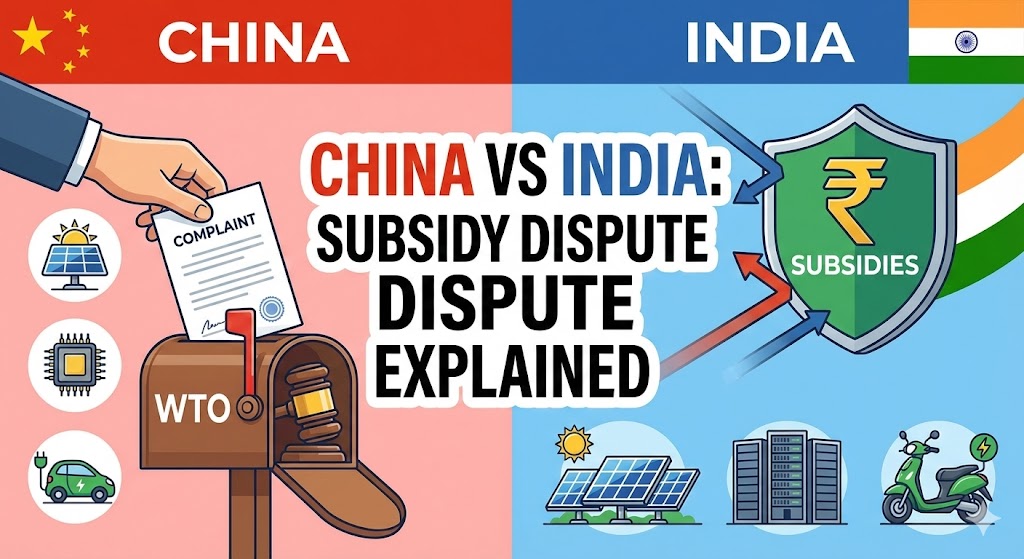
China WTO complaint against India has brought fresh attention to New Delhi’s subsidy-driven industrial strategy in solar energy, information technology, and electric vehicles. China has formally approached the World Trade Organization, alleging that India’s incentive schemes discriminate against imported goods and violate core trade principles. The dispute centers on local content requirements, tariff structures, and production-linked incentives that China claims unfairly benefit domestic manufacturers. As India pushes for self-reliance and supply-chain security, this legal battle exposes a deeper conflict between industrial policy and global trade rules—with implications that extend well beyond bilateral ties.
China WTO Complaint Against India: Why Beijing Approached the WTO?
China WTO complaint against India is not a random diplomatic flex—it is a calculated legal move rooted in trade law, market access, and long-term economic strategy. By approaching the World Trade Organization, China argues that India’s industrial policies in key sectors violate established WTO principles and unfairly disadvantage Chinese exporters.
The immediate trigger behind the China WTO complaint against India is New Delhi’s use of tariffs, subsidies, and local content requirements in sectors where China is a dominant global supplier—especially solar cells, solar modules, IT hardware, and electric vehicles. Beijing claims these measures tilt the playing field in favor of domestic manufacturers while systematically sidelining imported—particularly Chinese—products.
Under WTO rules, member countries are bound by the “national treatment” principle, which requires imported goods to be treated no less favorably than domestically produced goods once they enter the market. China alleges that India’s policies do the opposite. According to the China WTO complaint against India, financial incentives and eligibility for government-backed schemes are linked to minimum local value addition, effectively rewarding companies for using Indian-made components instead of imports. From China’s perspective, this amounts to prohibited import substitution.
A major point of contention in the China WTO complaint against India is the Production Linked Incentive (PLI) Scheme, particularly the National Programme on High Efficiency Solar PV Modules. China argues that incentives under this scheme discriminate against foreign suppliers, especially Chinese firms that have long dominated the global solar supply chain. Any policy designed to reduce import dependence directly impacts China’s commercial interests in the Indian market.
China has also raised concerns over tariff treatment on certain technology products, alleging selective duty structures that create an uneven cost advantage for domestic firms. In WTO terms, Beijing claims violations of GATT 1994, the Agreement on Subsidies and Countervailing Measures (SCM), and the TRIMS Agreement—frameworks meant to keep global trade predictable and non-discriminatory.
It is important to note that requesting consultations is only the first step in the WTO dispute settlement process. Still, the China WTO complaint against India is a clear signal of strategic pressure. If talks fail, Beijing can push for a formal dispute panel, escalating the matter into a prolonged legal battle.
Beyond legal arguments, this dispute reflects deeper geopolitical and economic tensions. India’s push for self-reliance through Make in India and Aatmanirbhar Bharat is seen by China as protectionism under the guise of development policy. Ultimately, this case is not just about subsidies—it is about how far nations can go in protecting domestic industries without crossing global trade red lines.
China WTO Complaint Against India on Solar and IT Subsidies Explained
At the center of the China WTO complaint against India lies a direct challenge to how India is supporting its solar and information technology sectors. Beijing’s allegation is blunt: India’s subsidy framework is designed in a way that systematically favors domestic manufacturers and discourages the use of imported products—particularly those from China—in violation of commitments made at the World Trade Organization.
The most prominent target in the China WTO complaint against India is the Production Linked Incentive (PLI) Scheme for high-efficiency solar photovoltaic (PV) modules. Officially, the scheme aims to strengthen domestic manufacturing capacity, reduce import dependence, and secure supply chains in a strategic sector. China, however, argues that the conditions attached to these incentives cross a red line under WTO rules.
According to China’s submission, eligibility for incentives under the solar PLI scheme depends on minimum local value addition requirements. In simple terms, companies receive greater financial benefits if they source more components domestically rather than importing them. China claims this violates the TRIMS Agreement and GATT 1994, which prohibit policies that link advantages to the use of local goods over imported ones. From Beijing’s perspective, the China WTO complaint against India is about import substitution being disguised as green energy promotion.
The solar sector is particularly sensitive because China dominates global production of solar cells and modules. For years, Indian solar projects have relied heavily on Chinese imports due to lower costs and well-established supply chains. By restructuring subsidies to favor Indian-made modules, New Delhi is effectively reshaping market demand and pushing developers away from Chinese suppliers. China argues that this undermines fair competition and artificially alters trade flows—one of the core arguments in the China WTO complaint against India.
The IT sector faces similar accusations. China alleges that India’s tariff structures and incentive-linked policies in electronics and technology hardware create unequal cost burdens for imported products. While India maintains these measures fall within its bound tariff commitments, China contends that the combined effect of tariffs and subsidies results in discriminatory treatment against foreign manufacturers, with Chinese firms being the primary casualties.
Another layer of the China WTO complaint against India focuses on policy predictability. Beijing argues that frequent changes—such as sudden tariff hikes, shifting eligibility norms, and revised incentive criteria—create uncertainty for foreign firms operating in or exporting to India. Under WTO norms, transparency and stability are expected; China claims India’s approach discourages long-term foreign participation.
India, meanwhile, is likely to defend these measures as developmental and strategic, not protectionist. New Delhi’s argument rests on the need to build domestic capacity in sectors critical to energy security, digital infrastructure, and economic resilience. Reducing over-dependence on a single foreign supplier, India may argue, is a legitimate national objective.
But this is precisely where the clash lies. For China, India’s solar and IT subsidies go beyond domestic growth—they represent a structural exclusion of Chinese products from one of the world’s fastest-growing markets. That perception, combined with widening trade imbalances, explains why Beijing escalated the issue multilaterally instead of resolving it through quiet diplomacy.
In essence, the China WTO complaint against India accuses New Delhi of using subsidies not merely to promote growth, but to engineer market outcomes—a move that, if upheld by the WTO, could reshape how countries pursue industrial policy in an era of strategic competition.
EV Subsidies Under China WTO Complaint Against India: The Electric Mobility Dispute
Electric mobility may look like a climate-first, future-facing policy choice, but under the China WTO complaint against India, it has emerged as a major legal and economic flashpoint. China’s case at the World Trade Organization does not stop at solar panels and IT hardware; it extends firmly into electric vehicle (EV) subsidies, where Beijing believes India has gone too far in tilting the market toward domestic players at the expense of foreign manufacturers, particularly those from China.
India currently operates one of the most generous EV support regimes in the world. Consumers benefit from reduced GST, exemptions or cuts in road tax, direct purchase incentives, and state-level subsidies. On the supply side, manufacturers receive strong backing through Production Linked Incentives (PLI) for advanced automotive and battery technologies. When combined, the total support for certain EV models in India can exceed that offered in most major economies—an issue central to the China WTO complaint against India.
From India’s perspective, this approach is rational policy. The country aims to reduce oil imports, curb urban pollution, meet climate targets, and build an indigenous EV manufacturing ecosystem. From China’s standpoint, however, these subsidies do more than accelerate adoption. Beijing argues that they reshape competition by sidelining foreign manufacturers, especially Chinese firms that dominate global EV batteries, components, and low-cost vehicle segments.
Importantly, China does not claim that EV subsidies themselves are illegal. Under WTO rules, subsidies are permitted. The dispute arises over how the subsidies are structured. According to the China WTO complaint against India, many incentives are directly or indirectly linked to local manufacturing, domestic sourcing, or minimum value addition within India. China argues this violates WTO norms that prohibit subsidies contingent on the use of domestic goods over imported ones.
Another key grievance is the combined impact of subsidies and tariffs. While incentives push consumers toward domestically manufactured EVs, import duties on fully built vehicles and critical components significantly raise the cost of foreign EVs. China claims this dual strategy creates a de facto exclusion of imported electric vehicles, even in the absence of an explicit ban—strengthening the case within the China WTO complaint against India.
This issue matters because China is not a marginal EV exporter; it is the global heavyweight. Chinese companies lead in battery technology, manufacturing scale, and cost efficiency. India’s EV policy framework, however, is clearly designed to prevent Chinese dominance in its domestic market, prioritising Indian firms, joint ventures, and locally integrated supply chains.
China had earlier raised concerns through diplomatic channels, but as EV adoption in India accelerated, the economic stakes grew. What once appeared to Beijing as an experimental industrial policy now looks like a long-term structural barrier to market access. That shift explains why EV subsidies were formally included in the China WTO complaint against India, alongside solar and IT measures.
India is expected to counter that EV subsidies serve legitimate public policy objectives—climate mitigation, energy security, and technological development—and are applied in a non-discriminatory manner. New Delhi may also argue that incentives are available to any firm, regardless of nationality, as long as manufacturing occurs locally.
This is where the dispute becomes legally complex. If a WTO panel is established, it will have to assess intent versus effect: are India’s EV subsidies neutral tools for a green transition, or do they function as instruments of import substitution?
Either way, the EV dimension of the China WTO complaint against India highlights a broader reality. The global clean-energy transition is no longer just about climate goals—it is about trade power, supply chains, and strategic dominance. And electric mobility has become one of the most fiercely contested battlegrounds.
WTO Rules Behind the China WTO Complaint Against India
To understand why the dispute between India and China has escalated to the World Trade Organization, it is essential to decode three core WTO principles that sit at the heart of global trade law: national treatment, local content restrictions, and limits on subsidies. These rules are central to the China WTO complaint against India and determine how far governments can go in protecting domestic industries without breaching international commitments.
The first pillar is national treatment, one of the most fundamental WTO obligations under GATT 1994. In simple terms, once a product enters a country’s market, it must be treated no less favourably than a domestically produced equivalent. While governments are allowed to impose tariffs at the border within agreed limits, imported goods must compete on equal terms thereafter. China argues that India violates this principle by designing policies that appear neutral on paper but, in effect, give domestic products a systematic advantage—an argument central to the China WTO complaint against India.
This brings in the second pillar: local content requirements. Under the TRIMS Agreement, WTO members are prohibited from enforcing measures that require companies to use a certain share of domestic inputs as a condition for receiving benefits. These rules were crafted to prevent countries from forcing import substitution—replacing foreign goods with local ones through regulatory pressure rather than market competition.
China alleges that India’s incentive schemes—particularly in solar, electronics, and electric vehicles—tie financial benefits to domestic value addition. Even where policies do not explicitly ban imports, linking higher incentives to local sourcing produces the same outcome. Under WTO jurisprudence, impact matters more than intent. If a measure discourages imports and favours domestic goods, it can be challenged, as seen in the China WTO complaint against India.
The third pillar concerns subsidy discipline, governed by the Agreement on Subsidies and Countervailing Measures (SCM). Subsidies themselves are not illegal under WTO rules. They are classified as permitted, actionable, or prohibited. The red line is crossed when subsidies are contingent on export performance or on the use of domestic goods over imported ones. Such subsidies fall into the prohibited category.
China’s argument in the China WTO complaint against India is that India’s subsidies, though framed as developmental tools, effectively operate as prohibited import-substitution subsidies. When companies gain greater benefits by avoiding imports, subsidies move from being legitimate policy instruments to potential trade violations.
Another crucial concept is cumulative effect. Even if individual measures—such as tariffs, subsidies, or procurement preferences—are defensible on their own, their combined impact can still breach WTO obligations. China claims that India’s layered strategy—tariffs at the border combined with subsidies inside the market—creates conditions where imported goods, particularly Chinese products, become commercially unviable.
India is expected to counter these claims by emphasising its status as a developing economy and its right to pursue industrial development, energy security, and climate objectives. New Delhi may argue that local manufacturing incentives are essential to reduce strategic dependence and that WTO rules were never intended to lock countries into permanent reliance on imports.
Ultimately, the China WTO complaint against India exposes a deeper tension within the WTO system itself. The rulebook was written in an era of globalisation, not strategic decoupling. Today, governments increasingly prioritise resilience, self-reliance, and control over critical technologies—goals that often collide with traditional free-trade norms.
In short, this dispute is not merely about technical legal violations. It is about whether WTO rules can still accommodate modern industrial policy in a world where economics and geopolitics are deeply intertwined.
China WTO Complaint Against India: What It Means for Trade Relations and Global Supply Chains
With the China WTO complaint against India now formally underway, the real question is not just who wins the case—but what kind of global trade order emerges next. Whatever the outcome, the impact will extend far beyond India and China, reshaping how countries balance industrial policy with trade commitments.
In the short term, the China WTO complaint against India will proceed through the consultation phase at the World Trade Organization, where both sides attempt to find a negotiated settlement. Historically, many disputes are resolved at this stage through quiet compromises and policy adjustments. But given the scale of economic rivalry and the deep trust deficit between India and China, a full WTO dispute panel appears increasingly likely. If that happens, the legal process could stretch over several years.
For India–China trade relations, normalisation looks unlikely anytime soon. Even before the dispute, bilateral trade was heavily skewed, with India running a large and persistent deficit. The China WTO complaint against India is likely to further harden New Delhi’s stance against economic dependence on China, especially in strategic sectors such as clean energy, electronics, and electric mobility. Domestically, the case reinforces the political narrative that India must build local manufacturing capacity—even if it means prolonged legal friction.
China, meanwhile, is sending a clear signal. By invoking WTO rules, Beijing is making it known that it will not quietly concede market access in one of the world’s fastest-growing economies. The China WTO complaint against India also serves as a broader warning to other countries experimenting with aggressive industrial policy under the banners of self-reliance, supply-chain security, and green transition.
Looking at global supply chains, the implications are even more significant. China has long been the backbone of solar manufacturing, EV batteries, and electronics production. India’s push to localise manufacturing is part of a wider global shift—also visible in the United States and the European Union—toward de-risking and diversification. If India’s policies withstand WTO scrutiny, more countries may adopt similar models, even if doing so stretches existing trade rules.
Conversely, if India is forced to dilute or roll back its schemes, domestic manufacturing momentum could slow. That outcome would strengthen China’s position as the default supplier in clean-tech ecosystems worldwide. In that sense, the China WTO complaint against India is not merely about tariffs or subsidies—it is about who controls the future of green manufacturing and critical technologies.
Another plausible outcome is selective compliance. India may revise policy language, recalibrate incentive structures, or introduce technical workarounds that meet WTO obligations on paper while preserving the underlying policy intent. This approach has precedent, and many governments have learned to operate in the grey zone between strict legality and strategic autonomy.
For the WTO itself, the China WTO complaint against India represents a critical stress test. The organisation already faces questions about enforcement capacity and the relevance of rules written in a different economic era. A hard clampdown on industrial policy could sideline the WTO in a world where economic security matters as much as free trade. Ignoring the issue, however, risks eroding the credibility of rule-based commerce altogether.
The bottom line is clear: the China WTO complaint against India marks a shift toward a more legalistic and confrontational phase in India–China economic relations, while global supply chains continue to fragment along strategic lines. This dispute will not reverse that trend—it will accelerate it.
Whether the WTO adapts to this new reality or gets sidelined may prove to be the most consequential outcome of all.
About The Author