

Table of Contents
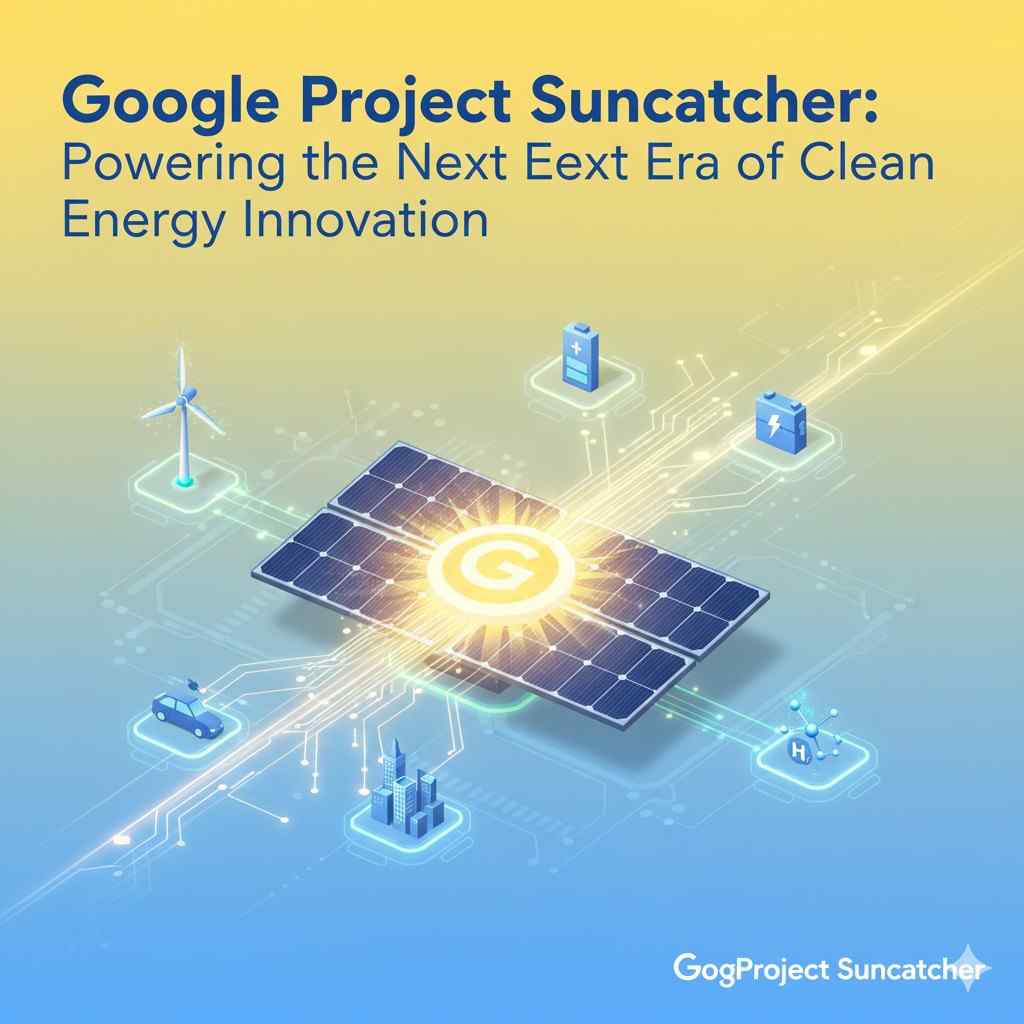
Google Project Suncatcher is Google’s latest move to turn climate ambition into real-world action. At a time when data centers are consuming massive amounts of electricity, Google is experimenting with smarter, more localized clean energy solutions to meet its 24/7 carbon-free energy goal. Project Suncatcher focuses on identifying, forecasting, and optimizing renewable energy generation—especially solar—using AI and advanced data analytics. Instead of relying only on traditional power purchase agreements, Google is testing a more dynamic model that aligns clean energy supply with actual demand. In short, this project reflects how big tech is reshaping the future of sustainable power systems.
What Is Google Project Suncatcher and Why Does It Matter?
Google Project Suncatcher is not just another sustainability buzzword—it’s Google quietly redesigning how clean energy actually works in the real world. For years, big tech companies claimed “100% renewable energy” mainly by buying annual offsets or long-term power purchase agreements (PPAs). Sounds good on paper, but here’s the hard truth: renewable energy isn’t available everywhere, all the time. The sun doesn’t shine at night, wind doesn’t always blow, and data centers don’t take breaks. That mismatch is exactly where Project Suncatcher steps in.
At its core, Project Suncatcher is an experimental initiative by Google to map, forecast, and optimize solar and other renewable energy sources using advanced data analytics and artificial intelligence. Instead of simply buying clean energy somewhere on the grid, Google wants to know when and where clean energy is being produced—and whether it actually matches electricity demand at that moment. This shift moves sustainability from accounting tricks to operational reality.
So, what does Suncatcher actually do? Think of it as a smart energy radar. It uses granular data—weather patterns, solar generation potential, grid conditions, and real-time demand—to identify opportunities where new solar projects can be most effective. The goal isn’t just adding more solar panels randomly, but placing them strategically so they deliver maximum climate impact. That’s a big upgrade from the old “install and forget” mindset.
Why does this matter so much? Because data centers are energy-hungry beasts. AI, cloud computing, YouTube, Search—none of this runs on vibes. As digital demand explodes, electricity consumption rises fast, and if that power isn’t clean at the moment of use, emissions still happen. Project Suncatcher directly supports Google’s ambitious target of 24/7 carbon-free energy—meaning every hour of every day, its operations should run on clean power, not just on an annual average.
There’s also a deeper system-level importance here. By improving forecasting and transparency around renewable generation, Project Suncatcher helps utilities, grid operators, and policymakers understand where clean energy gaps exist. That knowledge can guide smarter investments in solar, storage, and grid infrastructure. In other words, Google isn’t just cleaning its own house—it’s testing a model others can copy.
Another reason Project Suncatcher matters is scale. When Google experiments, markets listen. If this model proves successful, it could change how corporations procure clean energy globally—moving away from symbolic sustainability toward time-matched, location-based decarbonization. That’s the kind of shift climate experts have been asking for years.
Bottom line: Google Project Suncatcher matters because it treats climate action like an engineering problem, not a PR campaign. It respects how energy systems actually behave and tries to fix the weak points with data, technology, and long-term thinking. Old-school problem, new-school solution—and honestly, that’s how real progress is made.
Recent Developments and Pilot Initiatives Under Project Suncatcher
Google isn’t playing small with Project Suncatcher — this thing is a full-on tech moonshot with real movement happening right now. Officially unveiled in late 2025 by Sundar Pichai as a long-term research initiative to scale machine learning compute in space, Project Suncatcher goes beyond theoretical white papers — actual prototypes and timelines are being laid down.
Right out the gate, Google has started foundational research and experimentation into how you’d even build data centers above Earth. The company’s engineers have published early work on designing satellite constellations, figuring out control systems, communication protocols, and testing radiation resilience of its custom AI chips (TPUs) — crucial for surviving space environments where electronics face harsh conditions.
Here’s the first big development: a prototype satellite plan. Google has partnered with Planet Labs to launch two prototype satellites by early 2027. These won’t be full data centers yet, but they will test the core hardware and systems needed for solar-powered AI computing in orbit — from solar panel efficiency to radiation-hard AI chips and the laser-based optical links that could let satellites talk to each other in super-high bandwidth.
The idea isn’t just tech fantasy. In space, solar panels can be up to eight times more productive than on Earth because you can catch uninterrupted sunlight without days and nights interrupting power generation. That means potentially powering compute workloads more consistently, which aligns with Google’s broader push toward 24/7 carbon-free energy — a goal to operate entirely on clean power at every hour of every day.
This prototype phase is basically like building the Lego pieces before the whole model — verifying hardware, communication strategies, orbit control and energy management. Getting these right is huge because space is unforgiving: radiation, temperature swings, and the absence of conventional cooling systems all throw curveballs that Earth-based data centers don’t have to deal with.
Beyond prototypes, the buzz is building across the tech world. Other companies are exploring similar ideas — orbital AI hardware, solar-powered satellites and even mini data centers on the Moon — meaning Project Suncatcher is part of a broader shift toward off-Earth infrastructure. Google’s early public disclosures put it in the driver’s seat of that race, making the initiative not just about internal sustainability, but about potentially setting industry standards.
Also noteworthy: Google’s push isn’t purely academic. They’re already scaling terrestrial renewable energy deals to support these future visions. For example, just recently, Google signed a deal to build a 150 MW solar project in Rajasthan, India, contributing clean power today while the space stuff is being tested for tomorrow.
So what’s the real status?
✔️ Research and design work published on satellite systems and hardware.
✔️ Prototype satellites planned for 2027 to test key tech.
✔️ Industry momentum building around space-based data infrastructure.
✔️ Terrestrial clean energy projects scaling up now to bridge toward future 24/7 carbon-free energy.
In short, Google isn’t just talking space energy tech — it’s building the first steps of it. And that is what makes the recent developments under Project Suncatcher genuinely newsworthy and future-changing. 🌍☀️🚀
How AI and Data Analytics Power Project Suncatcher
Let’s be real: without AI, Project Suncatcher would just be a fancy sustainability idea. With AI, it becomes a precision-engineered system that actually understands how energy behaves in the real world. This is where Google plays to its biggest strength—data at scale and machine intelligence that learns, adapts, and predicts faster than humans ever could.
At the heart of Project Suncatcher is advanced forecasting. Renewable energy, especially solar, is inherently variable. Clouds don’t follow schedules, seasons shift demand patterns, and grids operate under local constraints. Google uses machine learning models trained on massive datasets—satellite imagery, historical weather data, real-time atmospheric conditions, and grid performance metrics—to predict solar generation with high temporal and geographic accuracy. Instead of rough daily averages, Suncatcher works at an hour-by-hour, location-specific level. That granularity is the difference between symbolic green energy and actual carbon reduction.
AI also plays a crucial role in matching energy supply with demand. Google’s data centers consume power continuously, but not uniformly. Workloads spike and dip depending on user behavior, AI training cycles, and regional usage patterns. Using predictive analytics, Google can anticipate when and where demand will rise and align it with expected clean energy availability. This allows smarter scheduling of compute tasks—pushing energy-intensive operations to times and locations where solar or wind power is abundant. Old-school grids react after the fact; Suncatcher’s AI plans ahead.
Another key layer is site selection and optimization. Data analytics helps identify where new solar projects will deliver the highest climate impact. Instead of just looking for cheap land or high sunlight averages, AI evaluates grid congestion, fossil fuel displacement potential, local demand profiles, and transmission constraints. The result? Solar installations that don’t just exist, but actually matter. This is surgical decarbonization, not blanket deployment.
AI also improves grid interaction and transparency. By modeling how clean energy flows through the grid, Suncatcher highlights gaps—hours when fossil fuels still dominate despite renewable capacity being present elsewhere. These insights can guide investments in battery storage, demand response systems, and grid upgrades. In effect, Google’s internal analytics become a diagnostic tool for the wider energy ecosystem.
What’s especially forward-looking is how feedback loops are built into the system. As real-world outcomes differ from predictions—as they always do—the AI models retrain themselves. Weather forecasts improve, demand estimates sharpen, and energy matching becomes more precise over time. This self-learning architecture is classic Google: deploy, measure, refine, repeat.
Why does all this matter? Because the future of clean energy isn’t just about generating more power—it’s about using power intelligently. AI turns renewables from an intermittent resource into a managed, predictable system. Project Suncatcher proves that climate goals don’t have to rely on sacrifice or slowdown; they can be achieved through optimization and smarter design.
Bottom line: AI and data analytics are the brain of Project Suncatcher. Solar panels may catch the sun, but algorithms decide how effectively that sunlight becomes real, usable, carbon-free energy. Tradition gave us electricity; intelligence will decide how clean it becomes.
Role of Project Suncatcher in Google’s 24/7 Carbon-Free Energy Goal
Google’s promise of running on 24/7 carbon-free energy (CFE) isn’t marketing fluff—it’s one of the toughest climate targets any global corporation has ever set. Not “net-zero,” not annual offsets, not accounting gymnastics. The goal is brutally simple and brutally hard: every hour of every day, in every location, Google’s electricity use should be matched with clean energy. Project Suncatcher sits right at the center of making that goal even remotely achievable.
Until now, most companies—including Google in its earlier phase—claimed 100% renewable energy on an annual basis. That meant if a data center ran on coal power at 2 a.m., it could be “balanced” by solar generation at noon somewhere else. Climate-wise, that’s weak sauce. Emissions happen in real time, and the atmosphere doesn’t care about yearly averages. Project Suncatcher exists to kill this mismatch between when energy is used and when it’s clean.
Suncatcher enables time-matching, the core principle behind 24/7 CFE. By using AI-driven forecasting, Google can know—hour by hour—how much carbon-free energy is available on the grid near each data center. When clean energy is abundant, workloads can be ramped up. When it’s scarce, operations can shift to other regions, rely on storage, or temporarily reduce non-critical compute. This turns Google’s global infrastructure into a flexible system that bends around clean energy availability instead of blindly consuming power.
Another critical role of Project Suncatcher is location-based decarbonization. Google operates in dozens of grids worldwide, each with different energy mixes. Some grids are already renewable-heavy; others still lean heavily on coal or gas. Suncatcher helps identify the dirtiest hours and places on each grid and directs clean energy investments precisely there. That means new solar or wind projects aren’t just increasing capacity—they’re displacing fossil fuels where it counts most.
Project Suncatcher also strengthens investment decisions for 24/7 CFE. Google can now decide whether a new solar farm, wind project, or battery storage system will actually close a clean-energy gap during high-emission hours. This avoids the trap of overbuilding renewables that generate power when it’s not needed. The result is smarter capital allocation and faster progress toward full carbon-free operations.
Equally important is transparency. Through Suncatcher’s analytics, Google measures its CFE score—the percentage of hours in which operations are powered by clean energy. This moves sustainability from vague claims to measurable performance. If a data center hits 92% CFE, the remaining 8% becomes a clearly defined engineering and policy challenge, not a PR inconvenience.
Zooming out, Project Suncatcher turns Google’s 24/7 CFE goal into a systems problem, not a moral appeal. It treats climate action the way engineers treat reliability or uptime: measure precisely, optimize continuously, and fix the weakest link first. That mindset is why Google has made more progress on 24/7 CFE than almost any other company on the planet.
Straight up: without Project Suncatcher, 24/7 carbon-free energy would remain a nice ambition. With it, the goal becomes a roadmap—difficult, expensive, but technically achievable. That’s the difference between climate promises and climate execution.
Global Impact and What Project Suncatcher Means for the Clean Energy Sector
Project Suncatcher isn’t just a Google-only experiment—it’s a signal to the entire global clean energy ecosystem that the rules of the game are changing. For decades, renewable energy growth focused on capacity: more solar panels, more wind turbines, bigger numbers on paper. Project Suncatcher shifts the conversation to something far more mature and frankly overdue—quality, timing, and impact of clean energy.
At a global level, the biggest contribution of Project Suncatcher is popularizing time-based and location-based clean energy accounting. When a company as influential as Google starts saying “annual averages aren’t enough,” regulators, investors, and utilities listen. This pushes the clean energy sector toward more honest metrics—measuring emissions reductions when and where electricity is actually consumed. Over time, this could reshape how climate targets are defined under national policies and international frameworks.
For renewable energy developers, Suncatcher changes incentives. Instead of building projects wherever land is cheap or subsidies are generous, developers are encouraged to focus on high-impact zones—regions and hours where fossil fuel displacement is maximum. This leads to smarter project siting, better grid integration, and higher real-world emissions reduction per unit of investment. In simple terms: fewer vanity projects, more meaningful ones.
Project Suncatcher also accelerates demand for energy storage and grid flexibility solutions. Once companies start caring about hourly clean energy matching, batteries, pumped hydro, green hydrogen, and demand-response systems stop being “optional add-ons” and become core infrastructure. This is huge for innovation. Storage startups, grid software firms, and flexibility providers suddenly find themselves essential players, not side characters.
Another global impact is corporate climate leadership pressure. When Google raises the bar to 24/7 carbon-free energy and backs it with data-driven systems like Suncatcher, it exposes how shallow many corporate net-zero claims really are. This creates a competitive push—no company wants to look lazy or outdated. Over time, this peer pressure effect could drive entire sectors—tech, finance, manufacturing—toward deeper decarbonization strategies.
For developing countries, including India, the implications are especially important. Project Suncatcher-style analytics can guide renewable expansion in fast-growing grids where electricity demand is rising sharply. Instead of repeating the mistakes of fossil-heavy development, emerging economies can leapfrog toward optimized renewable systems—where clean power growth is aligned with actual demand patterns. That’s climate justice with engineering muscle behind it.
From a policy perspective, Suncatcher strengthens the case for data transparency in energy markets. Governments can use similar models to identify peak-emission hours, design smarter tariffs, and prioritize grid upgrades. Climate policy stops being ideological and becomes operational—focused on fixing bottlenecks rather than arguing intentions.
Zoom out even further, and the real legacy of Project Suncatcher becomes clear: it reframes clean energy as a systems challenge, not a checkbox. It says the future isn’t just renewable—it’s intelligent, adaptive, and accountable. Solar panels alone won’t save the planet. Smart deployment, smart usage, and smart measurement just might.
Final truth bomb: Project Suncatcher proves that the clean energy transition is entering its grown-up phase. Less hype, more math. Less slogans, more systems. And honestly? That’s exactly how lasting change has always happened.
About The Author











Leave a Reply