

Table of Contents
India’s journey toward simplifying and modernizing its labour landscape took a major turn with the nationwide implementation of the four Labour Codes. These codes — on Wages, Social Security, Industrial Relations, and Occupational Safety & Health — aim to streamline over 29 existing labour laws into a unified, business-friendly, and worker-centric framework. As India positions itself for rapid economic growth, these reforms promise greater transparency, ease of compliance, and improved welfare for millions of workers. But with major structural changes come big questions: how will employers adapt, and what impact will workers feel on the ground? This blog breaks it all down.
Understanding India’s Four Labour Codes: A Quick Overview
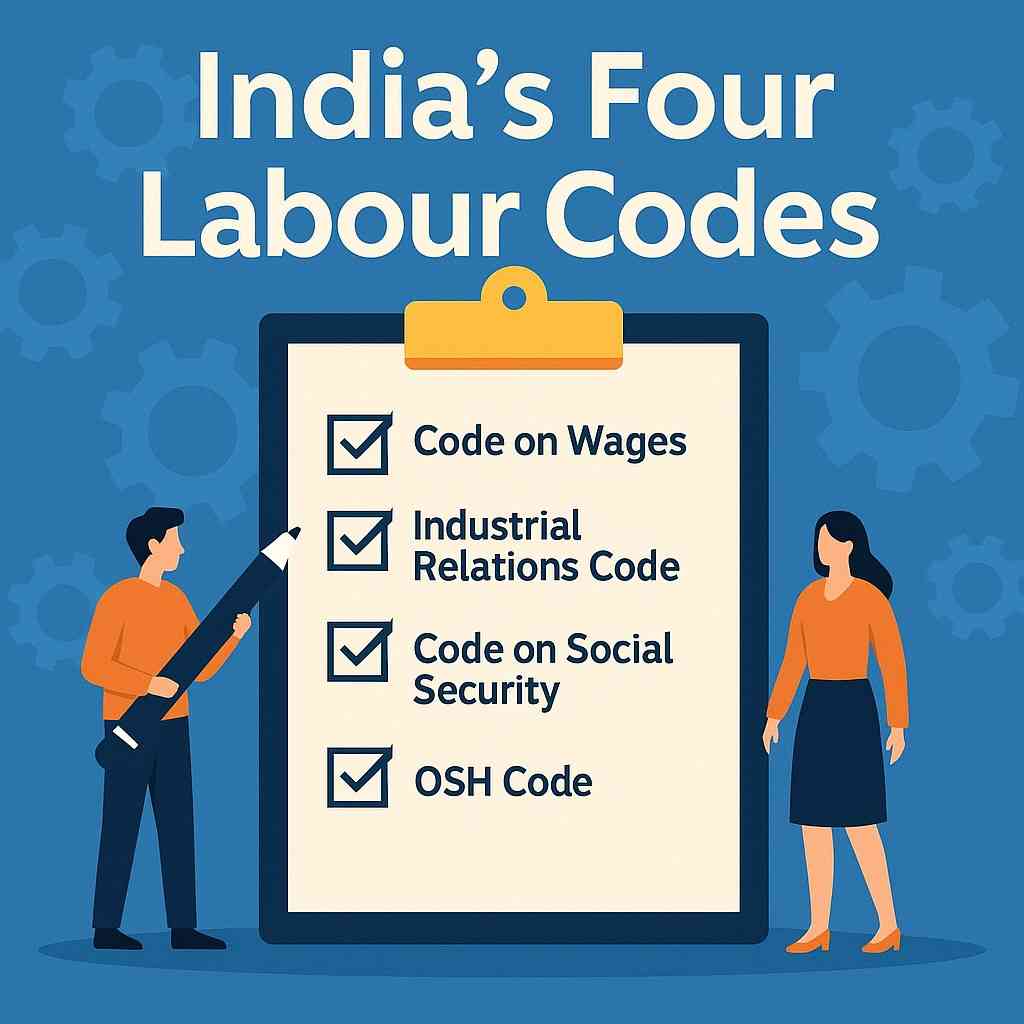
India’s labour ecosystem has historically been a maze of complex, overlapping, and outdated laws. With more than 29 central labour legislations scattered across different sectors, industries often struggled with compliance, while workers faced inconsistent protections. To fix this, the Government of India rolled out a major reform: consolidating these scattered laws into four comprehensive Labour Codes. These codes aim to modernize, simplify, and unify the country’s labour regulations, making them more relevant to the 21st-century workforce.
The four Labour Codes are:
- The Code on Wages, 2019
- The Industrial Relations Code, 2020
- The Code on Social Security, 2020
- The Occupational Safety, Health and Working Conditions (OSH) Code, 2020
Each code addresses a core aspect of employment, ensuring that workers’ rights and employers’ responsibilities are aligned under a uniform structure. Let’s break them down in a straightforward way.
1. Code on Wages, 2019
This code merges four previous wage-related laws, including the Minimum Wages Act and Payment of Wages Act. The goal is to ensure uniform wage definitions, timely payments, and universal minimum wages across all industries. One of the most significant reforms here is the introduction of a single “wage” definition, which affects calculations for PF, gratuity, and other benefits. The code also ensures transparency in setting floor wages, protecting workers from exploitation while giving employers a clear compliance path.
2. Industrial Relations Code, 2020
This code focuses on how employers and workers interact. It combines laws related to industrial disputes, trade unions, and conditions for layoffs and retrenchments. The IR Code aims to balance workers’ rights with the need for businesses to remain flexible. It introduces provisions like fixed-term employment, simpler closure norms, and a more structured dispute resolution system. By creating clarity on strikes, lockouts, and negotiation frameworks, the IR Code attempts to reduce conflicts and promote smoother industrial relations.
3. Code on Social Security, 2020
A major step towards inclusive welfare, this code expands social security benefits to a wider workforce, including gig workers, platform workers, and unorganized sector employees. It consolidates laws related to EPF, ESI, maternity benefits, gratuity, and more. With digital records and unified registration, the aim is to ensure that workers — regardless of their employment type — can access essential protections. This code symbolizes India’s shift towards recognising newer forms of employment created by the digital economy.
4. OSH Code, 2020
Safety and well-being at workplaces get special focus under this code. It brings together multiple laws related to health, safety, and working conditions across industries. Key areas covered include working hours, leave policies, safety norms, and workplace welfare measures. The code lays down clearer responsibilities for employers, especially in hazardous sectors, while empowering workers with safer environments and grievance mechanisms.
Key Changes Introduced Under the New Labour Framework
The nationwide implementation of India’s four Labour Codes marks one of the biggest overhauls in the country’s labour ecosystem since Independence. By merging 29 existing laws into four streamlined codes, the government aims to create a regulatory environment that is simpler, more transparent, and aligned with global labour standards. These changes are not just cosmetic — they redefine how wages are calculated, how employers hire and manage workers, how industries ensure safety, and how millions of workers receive social security.
Here are the most important changes that shape this new labour landscape:
1. Uniform Definition of Wages
One of the biggest and most impactful reforms is the introduction of a standardized definition of “wages.” Earlier, the wage structure varied across laws, creating confusion in calculating PF, gratuity, and bonuses.
Under the new framework:
- Allowances cannot exceed 50% of total wages.
- Basic salary becomes the backbone for calculating social security contributions.
This ensures consistency and prevents employers from manipulating wage components to reduce statutory payouts.
2. Floor Wages Across the Nation
The Code on Wages introduces the concept of national floor wages, set by the central government. States cannot fix minimum wages below this threshold.
This change:
- Protects low-income workers
- Brings uniformity across states
- Controls exploitation in labour-intensive sectors
For employers, it offers a clear, unified wage benchmark.
3. Simplified Hiring Through Fixed-Term Employment
Earlier, companies hesitated to hire full-time workers due to rigid labour laws. The new codes formally recognise fixed-term employment, allowing companies to hire workers for specific durations with all the benefits of permanent employees — except retrenchment compensation.
This creates a win-win:
- Employers get flexibility
- Workers get benefits like PF, ESI, and gratuity (even for one year of service)
4. Stricter Rules for Strikes and Lockouts
The Industrial Relations Code introduces a more regulated system for industrial strikes. Workers in all industries — not just public utilities — must now:
- Give a 14-day notice before striking
- Avoid strikes during conciliation proceedings
This aims to reduce sudden disruptions and encourage negotiation over conflict.
5. Wider Social Security Cover for Gig and Platform Workers
For the first time, gig workers, platform workers, and unorganized sector workers are officially included in a social security framework.
The new code allows:
- ESIC and EPF benefits (in phases)
- Government and aggregator-funded welfare schemes
This is a landmark move considering India’s rapidly growing app-based workforce.
6. Consolidated Compliance Through Digital Systems
The new framework pushes for digital labour records, single registration, and unified returns. This means:
- Less paperwork
- Faster compliance
- Easier audits
Digitalisation reduces corruption and delays while improving transparency.
7. Stronger Safety Standards and Working Conditions
Under the OSH Code, employers must ensure better workplace safety, especially in high-risk sectors like construction, mining, and factories.
Some changes include:
- Mandatory annual health checkups
- Clear working hour limits
- Stricter licensing rules for contractors
This makes the workplace safer and more accountable.
Impact on Workers: Benefits, Challenges, and Concerns
The nationwide rollout of India’s four Labour Codes promises a major shift in how workers experience job security, wages, and social protection. While the reforms aim to improve worker welfare and create a more organised labour market, the actual impact on the ground is a blend of big wins, genuine concerns, and transitional challenges. For millions of workers across formal, informal, gig, and platform sectors, the new framework brings change that is both exciting and complicated.
1. Benefits for Workers
a. Better Wage Protection and Timely Payments
With the new uniform wage definition and national floor wage, workers are more likely to receive fair earnings. The codes mandate:
- Timely payment of wages
- Clearly defined overtime rules
- Protection from arbitrary wage deductions
This strengthens the financial security of low-income and vulnerable workers.
b. Expanded Social Security Access
For the first time, gig workers and platform workers — such as delivery partners, cab drivers, and app-based service providers — are included under social security.
Benefits include:
- Access to future EPF and ESIC schemes
- Government-funded insurance and pension programs
- Stronger welfare boards for unorganized workers
This makes India’s labour system more inclusive and future-ready.
c. Safer Working Environments
Under the OSH Code, workers across factories, construction sites, and hazardous units get enhanced safety measures.
Key improvements:
- Mandatory health check-ups
- Better housing and sanitation facilities
- Clear maximum working hours
This strengthens workers’ dignity and reduces workplace accidents.
d. More Stable Industrial Relations
The IR Code aims to reduce sudden strikes and lockouts, encouraging negotiation over conflict. This promotes stability and reduces the fear of abrupt work stoppages that often hurt daily-wage workers the most.
2. Challenges Workers May Face
a. Higher PF Deductions Could Reduce In-Hand Salary
Due to the new wage definition (where basic salary becomes 50% of total pay), PF contributions may increase.
This means:
- Long-term benefits increase
- BUT monthly take-home pay may drop
For workers already living on tight budgets, this is a significant concern.
b. Risk of Job Insecurity Under Fixed-Term Employment
While fixed-term jobs offer benefits like gratuity and PF, employees may worry about:
- Short contract durations
- Uncertain renewals
- Lack of long-term stability
Companies may prefer contract-based hiring over permanent roles, creating anxiety among workers.
c. Difficult Transition for Informal Sector Workers
India’s informal workforce (over 80%) may struggle with:
- Digital registration
- Documentation
- Lack of awareness about benefits
Without active government outreach, millions may remain outside the system.
3. Major Concerns Expressed by Workers and Unions
a. Limited Role of Trade Unions
New regulations on strikes, lockouts, and registration of unions may weaken collective bargaining power. Workers worry this could tilt the balance toward employers.
b. Implementation Gaps Across States
Labour is a concurrent subject, meaning states must frame their own rules. Delays or inconsistencies across states can cause confusion and unequal protections.
c. Fear of Increased Workload
With new compliance rules, some industries may push workers toward longer hours or tighter performance metrics.
How Businesses Will Adapt to the New Compliance Structure
The nationwide implementation of India’s four Labour Codes has pushed businesses into a new era of compliance. Companies now have to rethink their HR policies, payroll structures, hiring practices, and labour management systems. While the reforms aim to simplify the legal environment, the transition phase demands careful adjustments. Businesses that adapt early will enjoy smoother operations, reduced legal risks, and improved relationships with their workforce.
Here’s a deep dive into how businesses are expected to respond and realign under the new labour framework:
1. Redesigning Salary Structures
The new, uniform definition of wages has a major impact on salary components. Since allowances cannot exceed 50% of total wages, companies must restructure existing pay packages.
Businesses will need to:
- Rebalance basic pay, HRA, and allowances
- Recalculate PF, ESI, and gratuity contributions
- Update employment contracts to reflect revised wage definitions
This may lead to higher social security contributions for employers, but greater transparency and stability in wage policies.
2. Upgrading Digital Compliance Systems
The new Labour Codes push for digitisation through single registration, unified returns, and online record-keeping.
Businesses will adapt by:
- Implementing HRMS and payroll software
- Adopting digital attendance and wage payment systems
- Maintaining e-records for audits and inspections
This shift reduces paperwork, prevents duplication, and improves overall compliance efficiency.
3. Reworking Hiring and Workforce Planning
Fixed-term employment and flexible exit norms change how companies approach staffing.
Businesses are likely to:
- Increase fixed-term and project-based hiring
- Reduce long-term hiring risks
- Maintain leaner, more agile teams
Startups, manufacturing units, and service industries with seasonal demands may especially benefit from this flexibility.
4. Strengthening Workplace Safety and Welfare Programs
The OSH Code introduces stricter norms for safety, health, and working conditions. Industries like construction, mining, logistics, and manufacturing must upgrade their safety protocols.
This includes:
- Conducting regular safety audits
- Providing protective gear and training
- Ensuring better sanitation and housing (where applicable)
- Offering periodic medical check-ups
While this increases operational costs initially, it reduces accidents, compensation claims, and downtime in the long run.
5. Adapting IR Strategies for Industrial Stability
With new strike notice rules and redefined thresholds for layoffs and closures, businesses must refine their industrial relations strategy.
Companies will need to:
- Strengthen communication channels with workers
- Train HR teams in dispute management
- Establish internal grievance redressal systems
- Promote transparent decision-making
A proactive approach reduces disruptions and builds trust between management and workers.
6. Onboarding Gig and Platform Workers into Social Security
Companies employing gig workers — like delivery services, app-based platforms, and ride-hailing services — now share responsibility for social security contributions.
Businesses must adapt by:
- Creating welfare schemes
- Partnering with government programs
- Building digital processes to track gig workers’ contributions
This helps formalize India’s rapidly growing gig economy.
7. Managing Increased Compliance Costs
While the codes simplify laws, initial compliance expenses may rise.
Costs may include:
- HR system upgrades
- Legal consultations
- Increased PF/ESI contributions
- Safety improvements
Forward-thinking companies treat these as long-term investments that improve productivity, worker satisfaction, and brand reputation.
The Road Ahead: Opportunities and Implementation Challenges
The nationwide implementation of India’s four Labour Codes is not just a legal reform—it’s a structural shift that will shape how India works, hires, and grows in the coming decades. While these reforms promise modernization and clarity, their success ultimately depends on how effectively they are executed on the ground. The road ahead is filled with major opportunities, but also practical challenges that India must navigate carefully.
1. Opportunities Ahead
a. A Simplified and Business-Friendly Environment
By consolidating 29 laws into four streamlined codes, India reduces the compliance burden on businesses. This makes India more competitive, especially for:
- Foreign investors
- Manufacturing companies
- Startups expanding rapidly
A cleaner legal structure attracts investment and encourages job creation.
b. Improved Social Security for Millions
With gig workers, platform workers, and unorganized laborers finally included in social protection, India moves toward a more inclusive welfare system. As the digital workforce grows, these benefits will reduce vulnerability and improve workers’ long-term stability.
c. Stronger Formal Workforce Growth
Clear rules on wages, working hours, benefits, and safety help shift India’s massive informal workforce into the formal sector. A more formal workforce means:
- Higher tax revenues
- Better worker protection
- More predictable business operations
d. Technological Modernization in Labour Management
The push for digital compliance—single registration, online record-keeping, and unified returns—encourages companies to adopt advanced HR automation tools. This will:
- Boost transparency
- Reduce corruption
- Create real-time governance
Digitalisation ultimately creates a smarter and more accountable labour ecosystem.
2. The Challenges on the Path
a. Uneven Implementation Across States
Labour is a concurrent subject, meaning states must create their own rules under the central codes. Some states are prepared, while others lag behind.
This can lead to:
- Inconsistent application
- Worker confusion
- Compliance headaches for companies operating in multiple states
b. Resistance from Workers and Trade Unions
Changes in strike rules, union recognition, and retrenchment thresholds have triggered concerns among labour groups. Some fear the codes may dilute workers’ bargaining power.
Without proper dialogue, this resistance may slow down effective adoption.
c. Compliance Cost for Small Businesses
MSMEs may struggle with:
- Digital compliance requirements
- Safety upgrades
- Higher PF/ESI contributions
While large corporations can adapt faster, smaller businesses may find the transition challenging unless supported through training and incentives.
d. Awareness Gap Among Informal and Gig Workers
Millions of workers still lack awareness about the new labour benefits, digital registrations, and welfare schemes.
If not addressed through campaigns and outreach programs, a large part of the workforce may remain excluded from the benefits.
3. What Needs to Happen for Smooth Implementation
To unlock the full potential of the Labour Codes, India needs:
- State-level readiness through faster rule-making
- Robust digital infrastructure for easy compliance
- Regular training for employers and HR teams
- Widespread awareness campaigns for workers
- Strong monitoring and grievance systems to ensure fairness
Conclusion: A Transformative Journey
The Labour Codes mark a milestone in India’s economic transformation. They offer a pathway to a more structured, transparent, and worker-friendly environment. But the real outcomes will depend on consistent implementation, cooperation between states and the Centre, and active participation from both employers and workers. If executed well, this reform can push India toward a stronger, fairer, and more future-ready labour ecosystem.
About The Author











Leave a Reply