

Table of Contents
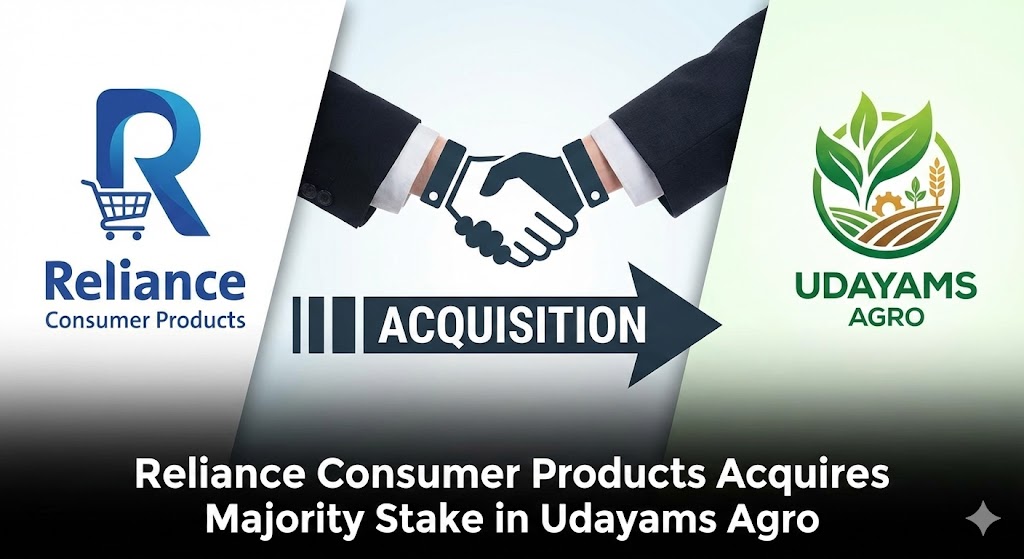
RCPL Udayams Agro acquisition marks a decisive shift in India’s fast-moving consumer goods (FMCG) landscape. By acquiring a majority stake in Udayams Agro Foods, Reliance Consumer Products Limited has signaled its intent to dominate the staples and everyday nutrition segment. This move is not about short-term expansion, but about securing long-term control over high-volume, trust-driven food categories such as rice, pulses, spices, and breakfast mixes. Backed by Reliance’s vast retail and distribution network, the acquisition combines regional brand credibility with national-scale execution, positioning RCPL as a serious challenger to established FMCG leaders.
Why the RCPL Udayams Agro Acquisition Matters in India’s FMCG Landscape?
This deal isn’t just another corporate acquisition—it’s a signal. When Reliance Consumer Products Limited picks up a majority stake in Udayams Agro Foods Private Limited, it’s basically saying: “India’s real FMCG battle is in staples, not just snacks and soda.” And honestly? That read is spot on.
India’s FMCG market has matured. Premium products grab headlines, but the real volume—and real loyalty—still lives in everyday essentials: rice, pulses, idli batter, spices, breakfast mixes. These aren’t impulse buys; these are habit buys. Once a household trusts a brand for staples, switching is rare. That’s the kind of stickiness every FMCG giant wants.
Udayams brings exactly that. For over three decades, it has built deep-rooted trust in Tamil Nadu, especially in breakfast and staple food categories. This isn’t a startup brand chasing discounts—it’s a kitchen staple for millions. RCPL isn’t buying factories alone; it’s buying consumer belief, which is way harder to build than infrastructure.
For Reliance, timing matters. RCPL has already cracked beverages, edible oils, and packaged foods, but staples were the missing piece. With Udayams, RCPL now gets instant credibility in a category that otherwise takes years to penetrate. Instead of starting from zero, Reliance is fast-forwarding straight into relevance.
The FMCG landscape also explains why this deal matters now. Urban consumption is stabilising, rural demand is price-sensitive, and consumers are actively downshifting from loose, unbranded products to trusted packaged staples. That transition is where the next decade of FMCG growth sits. Reliance clearly wants to own that curve early.
Then there’s the distribution angle—this is where things get spicy. Udayams was strong regionally, but scale was its natural limitation. RCPL brings India’s largest retail and logistics network into play. Overnight, a South-focused brand gets a pan-India highway. Very few FMCG companies can pull that off without bleeding cash.
This deal also sharpens competition. Players like Tata Consumer Products, iD Fresh Food, and MTR have dominated staples and breakfast foods through brand legacy. Reliance entering this space with scale + pricing power changes the math completely. Expect tighter margins, aggressive expansion, and faster product innovation across the sector.
From a bigger-picture lens, the RCPL–Udayams deal reflects how Indian FMCG is evolving:
- From flashy launches → daily consumption dominance
- From regional brands staying regional → nationalisation through partnerships
- From private labels → full-fledged consumer brands
Bottom line? This acquisition matters because it strengthens Reliance where FMCG wars are actually won—inside Indian kitchens, every single day. It’s not loud, but it’s lethal. And in FMCG, boring staples often deliver the biggest victories.
Inside the Deal: Stake, Valuation, and What Reliance Really Bought
On paper, this looks like a straightforward acquisition. In reality? It’s a precision strike. When Reliance Consumer Products Limited acquired a majority stake in Udayams Agro Foods Private Limited, it wasn’t just buying shares—it was buying time, trust, and traction.
Let’s break it down cleanly.
RCPL picked up around 76% stake in Udayams through a preferential allotment, investing roughly ₹380 crore. Industry estimates peg the overall deal valuation at about ₹668 crore. Reliance hasn’t officially confirmed the final number—and honestly, that’s classic Reliance. They rarely talk numbers when strategy is the real headline.
Now here’s the part people miss: Reliance didn’t go for a 100% buyout. The original promoters, S. Sudhakar and S. Dinakar, continue to hold a minority stake and stay involved operationally. That’s intentional. In FMCG—especially food—local know-how, sourcing relationships, and cultural taste preferences matter more than boardroom control. Reliance chose continuity over disruption, which is smart, not soft.
So what exactly did Reliance “really” buy?
First, a profitable, running business, not a turnaround case. Udayams isn’t a loss-making startup burning cash on ads. It’s a mature brand with steady demand in staples like rice, pulses, spices, snacks, and breakfast mixes. That means immediate revenue contribution—not “maybe in five years” projections.
Second, manufacturing and sourcing capability rooted in South India. Building food-grade processing units, supplier networks, and quality controls takes years. Reliance skipped that learning curve entirely. This gives RCPL faster capacity expansion without massive capex upfront.
Third—and this is gold—consumer trust. Udayams has been in Tamil households for decades. That loyalty is not bought through discounts or influencer reels. It’s built slowly, generation by generation. Reliance can scale factories, but trust? That’s rare currency. This deal handed them a loaded wallet.
Fourth, Reliance bought optionality. With RCPL’s distribution muscle, Udayams can be:
- Expanded pan-India
- Extended into adjacent categories
- Repositioned as value or mass-premium depending on region
That flexibility alone justifies the valuation.
From a valuation perspective, the deal makes sense. Staples companies don’t trade at flashy tech multiples, but they offer predictable cash flows and volume-led growth. For Reliance, this fits perfectly with its strategy of growing FMCG volumes rather than chasing margin-heavy premium niches only.
Also worth noting: the acquisition was executed via a joint venture structure, not an outright absorption. That keeps regulatory friction low and operational agility high. Again—very Reliance-coded.
Bottom line? Reliance didn’t just buy 76% equity. It bought:
- A shortcut into staples
- A brand with emotional equity
- A scalable food platform
- And a defensive moat against FMCG rivals
Not loud. Not flashy. But extremely calculated. This is how market leaders quietly widen the gap.
Udayams Agro: From Regional Trust to National Brand Ambition
Before the deal hype, before valuations and strategy decks, Udayams Agro was something far more powerful—a trusted household name. Especially in Tamil Nadu, Udayams wasn’t just another FMCG brand sitting on a shelf; it was part of the daily routine. That’s exactly why Reliance Consumer Products Limited didn’t try to build a staples brand from scratch and instead chose to scale Udayams Agro Foods Private Limited.
Udayams’ strength lies in how it grew—slow, steady, and deeply rooted. For over three decades, the brand focused on core kitchen essentials: rice, pulses, spices, snacks, idli batter, edible oils, and sugar. No over-branding, no aggressive pan-India push. Just consistent quality at the right price. In traditional Indian households, that matters more than glossy ads.
This regional trust is priceless. In FMCG, especially food, consumers don’t experiment lightly. What your family has eaten for years becomes default. Udayams earned that default status across large parts of South India. That’s not something money alone can buy—and Reliance knows it.
But here’s the catch: regional brands often hit a scale ceiling. Distribution costs rise, marketing budgets balloon, and supply chains strain when you try to go national alone. Many strong regional brands either stagnate or dilute quality chasing expansion. That’s where Reliance enters the picture—not to replace Udayams’ identity, but to unlock its next phase.
With Reliance’s retail and logistics backbone, Udayams now has the infrastructure to dream bigger. A brand that was once limited by geography can now travel across states without losing consistency. The idea isn’t to turn Udayams into a generic national label overnight. It’s to keep its regional authenticity, while giving it national reach.
This is a classic FMCG play that has worked globally:
- Keep the brand’s soul intact
- Scale operations quietly
- Let distribution, not advertising noise, do the heavy lifting
Reliance has done this before—nurturing brands instead of bulldozing them. Expect Udayams to expand category-by-category, market-by-market, rather than a sudden nationwide splash.
Another key factor is taste localisation. Indian food preferences change every few hundred kilometres. Udayams already understands this at a micro level. With Reliance’s data and supply chain intelligence, the brand can now adapt products regionally while operating at national scale—a deadly combo.
For consumers, this transition will feel subtle. The packaging may evolve, availability will increase, and pricing will stay competitive. But the taste and trust—the real brand equity—will remain unchanged. That’s intentional.
In essence, Udayams is moving from being a regional champion to a national contender, without losing what made it special. Reliance didn’t buy Udayams to repaint it. It bought it to amplify it.
And if this expansion is executed right, Udayams could become one of those rare Indian FMCG brands that feels local everywhere—yet is available everywhere.
Reliance’s FMCG Playbook: Retail Power, Pricing, and Distribution
If there’s one thing Reliance Consumer Products Limited understands better than anyone in India, it’s this: FMCG is not won on ads—it’s won on shelves. And Reliance owns more shelves than anyone else. That’s the real engine behind its FMCG strategy, and the Udayams acquisition plugs straight into this system.
Reliance’s biggest unfair advantage is its retail ecosystem. With over 18,000+ stores across India, spanning supermarkets, neighbourhood outlets, wholesale formats, and digital platforms, Reliance doesn’t enter markets—it arrives fully formed. For an FMCG brand, distribution is often the hardest and most expensive hurdle. For Reliance, it’s already solved.
This is where the playbook gets ruthless (in a good way). New or acquired FMCG brands under RCPL don’t have to beg distributors or burn cash on visibility. They get instant national exposure, faster inventory turnover, and real-time demand data. That speed is something traditional FMCG players struggle to match.
Pricing is the second lever—and Reliance pulls it hard. RCPL follows a volume-first strategy, not margin obsession. By keeping prices competitive, sometimes even undercutting rivals, Reliance focuses on market share capture. In a price-sensitive country like India, that’s not optional—it’s survival.
How does Reliance afford this? Scale. Bulk sourcing, centralized procurement, and hybrid manufacturing models allow RCPL to control costs tightly. In-house production is combined with contract manufacturing and regional sourcing, ensuring flexibility without bloated overheads. This isn’t flashy, but it’s deadly efficient.
Distribution is where everything comes together. Reliance’s supply chain connects farmers, processors, warehouses, and retail endpoints in one loop. That shortens lead times, reduces wastage, and stabilises prices—especially critical for food and staples. For a brand like Udayams Agro Foods Private Limited, this means fewer bottlenecks and wider reach without compromising quality.
Another underappreciated weapon is data. Reliance tracks consumer buying behaviour across offline and online platforms at massive scale. That insight helps tweak pack sizes, pricing bands, and regional assortments with surgical precision. FMCG giants used to rely on quarterly reports; Reliance operates almost in real time.
Then there’s kirana integration. Rather than replacing small stores, Reliance feeds them. Through wholesale and B2B models, RCPL ensures its products reach even the smallest neighbourhood shops. That’s critical in India, where kiranas still dominate everyday consumption.
Put simply, Reliance’s FMCG playbook runs on three pillars:
- Retail control → guaranteed visibility
- Aggressive pricing → rapid adoption
- Deep distribution → sustained volume growth
The Udayams deal fits perfectly into this machine. A trusted food brand plus Reliance’s scale is not just expansion—it’s acceleration.
In FMCG, the company that controls access controls outcomes. And right now, Reliance controls access better than anyone else.
Competition Alert: How This Acquisition Changes the Staples Market
Let’s be blunt—this acquisition raises the temperature in India’s staples market. When Reliance Consumer Products Limited scales a trusted staples brand like Udayams Agro Foods Private Limited, it doesn’t just add another player. It rewrites the rules.
Staples—rice, pulses, spices, breakfast mixes—have traditionally been dominated by legacy brands and strong regional champions. These categories move on trust, habit, and price discipline. Growth has been steady, margins thin, competition predictable. Reliance entering this space with scale, pricing power, and retail control disrupts that balance instantly.
First impact: pricing pressure. Reliance’s volume-first approach means competitors will feel margin stress. RCPL can afford aggressive pricing without bleeding because it optimises costs end-to-end—from sourcing to shelf. For incumbents, especially mid-sized players, matching those prices without losing profitability will be tough.
Second impact: shelf space squeeze. In FMCG, visibility equals velocity. With Reliance’s retail dominance, RCPL-backed brands enjoy premium placement and faster rotations. That forces rivals to fight harder—either by paying more for visibility, increasing promotions, or improving distributor incentives. None of these come cheap.
Third impact: speed of expansion. Regional brands typically take years to go national, risking inconsistency along the way. Udayams just skipped that queue. With Reliance’s logistics and data, it can expand market-by-market with precision. That kind of acceleration compresses competitors’ reaction time.
Established players like Tata Consumer Products will rely on brand depth and premiumisation to defend share. Brands such as MTR and iD Fresh Food have strong category equity, especially in breakfast foods, but they’ll now face a rival that combines legacy-like trust with modern scale—a rare mix.
The biggest shift, however, is psychological. Reliance entering staples tells the market that this “boring” category is actually the next big battleground. Expect:
- Faster product innovation
- Better packaging and quality upgrades
- More focus on value packs and regional tastes
Consumers will benefit first—better quality at competitive prices. Smaller players, though, may struggle unless they double down on niche positioning or regional dominance.
There’s also a long-term angle. As more households move from loose, unbranded staples to packaged options, market size itself will expand. Reliance isn’t just competing for share; it’s growing the pie, then taking a big slice of it.
In short, the RCPL–Udayams deal turns staples from a slow, defensive game into a high-speed contest. Companies that adapt will survive. Those that don’t will quietly fade.
For Reliance, this isn’t about winning one category—it’s about becoming the default choice for everyday consumption. And in FMCG, defaults are everything.
Conclusion: A Calculated Move That Redefines Reliance’s FMCG Ambitions
The acquisition of a majority stake in Udayams Agro Foods Private Limited by Reliance Consumer Products Limited is not a short-term headline grab—it’s a long-view strategy unfolding in plain sight. In a market where noise often overshadows substance, Reliance has chosen the quieter but far more powerful path: owning the everyday essentials that Indian households rely on without thinking twice.
This deal reflects a deep understanding of how India’s FMCG market truly works. While premium categories come and go, staples remain constant. They deliver volumes, loyalty, and resilience across economic cycles. By integrating Udayams into its FMCG ecosystem, Reliance secures a trusted foothold in exactly those categories that define daily consumption—rice, pulses, spices, and breakfast foods. These are not impulse purchases; they are habits passed down across generations.
What makes this acquisition especially effective is the balance it strikes. Reliance has not dismantled Udayams’ identity or leadership. Instead, it has preserved the brand’s regional credibility while unlocking national potential through unmatched retail access, pricing strength, and logistics efficiency. This approach reduces execution risk while accelerating scale—something few FMCG players can manage simultaneously.
For the broader market, the implications are clear. Competition will intensify, pricing will tighten, and innovation will speed up. Consumers stand to gain the most through better quality, improved availability, and competitive pricing. For rival brands, the message is unmistakable: the staples segment is no longer a comfort zone. It is now a high-stakes arena.
Ultimately, the RCPL–Udayams deal signals Reliance’s intent to become not just a major FMCG player, but a default presence in the Indian kitchen. By focusing on fundamentals—trust, distribution, and value—Reliance is building an FMCG portfolio designed for endurance, not hype.
In the years ahead, this acquisition may be remembered not as a single transaction, but as the moment Reliance decisively positioned itself at the heart of India’s everyday consumption story.
About The Author










Leave a Reply