

Table of Contents
Indian Monopolies are no longer a distant threat—they’re shaping daily life in ways most consumers don’t even notice until a crisis erupts. India’s recent aviation meltdown, triggered by IndiGo’s clash with new pilot fatigue norms, didn’t just strand passengers; it exposed the deeper rot of comfort enjoyed by dominant players. When one airline controls the skies, accountability becomes optional. And honestly, this isn’t just about aviation. The same story is unfolding in telecom, digital payments, logistics, and even e-commerce: shrinking competition, rising dominance, and fewer choices for consumers. As India pushes for a fairer, regulation-backed marketplace, one question now defines the moment—can the state rein in corporate power before “Too Big to Fail” becomes the new normal?
India’s Regulatory Framework: Strong Laws, Slow Reflexes, and the Monopoly Blind Spot
India does have a regulatory framework to keep market giants in check — but let’s be real, it works more like a referee blowing the whistle after the foul, not a gatekeeper stopping corporate giants from becoming unstoppable in the first place. And that “ex-post” mindset is exactly why monopolies grow comfortably before anyone even raises an eyebrow.
The Competition Act, 2002: India’s Main Shield Against Abuse of Power
The Competition Act replaced the old MRTP regime, which automatically disliked monopolies. Today, India doesn’t punish dominance — it punishes the abuse of dominance. Section 4 is the backbone here: no predatory pricing, no squeezing supply to inflate fares, no blocking new players, no unfair contractual terms.
But again, the catch? Action starts after the market is already distorted. Example: Google was fined only after Android became the globe’s unofficial monopoly operating system.
Merger Control: Sections 5 & 6 and the AAEC Test
When big boys want to merge — PVR + Inox, Air India + Vistara — the CCI steps in using the AAEC test: will the deal harm competition? If yes, the commission can straight-up block it or demand fixes like giving up airport slots.
Sounds good, but in reality, once the deal hits the CCI, the companies have already grown large enough to shape the industry narrative.
The CCI: Powerful on Paper, Slow in Practice
The Competition Commission of India can impose brutal penalties (10% of global turnover is no joke) and order companies to stop anti-competitive behavior.
But its biggest weakness is structural: it reacts, it doesn’t pre-empt.
By the time it acts, consumers have already suffered higher prices, fewer choices, and overall market distortion.
Sectoral Regulators: Everyone Has Power, but No One Controls Monopoly
India loves regulators — TRAI, DGCA, AERA — but none are designed to prevent corporate dominance.
Telecom (TRAI)
TRAI handles tariffs and quality, but not pure competition issues. In the Airtel vs. CCI clash (2018), the Supreme Court basically told the CCI to wait for TRAI’s technical findings before investigating predatory pricing. Translation: delays, delays, and more delays — perfect for dominant players.
Aviation (DGCA & AERA)
DGCA handles safety. AERA handles airport tariffs.
But here’s the twist: no regulator is responsible for ensuring healthy competition in airline routes.
This is how one airline ends up controlling over 60% of the market without any structural checks.
The Government Finally Wakes Up: New Reforms to Plug the Gaps
Competition (Amendment) Act, 2023
- Deal Value Thresholds: Stops Big Tech from swallowing innovative startups quietly.
- Settlements: Companies can fix problems without a decade-long courtroom drama.
Draft Digital Competition Bill
This is India’s bold attempt to move from ex-post to ex-ante, like the EU.
It targets Systemically Significant Digital Enterprises (SSDEs) — Google, Amazon, Meta-type giants — and sets rules before they misbehave.
But of course, Big Tech lobbying has kept it stuck in discussions.
How Market Consolidation Is Creating a “Too Big to Fail” Crisis Across India’s Economy
India loves to celebrate scale — big airlines, big banks, big tech platforms. But when “big” quietly turns into “the only option,” the entire economy starts walking on a thin rope. And right now, multiple critical sectors are drifting into a zone where one glitch, one miscalculation, or one bad boardroom call can shake the entire system. That’s the heart of India’s looming Too Big to Fail problem.
Aviation: One Airline, One Meltdown, Nationwide Chaos
IndiGo’s insane 64% market share means aviation has effectively become a single point of failure. The recent pilot rostering fiasco showed how fragile this setup really is — thousands stranded, zero alternatives, and spot fares shooting up by 300–400% overnight.
This dominance breeds moral hazard. When a company knows the state cannot let it collapse, it naturally takes bolder, riskier operational bets — including chronic understaffing — because the downside falls on passengers, not the boardroom.
Telecom: A Duopoly That Moves Like a Cartel
India moved from cut-throat telecom competition to a chilled-out duopoly where Jio and Airtel practically move in sync. High spectrum fees and insane infrastructure costs make it impossible for new players to join, turning the market non-contestable.
In 2024, both giants raised tariffs by 10–25% almost simultaneously — not illegal, but definitely suspicious in spirit. Consumers didn’t choose higher prices; they were cornered into them.
UPI Payments: When Two Apps Process 80% of India’s Money
Digital payments may feel open and free, but behind the scenes, the entire ecosystem is balancing on two platforms: PhonePe and Google Pay. Together they handle over 80% of UPI traffic.
This creates two major risks:
- A technical outage can paralyze half the economy.
- Innovation dies in the kill zone because no startup can compete with such massive network effects.
NPCI’s repeated delays of the 30% market-cap rule make one thing obvious — the ecosystem doesn’t have viable alternatives yet.
Logistics & Infrastructure: Monopoly Over National Gateways
When ports, airports, logistics chains, and terminals cluster under a single conglomerate, vertical integration starts bending the market. These players can set prices, cross-subsidize, and sideline smaller competitors with ease.
At some major ports, a handful of private terminal operators already control stevedoring charges and storage fees. Smaller logistics firms simply can’t keep up, while big exporters negotiate sweetheart deals in private rooms.
Banking: Mega-Banks and Mega-Risks
Bank mergers have created behemoths like HDFC Bank, which now holds around 14% weightage in the Nifty 50. SBI, HDFC, and ICICI are all classified as D-SIBs by the RBI — meaning their failure would create systemic contagion.
And when institutions know they are “too big to save,” risky lending quietly gets normalized under the belief that the government will always catch them if they fall.
Media Giants: Fewer Voices, Louder Monologues
The Reliance–Disney merger has birthed a media powerhouse controlling nearly 40% of India’s TV and OTT viewership — plus premium cricket rights. With content creation and distribution under one umbrella, the risk is clear: fewer voices, more narrative control, and less bargaining power for advertisers and creators.
Regulation: The Game Is Evolving, But the Referees Are Not
Market consolidation is happening way faster than the regulators who are supposed to contain it. By the time the CCI fines a platform, it has already reshaped the market beyond repair.
Flipkart still leads e-commerce with nearly 48% market share despite years of investigations. And without the Digital Competition Bill, small sellers remain at the mercy of algorithms and deep discounting.
The Four Structural Forces Driving India Toward Monopoly Risks
India’s consolidation crisis isn’t just happening randomly — it’s being powered by four deep structural forces that keep repeating across sector after sector. Think of them as the invisible mechanics behind why giants keep getting bigger, stronger, and harder to regulate. And honestly, once these forces kick in, the market becomes less of a playground and more of a fortress guarded by billion-dollar titans.
1. The Moral Hazard Paradox: When Giants Know the State Can’t Let Them Die
This is the moment a company becomes so huge, so critical, that its collapse could choke an entire national system. And when a company knows that? It starts behaving recklessly because the downside will be absorbed by taxpayers, not executives.
Aviation shows this in 4K HD. IndiGo’s dominance means any operational glitch — pilot shortages, rostering failure, under-staffing — instantly becomes a national crisis. Flights get canceled, passengers get stranded, and prices skyrocket. But the airline knows one truth: the government cannot let the aviation backbone collapse, so the risks become easier to justify internally. Profits stay private, but the chaos gets socialized.
2. High Barriers to Entry: The Economic Moat That Keeps Challengers Out
India’s biggest incumbents don’t just compete — they build walls. Massive walls.
Whether it’s airport slots, telecom spectrum, or essential data resources, large firms hoard the scarcest inputs. This creates a Moat so wide that new players simply can’t cross it.
The fallout?
- Innovation slows down.
- Prices drift upward.
- Existing players stop feeling pressure to improve.
Look at infrastructure. Prime morning and evening airport slots in Mumbai and Delhi are completely cornered, making it impossible for new airlines like Akasa to compete seriously for business travelers. The moat is invisible, but it’s real — and it kills competition before it even tries to enter.
3. Regulatory Capture & Enforcement Lag: When the Referee Gets Outplayed
As companies grow, they often become more powerful than the regulators meant to watch over them. Enforcement becomes slow, messy, and painfully expensive. So instead of preventing bad behavior, regulators end up penalizing it after the damage is done.
This is the “Toothless Watchdog” problem.
E-commerce is the perfect example. Platforms dominate sellers, extract steep commissions, undercut small businesses with deep discounting, and then treat CCI fines as just another cost of doing business. Ex-post penalties don’t change behavior — they just get added to yearly budgets.
4. The Supply Chain Squeeze: When a Giant Controls Both Sides of the Market
Some companies don’t just dominate customers — they dominate their suppliers too. This creates a Monopsony, where one buyer controls the fate of thousands of sellers.
In FMCG, retail giants use their scale to squeeze manufacturers with razor-thin margins, exclusive contracts, and rapid payment cycles. Small vendors and ancillary businesses (like packaging or transport firms) get crushed because they’re locked into one giant buyer who dictates terms. The ecosystem becomes dependent, fragile, and dangerously one-sided.
These four forces — moral hazard, entry barriers, regulatory capture, and supply chain squeeze — aren’t isolated incidents. They’re the blueprint of how monopolies form in modern India. And unless policy shifts from reactive to preventive, the cycle will keep repeating across every major sector.
What India Must Do Now: Real Reforms to Prevent Monopolies and Protect Consumers
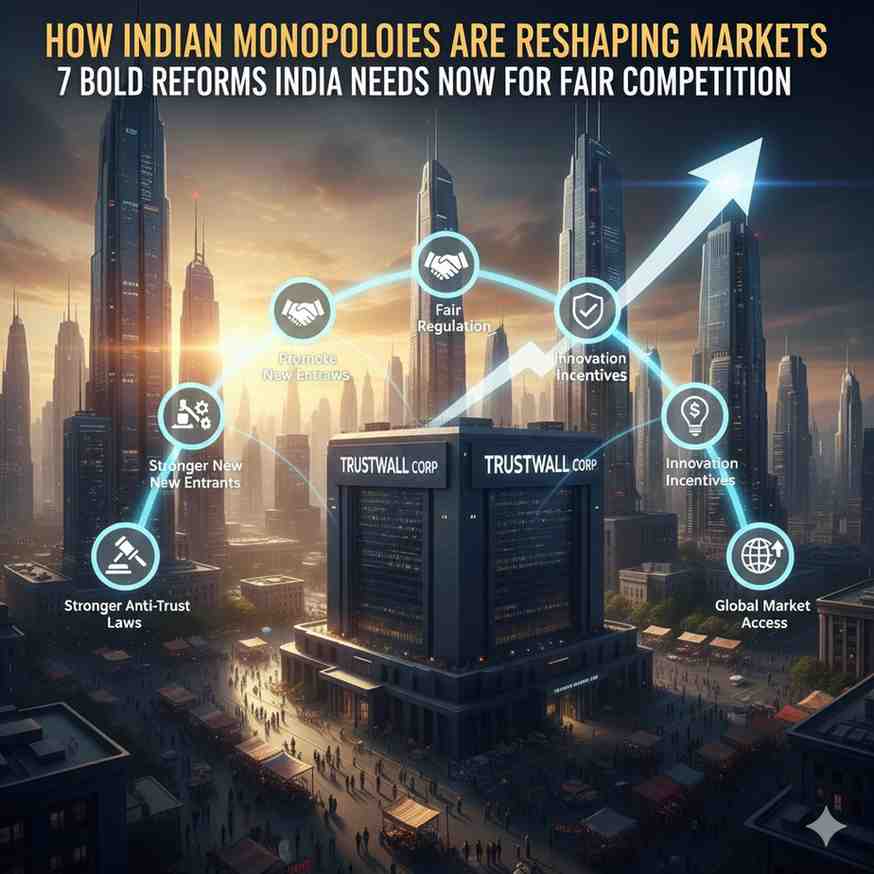
If India wants real competition, real innovation, and real consumer power, it needs to stop playing referee after the match is over. The future demands proactive, asymmetric, and tech-aware regulation that prevents giants from capturing entire markets. Here’s what a forward-thinking playbook looks like.
1. Asymmetric Ex-Ante Regulation: Hold Giants to Higher Standards
Right now, every company — from a tiny startup to a trillion-rupee giant — faces similar rules. That’s outdated. India needs Asymmetric Regulation, where only Systemically Significant Enterprises (SSEs) face stricter controls.
This means big platforms can’t:
- Self-preference their own products
- Bundle services to suffocate competition
- Use scale as a weapon
Instead of punishing abuse after it happens, the state should design fair play from the start, ensuring markets remain contestable and open to new challengers.
2. Make Critical Infrastructure a “Common Carrier”
Some assets are too essential to be privately controlled like personal property. Airport slots, telecom towers, fiber networks, and payment rails should be legally declared Essential Facilities.
This forces dominant owners to provide:
- Open access
- Non-discriminatory pricing
- Transparent rules
By separating infrastructure ownership from service delivery, no single conglomerate can weaponize physical assets to block out competition. In plain terms — control the port if you want, but you don’t get to decide who’s allowed to dock.
3. Dynamic Price Collars & Algorithmic Audits
Surge pricing has gone from convenience to exploitation. Airlines and telcos today use algorithmic systems that quietly mimic cartel-like behavior. India needs:
- Dynamic Price Collars → caps on surge multiples based on historical averages
- Mandatory Algorithm Audits → to detect tacit collusion encoded into pricing engines
This keeps AI from becoming a digital cartel that punishes consumers during crises or peak demand.
4. Scrap Grandfather Rights: Recycle Prime Assets
“Grandfather Rights” let incumbents hoard prime airport slots forever — even if they underuse them. This needs a sunset clause.
A Use-It-or-Share-It model ensures that:
- Unused or poorly used assets get taken back
- A share of premium slots gets auctioned to new or smaller players
- Market dominance can’t fossilize over time
This keeps the industry dynamic instead of frozen around legacy players.
5. Enforce Interoperability & Data Portability
The biggest reason duopolies survive? Lock-in. People don’t switch because it’s painful. Fix that, and the whole game changes.
If users can switch providers instantly — without losing:
- Transaction history
- Phone number
- Rewards
- Personal data
— then switching costs drop to zero. Suddenly, incumbents must compete on quality, not captivity.
6. Deploy the State as a Strategic Balancer
A competitive market doesn’t mean the government disappears. Sometimes, the state needs to act as a price anchor.
Think BSNL stabilizing tariffs, or Vande Bharat keeping railway monopolies in check.
A strong public alternative keeps private players from price-gouging and ensures essential services stay accessible.
7. Fix Tax Distortions: Input Tax Neutrality
High state taxes on ATF or natural gas hit small players harder than giants with deep pockets. Bring key inputs under GST, allow input tax credit, and end inverted duty structures.
This levels the playing field so survival depends on efficiency — not the ability to absorb unfair taxes.
5. Conclusion: Why Tackling Indian Monopolies Is Essential for a Fairer Economy
India’s rising duopolies are more than a business story — they’re a warning signal that unchecked consolidation is quietly rewriting the country’s economic DNA. What we’re witnessing isn’t just market failure; it’s regulatory hesitation at a time when the stakes are simply too high. A future where a handful of corporations control mobility, payments, communication, and information is a future built on fragility.
The solution isn’t harsher fines after the damage — it’s proactive guardrails that keep markets open, contestable, and genuinely consumer-first. Fairness doesn’t appear on its own; it has to be engineered with intention. Because in every society, one rule endures:
When power concentrates, freedom evaporates — unless regulation steps in to restore the balance.
About The Author









Leave a Reply