

Table of Contents
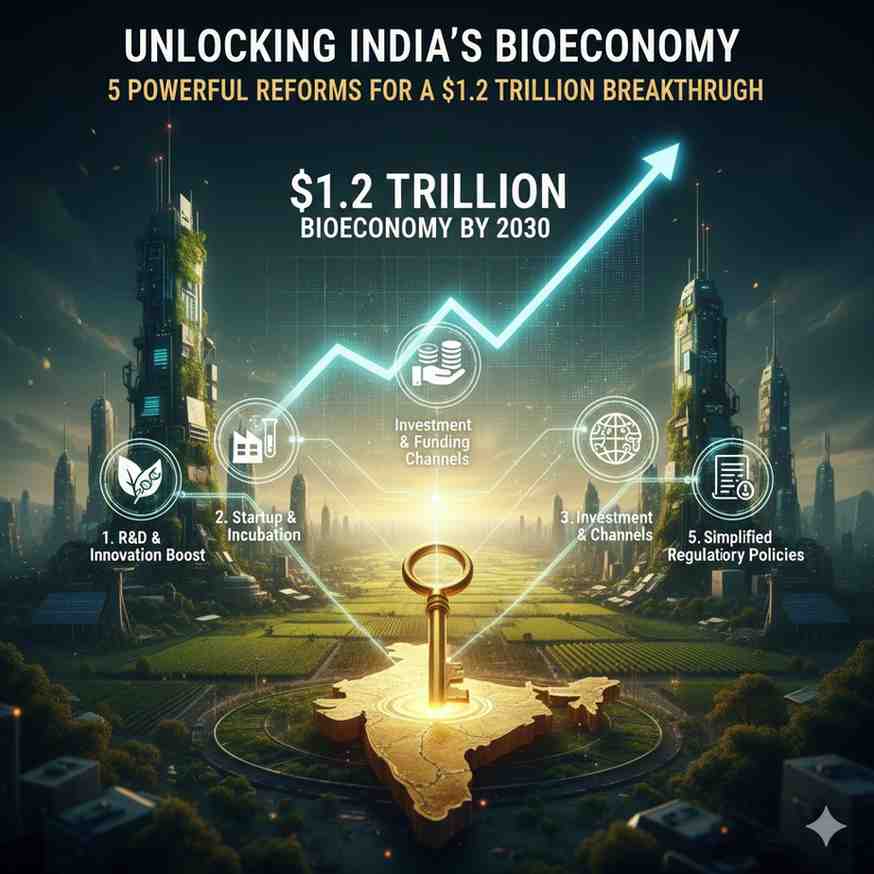
Indias bioeconomy has risen from just $10 billion to $165 billion in a decade, and the momentum is only accelerating. But reaching the $1.2 trillion vision by 2047 needs more than scientific talent. It requires bold reforms in regulation, capital, and manufacturing. China’s transformation—powered by dedicated biotech listing boards and a science-led regulator—shows how fast progress can happen. India already has major strengths in genomics, vaccines, and biomanufacturing, supported by 9,000 deep-science startups. With smarter policies and stronger investment, India can lead the next global biotech wave and emerge as a world-scale innovation powerhouse.
Major Advancements in India’s Bioeconomy
India’s bioeconomy isn’t just growing — it’s evolving faster than most developed nations. The country has shifted from a small biotech base into a genuine global force by decoupling growth from fossil fuels and rooting value in circular bio-resources. The numbers speak for themselves: the bioeconomy has jumped from $10 billion in 2014 to $165.7 billion in 2024, with a clear near-term ambition of $300 billion by 2030. This trajectory isn’t accidental; it reflects policy intent, scientific capacity, and a market hungry for biological solutions.
A major turning point came with the Cabinet-approved BioE3 Policy, which represents India’s most strategic shift so far. Instead of using biology simply for research, the policy pushes “High-Performance Biomanufacturing” — industrialising biology to replace chemical-driven processes. Under this framework, Bio-Foundries and Bio-AI hubs become the engines of production, creating a self-reliant ecosystem that can manufacture everything from green chemicals to smart proteins. Six thematic sectors — including precision biotherapeutics and bio-materials — are being targeted through a national network of Bio-Enabler Hubs, all aligned with India’s Net-Zero 2070 goals. The goal is simple: treat biology not as a niche science, but as a core industry.
Genomic sovereignty is another breakthrough. With the completion of the Genome India Project, India has established its own reference genome, correcting decades of Euro-centric bias in global medical datasets. Sequencing the complete genomes of 10,000 individuals revealed population-specific variations linked to diseases — a foundation for precision medicine that actually reflects India’s genetic diversity. Instead of importing medical assumptions from Western databases, India is now generating knowledge rooted in its own population. This matters for everything from diagnostics and drug discovery to rare disease treatment.
In biopharma, the transition is equally dramatic. India is no longer satisfied being just the world’s low-cost supplier. While the country continues to be called the “Pharmacy of the World,” it is now moving aggressively into high-value biologics and biosimilars. R&D spending has gone up, and capabilities around immunotherapies, cell technologies and complex vaccines are expanding. India broke into the Top 10 of Cytiva’s Global Biopharma Index 2025, and the Serum Institute of India remains the world’s largest vaccine producer, crossing 1.5 billion doses annually. The shift up the value chain means more domestic innovation and less reliance on imported high-end drugs.
Energy security is being reshaped through biology too. Instead of treating agricultural waste as a burning hazard, India has turned it into renewable energy. The achievement of 20% ethanol blending (E20) in 2025 — five years ahead of schedule — saved an estimated ₹1.44 lakh crore in foreign exchange and substituted 244 lakh metric tonnes of crude oil. Farmers benefit from new income streams, cities benefit from cleaner air, and the nation benefits from reduced oil dependency. It’s a rare win-win across agriculture, energy, and climate.
Finally, this transformation has been fuelled by a thriving startup ecosystem. Back in 2014, India had barely fifty biotech startups. Today, that number has exploded to nearly 9,000 deep-science startups, supported by BIRAC funding, 12 biotechnology parks, and 95 bio-incubators across the country. These ventures are not building apps — they are building solutions for cancer, drug discovery, crop resilience, bioplastics, and wastewater treatment.
Even agricultural biotechnology — often slowed by regulatory caution — is advancing. The successful development of the GM mustard hybrid DMH-11, projected to increase yields by 25–30%, signals a practical, science-based approach to food security. Climate-resilient crops and bio-stimulants are becoming central tools for sustaining productivity without harming ecosystems.
Taken together, these advances show a country that isn’t dabbling in biotech — it is scaling it. The foundation has been laid. The next challenge is ensuring capital, regulation, and markets move at the same speed as the science.
Major Challenges Confronting Indias Bioeconomy
India’s bioeconomy is full of promise, but several structural barriers continue to pull the brakes. The country has talent, market size, and scientific capability — yet progress often collides with hard ceilings. These challenges are not theoretical; they show up in stalled products, slow investment cycles, and opportunity costs that compound every year.
The first obstacle is the stagnant investment in R&D, which traps innovation in a resource poverty zone. India’s Gross Expenditure on R&D hovers between 0.64% and 0.7% of GDP, less than half the global average of 1.8%. For a science-led economy, that gap is brutal. Breakthrough discoveries demand high-risk capital, but the private sector largely sits out, leaving government grants to shoulder most of the burden. This dependence is unsustainable and stifles ambition — moonshot ideas get shelved because labs don’t have the runway to experiment.
Agricultural biotechnology faces an even sharper bottleneck: regulatory gridlock. Although India has indigenous climate-resilient GM solutions, the policy environment is unpredictable and stuck in litigation. GM mustard (DMH-11), despite receiving technical approval from GEAC, remains in limbo after a split Supreme Court verdict. The result is surreal — Bt Cotton, commercialized in 2002, is still the only GM crop approved in India. Farmers lose access to better seeds, edible oil imports continue inflated, and foreign investors stay away from a sector filled with uncertainty. A single stalled decision becomes a national opportunity cost.
Another vulnerability lies in supply chains. India’s bio-pharma and medtech industries are highly dependent on imported inputs, especially from China. Over 70% of critical APIs and Key Starting Materials come from abroad, while nearly 70–80% of medical devices are imported. It’s a strategic risk: COVID exposed what happens when these supply chains break. Even today, domestic manufacturers operate with thinner margins, longer lead times, and reduced bargaining power because upstream capabilities remain weak.
Financing is another Achilles’ heel. There is a lethal “valley of death” between proof-of-concept and commercialization. Early-stage grants through schemes like BIRAC are available, but once projects leave the lab, patient capital dries up. Biotech is not a quick money business — returns take years. Without late-stage venture capital, startups are forced to sell their intellectual property or move abroad before hitting industrial scale. India ends up exporting talent and IP instead of scaling it at home.
The BioE3 vision of industrial-scale biomanufacturing also runs into hard infrastructure limits. India has a shortage of pilot plants, fermentation tanks, and large-scale Bio-Foundries. This creates a choke point: even when lab results succeed, there’s nowhere to manufacture at scale. High-end clusters like Genome Valley can’t service national demand alone. The outcome is ironic — the country with a $300-billion ambition still holds only 1.5% of the global MedTech market.
On the innovation front, the paradox is painful. India produces a huge volume of research papers but relatively few commercially relevant patents. This reflects a structural disconnect between academia and industry. Rather than a “lab-to-market” pipeline, the flow often becomes “brain-to-paper,” limiting commercial impact. India ranked 39th in the Global Innovation Index 2024, but lags in knowledge diffusion and IP creation.
Finally, the talent pool faces a quality-quantity mismatch. Thousands of biotech graduates enter the job market, yet industry leaders report a shortage of specialized skills in biologics, bioinformatics, and synthetic biology. The BioE3 policy itself identifies this skill gap as a constraint for building Bio-AI hubs. Companies invest in expensive re-training, slowing productivity and adding cost.
Taken together, these challenges explain why India’s bioeconomy has scale, but not yet the speed. The science is advancing, but the ecosystem — funding, regulation, infrastructure, and skills — must evolve just as fast for the $1.2-trillion vision to materialize.
Steps to Strengthen and Accelerate Indias Bioeconomy
If India wants to stop flirting with its biotech potential and actually deliver on the trillion-dollar vision, reform has to move from PowerPoint to ground reality. The next decade needs serious execution, not just enthusiasm. The good news? The roadmap is already visible — and most of it is well within reach.
The first big move is building plug-and-play bio-foundries. Right now, every biotech startup that solves a problem in the lab hits the same wall: “Where do we scale this?” Constructing fermentation plants or downstream processing units is insanely expensive and often kills early momentum. The fix is blunt and obvious — shared pilot facilities, available on a pay-per-use model. Think of it like co-working spaces, but for industrial science. If India creates a national network of these bio-foundries, startups can scale without burning crores on equipment. This alone tackles the scale-up bottleneck that currently forces innovators to outsource manufacturing abroad.
The second pillar is regulatory reform. India needs a science-first regulatory sandbox, especially for synthetic biology and gene editing. Instead of working like a policeman waiting to say “No,” regulators must enable safe, fast experimentation. Parallel processing of clinical trial phases, time-bound approvals, and a clean separation between scientific evaluation and bureaucratic licensing can cut years from the development cycle. Predictable rules don’t just make life easier — they attract investment. Biotech thrives on certainty, not guesswork.
Money is the third pillar. The valley of death in late-stage funding has already claimed too many promising ventures. It’s time for a Biotech Innovation Board on stock exchanges where pre-revenue, IP-rich companies can list. Global markets already do this — China’s STAR Market and NASDAQ biotech boards unlocked tens of billions in patient capital. India’s investors are mature enough to back long-gestation science if given a clear structure. Once founders can raise domestic capital based on patents, not profits, the brain drain slows and the IP stays home.
The fourth priority is people. India produces biotech graduates in bulk, but industry wants specialists — in bioinformatics, biologics, AI-driven drug discovery. Academia has to update, fast. That means mandatory Bio-AI integration in curricula, creating scientists who can move seamlessly between the lab and the laptop. Computational biology isn’t a niche anymore — it’s the backbone of drug discovery. A hybrid, high-skill workforce is the single biggest enabler for the BioE3 era.
Supply chain security is another unavoidable reality. India must incentivize domestic manufacturing of Key Starting Materials, bioreactor components, and upstream inputs. Expanding PLI schemes here reduces import dependence and protects national health security. If India produces more of its own KSMs, pharma exporters instantly become more competitive in global markets. This is strategic, not cosmetic.
Universities also need a mindset shift. Research output is high, commercialization is low. The answer is Technology Transfer Offices staffed by industry veterans, not professors juggling fifteen roles. Their job: convert papers into patents, patents into products, and products into companies. Every major research institution should have this interface.
Finally, India’s genomic diversity is an asset most countries would kill for. With the Indian Biological Data Centre, the country can position itself as a hub for precision medicine for non-European populations. By creating a secure framework to share anonymized genomic data with global pharma, India moves from being a manufacturing destination to becoming a discovery partner.
The blueprint is clear. Build faster, regulate smarter, finance bigger, train deeper, and treat data as strategic capital. That’s how a $165 billion bioeconomy becomes a $1.2 trillion one — not in theory, but in practice.
Conclusion: The Future of Indias Bioeconomy
India’s bio-economy is no longer a fringe story — it is one of the country’s most powerful engines of future growth. The foundations are already in place: world-class scientists, nearly 9,000 deep-tech startups, ambitious national missions, and a policy architecture that finally treats biology as industry rather than academia. The BioE3 framework points in the right direction, but its success will depend on execution. Without faster regulatory pathways, large-scale bio-manufacturing, and patient domestic capital, the sector risks becoming a collection of brilliant lab ideas with no industrial expression.
The opportunity, however, is enormous. Genomic sovereignty, precision medicine, smart biomanufacturing, and bio-fuels offer India both strategic advantage and economic scale. If the country invests boldly in people, infrastructure, and innovation — while creating predictable rules and specialized capital markets — the next era of biotech breakthroughs can be born here rather than imported.
The choice is simple: continue as a competent participant, or rise as a global leader. With sustained reforms and a focus on execution, India can rewrite the map of global biotechnology. The trillion-dollar target is not hype — it is a realistic destination. By 2047, India has every chance to stand not just as a bioeconomy success story, but as a global powerhouse driving the next wave of biological innovation.
FAQs: Indias Bioeconomy – Telecast Global
Q. What is driving the rapid growth of India’s bioeconomy?
India’s bioeconomy is accelerating because of breakthroughs in genomics, biopharma, smart bio-manufacturing, vaccines, and biofuels. A thriving deep-tech startup ecosystem, supported by BIRAC, biotechnology parks, and policies like BioE3, has created strong momentum for innovation and commercialization.
Q. Why is the BioE3 Policy considered a game changer?
BioE3 signals a structural shift from traditional chemistry-based production to high-performance biomanufacturing. The policy builds Bio-Foundries, Bio-AI hubs, and Bio-Enabler networks that industrialize biology, boost domestic manufacturing, and make India less dependent on imported technologies and processes.
Q. What is the biggest challenge facing India’s biotech startups?
The toughest barrier is the “Valley of Death” — the lack of late-stage, patient capital between proof-of-concept and commercial scale. Many startups have great science but fail to scale because venture funding dries up, forcing them to sell their IP or move overseas before achieving industrial scale.
Q. Why is regulatory reform crucial for India’s bioeconomy?
Slow, fragmented approvals delay everything from GM crops to next-generation biologics. A science-led regulatory framework with fast-track approvals, sandbox models, and time-bound decisions is essential. Predictable rules reduce risk, attract investment, and speed up commercialization.
Q. How can India become a global biotech leader by 2047?
India must build national bio-foundries, secure domestic supply chains, expand precision medicine using genomic data, increase R&D spending, and create a dedicated biotech listing board for raising patient capital. With these steps, India can transform from a biotech participant into a world-scale innovation leader by 2047. 🚀
About The Author







Leave a Reply