

Table of Contents
IndiGo flight cancellations created nationwide chaos in early December, grounding passengers and forcing the government to step in with tough action. India’s largest airline abruptly scrapped thousands of flights, leading to packed terminals, long queues, and furious travelers. The crisis triggered penalties and a 10% cut in IndiGo’s operations, one of the strongest regulatory moves in recent aviation history. The episode didn’t just disrupt schedules — it exposed deep cracks in planning, accountability, and emergency management within Indian aviation. As the dust settles, questions remain about how such a meltdown could even happen.
1️⃣ IndiGo Flight Cancellations: Government Blames Airline for Chaos
India’s Civil Aviation Minister K. Ram Mohan Naidu didn’t mince his words. In a direct and unusually tough stance, he placed full responsibility on IndiGo for the travel chaos that has wrecked passengers’ plans since early December. Speaking to Times Now, Naidu said the airline had failed to handle its own operations, especially crew rostering, even after “extensive consultations” before new pilot duty rules kicked in.
For a carrier that dominates India’s skies, the fallout has been brutal. The government has now ordered a 10 percent cut in IndiGo’s daily operations — a massive escalation from the earlier 5 percent directive. In real terms, this means almost 220 flights axed every single day out of IndiGo’s 2,200 scheduled services. And on top of that, the airline will face penalties for the disruption, with Naidu making it clear:
“I will charge IndiGo with all the penalties that are there.”
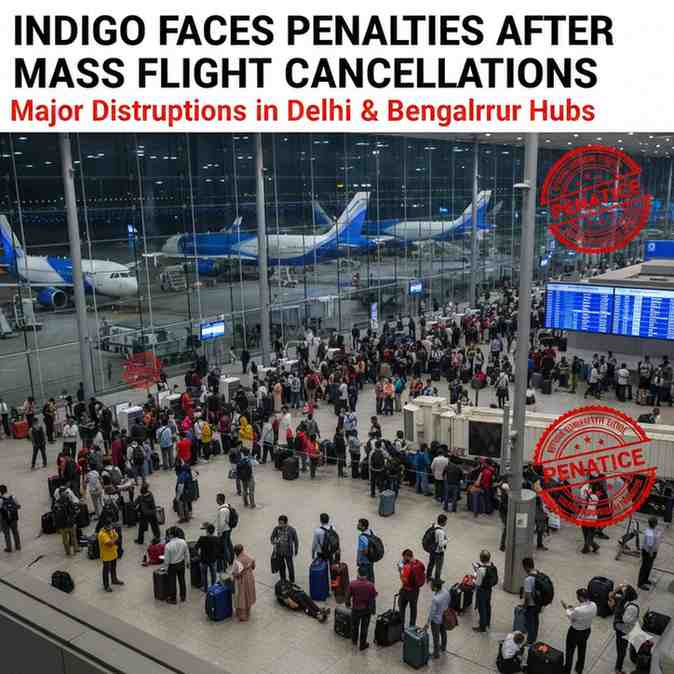
The impact on flyers has been nothing short of a nightmare. More than 400 flights were cancelled on Tuesday alone, leaving airports packed with angry, exhausted, and clueless passengers. Bengaluru, one of the country’s busiest hubs, saw 121 cancellations, while Hyderabad recorded 58 outbound flights scrapped. Delhi, Mumbai, and Chennai were similarly hit, with departure boards looking like a Christmas tree of red alerts.
What started as a scheduling hiccup soon snowballed into a national crisis. In just one week, the number of cancellations shot past 4,500 flights, paralysing travel plans for hundreds of thousands of passengers. Social media exploded with videos of long queues, crying children, and passengers sleeping on airport floors. India’s biggest airline suddenly looked like it had lost control of its cockpit.
IndiGo currently commands around 65 percent of the domestic aviation market, which means when it stumbles, the entire ecosystem shakes. With seats vanishing and fares rising on other airlines, passengers didn’t just lose flights — they lost options. The carrier has already processed more than ₹750 crore in refunds, but for many people, getting the money back didn’t make up for the missed weddings, international connections, and year-end holiday plans.
Industry insiders say IndiGo’s aggressive expansion, shortage of trained crew, and sudden transition to new pilot duty norms all collided like a stack of dominoes. The regulatory pushback from the government shows that accountability is no longer optional. For a brand that once prided itself on punctuality, this crisis is a reputation punch in the gut.
The coming weeks will decide whether IndiGo can stabilise its operations, regain public trust, and avoid deeper sanctions. What’s clear is that this is not just a bad week — this is a wake-up call for an airline that became too big to fail, and nearly did.
2️⃣ Government Action and Investigation on IndiGo Flight Cancellations
As chaos mounted at airports, the government shifted gears from frustration to enforcement. The Directorate General of Civil Aviation (DGCA) issued show-cause notices to two top executives of IndiGo — CEO Pieter Elbers and Chief Operating Officer Isidre Porqueras. The notices came with a clear warning: enforcement action would be taken under the Aircraft Act if the airline failed to justify how such a massive operational collapse was allowed to happen.
This wasn’t a sudden reaction. Civil Aviation Minister K. Ram Mohan Naidu revealed that the government had already met IndiGo executives on December 1, a full day before the crisis exploded. The agenda was straightforward — preparing the airline for the new Flight Duty Time Limitation (FDTL) norms. These rules increased the mandatory weekly rest for pilots from 36 to 48 hours and cut the number of allowed night landings from six to just two. The logic behind the changes was safety: rested pilots and fewer night landings reduce fatigue-related risks.
But instead of preparing for a smooth transition, IndiGo appears to have underestimated the implications. According to Naidu, the airline was given enough time to reorganise schedules, deploy reserve crew, and ensure passengers would not be affected. Yet, when the norms took effect, the system buckled. Pilots weren’t available, rosters were incomplete, and automated scheduling flagged shortages everywhere.
Naidu didn’t hold back in Parliament.
He made the point bluntly:
“Even after that, it was IndiGo which messed up its own internal crew management and crew rostering.”
The statement was more than criticism — it was a signal that the government would not absorb the blame. The narrative was shifting: this wasn’t a regulatory failure, it was an operational failure.
The crisis even reached the Prime Minister’s desk. During an NDA Parliamentary Party meeting, Narendra Modi addressed the issue indirectly, but firmly. According to Union Minister Kiren Rijiju, the Prime Minister reminded members that rules and laws are meant to correct systems, not to harass people. In other words, regulations are supposed to keep aviation safe and stable — not disrupt lives. When disruptions happen because of poor planning by a private operator, the consequences must be addressed.
Behind the scenes, the government began gathering data from airports, flight towers, and operations centres. Internal reports show that IndiGo’s scheduling system had already been flashing red, especially on routes with high night-landing frequency. But the airline continued operating aggressively, assuming that the new FDTL norms would not cause a major shock. That assumption turned out to be disastrously wrong.
With penalties looming and a 10 percent flight-cut already imposed, the investigation now aims to answer a deeper question: did IndiGo knowingly take risks, hoping to handle problems later? Or was it simply unprepared for the scale of change?
Either way, the fallout has triggered a rare moment of alignment between regulators and government: accountability is non-negotiable, especially when millions of passengers are affected.
3️⃣ Airline Response to IndiGo Flight Cancellations
After days of silence, IndiGo finally came out with its version of events. CEO Pieter Elbers released a video message on Tuesday, trying to cool the tempers that were boiling across terminals and timelines. His headline claim was simple: “As of December 9, our operations are fully stabilised.” According to him, the airline is now flying to all 138 destinations again, and the crisis has been contained.
The message was calm, corporate, and clearly scripted to reassure investors and passengers. But it also carried a rare admission: IndiGo had “let customers down.” For an airline that built its brand on punctuality, this was a humbling statement. Elbers said an internal review is underway to figure out what exactly went wrong, hinting that the problem wasn’t just the new pilot duty rules — but something inside the management machinery.
This acknowledgement matters. IndiGo has a history of operating like a perfectly tuned machine, often running more flights than any competitor. But when that machine jammed, the reality was exposed: no airline is too big to collapse under bad planning. Elbers didn’t get into the technical details of crew rostering failures, but he accepted that the disruption could have been avoided with better preparation.
For passengers, though, the apology came a little late. By the time the video went up, thousands had already missed weddings, business meetings, and connecting international flights. Social media was filled with stories of elderly parents stuck at airports, families sleeping on chairs, and passengers begging for information. Saying “operations are stabilised” might be accurate, but it doesn’t erase what people went through.
The government clearly doesn’t want to rely on corporate promises either. The aviation ministry has already taken a firm position: any freed-up flight slots from IndiGo may now be offered to other airlines that have capacity. That is a hard jab. For an airline that guards its slots fiercely, losing even a handful to a competitor is a major blow. It signals that the government is willing to increase competition if IndiGo cannot maintain reliability.
Industry watchers know what this means: if Air India, Vistara, Akasa or others step in and perform well, IndiGo could lose market share on key routes. And once a slot is gone, it’s rarely easy to get back.
Still, the airline is trying to rebuild trust. There are signs of increased communication at airports, more staff deployed at counters, and a renewed attempt to handle refunds faster. But reputations are fragile. It may take months before passengers stop remembering December as the month IndiGo fell apart.
Internally, the review could bring some uncomfortable findings. Crew availability, training pipelines, fatigue tracking, and automated rostering systems will now be under the microscope. Behind closed doors, executives will be asking one question: How did a planned regulatory change turn into a national crisis?
For now, the airline insists that everything is back to normal. The government is not fully convinced. And passengers — the real victims — are hoping that the next time they book a ticket, the boarding pass won’t come with uncertainty attached.
4️⃣ Passenger Backlash and Industry Fallout from IndiGo Flight Cancellations
If there was one group that suffered the most during this crisis, it was passengers. Airports across the country turned into waiting lounges of frustration. Hundreds lined up at counters, clutching tickets and staring at digital screens showing the same word again and again: CANCELLED. Many had been waiting since dawn with no clear explanation, no alternate flight, and often not even water or food coupons.
Videos flooded social media. One clip from Bengaluru showed a line stretching across the terminal with people shouting for updates. At Delhi, a group of passengers confronted staff after being told their flight had been rescheduled — only to find out later that it was cancelled without notification. These weren’t isolated stories. For a week, this chaos was the norm.
Travelers had every right to be angry. For weddings, funerals, business trips, interviews, vacations — everything was thrown into limbo. Some passengers lost non-refundable hotel bookings, others missed international connections and had to pay double for last-minute rebooking. Refunds started flowing, but a refund cannot fix a lost opportunity. Many people took to X (Twitter), Facebook, and Instagram, calling for stricter rules on airlines that fail to communicate.
The disruption also hit the aviation ecosystem like a domino. When the biggest airline pulls out hundreds of flights, fares shoot up. That’s exactly what happened. On several sectors, last-minute tickets doubled or even tripled as passengers scrambled for alternatives. Smaller airlines suddenly had an opportunity to fill seats, but they didn’t have enough aircraft or crew to absorb the demand.
Industry analysts argued that this crisis exposed a long-standing weakness: Indian aviation has too much dependence on one airline. IndiGo controls almost two-thirds of the domestic market. When IndiGo stumbles, everyone stumbles. This isn’t a balanced system — it’s a system built on the dominance of a single player.
Travel agents saw their phones ringing non-stop. One Delhi-based agent said they had never handled so many cancellations and emergency rebookings in such a short time. Corporate travel desks were begging airlines for group seats. The aviation ministry reported that some sectors saw occupancy jump to 100% for days at a stretch. Competition looked good on paper, but in reality, there wasn’t enough spare capacity.
The crisis also triggered a debate that has been going on for years: Do airlines in India need stronger regulation on transparency and compensation? Many countries require airlines to provide hotel stays, meals, or financial compensation for cancellations. India does not enforce these rules aggressively. Passengers felt abandoned, and that anger reached Parliament, media panels, and public forums.
While IndiGo insists operations are stable now, the scars are fresh. Trust is easy to lose and slow to rebuild. The incident served as a reminder that air travel is not just about aircraft — it’s about planning, communication, and accountability.
Passengers expect one thing when they buy a ticket: they want a journey, not a gamble. December’s meltdown showed that even the biggest airline in India can’t take that expectation lightly.
5️⃣ What Went Wrong Behind the Scenes of IndiGo Flight Cancellations
Now that the dust has settled, everyone is asking the same question: how did this even happen? IndiGo didn’t suddenly wake up to a new rule. The updated Flight Duty Time Limitation (FDTL) norms were known months in advance. Yet, the airline was caught unprepared. To understand the collapse, you have to look behind the glossy blue planes and smiling crew — at the mechanics of how a giant airline actually works.
Large airlines are basically moving puzzles. Every day thousands of employees, aircraft, routes, and schedules have to align perfectly. When one piece slips, the entire puzzle can crack. What happened in early December was a classic domino effect.
The new FDTL norms increased pilots’ weekly rest hours and reduced night landings. That meant IndiGo suddenly needed more pilots to operate the same number of flights. But pilot training isn’t like hiring temps — you can’t fast-forward qualifications, simulator checks, or medical clearances. IndiGo had the highest volume of night flights in the country, especially departures after 10 PM. When the rule changed, a big part of their network became instantly vulnerable.
Insiders say the airline assumed the disruption would be minor. They expected a few cancellations, some rescheduling, maybe a weekend of chaos. Instead, they got a full-blown meltdown.
Why? Because when pilots logged in to get their schedules, many of them simply couldn’t operate under the new limits. The automated roster started rejecting pairings. Pilots who had done too many night hours were grounded for rest. Reserve crew was not enough. Suddenly, hundreds of flights had no one available to fly them.
This isn’t about angry pilots refusing work. This was a mathematical bottleneck that nobody modelled properly.
And here’s where IndiGo made its biggest mistake:
Instead of pulling back and reducing flights proactively, it tried to stick to the original schedule, hoping things would magically fix themselves. It was like watching a boat filling with water and deciding to power the engine harder.
The result was predictable: cancellations snowballed.
Meanwhile, passenger communication didn’t improve fast enough. Many people reached airports without knowing their flight was already cancelled. The airline’s call centres couldn’t handle the surge. Social media responses were robotic and slow. When emotions are high, silence can look like arrogance — and IndiGo paid for that perception.
Aviation analysts point out a deeper issue: IndiGo has grown faster than any airline in India’s history. It adds planes aggressively, expands routes constantly, and leads the market by a mile. Growth is exciting, but control matters more. The December crisis exposed the fragility of hyper-expansion.
If a rule change can bring an airline with 65% market share to its knees for a week, the system is clearly over-stretched.
The internal review may lead to new recruitment, better rostering tools, and smarter forecasting. But one lesson stands out: even the biggest player must respect operational reality. Overconfidence is dangerous in aviation. Gravity doesn’t negotiate — and schedules don’t forgive poor planning.
6️⃣ The Road Ahead for IndiGo After Massive Flight Cancellations
The crisis of December wasn’t just a bad week for one airline — it was a warning for the entire aviation sector. If the country’s biggest carrier could fall apart because of planning errors, what does that say about the rest of the ecosystem? Airports were overwhelmed, passengers were furious, and the government was forced to intervene. This is not sustainable in a country where air travel is growing faster than almost anywhere in the world.
IndiGo now has two big jobs:
stabilise operations and rebuild trust.
The first part seems almost complete. Flights are back, schedules are normal, and refunds are largely processed. But the second part — trust — is harder. Passengers will remember the days they slept on terminal floors. They will remember missed ceremonies, crying relatives, and apps that refused to update. When people go through experiences like that, they don’t forget fast.
IndiGo must now demonstrate that it learns from mistakes. More hiring, stronger backup crew, realistic scheduling, and honest communication will be essential. Airlines often love talking about “load factors” and “on-time performance,” but passengers only care about one thing: will the plane take off when it’s supposed to? That is where IndiGo has to prove itself again.
On the government side, this episode showed that regulation has real teeth. A 10% schedule cut and threat of penalties made it clear that operational failures are not just private issues — they affect national infrastructure. India needs more competition, not a single giant dominating the sky. If other airlines can step up, take slots, and expand smartly, the entire sector becomes stronger. Monopoly is convenient until it collapses.
Prime Minister Modi’s message was also telling: rules are meant to correct the system, not harass people. That is the heart of aviation policy. Safety must come first, but disruption must be minimised. The new FDTL norms are here to stay — pilots deserve rest, and passengers deserve safe flights. The challenge is in execution.
As 2025 continues, IndiGo’s leadership will be under intense observation. Every delay, every cancellation, every scheduling glitch will be scrutinised. Investors and regulators want assurance that this was a one-time shock, not a sign of deeper cracks. The airline must invest in technology, simulators, crew planning, and well-being. Good aviation is not just about aircraft — it’s about systems, people, and discipline.
If there’s a positive takeaway from the chaos, it’s this: India finally had a serious conversation about accountability in aviation. Not everything can be blamed on weather or “operational reasons.” Airlines must be transparent. Passengers deserve clarity. And regulators must enforce rules consistently.
The skies are calm again, but the lesson is loud:
Growth is exciting, but stability is essential.
For IndiGo, the next few months will define its legacy. It can emerge stronger — or it can slip again. The whole country will be watching, ticket in hand. – Telecast Global
About The Author








Leave a Reply