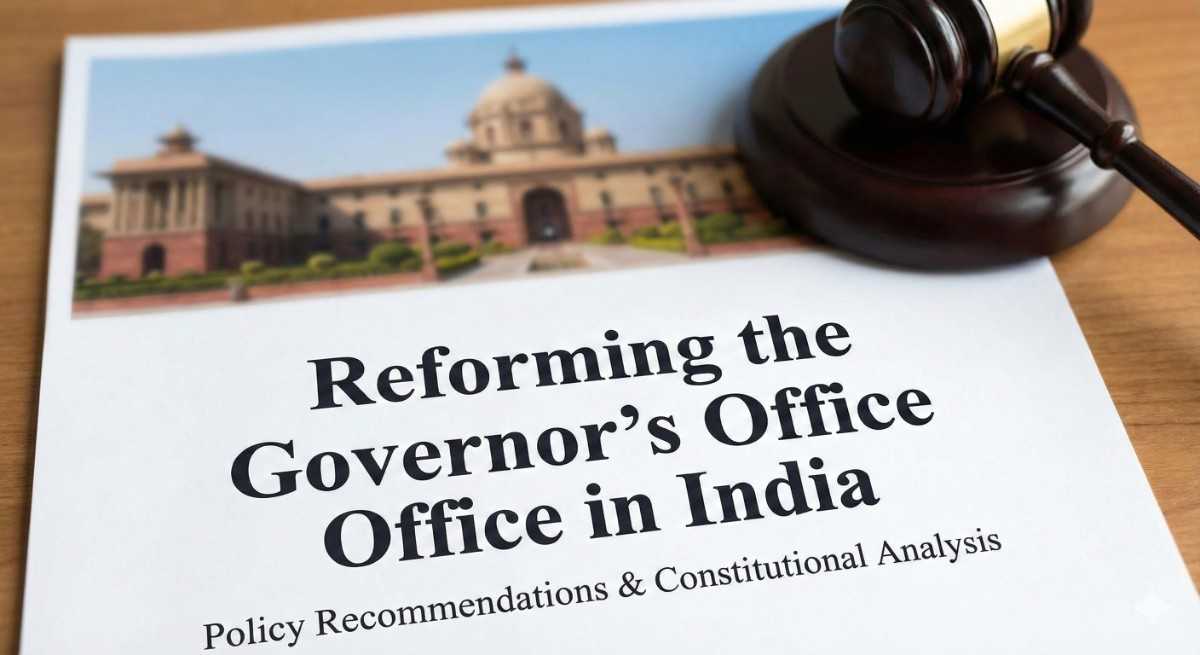
Reforming the Governor Office in India
Table of Contents
Reforming the Governor Office in India has become essential as rising clashes between Governors and State Governments expose deep constitutional gaps. From delayed bills to controversies in university appointments, the institution now finds itself at the centre of major federal disputes. As India’s democracy evolves, strengthening accountability, clarifying discretionary powers, and ensuring politically neutral appointments are critical for restoring balance. This blog explores why reforms are overdue and how a modern, cooperative federal system can be built by redefining the Governor’s role.
Why Reforming the Governor’s Office in India Is Back in the Spotlight
The debate around the Governor’s role has resurfaced sharply after the Supreme Court recently pulled up the Kerala Governor for disregarding the recommendations of a court-appointed committee on the appointment of Vice-Chancellors. This criticism isn’t just a one-off remark—it symbolizes the growing friction between state governments and Raj Bhavans across India.
Back in August 2025, the Supreme Court had constituted a high-level panel headed by Justice Dhulia to ensure transparency and merit-based selection of Vice-Chancellors in Kerala’s public universities. The committee was expected to depoliticize the process, offer a shortlist of qualified names, and create a system where decisions are driven by academic credentials rather than personal or political preferences.
However, the Governor’s refusal to act on the committee’s recommendations reignited a long-standing debate: Is the Governor overstepping constitutional boundaries, or is the system itself flawed enough to invite such conflicts?
The incident once again spotlights how Raj Bhavan–State Government tensions play out in sectors beyond politics—here, in the domain of higher education where academic freedom and institutional autonomy should ideally be shielded from political tug-of-war. Governors, as Chancellors of state universities, hold significant authority in appointments, approvals, and oversight. But when this authority collides with the elected government’s vision, or with judicially guided procedures, it breeds institutional paralysis.
This is not an isolated case. Similar stand-offs have been reported in Tamil Nadu, West Bengal, Punjab, Telangana, and Maharashtra, each reflecting deeper fault lines in India’s federal structure. The Kerala episode simply adds another chapter to this growing pattern of confrontations, pushing the conversation on reforms into the national spotlight.
The Supreme Court’s intervention makes the situation even more urgent. By stepping in and forming a committee, the Court essentially acknowledged that the existing mechanisms are inadequate to prevent delays, bias, or arbitrary behaviour. When the Governor still declined to follow the recommendations, it highlighted how wide the gap has become between constitutional expectations and on-ground functioning.
Ultimately, the controversy is not just about one appointment or one state. It represents a larger structural issue—ambiguity in roles, lack of accountability, and the absence of clear checks on the Governor’s discretionary powers. With multiple states facing similar friction, the question is no longer whether the Governor’s office needs reform, but how soon and how deep those reforms should be.
This moment has become a turning point, forcing policymakers, courts, and civil society to re-evaluate how the Governor’s office can be modernised to match the needs of a stronger, more cooperative federal democracy.
2. Key Controversies While Reforming the Governor’s Office in India
The Governor’s office has always occupied a tricky space in India’s federal setup—constitutionally neutral on paper, but politically explosive in practice. Over the years, several areas of friction have repeatedly triggered Centre–State confrontations, making the institution one of the most debated parts of India’s constitutional machinery.
1. Governor as Chancellor of State Universities
One of the biggest battlegrounds is the Governor’s role as the ex-officio Chancellor of state universities. While this position was originally designed to keep higher education insulated from political influence, it has ended up doing the opposite. Conflicts escalate when Governors reject or delay Vice-Chancellor appointments recommended by the state government or act independently in university administration.
This tussle often becomes a proxy war between the Centre and the states, because the Governor—appointed by the Union—can be seen as countering the state government’s mandate. As a result, academic institutions get stuck in political crossfire, raising concerns about institutional autonomy and the unchecked nature of the Governor’s discretionary power.
2. Withholding Assent to State Bills
Perhaps the most visible flashpoint is the Governor’s reluctance—or refusal—to grant assent to state legislation. Three powers are commonly at the centre of controversy:
- Withholding assent altogether, which effectively kills the bill.
- Reserving it for the President, a move often perceived as political, especially when the Centre and state are ruled by rival parties.
- Prolonged inaction, where a bill is kept pending for months without any constitutional explanation.
Several states, from Tamil Nadu to Punjab to Telangana, have accused Governors of using these powers to slow down or sabotage the legislative agenda of elected governments. This not only causes administrative paralysis but also raises serious federalism concerns.
3. Appointment and Tenure of Governors
The appointment process itself fuels suspicion. Governors are often retired politicians or bureaucrats aligned with the central ruling party, which creates a perception that they might act as the Centre’s political representatives rather than neutral constitutional guardians.
Their tenure—held at the “pleasure of the President”—deepens this mistrust. Whenever a new party comes to power at the Centre, it often replaces existing Governors, making the office look more like a political prize than an independent institution. This undermines both the dignity and credibility of the position.
4. Legislative Interference and Majority Politics
Governors sometimes get caught in the middle of high-stakes political drama, especially during majority crises. Delays in summoning the Assembly, or ignoring the Chief Minister’s advice during a political standoff, often lead to accusations of bias.
At times, Governors order floor tests based solely on opposition claims, bypassing the Speaker and even dictating voting procedures that tend to hurt the ruling party. These actions can shift the balance of power in a razor-thin political situation, making the Governor appear as an active participant rather than an impartial referee.
5. Controversies in Appointing Chief Ministers
The Governor’s discretion becomes highly sensitive in hung assemblies. When they choose to invite a coalition over the single largest party—or vice versa—questions about partisan judgment erupt instantly.
Similarly, when a sitting Chief Minister dies or resigns, internal party factions may fight for leadership, giving the Governor immense discretion in deciding the caretaker or successor. Any hint of favouritism triggers statewide political storms.
Major Committees Supporting Reforming the Governor’s Office in India
India has repeatedly tried to fine-tune the Governor’s role through expert bodies, especially as Centre–State tensions have sharpened over the years. Three major commissions stand out for offering clear frameworks to re-balance constitutional powers and create a more cooperative federal structure.
1. Sarkaria Commission (1988)
The Sarkaria Commission was the first major attempt to re-examine the Governor’s authority in the context of federalism. It recommended establishing a strong intergovernmental council to handle Centre–State disputes, reducing reliance on ad-hoc political interventions.
One of its strongest positions was on Article 356, urging that President’s Rule should be used rarely and only in extreme breakdowns of governance—not as a political weapon.
The Commission also emphasized that dissolving a state assembly shouldn’t be a casual executive decision. It should ideally happen only after Parliament’s approval, ensuring greater legitimacy and accountability.
These recommendations aimed to insulate state governments from arbitrary central interference.
2. Venkatachaliah Commission (2002)
This commission focused on strengthening institutional stability. It argued that Governors should be allowed to complete their five-year term, bringing predictability to the office.
However, early removal—if truly necessary—must involve mandatory consultation with the Chief Minister, preventing the Centre from dismissing a Governor purely for political reasons.
The message was clear: the Governor’s office must be constitutionally independent, but not politically unaccountable.
3. Punchhi Commission (2010)
The Punchhi Commission offered some of the most practical, forward-looking suggestions. It proposed restricting the Governor’s Chancellor role to purely constitutional duties, preventing them from acting as parallel power centres in higher education.
On legislative matters, it recommended fixed timelines:
- Six months for deciding on Bills reserved for the President
- A reasonable, structured timeframe for all other Bills
This was meant to prevent the increasing trend of political stall tactics through indefinite delays.
The Punchhi Commission also pushed for stronger checks on Article 356, ensuring it cannot be misused to destabilise elected governments.
Together, these reforms sought to make the Raj Bhavan more predictable, transparent, and constitutionally aligned.
Supreme Court Judgements Impacting Reforming the Governor’s Office in India
Judicial interventions have become crucial in defining the Governor’s real boundaries. Several landmark rulings have clarified what the office can—and cannot—do.
1. Nabam Rebia Case (2016)
The Supreme Court ruled that the Governor’s power to summon or prorogue the Assembly is not discretionary. It must be exercised only on the advice of the Council of Ministers.
This was a game-changing verdict that curbed unilateral actions by Governors during political crises.
2. Shivraj Singh Chouhan Case (2020)
Here, the Court held that both the Speaker and Governor can order a floor test if the government appears to have lost majority.
However, the Governor must act only when credible evidence suggests instability, not based on vague political claims.
3. Tamil Nadu vs Governor Case (2023)
In a major blow to arbitrary delays, the Court said Governors cannot sit on re-passed bills indefinitely. It set:
- One month to give assent
- Three months for actions on Cabinet advice
- One month for reconsidered bills
This ruling pushed hard for administrative discipline inside Raj Bhavans.
4. 2025 Presidential Reference on Governor’s Powers
Responding to concerns about prolonged delays by Governors, the Court held that while judges cannot impose rigid timelines, excessive inaction may attract judicial review.
Importantly, the Court noted that withholding assent indefinitely could amount to “deemed assent”, strengthening the state’s legislative autonomy.
Measures to Accelerate Reforming the Governor’s Office in India
The Governor–State relationship has become one of the most contentious points in India’s federal system, and the pattern of recurring stand-offs shows that piecemeal fixes won’t cut it anymore. Real reform needs structural clarity, institutional checks, and a political culture that respects constitutional balance. Several measures can significantly reduce these tensions and redefine the Governor’s role as a stabilising force rather than a political disruptor.
1. Codifying the Governor’s Discretionary Powers
One of the biggest sources of conflict is the ambiguity in Article 163, which vaguely states that the Governor can act in their “discretion” in certain situations. This loophole often becomes the basis for subjective interpretations and political manoeuvring.
A long-term solution is for the Supreme Court or Parliament to clearly list the exact situations where discretion applies—such as hung assemblies or breakdowns of constitutional machinery.
Codification would prevent Governors from stretching their authority and help states understand the boundaries of intervention, creating predictability in governance.
2. Procedural Reforms for Proving Majority
Political instability often becomes a playground for Raj Bhavan activism. To stop this, majority determination must rely on one principle alone: the floor of the House is the only space where numbers can be proven.
Under a reformed system, the Governor should:
- Administer the oath only to the leader who clearly has the support of the largest bloc or coalition.
- Mandate a floor test within 48 hours, ensuring transparency and preventing horse-trading.
This simple procedural clarity would shut down most of the high-drama political battles we see during government formation or collapse.
3. Depoliticising the Appointment Process
As long as Governors remain political loyalists of the central government, neutrality will remain a myth. A more credible approach is to institutionalize the appointment process through a bipartisan collegium, involving:
- The Prime Minister
- Chief Justice of India
- Lok Sabha Speaker
- The Chief Minister of the concerned state
This structure would ensure broader consultation, help appoint individuals of stature, and reduce the perception that the Governor is simply the Centre’s representative sent to override the state.
4. Reviving Constitutional Conventions
India’s Constitution relies not just on written rules but on democratic conventions. After decades of erosion, it’s time to restore them. Governors should:
- Consistently act on the aid and advice of the Council of Ministers
- Maintain open, regular communication with the Chief Minister
- Avoid surprise interventions, delays, or dramatic public statements
Good-faith adherence to conventions can prevent 90% of conflicts and bring back a cooperative relationship between the Raj Bhavan and the state government.
5. Implementing Long-Ignored Commission Recommendations
India doesn’t actually lack reform ideas—Sarkaria (1988) and Punchhi (2010) Commissions already laid out practical solutions. Key among them:
- Consult the Chief Minister before appointing a Governor
- Select Governors from outside the state
- Restrict their interference in day-to-day administration and university matters
These recommendations, if implemented with political will, can transform the institution into a neutral constitutional safeguard instead of a political flashpoint.
Conclusion: The Future of Reforming the Governor Office in India
The ongoing friction between State Governments and Governors isn’t just a series of political skirmishes — it exposes deeper constitutional grey areas that India has ignored for far too long. The root of the problem lies in two factors: vague discretionary powers that allow wide interpretation, and highly political appointments that compromise neutrality. As long as these structural gaps exist, flashpoints over bills, university appointments, or majority tests will continue to erupt.
A durable solution demands more than temporary fixes. India needs to finally implement the long-standing reforms proposed by the Sarkaria, Venkatachaliah, and Punchhi Commissions, which together lay out a credible roadmap for restoring balance. Codifying the Governor’s discretionary powers, setting strict timelines for legislative action, ensuring transparent communication with state governments, and institutionalizing a bipartisan appointment system are essential steps.
Ultimately, the Governor’s office must return to what the Constitution originally intended: a stabilising safeguard, not a parallel power centre. When Governors consistently act on the aid and advice of the elected government and respect democratic conventions, India can move toward a more cooperative and mature federal structure—where constitutional authority strengthens governance instead of fuelling confrontation.
About The Author