

Table of Contents
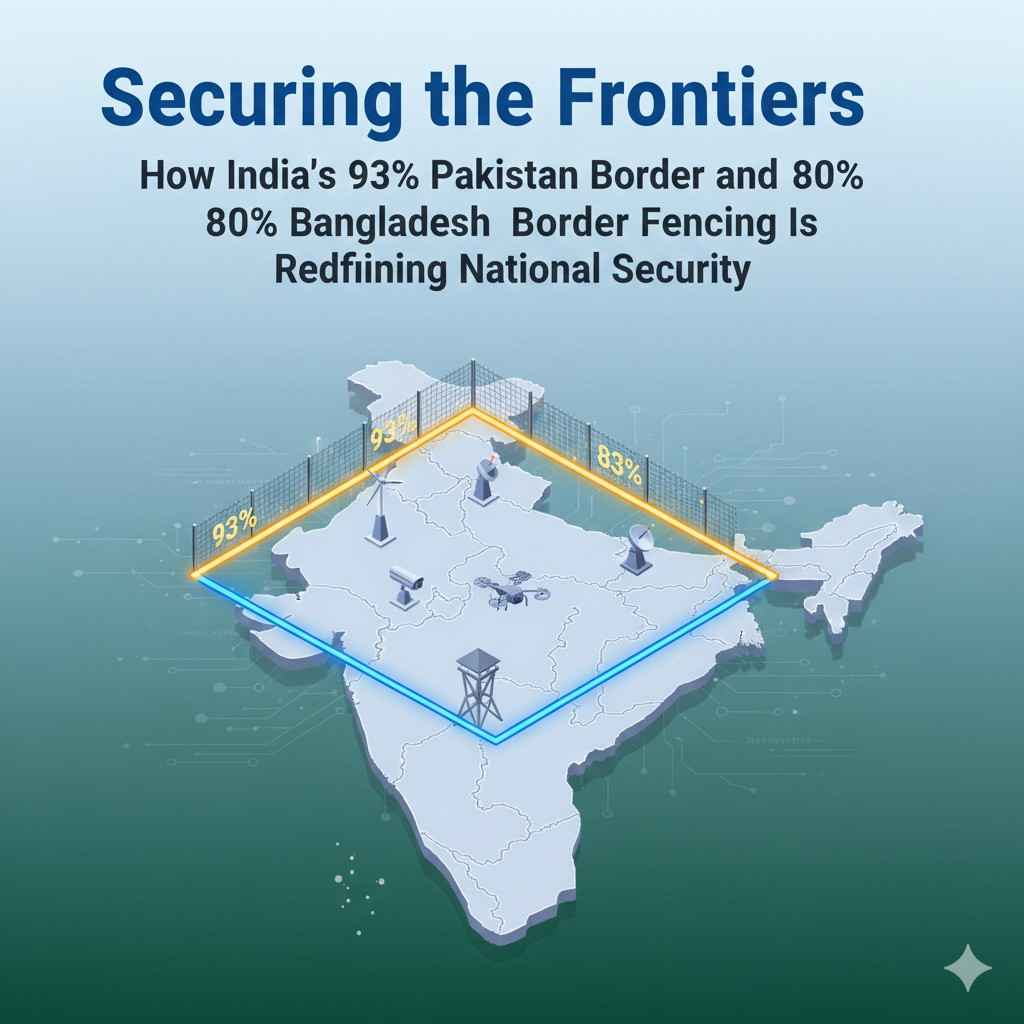
India has quietly crossed a major security milestone. With over 93% fencing completed along the Pakistan border and nearly 80% along the Bangladesh border, the country is reshaping how it manages infiltration, smuggling, and cross-border threats. This is not just about barbed wire and floodlights—it reflects a strategic shift toward technology-backed border management, faster response systems, and integrated surveillance. Recent developments, including smart fencing, anti-drone measures, and coordination between border forces, show that India is moving from reactive defense to proactive deterrence. The border is no longer just a line—it’s becoming a living security system.
Why Border Fencing Has Become Central to India’s National Security Strategy
For India, border fencing is no longer a defensive afterthought—it’s a frontline strategy. In a region where geography meets geopolitics every single day, physical borders have turned into pressure points. From cross-border terrorism and illegal migration to smuggling networks and drone-based threats, India’s borders are constantly stress-tested. Fencing, therefore, has evolved from basic barbed wire to a layered security doctrine.
Historically, India relied more on troop deployment and patrol-based vigilance. That approach worked in a different era. Today’s threats are faster, tech-enabled, and often non-state driven. Terror launchpads across the Pakistan border, narcotics smuggling via Punjab and Rajasthan, cattle and human trafficking along the Bangladesh border—these aren’t hypothetical risks, they’re recurring realities. Border fencing acts as the first deterrent, forcing hostile actors to expose themselves before they even reach Indian territory.
Another major reason fencing has become central is force optimisation. India guards over 15,000 km of land borders. Continuous human surveillance everywhere is neither efficient nor sustainable. Fencing, combined with sensors and floodlighting, reduces blind spots and allows border forces like the BSF to focus manpower on high-risk zones rather than routine patrolling. In simple terms: fewer surprises, faster response.
Post-2016, especially after the Uri attack and subsequent surgical strikes, India’s security doctrine visibly shifted. The emphasis moved from reaction to prevention and denial. Border fencing fits perfectly into this mindset. It denies easy access, disrupts infiltration routes, and raises the cost of hostile action. When infiltration drops, so does the frequency of terror incidents in hinterland states—this isn’t theory, it’s observable data.
On the eastern front, the logic is slightly different but equally important. The India–Bangladesh border is porous, densely populated, and socially interconnected. While fencing there is often criticised for humanitarian concerns, the state views it as essential for managing illegal migration, counterfeit currency flows, and transnational crime. Importantly, fencing is not meant to seal borders airtight but to regulate movement through legal channels, reinforcing sovereignty without shutting doors completely.
There’s also a political and psychological dimension. Borders define the authority of the state. Incomplete or poorly guarded borders signal vulnerability. Completing fencing sends a clear message—internally and externally—that territorial integrity is non-negotiable. For a rising power like India, credibility in border management directly affects diplomatic leverage and internal stability.
Finally, fencing is now integrated into the broader Comprehensive Border Management System (CBMS). It works alongside surveillance cameras, thermal imagers, UAV monitoring, and command-and-control centres. The fence is no longer just steel—it’s data, alerts, and real-time intelligence.
Bottom line? Border fencing isn’t about isolation. It’s about control. In a security environment where one breach can have national consequences, fencing has become the most visible—and effective—symbol of India’s evolving national security strategy.
India–Pakistan Border: Progress, Challenges, and Strategic Implications
The India–Pakistan border remains one of the most militarised and politically sensitive frontiers in the world. Stretching across Jammu & Kashmir, Punjab, Rajasthan, and Gujarat, this border has been the epicentre of wars, ceasefire violations, and cross-border terrorism for decades. Against this backdrop, India’s achievement of fencing over 93% of the Pakistan border marks a significant strategic milestone—not just in infrastructure, but in doctrine.
Progress on the Ground
Over the years, border fencing along Pakistan has evolved from rudimentary barbed wire to a multi-layered security grid. The present system includes double-row fencing, anti-cut and anti-climb features, floodlighting, ground sensors, thermal imagers, and regular patrolling by the Border Security Force (BSF). In high-threat sectors like Jammu and Punjab, fencing is supplemented by surveillance towers and real-time monitoring systems.
One of the biggest gains has been the sharp reduction in infiltration attempts. Data trends over the past decade show that areas with completed fencing consistently report fewer successful cross-border intrusions. This has directly contributed to improved internal security, particularly in Jammu & Kashmir, where militant movement from across the Line of Control (LoC) has historically fueled violence.
Persistent Challenges
Despite progress, the remaining unfenced stretches expose the limits of physical barriers. Riverine areas, marshlands, and shifting terrain—especially in Jammu’s Samba sector and parts of Gujarat—make permanent fencing technically difficult. Seasonal floods often damage existing structures, requiring constant maintenance and upgrades.
Another evolving challenge is technology-driven threats. Pakistan-based networks have increasingly turned to drones to drop weapons, explosives, and narcotics across the border, bypassing traditional fencing altogether. This has forced Indian agencies to recalibrate their approach, integrating anti-drone systems and electronic surveillance to complement physical barriers.
There’s also the issue of ceasefire volatility. Frequent firing incidents along the International Border and LoC complicate fencing work and endanger personnel. Construction and repair efforts often take place under hostile conditions, highlighting that border infrastructure is as much a security operation as it is an engineering task.
Strategic Implications
Strategically, fencing has altered the cost-benefit equation for Pakistan’s proxy war model. When infiltration becomes harder, militant groups are less effective, and handlers are forced to invest more resources for diminishing returns. This has pushed Pakistan toward indirect methods—cyber operations, propaganda, and drone warfare—indicating that fencing has achieved its primary goal of raising the threshold of hostility.
For India, the fencing effort reinforces a broader shift toward territorial denial and deterrence. It allows the military and intelligence agencies to focus beyond border management—toward counter-radicalisation, internal security, and regional diplomacy. Importantly, fencing strengthens India’s hand in ceasefire negotiations by reducing tactical vulnerabilities.
There is also a domestic strategic dividend. Border stability enables economic activity in frontier regions, improves civilian safety, and restores confidence among local populations. When borders are secure, governance follows.
In essence, the India–Pakistan border fencing is not a standalone project—it is a structural pillar of India’s national security architecture. While challenges remain, the progress made has already reshaped how the border functions: from a porous fault line to a controlled, monitored, and increasingly resilient frontier.
India–Bangladesh Border: Balancing Security, Migration, and Local Livelihoods
Unlike the western frontier, the India–Bangladesh border is not defined by hostility but by history, human movement, and everyday survival. Spanning over 4,000 km across West Bengal, Assam, Meghalaya, Tripura, and Mizoram, it is India’s longest land border—and arguably its most complex. With nearly 80% fencing completed, India is attempting a delicate balancing act: strengthening security without disrupting social and economic lifelines that predate the modern state.
Why This Border Is Uniquely Challenging
The India–Bangladesh border cuts through villages, farmlands, rivers, and even homes. Families live on both sides, often sharing language, culture, and kinship. Unlike the Pakistan border, threats here are rarely military. Instead, the challenges revolve around illegal migration, human trafficking, cattle and narcotics smuggling, and fake currency networks.
Porosity has long been the defining feature of this border. Riverine stretches, chars (sandbars), and densely populated areas make fencing technically and politically difficult. Seasonal changes alter river courses, rendering static infrastructure vulnerable. This is why fencing here is slower, costlier, and more contested.
Security Imperatives Driving Fencing
From a national security lens, fencing aims to bring order to an otherwise unregulated frontier. Illegal migration—while often framed emotionally—has real implications for demographic balance, resource allocation, and local governance in border states. Smuggling networks exploit the same gaps, funding organised crime and, in some cases, extremist elements.
Fencing acts as a regulatory filter. It doesn’t eliminate movement; it channels it through designated check posts, legal crossings, and documented processes. This distinction is crucial. The objective is control, not isolation.
Impact on Local Livelihoods
Here’s where it gets tricky. Many border residents depend on cross-border access for farming, grazing, and trade. Fields often lie beyond the fence, forcing farmers to pass through gates under BSF supervision. Delays, restricted timings, and heightened checks have undeniably disrupted daily life.
Critics argue that fencing securitises poverty. Supporters counter that unregulated borders perpetuate exploitation and criminalisation of border communities. The truth lies somewhere in between. Recent policy tweaks—such as improved gate access, border haats (markets), and coordination with Bangladesh—aim to soften the economic blow while retaining security oversight.
India–Bangladesh Cooperation Matters
A key difference on this front is bilateral cooperation. India and Bangladesh have worked together on boundary agreements, enclave exchanges, and coordinated border management. Dhaka’s cooperation has significantly reduced tensions, making fencing less about confrontation and more about administration.
This cooperation has also improved intelligence sharing, joint patrols, and dispute resolution—something unthinkable on the western border.
Strategic Takeaway
The India–Bangladesh border shows that fencing is not a one-size-fits-all solution. Here, it functions less as a wall and more as a managed interface between two deeply connected societies. Success depends not just on steel and sensors, but on empathy, local consultation, and diplomatic maturity.
In securing this border, India isn’t just protecting territory—it’s redefining how security and humanity can coexist.
Technology on the Fence: Smart Surveillance, Drones, and Integrated Border Management
Modern border security is no longer about standing watch with binoculars. In an era of drones, night infiltration, and tech-enabled smuggling, India’s borders are being transformed into digitally monitored security ecosystems. Fencing today is only the visible layer; the real action happens through sensors, data, and real-time decision-making.
From Physical Barriers to Smart Fencing
Traditional fencing worked on one principle—delay intrusion until forces arrive. Smart fencing upgrades this logic by adding early detection and instant alerts. Along vulnerable stretches of the Pakistan and Bangladesh borders, India has deployed seismic sensors, infrared beams, laser walls, and thermal cameras capable of detecting human movement even in fog, darkness, or harsh weather.
These systems are integrated with command-and-control centres, allowing BSF units to respond within minutes instead of relying on chance patrol encounters. The result is a dramatic reduction in response time—and a higher interception success rate.
Eyes in the Sky: The Rise of Drones
Ironically, drones are both the threat and the solution. Smugglers and hostile actors increasingly use drones to drop weapons, narcotics, and counterfeit currency, especially along the Punjab sector. In response, India has accelerated the deployment of counter-drone systems, including radar detection, radio-frequency jammers, and interceptor drones.
Simultaneously, surveillance drones operated by security forces provide aerial coverage over riverine and difficult terrain where fencing is incomplete or impractical. These UAVs offer live feeds, night vision, and terrain mapping—turning blind spots into monitored zones.
Comprehensive Border Management System (CBMS)
At the core of this transformation lies the Comprehensive Border Management System (CBMS). CBMS integrates physical infrastructure with electronic surveillance, communication networks, and data analytics. Instead of isolated checkpoints, the border functions as a connected grid.
Each alert—whether from a sensor, camera, or patrol—is logged, analysed, and responded to through a unified system. This reduces human error, prevents alert fatigue, and builds long-term intelligence patterns about infiltration routes and smuggling trends.
AI, Data, and Predictive Security
The next leap is predictive security. By analysing past intrusion attempts, weather patterns, and terrain data, AI-enabled systems can anticipate high-risk windows and locations. This allows commanders to pre-position forces instead of reacting after a breach.
Over time, this data-driven approach also helps policymakers identify where fencing upgrades, lighting, or technology investments deliver the highest returns.
Strategic Payoff
Technology doesn’t replace soldiers—it multiplies their effectiveness. With smart systems handling detection and monitoring, personnel can focus on interception, intelligence, and civilian coordination. This is critical for a country managing vast and varied borders with limited manpower.
In short, India’s borders are becoming smarter, faster, and harder to exploit. The fence still stands—but now, it thinks.
What Lies Ahead: Remaining Gaps, Diplomatic Dimensions, and Future Border Policies
Despite major progress in fencing and surveillance, India’s border management story is far from complete. The next phase will be less about construction and more about adaptation—to terrain, technology, diplomacy, and human realities. Securing borders in the 21st century isn’t about sealing lines on a map; it’s about managing constant flux.
The Gaps That Still Matter
The remaining unfenced stretches are not random—they are the hardest ones. Riverine zones, flood-prone areas, shifting sandbars, and dense habitations continue to challenge permanent infrastructure. Climate change is now a silent disruptor, altering river courses and damaging fences with increasing frequency.
Then there’s the tech gap. Surveillance systems are only as good as their maintenance and interoperability. Patchy integration between agencies, equipment downtime, and training lags can turn smart borders into expensive liabilities. Future policy must prioritise standardisation, upgrades, and continuous skill-building for border forces.
Diplomacy as a Security Multiplier
Borders don’t exist in isolation. India’s experience shows that fencing works best when backed by diplomatic engagement. Cooperation with Bangladesh has eased tensions, enabled intelligence sharing, and reduced misunderstandings on the ground. This model proves that secure borders and stable relations are not opposites.
On the Pakistan front, diplomacy remains constrained, but even there, sustained ceasefire adherence has allowed infrastructure consolidation. Border policy going forward will need to blend firmness with dialogue—especially on humanitarian issues like civilian safety and accidental crossings.
Human-Centric Border Management
One unavoidable truth: people live at borders. Farmers, traders, and families bear the daily cost of security decisions. Ignoring their concerns risks alienation, resentment, and local non-cooperation—exactly what security frameworks cannot afford.
Future border policies must deepen community engagement, expand border haats, improve gate access, and invest in local development. A secure border is strongest when border residents see themselves as stakeholders, not suspects.
The Road Ahead
India is moving toward a model where borders are predictive, responsive, and regulated, not merely guarded. This means greater use of AI, better civil–military coordination, and clear legal frameworks governing border technologies.
The fencing milestones mark the end of one chapter—but the real test lies in how India manages what it has built.
Conclusion
India’s borders are no longer neglected peripheries; they are strategic frontlines of governance. By combining infrastructure, technology, diplomacy, and empathy, India is redefining what effective border management looks like. The fence may mark the boundary—but policy will determine its strength.
Border Security Beyond Fencing: Why Infrastructure Alone Is Not Enough
While fencing and surveillance form the backbone of India’s border security, infrastructure alone cannot guarantee long-term stability. Borders are dynamic spaces shaped by people, politics, and geography. Without complementary institutional and social measures, even the strongest fence risks becoming a reactive tool rather than a preventive solution.
One key limitation of over-reliance on fencing is threat adaptation. As physical barriers improve, hostile actors innovate—using tunnels, drones, forged documents, and digital coordination. This means border security must constantly evolve, shifting from static defence to adaptive risk management. Intelligence-led operations, inter-agency coordination, and real-time data sharing become just as critical as steel and sensors.
Another overlooked dimension is governance capacity in border regions. Poor infrastructure, lack of employment, and weak service delivery make border populations vulnerable to exploitation by smuggling and trafficking networks. Strengthening roads, education, healthcare, and digital connectivity in frontier areas directly enhances security by reducing dependence on informal and illegal cross-border activities.
Legal clarity also matters. Clear protocols for border force conduct, civilian movement, and dispute resolution help prevent human rights concerns from escalating into diplomatic friction. Transparent grievance redress mechanisms build trust among border residents, which is essential for intelligence gathering and cooperation.
Finally, border security must align with India’s broader strategic vision. As India positions itself as a regional stabiliser and economic hub, its borders must enable secure connectivity, not permanent isolation. Trade corridors, legal migration pathways, and people-to-people contact—when regulated effectively—can coexist with strict security controls.
In essence, fencing is the foundation, not the finish line. Sustainable border security lies in combining infrastructure with intelligence, development, law, and diplomacy. Only then can borders function not just as lines of defence, but as zones of stability and state authority.
About The Author












Leave a Reply