

Table of Contents
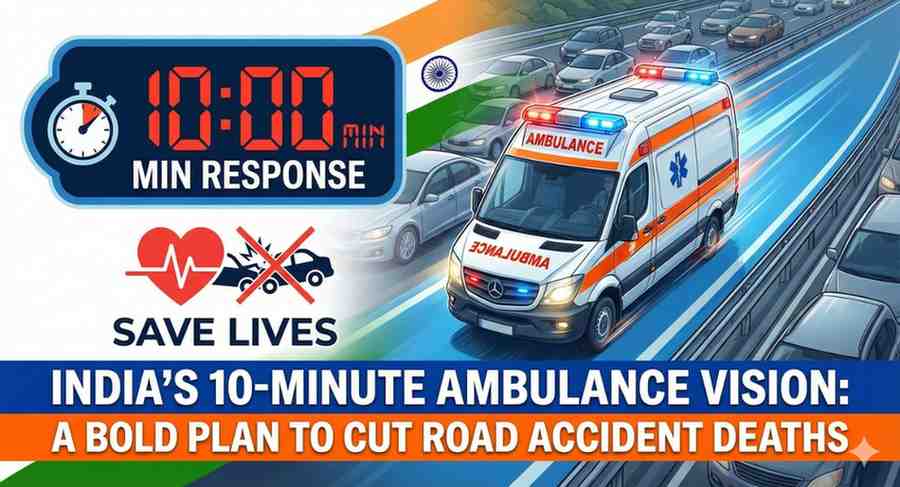
10 minute ambulance service plan is emerging as a critical intervention to address India’s rising road accident fatalities. Every year, thousands of lives are lost not due to the severity of injuries, but because emergency medical help reaches too late. By targeting rapid response within the “golden hour,” the plan aims to ensure that accident victims receive professional trauma care within minutes of a crash. Leveraging technology-driven dispatch systems, well-equipped ambulances, and trained paramedics, this initiative seeks to bridge long-standing gaps in pre-hospital care. If implemented effectively, it could fundamentally reshape India’s approach to road safety and emergency healthcare.
Why Response Time Matters: The Science Behind the ‘Golden Hour’
When it comes to road accidents, time isn’t just money—it’s life. Medical science has long established the concept of the “Golden Hour”, a critical window of roughly 60 minutes after a traumatic injury during which prompt medical intervention dramatically increases the chances of survival. Miss this window, and even injuries that are technically treatable can turn fatal. This is precisely why response time sits at the heart of the proposed 10-minute ambulance service plan.
Trauma experts agree on one uncomfortable truth: a large share of road accident deaths in India are not caused by the severity of injuries alone, but by delayed medical care. Victims often bleed to death, suffer irreversible brain damage, or go into shock while waiting for help. In many cases, ambulances arrive late, lack trained paramedics, or transport patients to facilities unequipped to handle trauma. The Golden Hour doesn’t forgive delays—and India’s current emergency response system loses precious minutes at every stage.
From a physiological standpoint, the human body reacts aggressively to trauma. Severe blood loss can lead to hypovolemic shock within minutes. Head injuries require immediate airway management and oxygen supply to prevent permanent neurological damage. Multiple fractures and internal injuries demand rapid stabilisation before transport. Medical studies show that each minute of delay in trauma care increases mortality risk by 1–2%, especially in cases involving bleeding or head trauma. Stretch that delay to 30–40 minutes, and survival odds nosedive.
Globally, countries that have invested in fast emergency response systems have seen measurable results. Nations with average ambulance response times under 10 minutes—combined with trained pre-hospital care—report significantly lower trauma fatality rates. The reason is simple: early interventions like bleeding control, immobilisation, oxygen support, and rapid triage prevent complications before they spiral out of control. The ambulance is no longer just a transport vehicle; it becomes the first mobile ICU.
In the Indian context, response time is affected by multiple bottlenecks: traffic congestion, poor road connectivity, lack of GPS-enabled dispatch systems, shortage of ambulances, and uneven distribution of trauma centres. Rural highways are particularly vulnerable, where accident victims may wait over an hour before reaching medical care. By then, the Golden Hour has often turned into a lost opportunity.
This is where the 10-minute response target becomes transformative. It forces a complete rethink of emergency care—from decentralised ambulance placement and real-time traffic integration to trained paramedics capable of delivering on-site trauma care. Instead of reacting late, the system anticipates emergencies and moves faster than the injury can worsen.
In short, the science is clear and unforgiving: speed saves lives. The Golden Hour is not a slogan or policy buzzword—it’s a medically proven reality. Any serious attempt to reduce road accident deaths must start by beating the clock. The proposed 10-minute ambulance service plan aligns directly with this science, making response time not just a metric, but the core strategy for survival.
What the 10-Minute Ambulance Service Plan Actually Proposes
The 10-minute ambulance service plan is not just about moving faster; it’s about redesigning India’s entire emergency response ecosystem from the ground up. For years, ambulance services in India have functioned in a fragmented, reactive manner—vehicles are called after chaos has already unfolded, dispatch systems are weak, and medical care begins only after reaching hospitals. This new proposal flips that outdated model on its head and treats emergency response as a time-critical public service, much like policing or firefighting.
At its core, the plan proposes a maximum 10-minute response time for ambulances to reach road accident victims, especially on national highways, expressways, and high-density urban corridors. To achieve this, ambulances would no longer be stationed randomly or centrally, but strategically placed based on accident data, traffic flow patterns, and population density. High-risk zones—black spots, accident-prone curves, toll plazas, and logistics corridors—would see permanent or semi-permanent ambulance deployment, reducing travel distance at the moment of crisis.
A key feature of the plan is technology-driven dispatch and coordination. Emergency calls would be routed through an integrated digital platform using GPS tracking, real-time traffic data, and automated nearest-ambulance allocation. This eliminates manual delays and confusion, ensuring the closest equipped ambulance reaches the site. Some proposals also envision integration with vehicle-based emergency alert systems, allowing automatic distress signals during severe crashes—cutting down response time even further.
Crucially, the plan shifts the role of ambulances from “transport vans” to mobile trauma units. Each ambulance is expected to be equipped with advanced life-support systems—oxygen delivery, defibrillators, bleeding control kits, immobilisation equipment, and essential trauma drugs. Just as important is the human element: trained paramedics and emergency medical technicians capable of administering immediate care at the accident site. This ensures that treatment begins within minutes, not after hospital admission.
Another pillar of the proposal is hospital network integration. Ambulances would be digitally linked to nearby trauma care centres, allowing hospitals to prepare in advance for incoming patients. Real-time data sharing—patient condition, injury severity, estimated arrival time—helps reduce handover delays and ensures victims are taken to the right facility, not just the nearest one. This is especially critical in cases requiring neurosurgery, orthopaedic intervention, or intensive care.
Funding and governance form the backbone of the plan’s sustainability. The model under discussion includes a mix of public funding, insurance-linked mechanisms, and private-sector participation, particularly for highway coverage. Standardised protocols, response benchmarks, and third-party audits are proposed to ensure accountability and uniform service quality across states, avoiding the patchwork performance seen in existing emergency services.
In essence, the 10-minute ambulance service plan proposes a systemic shift—from slow, hospital-centric care to rapid, field-based lifesaving intervention. It acknowledges a hard truth: in trauma cases, the first 10 minutes often decide whether the Golden Hour is used or wasted. By institutionalising speed, technology, and skilled care, the plan aims to turn emergency response into a predictable, reliable safety net rather than a matter of luck.
Technology, Trauma Care, and Trained Personnel: The Backbone of the Model
If the 10-minute ambulance service plan is the vision, then technology, trauma care, and trained personnel are the engine making it real. Without these three pillars working in sync, faster response times would be meaningless. Speed alone doesn’t save lives—what happens in those first 10 minutes does. This is where the model shows real intent, not just headline ambition.
Technology sits at the centre of the proposed system. Every ambulance under the plan is envisioned as a GPS-enabled, digitally connected emergency unit. Real-time tracking allows central command centres to identify the nearest available ambulance instantly, cutting out manual call routing and human delays. Integration with live traffic data—through city traffic control rooms and highway authorities—helps ambulances choose the fastest route, not just the shortest one. In practical terms, this could mean green corridors created on the fly, traffic signals auto-adjusted, and law enforcement alerted to clear bottlenecks. Old-school sirens meet smart-city brains—finally.
Beyond dispatch, technology also powers on-site medical decision-making. Modern ambulances are expected to carry patient monitoring systems that transmit vital data—heart rate, oxygen levels, blood pressure—directly to hospitals while the vehicle is still en route. This allows doctors to guide paramedics remotely and prepare emergency rooms in advance. In serious trauma cases, those saved minutes inside the hospital can be just as crucial as the minutes saved on the road.
Trauma care is the second, and arguably most critical, pillar. The plan treats ambulances as mobile trauma care units, not just transport vehicles. Advanced Life Support (ALS) equipment becomes standard: oxygen delivery systems, automated external defibrillators (AEDs), spinal immobilisation tools, hemorrhage control kits, and emergency medications. For accident victims suffering from severe bleeding, airway obstruction, or head injuries, immediate stabilisation at the scene can prevent irreversible damage before hospital admission.
Equally important is standardised trauma protocols. Paramedics are trained to rapidly assess injury severity, prioritise life-threatening conditions, and decide the most appropriate hospital for treatment. This avoids the common problem of victims being taken to under-equipped facilities, only to be referred elsewhere—wasting precious time and lives. The model aligns pre-hospital care with India’s trauma centre classification system, creating a smoother continuum of care.
The third pillar—trained personnel—is where the system either succeeds or collapses. The plan recognises a blunt reality: equipment without skilled hands is useless. It therefore emphasises the expansion of professionally trained paramedics and emergency medical technicians (EMTs). These are not drivers with basic first-aid knowledge, but specialised responders trained in trauma life support, airway management, bleeding control, and emergency resuscitation.
Continuous training, certification, and performance audits are built into the model to maintain standards across states. Some proposals also include partnerships with medical colleges, defence medical services, and international trauma training programmes to build capacity quickly. Importantly, paramedics are empowered to act decisively on the field, reducing over-dependence on hospital-based doctors for routine emergency decisions.
Together, technology, trauma care, and trained personnel transform the ambulance from a passive carrier into an active life-saving platform. This integrated approach ensures that the first 10 minutes after an accident are not wasted in chaos or confusion, but used with precision, professionalism, and purpose. In a country where road accidents kill more people than many diseases combined, this backbone could be the difference between another statistic and a life saved.
Implementation Challenges: Infrastructure Gaps, Funding, and Coordination
On paper, the 10 minute ambulance service plan sounds like a silver bullet. In reality, execution is where India’s biggest dreams often stumble. The idea is strong, the intent is right—but turning this vision into a nationwide, reliable system means confronting some brutally real challenges. No sugar-coating here: infrastructure gaps, funding constraints, and coordination failures are the three speed-breakers that could make or break this model.
First up, infrastructure. India’s road network is vast and uneven. While expressways and metro cities may realistically hit a 10-minute response target, rural highways, hilly regions, and remote districts are a different story altogether. Poor road quality, limited connectivity, and long distances between settlements slow down even the best-equipped ambulances. Add traffic congestion in urban centres—where emergency lanes are more fantasy than fact—and the clock starts ticking against the responder, not the injury.
Then there’s the uneven spread of trauma care facilities. Fast ambulances mean little if hospitals on the receiving end lack trauma units, ICU beds, neurosurgeons, or blood banks. Many district hospitals are understaffed and under-equipped to handle serious accident cases. Without parallel investment in upgrading trauma centres along highways and accident-prone corridors, ambulances risk becoming fast delivery systems to inadequate care.
The second hurdle is funding, and this is where idealism meets budget sheets. A 10-minute response system is expensive—high-end ambulances, advanced equipment, trained paramedics, digital command centres, and 24/7 operations don’t come cheap. States already struggling with healthcare budgets may find it difficult to sustain such a service without central support. Public–private partnerships can help, but they also raise questions about pricing, accountability, and service quality—especially in emergencies where profit motives should never override patient care.
Insurance-linked funding models are promising, but coverage gaps remain a concern. A significant portion of accident victims come from informal sectors or lack adequate insurance, raising the risk that emergency services become unevenly accessible. If the system is perceived as “free in theory but patchy in practice,” public trust will erode fast.
The third—and often most underestimated—challenge is coordination. Emergency response sits at the intersection of multiple agencies: health departments, traffic police, highway authorities, local administrations, private hospitals, and emergency call centres. In India, silos are the norm. Miscommunication, jurisdictional confusion, and delayed handovers can easily eat up those critical 10 minutes the plan aims to save.
A single accident may require traffic diversion by police, medical dispatch by health authorities, ambulance routing by a private operator, and hospital preparedness by another institution altogether. Without a unified command-and-control structure and clearly defined standard operating procedures, chaos is just one crash away. Technology can help, but only if institutions are willing to integrate and share control—something India’s bureaucratic culture struggles with.
Finally, there’s the human factor. Staff shortages, burnout, uneven training quality, and high attrition rates among paramedics can weaken the system over time. Sustaining motivation and professionalism in a high-pressure, round-the-clock service requires more than policy announcements—it needs career pathways, fair pay, and respect on the ground.
In short, the challenge isn’t imagining a 10-minute ambulance response—it’s making it work everywhere, every time. Infrastructure must be upgraded, funding must be predictable, and coordination must be ruthless in its clarity. If these hurdles are ignored, the plan risks becoming another well-intentioned promise. If they’re addressed head-on, it could redefine emergency care in India.
The Bigger Picture: How This Plan Could Transform Road Safety in India
Zoom out for a second, and the 10 minute ambulance service plan stops looking like just a healthcare reform. It starts looking like a structural reset of India’s road safety ecosystem. This isn’t only about saving accident victims after a crash—it’s about changing how the country prepares for, responds to, and ultimately prevents road fatalities. And honestly? That’s long overdue.
First, the most direct impact would be a sharp reduction in preventable deaths. India loses over a lakh lives to road accidents every year, and a significant share of these deaths occur due to delayed medical attention rather than unsurvivable injuries. By institutionalising rapid response and professional trauma care, the plan turns survival from a matter of luck into a matter of system design. When citizens know help will arrive within minutes, the fatalism around road accidents begins to break.
Second, the plan could act as a catalyst for better road discipline and emergency awareness. Countries with strong emergency response systems often see improved bystander behaviour—people are more willing to call for help, follow protocols, and cooperate with responders. In India, confusion and fear of legal trouble often delay assistance. A reliable, state-backed ambulance network, combined with Good Samaritan protections, can rebuild public confidence and encourage faster reporting of accidents.
Third, the ripple effect on infrastructure planning could be massive. To meet a 10-minute response benchmark, authorities will be forced to map accident black spots more seriously, redesign dangerous road segments, and improve signage, lighting, and surveillance. Emergency data generated by ambulances—location, time, severity—can feed into evidence-based policymaking, shifting road safety from reactive patchwork fixes to proactive design reform.
The plan also has the potential to professionalise emergency medical services in India. Paramedicine, long treated as a secondary or informal profession, would gain structure, prestige, and clear career pathways. This strengthens the broader healthcare system, especially in semi-urban and rural areas where emergency skills are scarce. Over time, a stronger pre-hospital care network could improve outcomes not just for accidents, but for cardiac emergencies, strokes, and disasters.
From an economic standpoint, the benefits are equally compelling. Road accidents impose huge costs through lost productivity, long-term disability, and healthcare expenditure. Faster response and better trauma care reduce the severity of injuries, helping victims return to work sooner and easing the burden on families and the state. In policy terms, this is not just spending—it’s high-return public investment.
Perhaps the most transformative shift, though, is psychological. A 10-minute ambulance guarantee sends a powerful signal that human life is valued at the system level, not left to chance or charity. It aligns India with global best practices while adapting them to local realities. Like emergency fire services or 112 policing, it normalises the idea that rapid emergency response is a basic civic right, not a privilege.
In the long run, if implemented with seriousness and consistency, this plan could mark the moment when India moved from reacting to road deaths to systematically preventing them from becoming fatalities. Roads will still see accidents—no country eliminates them entirely—but fewer families will lose loved ones simply because help arrived too late. And that, frankly, would be a transformation worth fighting for.
Ministry of Road Transport & Highways, Government of India
About The Author












Leave a Reply