Indian Railways Fare Hike December 26 - Telecast Global
Table of Contents
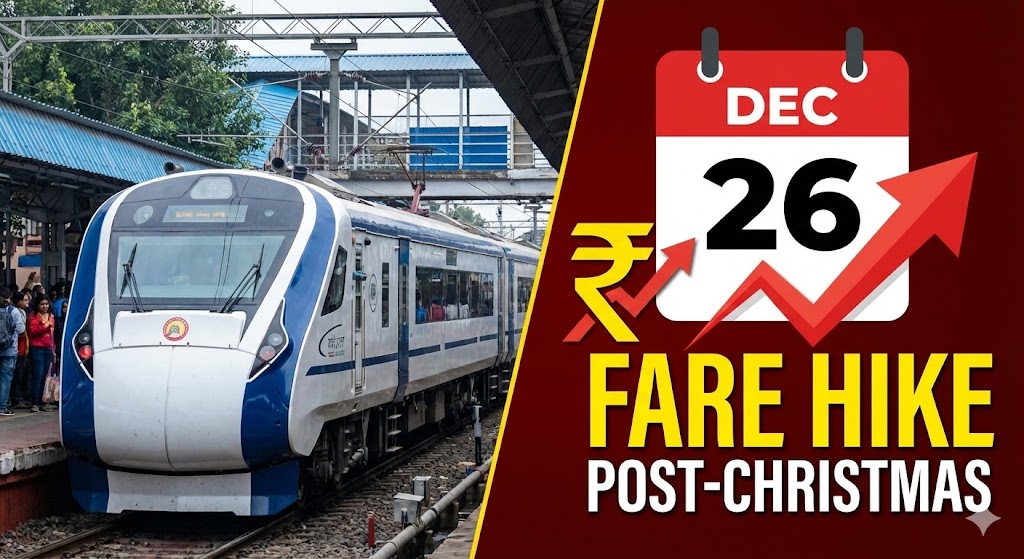
Indian Railways Fare Hike December 26 marks a small but significant change for long-distance train passengers across India. From this date, travellers using AC and non-AC Mail and Express trains will pay slightly higher fares, calculated on a per-kilometre basis. While the increase is marginal, it becomes noticeable on longer routes such as Delhi–Mumbai and Delhi–Chennai. Importantly, daily commuters, suburban travellers, and short-distance passengers remain fully exempt from the revision. The move reflects Indian Railways’ attempt to balance rising operational costs with affordability, ensuring financial sustainability without placing undue burden on economically sensitive passenger groups.
Indian Railways Fare Hike December 26: What Exactly Has Changed in Train Ticket Prices
From December 26 onward, Indian Railways has implemented a marginal but structured revision in passenger train fares, primarily affecting long-distance travellers. This isn’t a shock hike or a festival-season cash grab—it’s a calibrated adjustment measured in paise per kilometre, designed to quietly absorb rising operational costs without triggering public backlash.
The Core Change: Per-Kilometre Fare Revision
The fare increase is based on distance travelled and the category of train and coach. Here’s what has officially changed:
- Mail and Express Trains (Non-AC: Sleeper, 2S):
Fare increased by 2 paise per kilometre, applicable across the entire journey distance. - AC Classes (1A, 2A, 3A):
Fare also increased by 2 paise per kilometre, again applicable to the full distance travelled. - Second Class Ordinary (Beyond 215 km):
A smaller increase of 1 paisa per kilometre, but only for distances exceeding 215 km.
To put this into perspective:
A passenger travelling 500 km in a Mail or Express train will now pay around ₹10 extra on the base fare. That’s less than a cup of station chai—annoying, yes, but hardly wallet-breaking. Ticket prices
What Has NOT Changed (Important)
Here’s where Indian Railways played it smart:
- No change in suburban train fares
- No increase in Monthly Season Tickets (MSTs)
- No hike for ordinary second-class journeys up to 215 km
- No changes in reservation charges, superfast surcharge, or GST
This means daily commuters, short-distance travellers, and economically sensitive groups are completely insulated from the hike. The increase is laser-focused on long-distance, occasional travellers—those statistically more capable of absorbing minor fare changes.
Why This Change Feels “Invisible” to Many Passengers
Because the revision applies only to the base fare, most passengers may not immediately notice it when booking tickets online. Platforms display the final ticket price, which already bundles reservation fees, superfast charges, and taxes. The actual hike is buried quietly within that number.
That’s intentional. Indian Railways knows fare hikes are politically radioactive. So instead of loud announcements or flat-rate jumps, they’ve gone with a low-noise, data-backed adjustment.
Second Fare Revision in FY 2025–26
This December hike is not an isolated move. It’s the second passenger fare revision in the current financial year, following an earlier increase in July. Together, these incremental changes are expected to generate around ₹600 crore in additional revenue, helping the railways manage ballooning expenses without dramatic fare shocks.
Bottom Line
What changed on December 26 isn’t dramatic—but it is deliberate. Long-distance travellers will pay slightly more, short-distance passengers stay protected, and Indian Railways gets breathing room to fund operations. It’s classic old-school governance: small steps, minimal noise, maximum coverage.
Who Will Pay More—and Who Is Completely Exempt From the Fare Hike
When Indian Railways revised passenger fares from December 26, it didn’t apply a blanket increase across the board. Instead, the railways followed a targeted, class-based approach, ensuring that only specific categories of travellers bear the additional cost—while the most price-sensitive passengers remain fully protected.
Let’s break down who pays more and who walks away untouched.
Passengers Who Will Pay More
The fare hike is squarely aimed at long-distance travellers, especially those using Mail and Express services. These are passengers who typically travel hundreds—sometimes thousands—of kilometres in one journey.
1. Long-Distance Mail & Express Travellers (Non-AC)
Passengers travelling in Sleeper (SL) and Second Sitting (2S) classes on Mail and Express trains will now pay 2 paise more per kilometre for the entire journey.
- Example: A 1,000 km journey now costs roughly ₹20 extra on the base fare.
This category includes migrant workers, students, and inter-state travellers—groups that travel less frequently but cover longer distances.
2. AC Class Passengers (1A, 2A, 3A)
All AC classes also see a 2 paise per km increase. In absolute terms, the hike is marginal, but on premium routes and long journeys, it adds up.
That said, AC travellers already pay significantly higher fares, so the incremental burden remains proportionally small.
3. Ordinary Second-Class Passengers (Beyond 215 km)
Even the most basic category isn’t entirely untouched—but with conditions.
- Only journeys beyond 215 km are affected
- Increase is just 1 paisa per km
This ensures that long-haul, low-cost travellers contribute minimally, without hurting short-distance affordability. Ticket prices
Passengers Completely Exempt From the Fare Hike
Here’s where Indian Railways made a politically and socially smart move.
1. Daily Commuters & Suburban Train Users
Suburban services—used heavily in cities like Mumbai, Kolkata, Chennai, and Hyderabad—remain 100% untouched. These trains carry millions daily, and even a small hike here would trigger immediate backlash.
2. Monthly Season Ticket (MST) Holders
Workers and students who rely on Monthly Season Tickets get full protection. No fare increase. No fine print. This keeps the backbone of urban mobility intact.
3. Short-Distance Ordinary Class Passengers (Up to 215 km)
If your journey is 215 km or less in second-class ordinary coaches, you pay nothing extra.
This exemption protects rural travellers, small-town passengers, and economically weaker sections who rely on short hops for work, healthcare, and family needs.
Why This Segmentation Matters
This fare revision clearly shows a “pay-by-capacity” philosophy.
- Frequent, essential travellers → protected
- Occasional, long-distance travellers → marginally charged
It’s an old-school railway logic—keep trains affordable for survival travel, charge slightly more for convenience and distance. No drama, no sudden shocks.
The Bigger Picture
In practical terms, most Indians won’t feel this hike at all. The impact is narrow, deliberate, and controlled, ensuring revenue generation without social unrest. Indian Railways gets financial breathing room, while the common commuter remains insulated.
That’s not populism. That’s calculated governance.
Impact on Major Long-Distance Routes Like Delhi–Mumbai and Delhi–Chennai
The real effect of the December 26 fare revision becomes visible on long-distance, high-traffic corridors, where passengers cover 1,000 km or more in a single journey. These routes form the economic spine of the country—and even a small per-kilometre hike shows up clearly once distances add up. That’s exactly where Indian Railways expects most of the additional revenue to come from.
Let’s break it down route by route, minus the noise.
Delhi–Mumbai: India’s Busiest Long-Haul Corridor
- Distance: ~1,400 km
- Fare increase: ~₹28 on the base fare
This route connects the political capital with the financial capital, serving business travellers, migrant workers, students, and families alike. With the revised rate of 2 paise per km for Mail and Express trains (both AC and non-AC), the added cost remains modest in isolation—but multiplied across millions of passengers annually, it becomes a serious revenue stream.
For an AC traveller already paying a premium fare, ₹28 barely registers. For sleeper-class passengers, it’s noticeable—but still manageable. Crucially, there’s no change in reservation charges, superfast surcharge, or GST, so the final ticket price doesn’t spike dramatically. Ticket prices
Delhi–Chennai: The Longest High-Demand North–South Route
- Distance: ~2,200 km
- Fare increase: ~₹44 on the base fare
This is where distance really amplifies the impact. A journey stretching across half the subcontinent naturally attracts the highest incremental cost under the new structure. Still, ₹44 on a journey of over 2,000 km works out to pennies per hour of travel.
For Indian Railways, however, this route is gold. High occupancy, long distances, and consistent demand make it ideal for small, silent fare revisions that don’t disrupt passenger behaviour.
Other Major Routes Feeling the Increase
- Delhi–Kolkata (~1,440 km): ~₹29 increase
- Mumbai–Bengaluru (~1,200 km): ~₹24 increase
- Howrah–Chennai (~1,660 km): ~₹33 increase
These routes serve industrial belts, IT hubs, and educational centres. The pattern is clear: the longer the journey, the higher the absolute increase—but the lower the psychological impact per kilometre.
Why Passengers May Not Even Notice Immediately
Here’s the clever part. The hike applies only to the base fare. When passengers book tickets online, they see a final consolidated price, not a breakdown screaming “fare hike.” That design choice keeps backlash low and acceptance high.
Most travellers will chalk it up to “rounding off” or seasonal fluctuation—exactly as intended.
Revenue vs Reality
From a passenger’s point of view, the increase is annoying but tolerable. From Indian Railways’ perspective, it’s strategic and scalable. Long-distance routes like Delhi–Mumbai and Delhi–Chennai alone can generate crores in additional annual revenue, without touching suburban services or daily commuters.
That’s classic railway economics—old-school, data-driven, and politically cautious.
Bottom Line
On major long-distance routes, the December 26 fare revision is felt numerically but not emotionally. Passengers still travel, trains still fill up, and Indian Railways quietly strengthens its balance sheet. No shock, no strike, no slowdown—just a subtle recalibration of who pays a little more for crossing big distances.
Why Indian Railways Increased Fares Despite Public Sensitivity
Any increase in train fares in India is politically sensitive—full stop. Railways aren’t just transport here; they’re an emotional and economic lifeline. So when Indian Railways still went ahead with a fare hike from December 26, it wasn’t carelessness—it was compulsion backed by hard numbers.
Let’s be blunt: this increase was less about revenue greed and more about financial survival.
Rising Costs Have Cornered Indian Railways
Over the past decade, Indian Railways has expanded aggressively—more trains, better safety systems, faster corridors, electrification, and modern stations. But expansion comes with a price tag that passengers rarely see.
- Staff expenditure has crossed ₹1.15 lakh crore
- Pension liabilities are nearing ₹60,000 crore
- Total operational costs for FY 2024–25 stand at around ₹2.63 lakh crore
These aren’t abstract numbers. They’re recurring, non-negotiable expenses. Salaries and pensions don’t pause just because fares remain politically untouchable. Ticket prices
For years, Indian Railways absorbed these costs internally, leaning heavily on freight revenue and government support. But that cushion is thinning.
Passenger Fares Were Frozen for Too Long
Here’s the uncomfortable truth: passenger fares in India have not kept pace with inflation.
While fuel prices, electricity tariffs, spare parts, and labour costs steadily climbed, passenger fares barely moved—especially for long-distance travel.
This created a structural imbalance:
- Passenger services = high cost, low margin
- Freight services = profit-making, overburdened
Over-dependence on freight revenue isn’t sustainable. It distorts logistics costs and hurts industry competitiveness. A limited passenger fare correction was inevitable.
Why the Increase Was Small—and Surgical
Indian Railways knew one thing clearly: a blunt fare hike would trigger backlash. So it chose the least disruptive path.
- Increase measured in paise per kilometre
- Applied mainly to long-distance Mail and Express trains
- Daily commuters, MST holders, and short-distance passengers fully protected
- No change in reservation charges, superfast surcharge, or GST
This wasn’t populism, but it wasn’t arrogance either. It was calculated restraint.
Revenue Target: Modest but Necessary
The December revision is expected to generate around ₹600 crore in additional revenue. In the context of Indian Railways’ total budget, this is not massive, but it’s meaningful.
Think of it as financial oxygen—not a windfall.
That money helps:
- Maintain safety infrastructure
- Fund track upgrades and signalling
- Offset pension and manpower costs
- Reduce pressure on freight cross-subsidisation
Timing Wasn’t Random
Yes, the hike came right after Christmas—but that’s exactly when long-distance travel peaks. Higher demand reduces fare sensitivity. Passengers grumble, but they still travel.
Old-school economics: never raise prices when demand is weak.
The Bigger Strategic Shift
This fare hike signals something bigger: Indian Railways is slowly moving toward realistic pricing without abandoning social responsibility. It’s a delicate balance—modernisation without exclusion.
Public sensitivity wasn’t ignored. It was managed.
Bottom Line
Indian Railways increased fares not because it wanted to—but because standing still was no longer an option. Rising costs, frozen fares, and infrastructure ambitions forced a rethink. The result? A low-noise, low-impact hike that spreads the burden thinly while protecting those who rely on trains the most.
Not popular—but necessary.
What This Fare Revision Means for Passengers Going Forward
For passengers, the December 26 fare revision by Indian Railways is less about immediate financial pain and more about what kind of railway system India is moving toward. The real story isn’t the extra ₹20–₹40—it’s the direction of travel.
Let’s look at what this change signals for the future.
Expect Gradual, Not Sudden, Fare Adjustments
If this revision tells us anything, it’s that Indian Railways prefers small, periodic corrections over dramatic hikes. The era of decade-long fare freezes followed by public outrage is slowly ending.
Going forward, passengers should expect:
- Minor, distance-based fare tweaks
- Adjustments spread across financial years
- Fewer “shock” announcements
This is how mature transport systems operate. Quiet, boring—but stable.
Long-Distance Travel Will Carry Slightly Higher Costs
The message is clear: long-distance, non-essential travel will bear more of the financial load. That doesn’t mean trains are becoming unaffordable—it means the cost of maintaining a massive national network is being shared more realistically.
For most travellers:
- The increase remains a one-time irritation, not a deal-breaker
- Train travel still beats flights and buses on value
- Affordability for short journeys remains intact
In plain terms: trains are still the best deal in India.
Daily Commuters Remain Politically and Economically Protected
Suburban passengers, MST holders, and short-distance travellers can breathe easy. Their exemption confirms a long-standing principle: railways are a public service first, a business second.
That philosophy isn’t going away anytime soon.
Better Services Are the Unspoken Trade-Off
While Indian Railways rarely markets fare hikes well, the expectation is obvious:
- Improved punctuality
- Safer tracks and signalling
- Cleaner coaches and stations
- More trains and higher speeds
Passengers may not see instant transformation, but fare realism makes modernisation financially possible.
Freight Pressure May Ease—Good News for the Economy
As passenger fares inch closer to reality, Indian Railways can rely less on freight cross-subsidisation. That helps keep logistics costs under control—something passengers ultimately benefit from as consumers.
Lower freight pressure = healthier supply chains.
Psychological Shift: Paying a Little More Without Panic
Perhaps the biggest change is psychological. Passengers are slowly being conditioned to accept minor fare adjustments as normal, not as betrayal. That’s essential if Indian Railways is to modernise without political paralysis.
Bottom Line
For passengers, this fare revision is not a warning sign—it’s a transition signal. Trains remain affordable, commuters stay protected, and long-distance travellers contribute marginally more to sustain a system that serves over a billion journeys a year.
No drama. No derailment. Just slow, steady recalibration.
About The Author