H-1B Visa Processing Delays 2025: 5 Shocking Impacts on Tech, Travel & India-US Ties - Telecast Global
Table of Contents
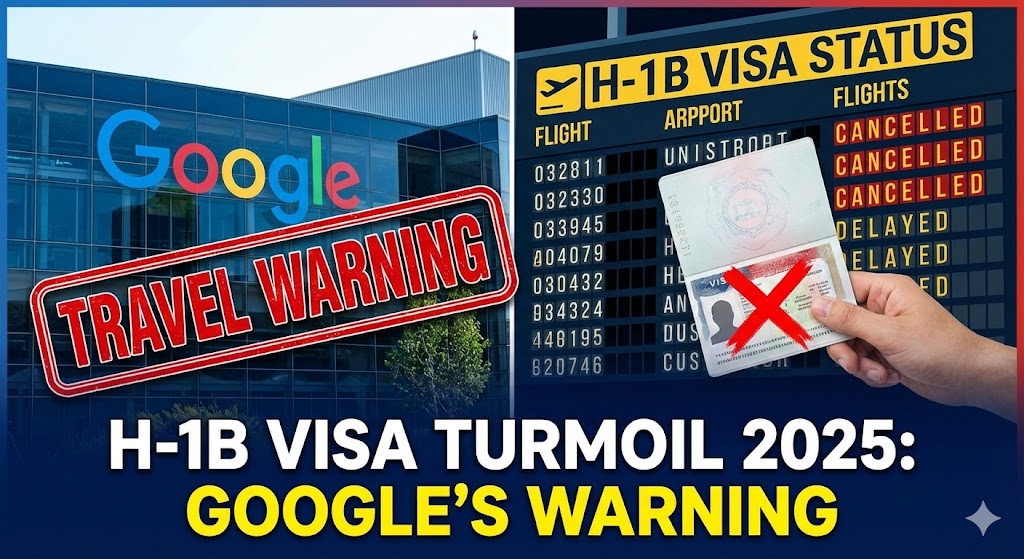
H-1B Visa Processing Delays 2025 have pushed the US immigration system into one of its most uncertain phases in recent years. What was once a manageable administrative process has now become a serious risk for global professionals, especially those working in the technology sector. Mounting backlogs, tougher security screening, and sudden appointment cancellations have disrupted travel and career plans. Even major tech firms like Google have issued internal advisories warning employees to reconsider international travel. As visa timelines stretch unpredictably, the ripple effects are being felt across the global tech workforce, privacy norms, and India–US strategic relations.
Why Google Issued a Travel Advisory to H-1B and H-4 Visa Holders
In 2025, Google took an unusually direct step by advising its H-1B and H-4 visa–holding employees to avoid or postpone international travel. For a company that operates across borders and thrives on global mobility, this warning wasn’t routine HR paperwork—it was a red flag about how broken and unpredictable the US visa system has become.
At the core of Google’s advisory is severe visa processing uncertainty. US consulates are dealing with unprecedented backlogs, tighter security reviews, and reduced interview capacity. Employees traveling abroad for family visits, conferences, or even emergencies now face a very real risk: they may not be able to return to the US for months. Internal assessments suggest some workers could be stuck outside the country for up to a year, despite holding valid approvals and employment contracts.
One major trigger behind this advisory is the expanded national security screening regime introduced in late 2025. Visa renewals that were once procedural now involve deep digital scrutiny. Applicants’ social media histories, online activity, and digital footprints from the past several years are being reviewed in detail. This has dramatically slowed down processing times. For Google, which employs thousands of foreign-born engineers and researchers, the probability of disruption became too high to ignore.
Another concern is the unpredictability of appointment availability. Visa interview slots in countries like India have been abruptly canceled or pushed far into the future. Employees who leave the US assuming they’ll return in a few weeks are discovering that timelines are no longer reliable. From a corporate risk perspective, this is a nightmare: key team members suddenly go offline, projects stall, and legal compliance issues crop up around work authorization and payroll.
Google’s advisory is also rooted in US labor and tax law constraints. Many H-1B employees cannot legally work remotely from outside the US for extended periods. Being stuck abroad isn’t just inconvenient—it can put workers in violation of immigration or employment rules. That exposes both the employee and the company to legal and financial risks. Google is essentially saying: don’t gamble with your status.
There’s also a human angle here, and Google knows it. Visa uncertainty hits mental health hard. Employees caught outside the US face stress around job security, family separation, children’s schooling, and housing commitments. By issuing a formal advisory, Google is trying to prevent avoidable crises rather than reacting after the damage is done.
Zoom out, and this advisory reflects a bigger shift: corporations no longer trust the system to function predictably. When a company like Google—used to navigating complex regulations—tells its own employees to stay put, it signals that immigration volatility has crossed from “manageable friction” into “operational threat.”
Bottom line: Google didn’t issue this warning to scare employees. It did it because in 2025, international travel on H-1B or H-4 status is no longer a calculated risk—it’s a roll of the dice. And in high-stakes careers, nobody wants to bet their future on broken processes.
H-1B Visa Processing Delays 2025: Inside the Crackdown on Travel and Renewals
The 2025 visa crackdown didn’t arrive with sirens—it crept in through policy tweaks, security memos, and administrative overload. But the impact? Loud, messy, and career-altering for H-1B and H-4 visa holders worldwide. What used to be a structured, if slow, process has morphed into a high-friction system where timeframes are fuzzy, scrutiny is intense, and costs are rising.
First, the delays. US consulates are operating under a heavier security mandate while simultaneously handling record volumes. Interview slots have been slashed because each application now requires longer, individualized review. Posts in India—among the busiest globally—have seen appointments canceled or pushed months ahead with little notice. The result is a backlog that feeds on itself: fewer interviews per day means longer queues, which means even fewer predictable outcomes.
What changed? The biggest shift is digital scrutiny. In late 2025, the United States Department of State expanded vetting rules that treat online behavior as a national security signal. Applicants are now expected to keep social media profiles publicly accessible for years of history. Officers can review posts, likes, comments, affiliations—basically your internet exhaust. This isn’t a quick scan; it’s a deep audit. Multiply that by millions of applicants, and delays are inevitable.
This scrutiny also introduces subjectivity. Online context is messy. Sarcasm, political opinions, old posts taken out of context—anything can slow a case while officers seek clarifications or escalate reviews. Even clean records can get stuck in “administrative processing,” a black box with no firm deadline. For professionals on tight project timelines, that uncertainty is brutal.
Then there’s the money. 2025 brought new and higher fees layered onto an already expensive system. Beyond standard filing and fraud prevention fees, additional charges have been justified as deterrents against misuse and as funding for enhanced screening. In practice, they raise the barrier for legitimate applicants and employers alike. Smaller firms feel the pinch; even large tech companies have to rework budgets and hiring plans.
Operationally, the crackdown ripples through companies. Employees stuck abroad may not be allowed to work remotely due to tax, payroll, or immigration constraints. Teams lose momentum. Deadlines slip. Legal departments scramble. The crackdown effectively turns immigration into a business continuity risk, not just an HR issue.
There’s also a trust deficit forming. When timelines aren’t honored and rules shift midstream, applicants lose faith in predictability. Planning weddings, schooling, home purchases, or elder care becomes guesswork. The human cost is real—and it compounds the economic one.
Big picture? The 2025 crackdown reflects a philosophy shift: security first, speed last. Governments have the right to protect borders, no debate there. But when safeguards expand without capacity to process them efficiently, the system chokes. And when it chokes, talent looks elsewhere.
Call it what it is: the visa pipeline didn’t just slow down—it changed character. For H-1B and H-4 holders, navigating 2025 means patience, caution, and zero assumptions. Old playbooks are outdated. Welcome to the new normal.
How H-1B Processing Delays Are Disrupting the Global Tech Workforce
H-1B visa delays in 2025 aren’t just an immigration headache—they’re actively reshaping how the global tech workforce functions, and not in a good way. What once powered Silicon Valley’s speed and innovation is now a bottleneck slowing teams, products, and entire roadmaps.
Let’s start with the obvious hit: people stuck in limbo. Thousands of highly skilled professionals—software engineers, AI researchers, cloud architects—are stranded outside the US while waiting for visa stamping or renewal. Many of them work for giants like Google, Apple, and other US-based tech firms that depend heavily on international talent. When these employees can’t return, teams lose critical expertise overnight.
Now here’s the kicker: most people assume remote work solves this. It doesn’t. US immigration, tax, and labor laws often restrict long-term remote work from abroad for H-1B holders. That means employees stuck outside the US may be legally barred from working at all. Companies are forced to put them on unpaid leave, reassign their tasks, or—worst case—terminate roles temporarily. That’s not flexibility; that’s system failure.
The ripple effect inside companies is brutal. Product timelines slip. Sprint cycles stretch. Client deliverables get renegotiated. In high-stakes areas like AI development, cybersecurity, and cloud infrastructure, even a few missing specialists can stall entire initiatives. Tech doesn’t move at government speed—and this mismatch is costing companies real money.
Managers are also rethinking hiring strategies. With visa timelines unpredictable, firms are becoming cautious about recruiting international candidates, even when talent shortages are obvious. Some are shifting roles to offshore offices in India, Europe, or Southeast Asia—not because it’s optimal, but because it’s safer. This quietly dilutes the US’s dominance as the global tech hub.
For employees, the disruption is deeply personal. Careers built over a decade can be derailed by a single delayed appointment. Families are separated. Children’s schooling plans collapse. Mortgages, leases, and healthcare arrangements hang in the balance. The mental health toll is massive—and rarely acknowledged in policy debates.
There’s also a competitive global angle. Countries like Canada and Germany are watching this chaos closely—and capitalizing on it. Clearer immigration pathways, predictable processing times, and transparent rules are becoming selling points. Skilled professionals who once dreamed exclusively of the US are now diversifying their options. Talent, like capital, flows where friction is lowest.
Ironically, the H-1B delay problem hurts the very goal it claims to protect: economic strength. Innovation thrives on collaboration, speed, and continuity. When global teams are fractured by bureaucracy, productivity drops—and rivals gain ground.
Let’s be real: the tech world runs on brains, not borders. The longer H-1B processing remains unpredictable, the more the global tech workforce will adapt away from the US, not toward it. And once talent ecosystems shift, they don’t snap back easily.
This isn’t a short-term inconvenience. It’s a structural disruption—and 2025 may be the year its long-term consequences become unavoidable.
Privacy vs National Security: The Social Media Screening Debate
The 2025 visa crackdown has pushed a long-simmering question into the spotlight: how much of your digital life should a government be allowed to inspect in the name of national security? With social media screening now central to visa decisions, the line between personal expression and professional eligibility is getting uncomfortably thin.
At the policy level, the logic is straightforward. Governments argue that threats today don’t always announce themselves through criminal records or travel histories. Radicalization, misinformation networks, and hostile affiliations often leave digital footprints. By reviewing social media activity, authorities believe they can identify risks early. Under expanded guidelines from the United States Department of State, visa officers are now encouraged to examine applicants’ online presence going back several years.
On paper, that sounds reasonable. In practice, it’s messy.
Social media is not a courtroom transcript—it’s context-poor, emotional, and often impulsive. A sarcastic tweet, a political opinion, a meme shared years ago, or even a “like” on someone else’s post can be misread. What one officer sees as harmless expression, another may flag for further review. This subjectivity is the core problem. There are no clear public standards explaining what online behavior crosses the line.
That uncertainty has created a chilling effect. Visa applicants are now self-censoring, deleting old posts, locking accounts, or avoiding online discussion altogether. Free expression takes a back seat when a career depends on how an algorithm or officer interprets your digital trail. The irony? Many democracies champion free speech—yet professional mobility is increasingly tied to silence.
Privacy advocates argue that this approach effectively turns social media into a permanent background check, without due process or transparency. Applicants are rarely told what content triggered concern or how to contest an interpretation. Administrative processing can stretch for months, with no explanation beyond vague security language. For individuals, this feels less like vetting and more like digital profiling.
Governments counter that participation in visa programs is voluntary. If you want access, you accept scrutiny. That argument holds some weight—but it ignores scale. When entire industries, universities, and innovation ecosystems rely on cross-border talent, these policies don’t just affect individuals; they reshape global labor flows.
There’s also an equity issue. Digital footprints vary by culture, age, and region. Someone from a politically volatile country may have a more expressive online history than someone from a quieter environment. Treating all digital expression as equal risk bakes bias into the system, even unintentionally.
From a national security lens, the goal isn’t wrong. States must protect borders. But effective security depends on signal-to-noise ratio. When officers are overwhelmed by vast amounts of online data, genuine risks can be buried under irrelevant content. More data doesn’t automatically mean better decisions—sometimes it just means slower ones.
The real debate, then, isn’t privacy versus security. It’s how to balance both without breaking trust. Clearer guidelines, limited review windows, transparency on red flags, and appeal mechanisms could reduce fear without compromising safety.
Right now, the system leans heavily toward caution—at the cost of predictability and confidence. And when talented professionals feel watched rather than welcomed, they start looking for doors that don’t come with digital strings attached.
In 2025, social media isn’t just social anymore. It’s immigration infrastructure. And that reality is forcing the world to rethink what privacy really means in a hyper-connected age.
India–US Ties at Stake: Economic, Educational, and Strategic Fallout
The H-1B visa disruption of 2025 isn’t happening in a vacuum. Its shockwaves are rippling straight into the core of India–US relations, quietly straining a partnership that’s been decades in the making. What looks like a technical immigration issue on paper is, in reality, an economic, educational, and strategic stress test—and both sides are feeling it.
Start with the economic fallout. Indian professionals form the backbone of the US tech ecosystem. For years, Indian engineers, data scientists, and startup founders have powered innovation at scale, especially in Silicon Valley. A large share of approved H-1B visas consistently goes to Indian nationals, creating a symbiotic loop: US companies get talent; India gets remittances, experience, and global exposure. Visa delays disrupt this loop. When mobility slows, productivity drops—and so does confidence in the system.
India is the world’s largest recipient of remittances, and the US is a major contributor. If H-1B participation shrinks or becomes riskier, that flow weakens over time. This isn’t just about family income—it affects consumption, savings, and long-term human capital investment back home. Multiply that across thousands of households, and the macro impact becomes impossible to ignore.
Then comes education, the soft-power engine of the relationship. Indian students form one of the largest international cohorts in US universities. But visa uncertainty—spilling over from work visas to student categories—has shaken trust. Families planning multi-crore education investments want predictability. When appointments are delayed and rules feel opaque, alternatives start looking attractive.
Countries like Canada and Germany are already capitalizing, offering clearer post-study work pathways and faster processing. If students choose elsewhere, US universities lose tuition revenue, research capacity, and long-term alumni networks. Once that pipeline shifts, rebuilding it is painfully slow.
The strategic angle is where things get serious. India and the US aren’t just trade partners; they’re strategic collaborators in emerging technologies—AI, semiconductors, quantum computing, and defense innovation. Frameworks like iCET were built on the assumption that high-skilled talent can move freely between labs, campuses, and companies. Immigration friction directly undermines that assumption.
When scientists can’t travel, joint research stalls. When engineers can’t relocate, supply chains fragment. And when trust erodes, cooperation becomes cautious instead of ambitious. Strategic alignment isn’t sustained by summits alone—it runs on people.
There’s also a perception problem. India views its diaspora as a bridge, not a liability. Policies that leave professionals stranded or scrutinized excessively send the wrong signal. Over time, this feeds a narrative that the US is becoming a harder, less welcoming destination for global talent—especially compared to competitors who are aggressively courting the same pool.
To be fair, no country compromises on security lightly. But partnerships thrive on predictability and goodwill. When rules change abruptly and processing becomes opaque, even friendly ties feel the strain.
Bottom line: immigration policy has become foreign policy by other means. If visa bottlenecks persist, the cost won’t just be delayed travel—it will be lost momentum in one of the world’s most consequential bilateral relationships.
The India–US partnership has history, trust, and shared interests on its side. The question is whether policy execution will catch up with strategic intent—or quietly chip away at it.
About The Author