

Table of Contents
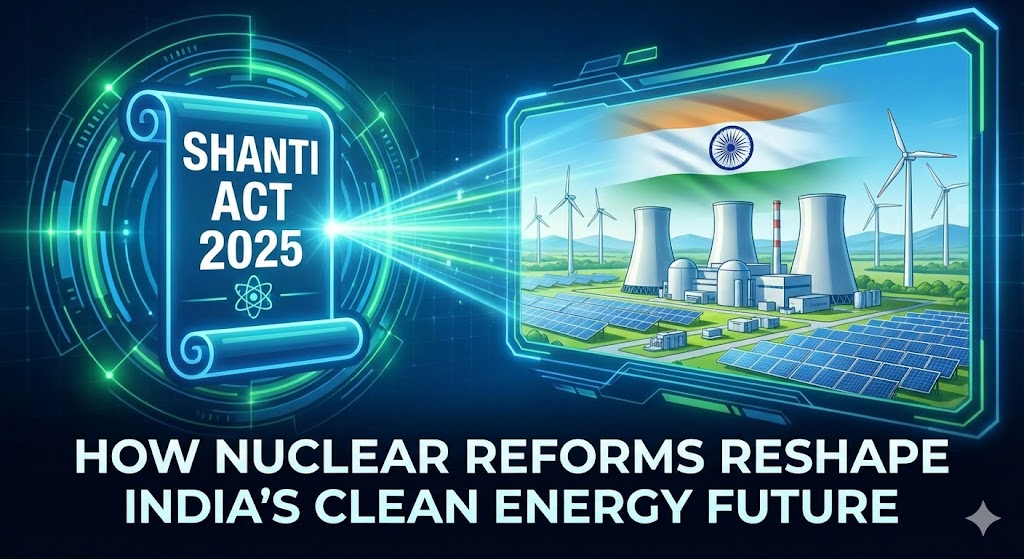
India’s civil nuclear sector has entered a historic phase with the passage of the SHANTI Act 2025, a reform that fundamentally reshapes how nuclear energy is governed, regulated, and expanded. Recently, the US-India Strategic Partnership Forum (USISPF) publicly welcomed the law, calling it the most comprehensive overhaul of India’s nuclear framework since Independence. By opening doors to private participation while strengthening safety oversight, the Act aligns India’s clean-energy ambitions with global standards. At a time of rising power demand and climate pressure, SHANTI Act 2025 signals that India is finally serious about scaling nuclear energy responsibly.
What Is the SHANTI Act 2025? Breaking Down Its Core Legal and Structural Changes
The SHANTI Act 2025—formally titled the Sustainable Harnessing and Advancement of Nuclear Technology for Transforming India Act—marks the biggest reset of India’s civil nuclear framework since Independence. For decades, India’s nuclear sector ran on laws written for a completely different era, when energy demand was lower, technology was limited, and the private sector had zero role. SHANTI 2025 flips that script—cleanly, deliberately, and with global alignment in mind.
At its core, the Act repeals and replaces two legacy laws: the Atomic Energy Act, 1962 and the Civil Liability for Nuclear Damage Act, 2010. These laws were drafted in a time when nuclear energy was treated as an exclusively sovereign activity. Over time, they became bottlenecks—slowing approvals, scaring away investors, and freezing innovation. SHANTI 2025 consolidates all civil nuclear rules into one unified, modern legal framework, cutting duplication and regulatory confusion.
One of the most structural changes introduced by the SHANTI Act is controlled private-sector participation. For the first time in Indian history, eligible private companies and joint ventures are legally allowed—under strict licensing—to build, own, operate, and decommission nuclear reactors. This is not deregulation; it’s structured expansion. Strategic parts of the nuclear fuel cycle—like uranium and thorium mining, high-level enrichment, spent fuel reprocessing, and heavy water production—remain firmly under government control. National security lines are not crossed; they’re clearly drawn.
Another game-changing reform is the statutory empowerment of the nuclear regulator. Earlier, the Atomic Energy Regulatory Board operated without full legal backing, which raised questions about independence and accountability. Under SHANTI 2025, the Atomic Energy Regulatory Board (AERB) becomes a legally autonomous authority accountable to Parliament. It now has clear powers to issue safety clearances, enforce radiation limits, regulate waste disposal, conduct inspections, and suspend or cancel licenses for violations. That’s a serious credibility upgrade—for citizens and investors alike.
The Act also restructures nuclear liability in a globally compatible way. India retains the no-fault liability principle—meaning the operator is responsible for damages regardless of negligence—but removes mandatory supplier liability unless explicitly written into contracts. This single change unclogs years of stalled projects and aligns India with international nuclear liability conventions, without diluting victim compensation safeguards.
To handle disputes and compensation efficiently, SHANTI 2025 proposes a specialised Nuclear Damage Claims Commission or Tribunal, ensuring faster resolution instead of dragging cases through regular courts. Appeals will still lie with the Supreme Court of India, maintaining constitutional oversight.
In short, the SHANTI Act 2025 is not just a policy tweak—it’s a structural reboot. It modernises outdated laws, brings regulatory clarity, balances openness with sovereignty, and positions nuclear energy as a central pillar of India’s clean-energy transition. Old rules were holding the system back. This law finally lets it move forward—with guardrails firmly in place.
Private Sector Entry Into Nuclear Power: Opportunity, Risk, and Regulation
The most talked-about—and frankly, most disruptive—feature of the SHANTI Act 2025 is its decision to open India’s civil nuclear sector to private participation. For over sixty years, nuclear power in India functioned as a near-total state monopoly, dominated by public entities like Nuclear Power Corporation of India Limited (NPCIL). That model delivered safety and control, sure—but it also delivered slow capacity growth, funding stress, and chronic project delays. SHANTI 2025 says: enough already.
The Opportunity: Capital, Speed, and Technology
Let’s be blunt—nuclear power is expensive. Long gestation periods, high upfront costs, and complex engineering have always limited India’s expansion pace. Allowing private companies into reactor construction and operation unlocks new capital, modern project management, and global technology partnerships. This matters if India is serious about jumping from under 9 GW today to ambitious long-term nuclear targets.
Private participation also opens doors to next-generation technologies, especially Small Modular Reactors (SMRs) and advanced fuel systems. These smaller, scalable reactors are faster to deploy, safer by design, and ideal for industrial clusters, data centres, and grid-stability roles. Global energy majors and advanced manufacturing firms are already circling this space. Without private entry, India risked watching that revolution from the sidelines.
The Risk: Safety, Security, and Public Trust
Now the uncomfortable part. Nuclear energy is not solar panels or wind farms. One failure can wipe out decades of public trust. Critics worry that profit motives could dilute safety culture, cut corners, or increase regulatory capture. Those fears aren’t imaginary—they’re historically grounded.
SHANTI 2025 addresses this head-on by drawing hard red lines. Strategic and sensitive parts of the nuclear fuel cycle—uranium and thorium mining, high-level enrichment, spent fuel reprocessing, heavy water production, and radioactive waste management—remain exclusively under government control. Private players operate reactors, not the strategic backbone. That’s not compromise; that’s containment.
The Regulation: Tight Leash, Clear Rules
This is where the Act gets smart. Private entry is not automatic—it’s license-based, conditional, and revocable. The newly empowered Atomic Energy Regulatory Board (AERB) acts as the gatekeeper. It can issue approvals, conduct inspections, enforce radiation limits, mandate emergency preparedness, and—crucially—shut plants down if standards slip.
The liability framework is another stabiliser. Operators carry no-fault liability, ensuring victims are compensated without legal gymnastics. Supplier liability, which earlier scared off manufacturers, is now contractual—bringing India in line with global norms while keeping accountability intact.
The Bottom Line
Private sector entry under SHANTI 2025 isn’t reckless liberalisation—it’s calculated expansion. Opportunity comes with risk, but risk is fenced in by regulation, state control of strategic assets, and a legally empowered safety watchdog. India isn’t abandoning caution; it’s upgrading capacity.
Old-school monopoly delivered stability. The future demands scale. SHANTI 2025 tries to deliver both—and honestly, that balance was overdue.
Safety First: How the SHANTI Act Strengthens India’s Nuclear Regulatory System
If private entry is the most visible change under the SHANTI Act 2025, regulatory reform is its backbone. For years, India’s nuclear safety architecture worked—but not without questions. The biggest concern was not intent, but structure. Regulators lacked full statutory backing, accountability lines were blurred, and public confidence remained fragile. SHANTI 2025 directly fixes this weak link by putting nuclear safety at the centre of the law, not as an afterthought.
The single most important reform is granting full legal status to the Atomic Energy Regulatory Board (AERB). Earlier, the AERB functioned through executive authority, which limited its perceived independence and enforcement muscle. Under the SHANTI Act, it becomes a statutory, autonomous regulator, answerable to Parliament of India. That shift matters. When a regulator derives power directly from law—not from the same executive it oversees—credibility goes up, and conflicts of interest go down.
With statutory backing comes expanded enforcement power. The AERB is now authorised to issue and revoke safety clearances, conduct unannounced inspections, impose radiation exposure limits, regulate radioactive waste handling, and suspend or cancel operating licenses if standards are breached. This isn’t symbolic authority—it’s real leverage. For private operators especially, the message is clear: compliance is not optional, and shortcuts will shut you down.
Another key upgrade lies in clear safety governance across the nuclear lifecycle. SHANTI 2025 brings reactor design approval, construction oversight, fuel handling, emergency preparedness, waste disposal, and decommissioning under one integrated safety framework. Earlier, overlapping rules created grey zones. Now, responsibility is traceable at every stage. In high-risk sectors like nuclear power, clarity isn’t bureaucracy—it’s protection.
Public safety and transparency also get a boost. The Act mandates stricter radiation monitoring, defined exclusion and emergency planning zones, and enforceable public disclosure norms during nuclear incidents. This addresses a long-standing trust deficit. People living near nuclear plants don’t just want assurances; they want visibility. SHANTI 2025 acknowledges that public acceptance is as critical as technical safety.
The law also strengthens waste management oversight, one of the most sensitive aspects of nuclear energy. While high-level waste and spent fuel reprocessing remain under state control, the regulator now has clearer authority to enforce storage standards, transportation safety, and long-term containment protocols. This reduces environmental risk and aligns India more closely with international best practices.
Crucially, SHANTI 2025 introduces penalties with teeth. Safety violations can now attract graded financial penalties, license suspension, and criminal liability depending on severity. Earlier, enforcement often relied on administrative action. Now, consequences are codified in law—making deterrence real, not theoretical.
In essence, SHANTI Act 2025 treats safety not as a checkbox, but as system design. By empowering an independent regulator, clarifying authority, and hardwiring accountability, India signals something important: nuclear expansion will not come at the cost of public safety. Old frameworks relied on institutional discipline. This one relies on law-backed enforcement.
And in nuclear energy, that difference can’t be overstated.
Why USISPF’s Endorsement Matters for India–US Energy and Strategic Ties
When the US-India Strategic Partnership Forum (USISPF) publicly welcomed the SHANTI Act 2025, it wasn’t just a polite press statement—it was a strategic signal. In global energy diplomacy, endorsements don’t come cheap, and they definitely don’t come without calculation. USISPF calling SHANTI 2025 the most comprehensive reform of India’s civil nuclear framework since Independence tells investors, governments, and allies one clear thing: India is now open for serious nuclear business—on predictable, globally aligned terms.
First, understand who USISPF speaks for. It represents major American corporations, investors, and policy stakeholders with direct access to Washington’s decision-making ecosystem. When such a forum backs a reform, it reduces perceived policy risk—the biggest red flag for long-gestation sectors like nuclear power. Nuclear projects don’t think in election cycles; they think in decades. USISPF’s endorsement reassures companies that India’s nuclear rules won’t flip overnight due to legal ambiguity or regulatory panic.
Second, the endorsement unfreezes Indo–US nuclear cooperation, which has historically been stuck in neutral despite the landmark civil nuclear deal of the late 2000s. For years, supplier liability concerns and regulatory uncertainty kept American companies on the sidelines. SHANTI 2025 directly fixes that bottleneck. By aligning India’s liability regime with international norms—without diluting victim protection—the Act makes it commercially viable for US firms to participate again. USISPF’s backing confirms that this alignment is credible, not cosmetic.
Third, this endorsement matters in the context of advanced nuclear technologies, especially Small Modular Reactors (SMRs). The US is a global leader in SMR design, fuel innovation, and nuclear safety systems. India, on the other hand, offers scale, demand, and a massive clean-energy transition challenge. SHANTI 2025 creates the legal space where these strengths can meet. USISPF’s support signals that American firms now see India as a realistic deployment market—not just a strategic talking point.
Beyond energy, the implications are geopolitical. In the Indo-Pacific, energy security is national security. Diversifying nuclear supply chains, reducing dependence on a handful of global suppliers, and building resilient clean-energy infrastructure are now strategic objectives. Stronger India–US nuclear cooperation under SHANTI 2025 contributes to that broader balance—quietly but decisively.
There’s also a climate dimension. Both India and the US face pressure to decarbonise without crashing their economies. Nuclear energy is one of the few scalable, non-intermittent clean power sources available. USISPF’s endorsement frames SHANTI 2025 not as an isolated Indian reform, but as a shared climate and energy-security solution between two democracies.
Finally, symbolism matters. When USISPF and the US diplomatic ecosystem publicly back India’s nuclear reforms, it boosts global investor confidence, not just American interest. European, Japanese, and allied firms take cues from Washington’s signals. SHANTI 2025, backed by USISPF, positions India as a credible, rules-based nuclear market—not a regulatory maze.
Bottom line: this endorsement isn’t applause—it’s alignment. It tells the world that India and the US are ready to move from cautious engagement to deep, operational cooperation in one of the most sensitive sectors of all. And that’s a big deal.
The Bigger Picture: Nuclear Energy, Net-Zero Goals, and India’s Clean Power Future
Zoom out, and the SHANTI Act 2025 stops looking like just a nuclear-sector reform. It becomes something bigger: India’s energy reality check. The country has pledged to achieve net-zero emissions by 2070, but ambition without baseload power is just vibes. Solar and wind are essential, no doubt—but they’re intermittent. Data centres don’t shut down when the sun sets. Metro systems don’t pause when the wind drops. That’s where nuclear energy quietly becomes indispensable.
India’s power demand is set to explode—urbanisation, electrification of transport, green hydrogen production, AI-driven infrastructure, and industrial growth will all push the grid harder than ever. Relying heavily on fossil fuels would derail climate commitments. Relying only on renewables would strain grid stability. Nuclear energy fills that gap by providing clean, round-the-clock electricity with near-zero operational emissions.
Until now, India’s nuclear capacity growth has been painfully slow—hovering under 9 GW for years. That’s not because of lack of intent, but because of structural constraints: outdated laws, limited capital, regulatory uncertainty, and a closed operating model. SHANTI 2025 removes those roadblocks. By modernising laws, opening controlled private participation, and strengthening regulation, the Act creates conditions for scalable, long-term nuclear expansion.
This matters for climate math. Nuclear power has one of the lowest lifecycle carbon footprints among energy sources. Every additional gigawatt of nuclear capacity reduces pressure on coal without increasing dependence on imported gas. In climate terms, nuclear isn’t competing with renewables—it’s complementing them. Solar and wind handle variability; nuclear handles reliability.
There’s also a strategic independence angle. India imports a significant portion of its fossil fuels. Expanding nuclear power—especially with domestic fuel cycles like thorium in the long run—improves energy sovereignty. SHANTI 2025 keeps strategic fuel-cycle control with the state, ensuring that expansion doesn’t mean vulnerability. Clean power, without strategic compromise—that’s the balance the law is aiming for.
On the global stage, nuclear capacity strengthens India’s climate credibility. As international climate finance and technology partnerships increasingly depend on measurable emissions reduction, a strong nuclear component makes India’s clean-energy roadmap more convincing. It also positions India as a serious player in global clean-tech leadership, not just a consumer of solutions developed elsewhere.
Of course, nuclear energy isn’t magic. It demands discipline, transparency, and public trust. SHANTI 2025 acknowledges that by hardwiring safety, accountability, and oversight into the system. Expansion without trust would fail. Regulation-first reform is what makes growth politically and socially sustainable.
The bigger picture is simple: India cannot reach net zero with ideology alone. It needs engineering, realism, and scale. Nuclear energy—enabled by SHANTI 2025—provides exactly that. This law doesn’t guarantee success, but it removes the excuses for stagnation.
Old energy models won’t power a new India. SHANTI 2025 is the country saying, clearly and confidently: we’re done playing small. ⚡🌍
About The Author










Leave a Reply