

Table of Contents
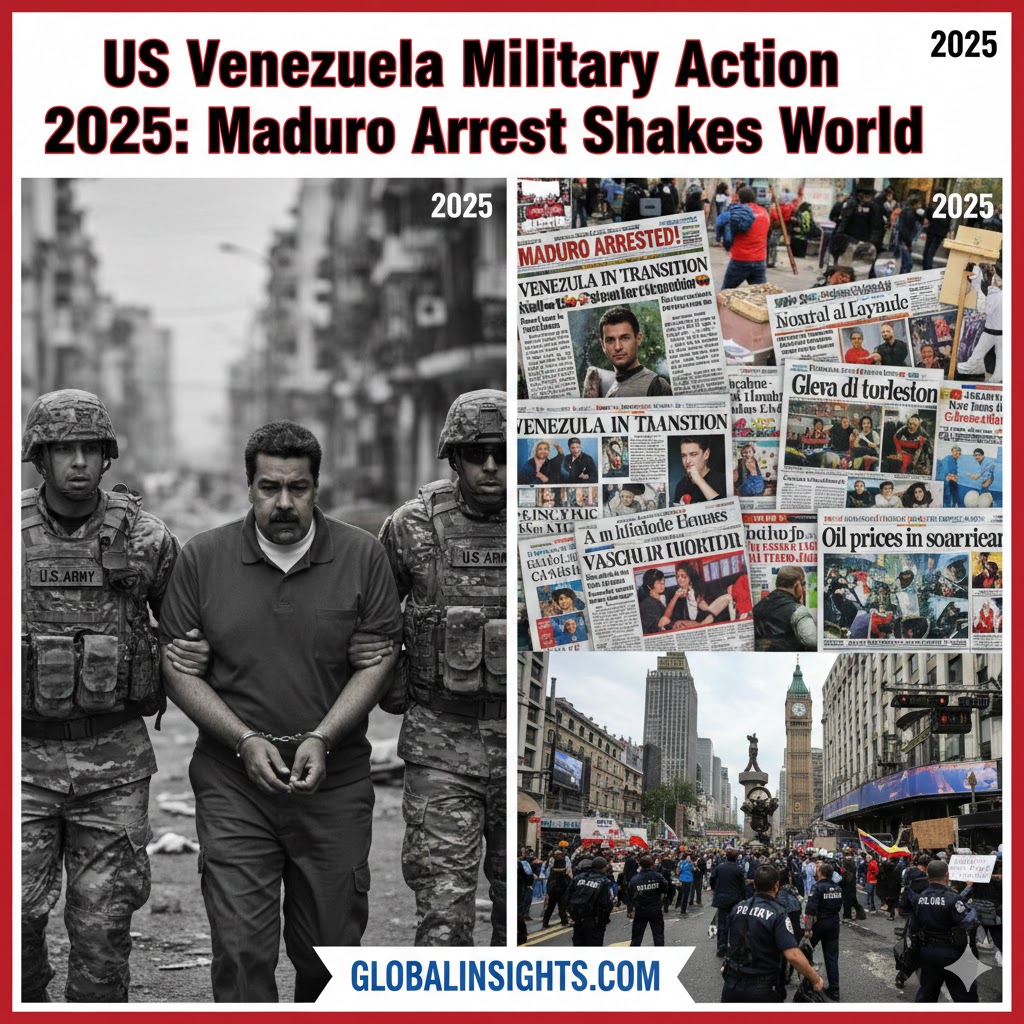
The US Venezuela Military Action 2025 marks one of the boldest geopolitical moves of the decade. The arrest of Venezuelan President Nicolás Maduro by US forces didn’t just shake Caracas—it rattled global diplomacy. In an era already defined by Ukraine, Gaza, Red Sea tensions, and great-power rivalry, this operation reopens uncomfortable questions about sovereignty, regime change, and resource control. With oil markets watching closely, China and Russia pushing back hard, and the Global South growing uneasy, this event fits neatly into 2025’s larger story: a world drifting from rules to raw power. History, it seems, is repeating—loudly.
US Venezuela Military Action 2025 and the Return of Regime-Change Doctrine
The US Venezuela Military Action 2025 has dragged an old ghost back into modern geopolitics—the regime-change doctrine. Washington may dress it up with new language like “counter-narcotics,” “security threat,” or “humanitarian necessity,” but the bones are familiar. From Iraq (2003) to Libya (2011), the playbook has always been the same: delegitimize the leader, justify intervention, and reshape power on American terms. Venezuela in 2025 fits that template almost too neatly.
What makes the US Venezuela Military Action 2025 different is timing. This isn’t the unipolar 1990s or the post-9/11 panic era. The world today is fragmented, suspicious, and heavily armed—politically and economically. China and Russia are no longer spectators. They are stakeholders. By arresting Nicolás Maduro through direct military action, the US has effectively signaled that sovereignty is conditional, not sacred.
Supporters in Washington argue this was not regime change but “law enforcement at scale.” That argument doesn’t survive serious scrutiny. When special forces cross borders, disable national infrastructure, extract a sitting head of state, and install pressure on interim leadership, that is regime change in everything but name. The US Venezuela Military Action 2025 revives the idea that powerful states can still decide who governs weaker ones—if the strategic prize is valuable enough.
And Venezuela is valuable. Oil remains the unspoken constant. With global energy markets jittery due to conflicts in Eastern Europe and the Middle East, Venezuela’s vast reserves are once again strategic gold. Add drug trafficking routes, migration pressure on the US southern border, and domestic election politics in America, and the incentives align uncomfortably well. Regime change, in this context, becomes less about democracy and more about control.
The doctrine’s return also exposes a deeper shift in US foreign policy thinking. Multilateralism is giving way to transactional realism. International law is cited when convenient and ignored when restrictive. The US Venezuela Military Action 2025 reflects a belief that deterrence now comes from action, not consensus. That belief resonates with parts of the American electorate—but alarms much of the world.
Reactions from China and Russia are not just moral objections; they are strategic warnings. If this precedent stands, tomorrow it could be Taiwan, Ukraine, Iran—or any resource-rich state lacking powerful allies. Smaller nations are watching closely, recalculating their security assumptions in real time.
History teaches a blunt lesson: regime change rarely ends where planners expect. Iraq destabilized a region. Libya collapsed into chaos. The US Venezuela Military Action 2025 risks repeating that pattern in Latin America, a region already strained by inequality, migration, and political polarization. Power may shift quickly, but stability never follows on schedule.
In plain terms, this operation tells the world one thing clearly: the age of polite diplomacy is fading. The era of force-backed geopolitics is back—and Venezuela is just the opening chapter.
Global Reactions in 2025: China, Russia, and the Fracturing World Order
The US Venezuela Military Action 2025 did more than remove a leader—it detonated a diplomatic shockwave that exposed how fractured the global order has become. Gone is the illusion of a rules-based consensus. What we see instead is a world split into power blocs, each reading international law through its own strategic lens. The reactions from China and Russia weren’t routine condemnations; they were warning shots.
China responded with unusually sharp language, calling the operation a “blatant violation of sovereignty” and a dangerous precedent. Beijing’s concern isn’t sentimental—it’s structural. China has long argued that regime change by force is the primary destabilizer of the modern world, partly because it fears the same logic being applied to its own core interests. For China, the US Venezuela Military Action 2025 reinforces the belief that the US selectively enforces international norms while reserving exceptional rights for itself. That perception hardens Beijing’s resolve to build parallel institutions and reduce reliance on Western-led systems.
Russia’s response was even more confrontational. Russia framed the action as imperial overreach, echoing Cold War-era rhetoric—but with modern urgency. Moscow sees Venezuela not only as a partner but as proof that American power still seeks territorial and resource leverage under new labels. In Russian strategic thinking, the US Venezuela Military Action 2025 confirms that restraint invites pressure, while defiance backed by strength earns respect. This logic explains why Moscow continues to double down in Ukraine rather than compromise.
What’s striking is how ineffective global institutions appeared in the aftermath. The United Nations Security Council became a stage for speeches, not solutions. Predictable vetoes, scripted outrage, and zero enforcement power laid bare an uncomfortable truth: the UN can document fractures, not repair them. For much of the Global South, this paralysis confirms long-standing suspicions that international law is aspirational, not operational.
Europe’s reaction was split down the middle. Some governments condemned the operation on legal grounds, others quietly aligned with Washington for security reasons. The European Union’s inability to speak with one voice further underlined the fragmentation of Western unity. The US Venezuela Military Action 2025 showed that even allies are now calculating risk individually, not collectively.
Beyond state responses, public opinion added another layer of pressure. Protests across Latin America, Europe, and parts of Asia framed the event as neo-imperialism, not justice. These movements may lack immediate policy impact, but they shape long-term legitimacy. Power exercised without consent eventually pays an interest rate—and history shows it’s always high.
In 2025, the world is no longer unipolar, but it isn’t truly multipolar either. It’s something messier: a competitive order where force, economics, and narrative warfare operate simultaneously. The US Venezuela Military Action 2025 didn’t break the world order—it exposed that it was already broken.
The takeaway is blunt. China and Russia are not merely opposing Washington; they are preparing for a future where such actions become normal. And once force becomes normalized, restraint becomes the exception. That’s not a transition—it’s a warning.
Oil, Sanctions, and Power: Why Venezuela Matters More Than Ever
At the heart of the US Venezuela Military Action 2025 lies an old, uncomfortable truth: oil still drives global power politics. Ideology makes headlines, human rights frame speeches, but energy security decides outcomes. Venezuela isn’t just another troubled state—it sits on the world’s largest proven oil reserves. In a fractured 2025 marked by wars, sanctions, and supply-chain anxiety, that fact alone makes Venezuela impossible to ignore.
For years, sanctions choked Venezuela’s oil sector, crippling PDVSA and collapsing production. What once exceeded 3 million barrels per day fell to a fraction of that. The official narrative blamed mismanagement and corruption—and there’s truth there—but sanctions were the chokehold that finished the job. The US Venezuela Military Action 2025 signals that Washington is no longer content with economic pressure alone. Control, or at least influence, over Venezuelan oil flows is now back on the table.
Timing matters. Global energy markets in 2025 are already strained. The Ukraine war disrupted Russian exports, Middle East instability threatens shipping lanes, and climate policies haven’t yet replaced fossil fuels at scale. Against this backdrop, Venezuela’s oil becomes strategic leverage. The US Venezuela Military Action 2025 effectively reframes Venezuela from “sanctions problem” to “energy opportunity”—especially for Western markets seeking alternatives to hostile suppliers.
Sanctions themselves are also evolving. Once designed to isolate regimes, they now function as bargaining tools. Washington’s message is clear: cooperation brings relief; resistance brings pressure. By reshaping political authority in Caracas, the US Venezuela Military Action 2025 creates conditions where sanctions can be selectively lifted, contracts renegotiated, and foreign investment reintroduced—on terms favorable to the US and its allies.
China understands this game well, which is why it reacted so sharply. Beijing has invested billions in Venezuelan oil infrastructure and relies on long-term supply agreements. Any realignment triggered by the US Venezuela Military Action 2025 threatens Chinese energy security and undermines its strategy of locking in resources across the Global South. Oil here isn’t just fuel—it’s geopolitical positioning.
India is watching closely too. ONGC Videsh has significant stranded investments in Venezuela, frozen by sanctions and instability. A shift in control could unlock those assets—or wipe them out, depending on whose influence prevails. That uncertainty explains New Delhi’s cautious, almost surgical diplomacy. In a world where energy equals growth, no major economy can afford to miscalculate.
What makes Venezuela different from past oil flashpoints is scale plus symbolism. Iraq had oil. Libya had oil. But Venezuela combines massive reserves with geographic proximity to the US and deep entanglement with rival powers. The US Venezuela Military Action 2025 isn’t just about barrels—it’s about who sets the rules of access in a divided world.
The hard reality is this: energy transitions are slower than political slogans. Until renewables truly dominate, oil remains king. Venezuela, battered but resource-rich, sits at the crossroads of sanctions policy, great-power rivalry, and energy desperation. That’s why the US Venezuela Military Action 2025 isn’t a regional episode—it’s a signal flare in the global struggle for power.
Strip away the rhetoric, and the message is blunt: in 2025, oil still decides who gets listened to—and who gets taken seriously.
International Law vs Military Realism in a Multipolar World
The US Venezuela Military Action 2025 has reignited one of the oldest and most uncomfortable debates in global politics: does international law actually restrain power, or does power merely tolerate law when convenient? In theory, the post–World War II order rests on sovereignty, non-intervention, and collective security. In practice, 2025 is proving that military realism is once again calling the shots.
From a legal standpoint, the operation sits on shaky ground. The United Nations Charter is explicit—no state may use force against another’s territorial integrity or political independence except in self-defense or with UN authorization. The US Venezuela Military Action 2025 meets neither condition cleanly. Claims of counter-narcotics operations, security threats, or humanitarian necessity sound familiar because they’ve been used before—often after the fact, rarely with universal acceptance.
Military realism, however, doesn’t wait for legal consensus. Its logic is brutally simple: states act to preserve interests, not ideals. In a multipolar world where enforcement mechanisms are weak and vetoes paralyze institutions, law becomes advisory rather than binding. The US Venezuela Military Action 2025 reflects this mindset clearly—act first, justify later, absorb criticism as the cost of doing business.
What’s changed since earlier interventions is the distribution of power. During the unipolar moment, legal objections rarely translated into consequences. Today, China and Russia are strong enough to contest narratives, block resolutions, and retaliate asymmetrically. Yet even they stop short of direct confrontation, revealing the central contradiction of the system: everyone condemns violations, but no one wants escalation.
This creates a dangerous gray zone. International law still exists, but selectively. Strong states interpret it flexibly; weaker states cling to it desperately. The US Venezuela Military Action 2025 underscores how legality increasingly depends on capability. If you can enforce your interpretation—or prevent enforcement against you—your version of the law prevails.
The erosion isn’t abstract. Smaller nations are recalibrating their security strategies right now. If sovereignty can be overridden without UN approval, alliances and deterrence matter more than treaties. This is why military spending is rising globally despite economic strain. The lesson being absorbed is clear: law without power is rhetoric.
Defenders of the operation argue that strict legalism enables bad actors to hide behind sovereignty. Critics counter that once exceptions become routine, the rule collapses entirely. History sides with the skeptics. Iraq, Kosovo, Libya—all were justified as exceptional cases. Each exception widened the door. The US Venezuela Military Action 2025 walks straight through it.
For the Global South, this tension feels especially acute. Many states lack the power to bend rules but bear the consequences when rules are bent by others. That asymmetry fuels distrust and accelerates the shift away from Western-led legal frameworks toward regional or alternative systems.
In the end, the clash between international law and military realism isn’t new—but its stakes are higher. In a multipolar world, violations don’t go unanswered; they echo. The US Venezuela Military Action 2025 may succeed tactically, but strategically it deepens a world where force outruns law.
And once that balance tips too far, rebuilding credibility becomes harder than launching any operation.
India, the Global South, and Strategic Silence in the Venezuela Crisis
The US Venezuela Military Action 2025 placed India in a familiar but uncomfortable position: speak loudly and risk strategic fallout, or stay measured and preserve long-term interests. New Delhi chose silence—carefully worded, deliberate, and entirely strategic. To casual observers, India’s response looked muted. To seasoned diplomats, it was textbook realism.
India’s official line emphasized concern, restraint, and dialogue—without naming or shaming. This wasn’t moral confusion; it was geopolitical calculation. The US Venezuela Military Action 2025 sits at the intersection of energy security, international law, and great-power rivalry—exactly the kind of terrain where India prefers balance over bravado. Public outrage satisfies headlines; quiet diplomacy protects interests.
Energy is the first reason. India remains a major energy importer, and Venezuela has long been part of that equation. Indian firms, particularly ONGC Videsh, have billions locked in Venezuelan assets, frozen by sanctions and instability. A sudden political realignment triggered by the US Venezuela Military Action 2025 could either unlock those investments or erase them. Loud condemnation would only reduce India’s room to maneuver when the dust settles.
Second is India’s broader Global South leadership ambition. India has positioned itself as a voice of moderation—not a megaphone for any bloc. The Global South isn’t ideologically uniform; it’s interest-driven. Many of these countries fear one precedent above all: that powerful states can remove inconvenient governments by force. India understands this anxiety deeply, having spent decades defending sovereignty as a principle.
Yet India also understands reality. The US Venezuela Military Action 2025 wasn’t going to be reversed by statements from New Delhi. Condemnation without leverage is symbolism, not policy. India’s silence signals a belief that influence is exercised after crises, not during media storms. This approach may look passive, but it keeps channels open with Washington, Moscow, Beijing, and Caracas simultaneously—a rare diplomatic advantage.
There’s also a legal dimension. India has historically supported international law, but it has also learned that enforcement is selective. By avoiding legal grandstanding, India avoids setting standards it cannot enforce elsewhere—especially in its own neighborhood. Strategic silence, in this context, is consistency, not cowardice.
Contrast this with smaller Global South states that issued fiery statements. Their outrage is understandable—but it rarely alters outcomes. India plays a longer game. It aims to shape post-crisis arrangements, humanitarian access, energy negotiations, and institutional reforms once emotions cool. The US Venezuela Military Action 2025 will pass; relationships will remain.
Critics argue that silence undermines India’s moral leadership. That’s a fair concern—but morality without capacity is fragile. India’s strategy reflects an old-school worldview: protect sovereignty in principle, protect interests in practice, and never confuse noise with influence.
In a fractured world, neutrality is not indifference—it’s leverage. The US Venezuela Military Action 2025 shows that India is betting on a future where bridges matter more than banners. Whether that bet pays off will depend not on what India said in the moment, but on what it achieves after the crisis fades from headlines.
Sometimes, the loudest message is the one delivered quietly.
About The Author







Leave a Reply