

Table of Contents
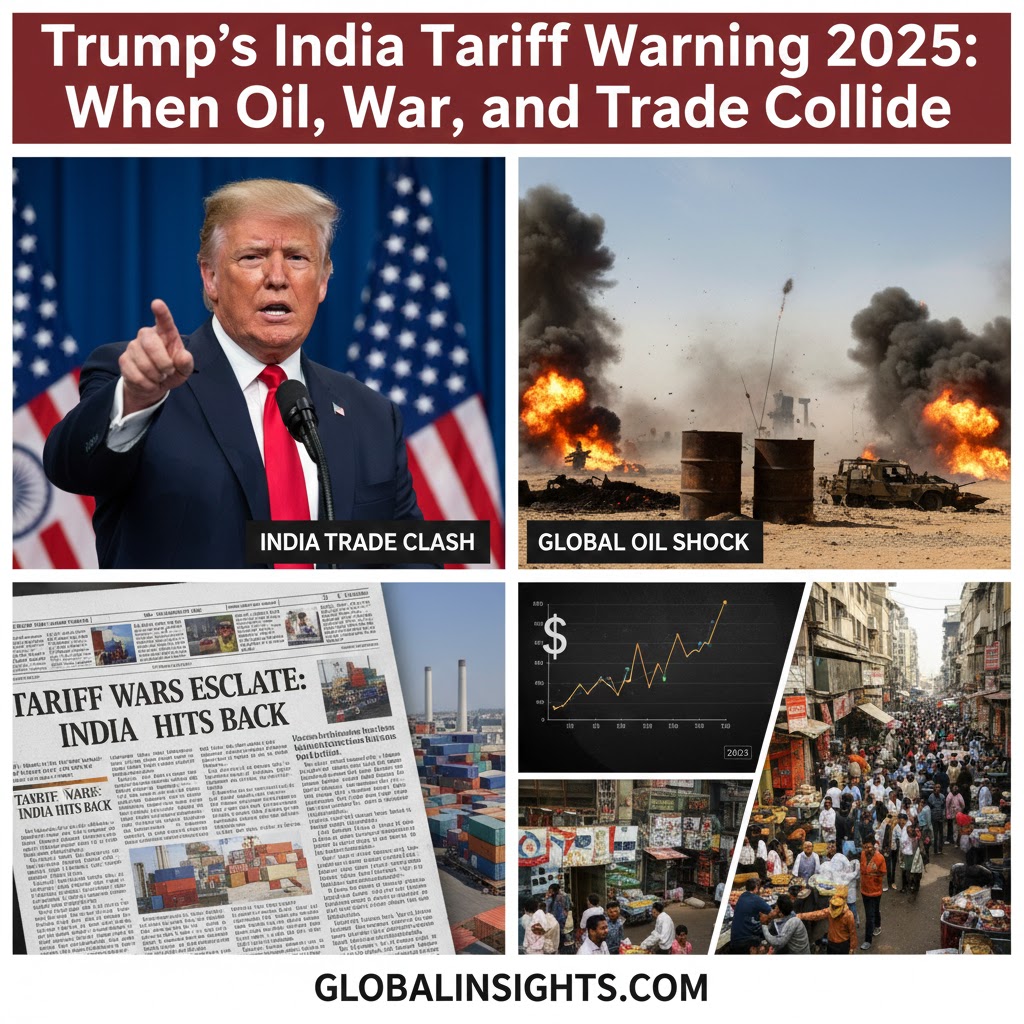
The Trump India Tariff Warning 2025 marks a sharp turn in global trade politics, blending energy security with war-time diplomacy. As the Russia–Ukraine conflict drags on, former US President Donald Trump has openly threatened higher tariffs on India over its continued purchase of Russian crude oil. India, led by Narendra Modi, now finds itself balancing affordable energy needs, export pressures, and strategic autonomy. With tariffs already at 50%, falling exports, and oil market shifts in 2025, this standoff reveals how geopolitics increasingly dictates global trade outcomes.
Trump India Tariff Warning 2025 and the Return of Energy-Linked Trade Sanctions
The Trump India Tariff Warning 2025 signals something bigger than a routine trade dispute—it marks the clear return of energy-linked trade sanctions as a weapon of geopolitical pressure. This is old-school power politics, dressed in modern economic language. If you’ve studied Cold War trade tactics, this movie feels familiar—only now, oil is the main character.
Under Donald Trump, tariffs are no longer just about correcting trade deficits. They are leverage tools, explicitly tied to foreign policy obedience. In 2025, Trump has drawn a hard line: continue buying Russian oil, or face escalating tariffs. The Trump India Tariff Warning 2025 openly links India’s energy choices to US expectations on the Russia–Ukraine conflict.
This approach revives a sanction model last seen at scale during US actions against Iran and Venezuela. What’s changed is the target. India isn’t an adversary—it’s a strategic partner. Yet, Trump’s message is blunt: partnership does not equal independence when core US interests are involved.
Oil as a Political Trigger
India’s Russian oil imports surged after the Russia–Ukraine War disrupted global energy flows. Discounted crude made economic sense—especially when inflation and energy security were top priorities. But in Washington’s view, oil purchases translate into indirect war financing. The Trump India Tariff Warning 2025 reframes energy trade as moral and strategic compliance.
This is where energy-linked sanctions come back into fashion. Trump isn’t banning oil directly. Instead, he’s using tariffs to raise the cost of independence. A 50% tariff wall hurts exporters faster than diplomatic statements ever could.
Why This Is a Dangerous Precedent
The danger of the Trump India Tariff Warning 2025 lies in normalization. If energy sourcing becomes sanctionable behavior, no country with strategic autonomy is safe. Today it’s Russian oil. Tomorrow it could be rare earths, semiconductors, or LNG contracts.
For India, this is especially sensitive. New Delhi has long followed a non-aligned, interest-first energy policy—buying from whoever offers reliability and value. The return of energy-linked trade sanctions directly challenges that tradition. It pushes India toward politically “approved” suppliers rather than economically optimal ones.
Global Ripple Effects in 2025
This strategy doesn’t stop at India. Energy markets are watching closely. Traders, shipping insurers, and refiners now price geopolitics into contracts. The Trump India Tariff Warning 2025 adds volatility to already fragile oil markets, where OPEC output decisions, Red Sea shipping risks, and post-war demand recovery are colliding.
Ironically, these tariffs may accelerate what Washington fears—countries building alternative trade systems to bypass US pressure. Energy payments in non-dollar currencies, regional trade blocs, and long-term supply pacts are becoming more attractive.
The Bigger Message
At its core, the Trump India Tariff Warning 2025 announces the return of transactional geopolitics: align, or pay. It’s tough, unapologetic, and very Trump. Whether it strengthens US influence—or pushes partners away—will define global trade for the rest of the decade.
Russian Oil, Ukraine War, and Why India Became Washington’s Target
The Trump India Tariff Warning 2025 didn’t appear out of thin air. It is the direct outcome of how the Russia–Ukraine war reshaped global energy flows—and how India used pragmatism where Washington wanted pressure. In geopolitics, realism often collides with idealism, and India found itself standing right at that fault line.
When the Russia–Ukraine War erupted, global oil markets went into shock. Europe rushed to cut Russian energy dependence, the US pushed sweeping sanctions, and crude prices briefly crossed $130 per barrel. India, however, played the long game. Rather than follow emotion-driven diplomacy, New Delhi followed an old civilizational instinct: secure energy first, explain later.
Why Russian Oil Made Sense for India
Russian crude came with deep discounts—sometimes $20–25 per barrel cheaper. For a fast-growing economy with massive fuel demand, this wasn’t ideological alignment; it was economic survival. Refineries adapted quickly, inflation stayed relatively controlled, and India avoided the kind of energy crisis Europe endured.
This is precisely what made India visible—and vulnerable. The Trump India Tariff Warning 2025 emerged because India became Russia’s largest oil buyer, not because it supported Moscow politically, but because it filled the vacuum left by Western exits.
Washington’s Perspective: Economics as Enforcement
From Washington’s viewpoint, oil revenue equals war funding. The US narrative is simple: buying Russian oil weakens sanctions and prolongs the war. Under Donald Trump, that logic turns into action. Instead of diplomatic nudging, Trump reached for tariffs—fast, painful, and headline-friendly.
Thus, the Trump India Tariff Warning 2025 framed India not as a neutral trader, but as a pressure point. Tariffs became the stick to force behavioral change without directly sanctioning Indian banks or refiners.
Why India—and Not Others?
Here’s the uncomfortable truth: India was targeted because it mattered. Its exports to the US are large, its strategic partnership is valuable, and tariffs hurt fast. Smaller buyers don’t move the needle. China already sits behind tariff walls. India was the leverage sweet spot.
This makes the Trump India Tariff Warning 2025 less about punishment and more about signaling. Washington wanted to show that even friendly powers are not exempt when core US war objectives are involved.
The Shift Already Underway
Ironically, by late 2025, India had already begun reducing Russian oil imports as discounts shrank and sanctions tightened. Middle Eastern suppliers regained ground, and US crude re-entered Indian refineries. But geopolitics doesn’t reward quiet course corrections—only visible compliance.
That’s the irony of the Trump India Tariff Warning 2025: it arrived just as market forces were doing the job sanctions failed to finish.
The Deeper Lesson
This episode confirms a hard reality of modern geopolitics: energy neutrality is shrinking. In a polarized world, oil barrels carry political color. India didn’t become Washington’s target because it chose Russia—it became a target because it chose autonomy.
Impact of US Tariffs on Indian Exports Amid Global Slowdown 2025
The Trump India Tariff Warning 2025 landed at the worst possible moment for Indian exporters. Global demand was already soft, freight costs were unstable, and credit conditions had tightened worldwide. Into this fragile environment came a blunt instrument: 50% US tariffs, turning commercial stress into a full-blown pressure test.
This wasn’t theoretical damage—it showed up immediately in export numbers, margins, and order books.
Export Numbers Tell a Brutal Story
In 2025, Indian exports to the US showed clear volatility. Month after month, shipments dipped as buyers delayed orders or renegotiated prices. US importers didn’t cancel because Indian goods were inferior—they paused because tariffs wiped out cost competitiveness.
That’s the sharp edge of the Trump India Tariff Warning 2025. Tariffs don’t shout; they quietly make contracts unviable.
Sectors hit hardest included:
- Textiles and garments
- Engineering goods
- Auto components
- Chemicals and specialty steel
These are labor-heavy industries. When exports slow here, job anxiety follows quickly.
Margin Compression: The Silent Killer
Indian exporters operate on thin margins even in good years. A sudden 25–50% tariff doesn’t get “absorbed”—it destroys pricing structures. Either exporters cut margins to survive, or buyers walk away. Many tried both and still lost.
The Trump India Tariff Warning 2025 forced businesses into defensive mode. Expansion plans froze. Capacity utilization dropped. New hiring paused. This is how trade policy seeps into everyday livelihoods without making headlines.
Why the US Market Still Matters
Despite diversification efforts, the US remains India’s most valuable export destination. High-value buyers, predictable legal systems, and scale make it irreplaceable in the short term. That’s why the Trump India Tariff Warning 2025 carried real weight—it targeted India where dependence still exists.
Under Narendra Modi, India has pushed “Make in India” and export-led growth. But tariffs exposed a hard truth: global integration comes with vulnerability. Strategic autonomy sounds strong—until invoices start bouncing.
The Global Slowdown Effect
Now layer in the 2025 global slowdown. Europe flirted with recession, China’s demand recovery stayed uneven, and global trade growth barely limped forward. In such conditions, exporters don’t have backup markets waiting with open arms.
That’s what amplified the damage of the Trump India Tariff Warning 2025. It wasn’t just US pressure—it was pressure with nowhere to hide.
Policy Response and Reality
India responded the traditional way: negotiations, diversification, and resilience messaging. Trade talks continued. Exporters explored Africa, Latin America, and Southeast Asia. Sensible moves—but slow to offset immediate pain.
Here’s the uncomfortable truth seasoned traders understand: markets move faster than diplomacy. The Trump India Tariff Warning 2025 worked precisely because it exploited that timing gap.
The Real Takeaway
This episode proves one thing clearly—tariffs are no longer economic tools; they are geopolitical weapons. In a slowing world economy, they hit harder, faster, and deeper.
For India, the lesson isn’t retreat—it’s insulation. Stronger domestic demand, broader export baskets, and reduced single-market exposure are no longer policy slogans. After the Trump India Tariff Warning 2025, they’re survival strategies.
India’s Strategic Oil Shift from Russia to Middle East and the US
The Trump India Tariff Warning 2025 didn’t just pressure trade policy—it accelerated a quiet but significant recalibration of India’s energy strategy. Faced with rising tariffs, shrinking Russian discounts, and mounting geopolitical scrutiny, India did what seasoned civilizations have always done: adapt without making noise.
This wasn’t surrender. It was strategic adjustment.
Why the Russian Oil Advantage Faded
Initially, Russian crude was irresistible—deep discounts, flexible logistics, and insulation from global price shocks. But by late 2025, that math changed. Discounts narrowed to almost symbolic levels, shipping and insurance costs rose, and sanctions made transactions slower and riskier.
At that point, Russian oil stopped being a bargain and started becoming baggage—especially under the shadow of the Trump India Tariff Warning 2025. When energy savings no longer offset export losses, pragmatism demanded a course correction.
The Return of the Middle East
India’s renewed tilt toward Saudi Arabia, the UAE, and Iraq wasn’t emotional—it was traditional. The Middle East has been India’s energy backbone for decades. Stable supply chains, shorter shipping routes, and predictable contracts still matter more than political theatrics.
Long-term supply agreements offered something Russian oil increasingly couldn’t: certainty. And in a tariff-heavy world shaped by the Trump India Tariff Warning 2025, certainty is currency.
US Crude: Strategic, Not Sentimental
India’s increased purchases of US crude oil carried symbolism—but also logic. Buying American oil didn’t just diversify supply; it softened trade tensions and signaled responsiveness without public concession.
Under Narendra Modi, India avoided chest-thumping. Instead, it quietly aligned energy flows with diplomatic realities. That’s how grown-up states behave.
From Washington’s side, especially under Donald Trump, US oil exports to India offered a political win: reduced Russian revenue and reinforced economic leverage—without firing a single sanction missile.
Strategic Autonomy, Redefined
Critics argue India bent under pressure. That’s lazy analysis. Strategic autonomy doesn’t mean stubbornness—it means flexibility without dependency. The oil shift shows India preserved optionality while reducing exposure.
The Trump India Tariff Warning 2025 forced clarity: energy policy can no longer be insulated from trade and diplomacy. India responded not by choosing sides, but by widening lanes.
Market Forces Did the Heavy Lifting
Here’s the inconvenient truth geopolitics doesn’t like to admit: markets solved what diplomacy couldn’t. Lower global oil prices, shrinking Russian incentives, and commercial efficiency made the shift inevitable. The Trump India Tariff Warning 2025 merely accelerated a transition already underway.
The Bigger Signal
India’s oil rebalancing sends a clear message to the world: New Delhi will adjust tactics—but not abandon interests. Energy security remains non-negotiable, but so is export competitiveness.
What the Trump India Tariff Warning 2025 Signals for Future India-US Relations
The Trump India Tariff Warning 2025 is more than a pressure tactic—it’s a signal flare for where India–US relations are heading in a harsher, more transactional global order. The honeymoon phase of strategic partnership is clearly over. What replaces it is something older, tougher, and brutally honest: interest-first engagement. And frankly, that’s not entirely bad.
From Shared Values to Shared Leverage
For years, India–US ties were wrapped in comforting language—shared democracy, Indo-Pacific cooperation, common threats. The Trump India Tariff Warning 2025 cuts through that softness. Under Donald Trump, the relationship is defined by deliverables, not declarations.
Trade, energy, and security are now tightly bundled. If one strand strains, the others feel it immediately. That’s the new operating system.
India Is No Longer a “Junior Partner”
Here’s the part many analysts miss: Washington uses tariffs on India because India matters. You don’t pressure irrelevant players—you pressure consequential ones. The Trump India Tariff Warning 2025 quietly acknowledges India’s economic weight, strategic geography, and growing influence.
Under Narendra Modi, India hasn’t responded with panic or defiance. It responded with negotiation, diversification, and calibrated adjustment. That signals maturity—not weakness.
Expect More Negotiation, Less Romance
Going forward, India–US relations will look less emotional and more contractual. Expect:
- Harder trade bargaining
- Sector-specific deals, not grand agreements
- Energy cooperation tied to geopolitical alignment
- Fewer exemptions, more enforcement
The Trump India Tariff Warning 2025 sets a precedent: disagreements will be resolved through economic pressure, not polite disagreement.
Strategic Convergence Still Holds
Despite the friction, the fundamentals remain intact. China, Indo-Pacific stability, defense cooperation, and technology partnerships still bind the two countries. The tariffs test resilience—but they don’t erase convergence. In fact, the Trump India Tariff Warning 2025 may ultimately force clearer rules of engagement—less ambiguity, fewer misunderstandings, and more predictable red lines.
India’s Long-Term Advantage
India walks away with a valuable lesson: overdependence is dangerous, but engagement is unavoidable. The response to the Trump India Tariff Warning 2025—oil diversification, export recalibration, steady diplomacy—shows India is learning to absorb shocks without losing balance. That’s exactly how enduring partnerships survive turbulent eras.
The Final Signal
The message is unmistakable: India–US relations have entered a phase of competitive cooperation. Friends, yes—but friends who negotiate hard, disagree openly, and still find common ground when it matters most.
The Trump India Tariff Warning 2025 doesn’t weaken the relationship. It hardens it. And in a fractured world, hardened partnerships tend to last longer than sentimental ones.
About The Author







Leave a Reply