

Table of Contents
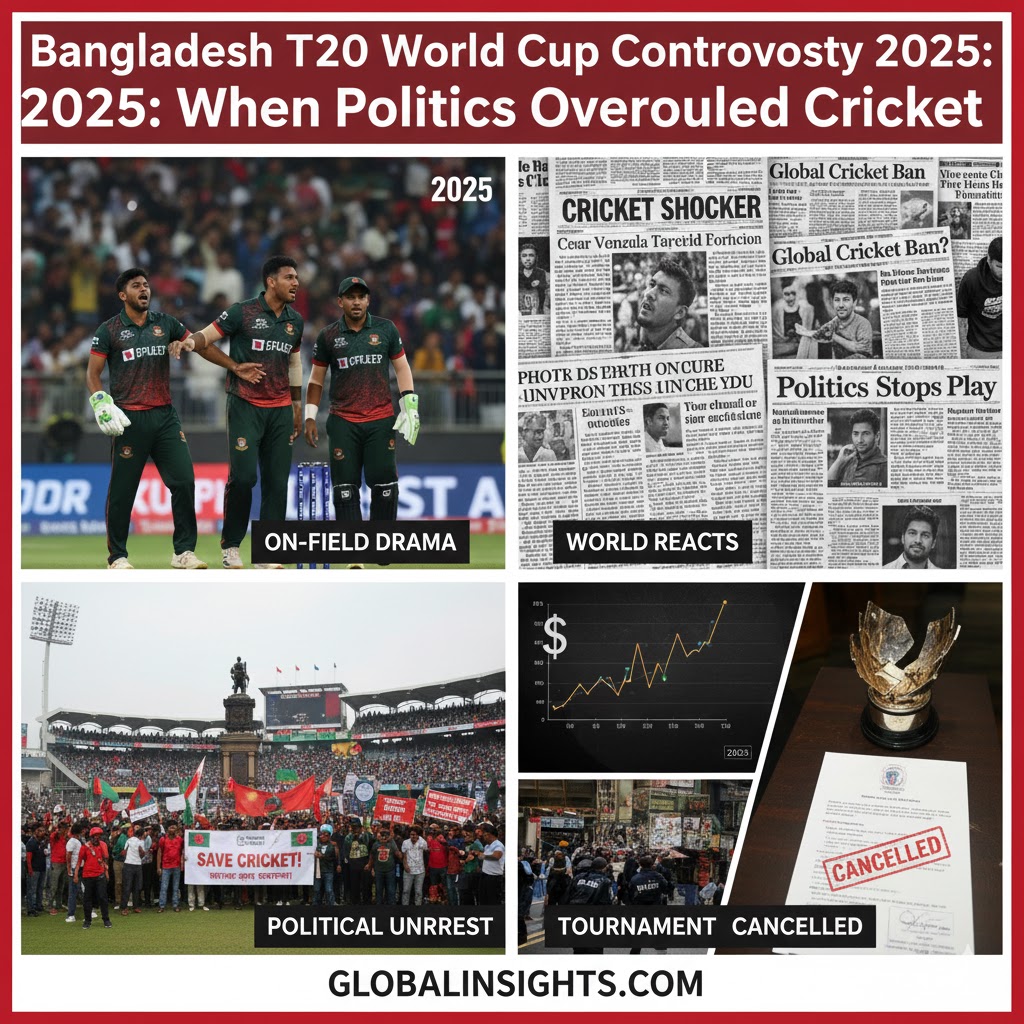
The Bangladesh T20 World Cup Controversy 2025 has turned what should have been a celebration of global cricket into a geopolitical flashpoint. Triggered by the removal of Mustafizur Rahman from the IPL and rising security concerns for Bangladeshi players, the Bangladesh Cricket Board’s refusal to play World Cup matches in India has sent shockwaves through international cricket. As ICC already struggles with hybrid hosting models, this decision reflects a larger 2025 trend—sports no longer exist in isolation from politics, minority rights, and diplomatic tensions. The controversy now tests ICC’s authority, tournament stability, and cricket’s claim of neutrality in a divided world.
Bangladesh T20 World Cup Controversy 2025 and the Mustafizur Rahman Fallout
The Bangladesh T20 World Cup Controversy 2025 did not erupt overnight—it detonated the moment Mustafizur Rahman was shown the exit door from the Indian Premier League. Cricket fans are used to injuries, poor form, and tactical reshuffles. What they are not used to is a player being removed amid political pressure and security narratives. That single decision triggered a domino effect that now threatens the smooth execution of a global ICC tournament.
Mustafizur’s removal from Indian Premier League—specifically from Kolkata Knight Riders—was officially justified on “security considerations.” But in 2025, everyone knows how that phrase operates. It’s the polite cover for political discomfort. The Board of Control for Cricket in India did not just make a squad decision; it sent a signal. And Bangladesh received it loud and clear.
This is where the Bangladesh T20 World Cup Controversy 2025 moves from IPL drama to international crisis. The Bangladesh Cricket Board interpreted Mustafizur’s removal not as an isolated incident, but as evidence of a broader risk environment for its players in India. With rising domestic tensions in Bangladesh and reports of communal violence, the optics were already fragile. Add the IPL episode, and suddenly the question was no longer “Should Mustafizur play?” but “Should Bangladesh play at all?”
The fallout was swift. Bangladesh informed the International Cricket Council that it would not send its team to India for the T20 World Cup. This is not a symbolic protest—it’s a logistical nightmare. Flights, venues, broadcast schedules, ticketing, sponsorship contracts—everything hinges on certainty. The Bangladesh T20 World Cup Controversy 2025 has exposed just how brittle modern cricket governance has become when politics enters the dressing room.
What makes the Mustafizur Rahman fallout especially damaging is precedent. Once one player’s exclusion leads to a nation withdrawing from host venues, the floodgates open. Today it’s Bangladesh. Yesterday it was Pakistan. Tomorrow, it could be any team citing “player safety.” Cricket, once proud of touring hostile nations and letting bat and ball do the talking, is now negotiating visas, public sentiment, and social media outrage.
There’s also an uncomfortable truth here: Mustafizur Rahman became collateral damage. He wasn’t accused of wrongdoing on the field. He wasn’t injured. His form wasn’t catastrophic. Yet his career moment became entangled in geopolitics he neither created nor controlled. That reality sits at the heart of the Bangladesh T20 World Cup Controversy 2025—players are no longer just athletes; they are political symbols whether they like it or not.
In 2025, cricket administrators can no longer pretend the game exists in a vacuum. The Mustafizur episode proves that domestic leagues influence international diplomacy, and international tensions can upend billion-dollar tournaments overnight. If the ICC doesn’t draw clearer lines between sport and state pressure, the Bangladesh T20 World Cup Controversy 2025 will be remembered not as an anomaly—but as the new normal.
Player Safety vs Politics: Why Bangladesh Refused to Play in India
At the heart of the Bangladesh T20 World Cup Controversy 2025 lies an old but uncomfortable question cricket has tried to dodge for decades: where does player safety end and politics begin? Bangladesh’s refusal to play its T20 World Cup matches in India was not a sudden emotional outburst—it was a calculated decision shaped by fear, precedent, and hard political reality.
Officially, the Bangladesh Cricket Board framed its decision around player security. In isolation, that sounds reasonable. International sport cannot function if athletes feel unsafe. But in 2025, “security concerns” are rarely just about crowd control or policing. They are about perception, media narratives, diplomatic tension, and how fast a sporting issue can spiral into a national controversy. The Bangladesh T20 World Cup Controversy 2025 is a textbook example of this collision.
The tipping point came after the IPL episode involving Mustafizur Rahman. His removal signaled something larger than one franchise decision. For Bangladesh, it suggested that political pressure could influence player participation inside India. Once that door opens, confidence collapses. Boards are custodians of their players, and in today’s climate, “better safe than sorry” has become an administrative survival instinct.
There’s also a domestic angle Bangladesh could not ignore. Reports of communal violence back home amplified sensitivities. Sending players into a charged environment—real or perceived—risked backlash not just from fans, but from political stakeholders. The Bangladesh T20 World Cup Controversy 2025 shows how modern cricket boards operate under dual pressure: international obligations on one side, domestic political legitimacy on the other.
From India’s perspective, this decision feels exaggerated, even unfair. India has successfully hosted multiple global tournaments, including high-risk fixtures. But global sport is no longer judged purely on infrastructure and experience. Optics matter. Social media outrage, 24-hour news cycles, and geopolitical narratives now travel faster than official reassurances. In that sense, Bangladesh’s refusal reflects a wider 2025 trend—risk avoidance over sporting bravado.
The International Cricket Council finds itself trapped in the middle. The ICC insists on neutrality, yet repeatedly accommodates hybrid models, neutral venues, and special arrangements. While these compromises keep tournaments alive, they also weaken authority. Every accommodation reinforces the idea that political pressure works. The Bangladesh T20 World Cup Controversy 2025 is not an isolated governance headache—it’s part of a growing pattern.
There’s a historical irony here. Cricket once prided itself on crossing borders even when diplomacy failed. Tours happened in hostile conditions; rival fans sat in the same stands. That era is fading. In its place is a risk-managed, politically cautious version of the sport. Bangladesh’s refusal to play in India reflects that shift. It’s not cowardice—it’s realism in an age where one incident can spiral into an international scandal.
Ultimately, the Bangladesh T20 World Cup Controversy 2025 is less about Bangladesh versus India and more about cricket versus the world it now inhabits. Player safety has become inseparable from politics, and pretending otherwise only delays the inevitable reckoning. The question is no longer why Bangladesh refused to play in India—but how long global cricket can keep functioning under these fragile assumptions.
ICC’s Hybrid Hosting Crisis in 2025: Sri Lanka as the New Neutral Venue
The Bangladesh T20 World Cup Controversy 2025 has dragged the International Cricket Council into a familiar but worsening dilemma: hybrid hosting. What began years ago as an “exceptional arrangement” has now become a default crisis-management tool. And in 2025, no country embodies this shift more clearly than Sri Lanka, fast emerging as international cricket’s go-to neutral venue.
On paper, hybrid hosting sounds practical—move matches, keep peace, protect players, save the tournament. In reality, it exposes a governance vacuum. The Bangladesh T20 World Cup Controversy 2025 forced the ICC to once again choose damage control over structural clarity. With Bangladesh refusing to play in India, Sri Lanka became the pressure-release valve. Reliable stadiums, experienced security protocols, and political acceptability make it an easy choice. Easy—but dangerous in the long run.
Sri Lanka’s rise as a neutral hub is not accidental. Since India–Pakistan bilateral cricket collapsed years ago, Colombo has hosted matches that couldn’t be played elsewhere. The Bangladesh T20 World Cup Controversy 2025 simply extends that pattern. What’s different now is scale. We’re no longer talking about one high-risk fixture—we’re talking about entire group-stage logistics being uprooted weeks before kickoff. That’s not flexibility; that’s institutional fragility.
From the ICC’s perspective, hybrid hosting keeps sponsors calm and broadcasters paid. But it quietly erodes the credibility of host nations. When India is announced as a World Cup host yet multiple teams refuse to play there, the title becomes symbolic rather than operational. The Bangladesh T20 World Cup Controversy 2025 underlines this contradiction. Hosting rights without guaranteed participation are little more than ceremonial trophies.
There’s also the competitive imbalance nobody likes to discuss. Neutral venues are never truly neutral. Conditions in Sri Lanka—pitch behavior, weather, crowd composition—favor some teams over others. When Bangladesh or Pakistan shift matches, the tournament’s sporting symmetry takes a hit. The Bangladesh T20 World Cup Controversy 2025 raises a blunt question: how “world” is a World Cup when geography is negotiated midstream?
Sri Lanka, for its part, plays the role well. It gains visibility, revenue, and diplomatic goodwill. But even Colombo risks becoming overused, overstretched, and politically exposed. Neutral today doesn’t mean neutral forever. If Sri Lanka becomes cricket’s permanent emergency exit, it will eventually inherit the same pressures others are trying to avoid. The Bangladesh T20 World Cup Controversy 2025 may benefit Sri Lanka short-term, but it sets a precedent with long-term consequences.
The deeper issue is governance courage—or the lack of it. The ICC keeps reacting instead of regulating. Clear frameworks on security assessments, political interference, and venue guarantees are still missing. Until those lines are drawn, every major tournament will flirt with chaos. The Bangladesh T20 World Cup Controversy 2025 isn’t an anomaly; it’s a symptom of an organization struggling to enforce its own authority.
In old-school cricket, tours happened despite discomfort. In 2025 cricket, discomfort cancels tours. Hybrid hosting is no longer a contingency—it’s the system. And Sri Lanka has become the system’s most visible pillar. The real question is whether the ICC is building resilience—or merely postponing the next crisis that will once again reshape the map of world cricket.
India–Pakistan Precedent and the Expanding Politics of Global Cricket
To understand the Bangladesh T20 World Cup Controversy 2025, you have to look backward before you look forward. The modern template for politicized cricket was written by the long-running standoff between India and Pakistan. What started as a bilateral dispute quietly reshaped how international cricket is scheduled, hosted, and governed—and in 2025, its ripple effects are everywhere.
For over a decade, India and Pakistan have refused to play bilateral cricket on each other’s soil. What was once framed as a temporary diplomatic pause hardened into a structural reality. Neutral venues, hybrid tournaments, and special scheduling became routine. The Bangladesh T20 World Cup Controversy 2025 is simply the next chapter in a story cricket administrators already know too well—but still refuse to confront honestly.
The precedent matters because it normalized exceptionalism. When Pakistan moved its World Cup matches out of India, the decision was packaged as unavoidable. When India avoided Pakistan-hosted tournaments, the justification was similar. Each time, the International Cricket Council adjusted quietly, prioritizing continuity over confrontation. Over time, this taught boards a crucial lesson: political pressure works.
Bangladesh learned from that script. The Bangladesh T20 World Cup Controversy 2025 did not emerge in a vacuum. When Bangladeshi administrators watched India–Pakistan disputes repeatedly override sporting logic, they understood that refusing to play in India would not lead to sanctions—it would lead to accommodation. And they were right. Requests for neutral venues are no longer radical demands; they’re expected negotiation tools.
This expanding politicization has consequences. Cricket’s traditional claim—that the game transcends politics—now sounds nostalgic, even naïve. In 2025, cricket follows geopolitics rather than defying it. The Bangladesh T20 World Cup Controversy 2025 highlights how national boards now operate less like sporting bodies and more like diplomatic actors, weighing public sentiment, security optics, and international signaling alongside batting orders and pitch reports.
There’s also a commercial dimension nobody likes to say out loud. India–Pakistan matches drive global viewership. That financial gravity gives both sides leverage. Smaller boards, including Bangladesh, have noticed. If politics can reshape fixtures at the highest commercial level, why wouldn’t it apply elsewhere? The Bangladesh T20 World Cup Controversy 2025 exposes a two-tier reality: the louder the political narrative, the more flexible the tournament structure becomes.
The danger is long-term erosion. Once politics dictate venues, cricket loses its anchor. Host nations lose certainty. Fans lose trust. And the ICC loses authority. The India–Pakistan precedent has already weakened centralized governance; the Bangladesh T20 World Cup Controversy 2025 pushes it further, signaling that future World Cups may be “world” in name but fragmented in execution.
Old-school cricket accepted risk, tension, and hostility as part of touring culture. Today’s cricket avoids discomfort at almost any cost. That shift didn’t start with Bangladesh—but Bangladesh is now operating within a system shaped by India–Pakistan history. The precedent has expanded, and with it, the politics of global cricket have gone from background noise to center stage.
If this trajectory continues, the Bangladesh T20 World Cup Controversy 2025 won’t be remembered as a crisis—it’ll be remembered as confirmation that international cricket has fully entered the age of negotiated neutrality. The only question left is whether the ICC will ever reclaim control, or continue managing politics match by match.
What the Bangladesh T20 World Cup Controversy 2025 Means for ICC’s Future
The Bangladesh T20 World Cup Controversy 2025 is not just another scheduling headache—it’s a stress test for the very relevance of the International Cricket Council. If this episode proves anything, it’s that the ICC’s authority is increasingly reactive rather than decisive. In a world where national boards confidently override hosting plans, the ICC now finds itself managing crises instead of preventing them.
For years, the ICC has survived by compromise. Hybrid models, neutral venues, special exemptions—each one presented as a one-off solution. The Bangladesh T20 World Cup Controversy 2025 exposes the cost of that approach. When exceptions become routine, rules lose meaning. Boards learn that they can invoke “player safety” or “political sensitivity” and force last-minute structural changes without facing consequences.
The immediate impact is logistical chaos. Tournaments are planned years in advance to satisfy broadcasters, sponsors, and host governments. When teams refuse to play at designated venues, the entire commercial ecosystem wobbles. The Bangladesh T20 World Cup Controversy 2025 signals to investors that even ICC World Cups are no longer predictable assets. That uncertainty is poison for long-term growth.
More damaging, however, is the erosion of neutrality. The ICC claims to sit above politics, yet repeatedly bends under political pressure. Each concession reinforces the perception that power—political, economic, or diplomatic—matters more than governance. In the wake of the Bangladesh T20 World Cup Controversy 2025, smaller boards will feel emboldened to make similar demands, citing precedent rather than principle.
There’s also a structural imbalance emerging. Host nations like India invest billions in infrastructure, security, and logistics, only to see hosting rights diluted. When “host” becomes a partial label rather than a guarantee, future bids may carry less enthusiasm—or more political conditions attached. The Bangladesh T20 World Cup Controversy 2025 could quietly reshape how hosting contracts are negotiated, with escape clauses becoming the norm.
For the ICC, the path forward is uncomfortable but unavoidable. It must either formalize hybrid hosting with clear rules and thresholds—or reassert authority with firm, enforceable commitments. Half-measures will only multiply crises. The Bangladesh T20 World Cup Controversy 2025 makes it clear that ambiguity is no longer sustainable governance.
Traditionalists will argue that cricket once thrived amid far worse tensions, and they’re right. But modern cricket is a billion-dollar industry, not a gentleman’s pastime. With that scale comes the need for institutional backbone. If the ICC continues to drift, future World Cups risk becoming diplomatic puzzles rather than sporting contests.
In the end, the Bangladesh T20 World Cup Controversy 2025 is a warning shot. It tells the ICC that its old playbook—delay, adjust, appease—no longer works in a hyper-politicized world. The future of global cricket depends on whether the ICC chooses to lead decisively, or quietly accept its transformation from governing body to event coordinator.
About The Author







Leave a Reply