
Table of Contents
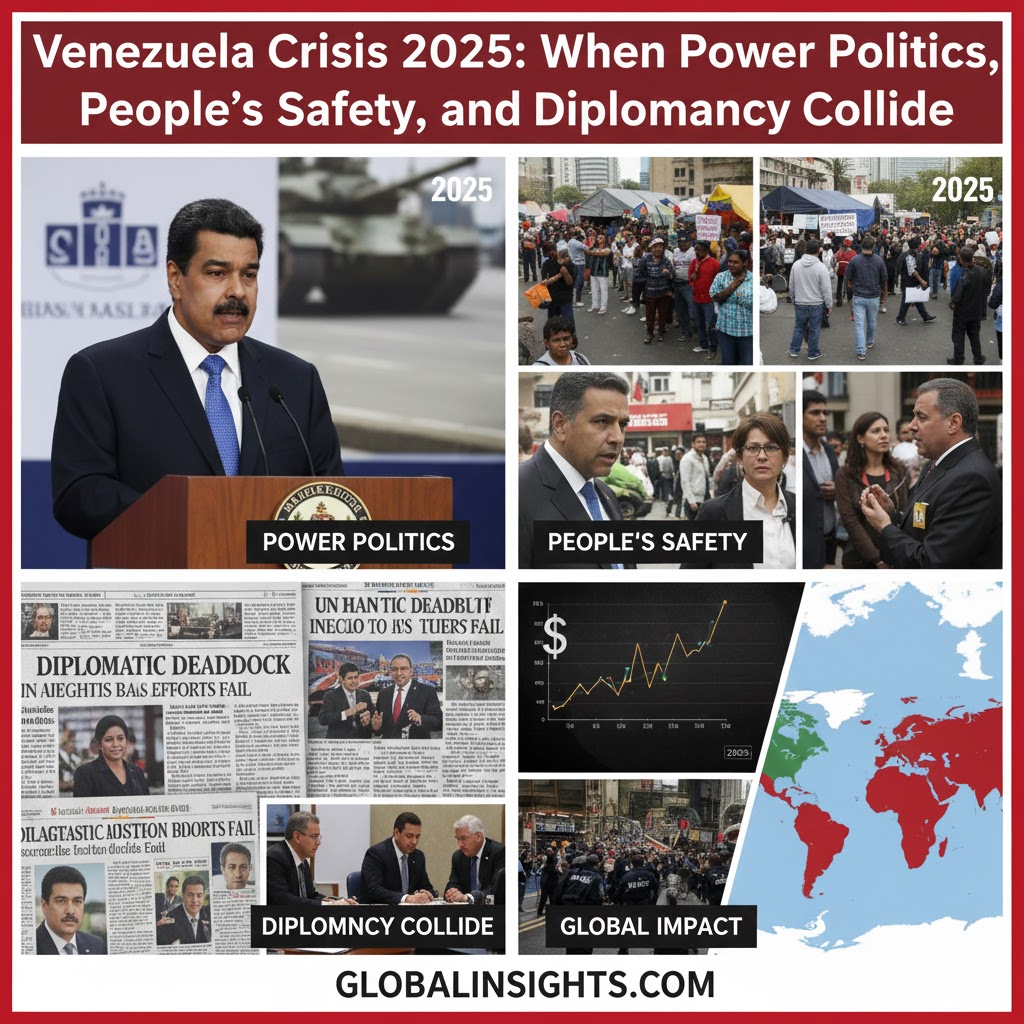
The Venezuela Crisis 2025 has become a defining moment in modern geopolitics, blending military intervention, regime change, and humanitarian concerns. Following the dramatic US-led operation that removed President Nicolás Maduro, global reactions have exposed deep fractures in the international order. India, through Foreign Minister S. Jaishankar, has taken a measured but firm stance—prioritizing civilian safety, dialogue, and strategic restraint. At a time when power often speaks louder than principle, India’s response reflects its evolving role as a stabilizing voice in a volatile, multipolar world.
Venezuela Crisis 2025 and the Return of US Military Intervention Politics
The Venezuela Crisis 2025 has dragged the world back to a familiar, uncomfortable pattern: American military intervention dressed up as democratic rescue. For a brief decade, Washington appeared cautious—preferring sanctions, proxy pressure, and diplomatic isolation over boots on the ground. That restraint is now history. The US operation that forcibly removed Nicolás Maduro has revived an old doctrine many believed was buried with Iraq and Libya.
At its core, the Venezuela Crisis 2025 reflects a blunt truth of global politics: when strategic interests collide with weak institutions, morality becomes optional. The US justified its actions by accusing Maduro of links to drug trafficking, arms smuggling, and authoritarian repression. None of these allegations are new. What is new is the timing. With energy markets unstable, global inflation lingering, and the Ukraine conflict still unresolved, Venezuela’s vast oil reserves suddenly look less like a liability and more like leverage.
This is where the Venezuela Crisis 2025 fits neatly into a larger trend. The US is no longer interested in managing decline—it is asserting dominance in a multipolar world by force when persuasion fails. Military intervention, once politically toxic, is being normalized again, especially when framed as “restoring democracy.” It’s a clever narrative, but one that many nations—particularly in the Global South—see through instantly.
History offers a sobering parallel. Iraq in 2003, Libya in 2011, and Afghanistan for two decades followed similar scripts: moral outrage, regime change, power vacuum. The Venezuela Crisis 2025 risks repeating that cycle. Removing a ruler is easy; stabilizing a fractured nation is not. Venezuela today faces institutional collapse, armed factions, and economic freefall. Military intervention may win headlines, but it rarely delivers peace.
What makes the Venezuela Crisis 2025 especially dangerous is the international reaction. Russia, China, Iran, and several Latin American states have openly condemned the US action, calling it a violation of sovereignty. This isn’t symbolic outrage—it signals resistance to a US-led world order that no longer commands automatic obedience. Every such intervention deepens mistrust and accelerates bloc politics.
Even allies are uneasy. While parts of Europe cautiously welcomed regime change, the enthusiasm was measured, not celebratory. The unspoken fear is obvious: if military power becomes the default tool again, international law turns optional—and smaller nations become expendable. That’s a world nobody publicly endorses, but many quietly prepare for.
The Venezuela Crisis 2025 also reveals Washington’s shifting priorities. Democracy promotion is no longer about values alone; it’s transactional. Energy access, supply chain security, and geopolitical signaling now drive decisions. Venezuela, sitting on one of the world’s largest proven oil reserves, is simply too important to ignore in a fragmented global economy.
In plain terms, the return of US military intervention politics signals a harder, less sentimental era. Power has reclaimed center stage. For countries watching from the sidelines—including India—the lesson is clear: strategic autonomy is no longer a luxury; it’s survival. And as the Venezuela Crisis 2025 unfolds, the world is being reminded that history doesn’t repeat itself—but it certainly rhymes.
India’s Diplomatic Signal—Why Jaishankar Put People Before Power
In the middle of chest-thumping geopolitics and military bravado, India’s response to the Venezuela Crisis 2025 stood out precisely because it refused to shout. Instead of picking sides or issuing ideological sermons, New Delhi chose an older, steadier tradition of statecraft—put people first, power later. That message was delivered clearly and deliberately by External Affairs Minister S. Jaishankar, and it wasn’t accidental. It was strategic.
The Venezuela Crisis 2025 placed India in a familiar dilemma. On one side stood the United States, flexing military muscle in the name of democracy. On the other were Russia, China, and several Global South nations condemning intervention and warning of chaos. India refused to be dragged into this binary. Instead, it focused on civilian safety, dialogue, and de-escalation—an approach rooted in realism, not idealism.
Jaishankar’s statement emphasizing the welfare and security of Venezuelan citizens may sound diplomatic on the surface, but make no mistake—it was a signal. In the age of regime-change politics, India was reminding the world that sovereignty and human cost still matter. The Venezuela Crisis 2025 was not treated as a chessboard move but as a humanitarian and regional stability issue. That distinction matters more than most headlines admit.
This posture aligns neatly with India’s evolving foreign policy in 2025. New Delhi is no longer chasing approval from power blocs. It engages with Washington, Moscow, Beijing, and Brussels—but kneels to none. By refusing to endorse military intervention while also avoiding outright condemnation, India preserved strategic space. In a fractured world order, flexibility is power.
The Venezuela Crisis 2025 also tested India’s Global South leadership credentials. Many developing nations see Western military interventions as selective morality—swift action when resources are involved, silence when they are not. India’s call for dialogue resonated because it echoed concerns shared quietly across Africa, Latin America, and Asia. This is precisely why India’s voice carries weight today: it speaks the language of experience, not lectures.
Another overlooked angle is India’s own citizens. With Indians and people of Indian origin present in Venezuela, New Delhi’s priority on safety wasn’t symbolic—it was practical. Advisories, embassy coordination, and crisis monitoring showed that India treats overseas Indians as strategic stakeholders, not afterthoughts. In the Venezuela Crisis 2025, protecting lives came before posturing.
There’s also a deeper philosophical layer. India’s foreign policy memory is long. It has seen what externally imposed “solutions” do to societies—fracture institutions, radicalize factions, and create permanent instability. By urging talks instead of triumphalism, India was quietly saying: regime change is easy; nation-building is not.
Critics may call this fence-sitting. That’s lazy analysis. What India practiced during the Venezuela Crisis 2025 was calibrated diplomacy—engaged, cautious, and unsentimental. In an era where power politics is making a noisy comeback, India chose restraint as strength.
And here’s the uncomfortable truth many won’t say out loud: when today’s interventions fail tomorrow, it’s the countries that urged dialogue—not missiles—that history tends to vindicate. India knows this. That’s why, in the Venezuela Crisis 2025, Jaishankar put people before power—and quietly reminded the world what responsible leadership still looks like.
Global Reactions to Venezuela: Russia, China, EU, and the New Fault Lines
The Venezuela Crisis 2025 didn’t just redraw Caracas’s power map—it exposed how sharply the world is now divided. The reactions from Russia, China, and the European Union revealed something deeper than diplomatic disagreement. They revealed fault lines in the global order that are no longer theoretical. They are active, hostile, and widening.
Start with Russia. Moscow’s condemnation of the US action was swift and uncompromising. For Russia, the Venezuela Crisis 2025 is not about Nicolás Maduro alone; it’s about precedent. If regime change through force is normalized in Latin America today, Eastern Europe or Central Asia could be next tomorrow. Russia’s leadership has consistently framed US military interventions as violations of sovereignty masked as moral crusades—and Venezuela fits neatly into that narrative. Energy ties, arms cooperation, and geopolitical signaling all made Venezuela a red line Moscow wasn’t willing to ignore.
China’s response to the Venezuela Crisis 2025 was calmer in tone but equally firm in substance. Beijing emphasized non-interference, national sovereignty, and peaceful resolution—phrases that have become staples of Chinese diplomacy for a reason. China has invested billions in Venezuelan infrastructure and energy projects, but more importantly, it sees Venezuela as a test case. If Western powers can unilaterally remove governments they dislike, Chinese overseas investments everywhere become vulnerable. The Venezuela Crisis 2025 reinforced Beijing’s belief that a rules-based order only exists when it serves Western interests.
Then comes the European Union—predictably conflicted. Brussels stopped short of celebrating US military action but made it clear that it viewed the Maduro government as illegitimate. This careful balancing act reflects Europe’s current weakness. The EU supports democratic transitions in principle, yet remains uncomfortable with overt military interventions that destabilize regions and trigger refugee flows. The Venezuela Crisis 2025 reopened an old European anxiety: how to align with the US without endorsing chaos.
What’s striking is how differently legitimacy is defined across blocs. For the US and parts of Europe, legitimacy flows from electoral narratives and governance standards. For Russia and China, legitimacy flows from sovereignty and continuity. The Venezuela Crisis 2025 turned this philosophical disagreement into an operational clash. There is no shared referee anymore—only rival interpretations of international law.
Latin America’s reaction further complicated matters. Mexico, Cuba, and others condemned the intervention outright, warning that the region was being dragged back into Cold War–era proxy politics. These responses matter because they highlight how the Venezuela Crisis 2025 is being read outside Western capitals—not as liberation, but as intrusion.
This fragmentation signals a larger trend in 2025: global consensus is dead. Multilateral institutions issue statements, but real decisions are made through power, pressure, and positioning. The Venezuela Crisis 2025 showed how quickly the world now splits into camps—each convinced of its own moral clarity.
For neutral or strategically autonomous countries, this is the most dangerous development. When fault lines harden, staying balanced becomes harder—but more necessary. The Venezuela episode proves that future crises will not be managed collectively. They will be contested aggressively, interpreted differently, and remembered bitterly.
In that sense, the Venezuela Crisis 2025 is not an isolated event. It’s a warning shot. The world isn’t just multipolar anymore—it’s mistrustful, impatient, and increasingly comfortable with confrontation. And once those fault lines settle in, they don’t fade quietly. They define eras.
Energy Security, Sanctions, and Why Venezuela Still Matters in 2025
The Venezuela Crisis 2025 isn’t just a political flashpoint—it’s become one of the defining energy-security issues of the decade. Even after years of decline and punishing sanctions, Venezuela sits on roughly 18–19% of the world’s proven oil reserves—the largest on the planet, far exceeding Saudi Arabia or Russia. That sheer scale means the crisis has implications beyond Caracas: it affects oil markets, global supply dynamics, sanctions regimes, and strategic calculations from Washington to Delhi.
For decades, Venezuela was a key crude supplier, especially to the United States. But sanctions and mismanagement slashed production from millions of barrels per day to under one million by 2025. Despite this collapse, the country’s potential remains huge: if its oil fields could be revived with investment and political stability, Venezuela could significantly influence global energy flows again. That’s why the Venezuela Crisis 2025 matters to every major energy consumer and producer.
Sanctions are a central part of the story. U.S.-led secondary sanctions have restricted Caracas’s ability to sell crude freely, redirecting much of its limited exports toward China and Russia through complex “shadow fleet” networks designed to evade restrictions. These sanctions reshaped regional energy security, forcing countries to diversify supply sources and rethink strategic reserves.
Meanwhile, the U.S. government under President Trump has taken an increasingly interventionist role, seizing sanctioned tankers and asserting control over Venezuelan oil exports—moves framed as both security enforcement and leverage in geopolitical competition with Beijing and Moscow. The White House’s intention to sell Venezuelan oil under U.S. oversight signals that, even amidst conflict, Venezuela’s oil remains strategically valuable.
Sanctions also affect migration and humanitarian conditions. Economic pressure on oil revenue deepens fiscal shortfalls, limiting Venezuela’s ability to import food, medicine, and basic goods, which in turn drives migration and regional instability. Energy security isn’t just about barrels; it’s about the human and economic fallout that follows when a heavily resource-dependent nation collapses into crisis.
In short, the Venezuela Crisis 2025 underscores that fossil fuel geopolitics hasn’t faded—even as the world talks about energy transitions. Control of oil supplies, sanctions enforcement, and access to markets are still pivotal levers in global power plays. For energy importers and exporters alike, what happens in Venezuela this year will reverberate through pricing, alliances, and strategic planning well into 2026 and beyond.
What the Venezuela Crisis 2025 Reveals About the Future World Order
The Venezuela Crisis 2025 is more than another headline—it’s a signal flare announcing how global order is shifting in 2025. When the United States launched a military operation, captured Nicolás Maduro, and asserted control over Venezuela’s oil—arguing it will manage exports “indefinitely” under U.S. oversight—it marked a bold reassertion of power politics and control over natural resources.
In the post–Cold War era, many assumed that norms, multilateral institutions, and international law would limit unilateral action. The Venezuela Crisis 2025 suggests otherwise: might still matters. Countries that once championed international cooperation are now debating whether military intervention can be justified under the banner of anti-corruption, drug wars, or energy security. That’s a profound break from the consensus model of the early 2000s and illustrates a world where power trumpets principle—especially when vital resources like oil are in play.
Global reactions underline this fractured order. Russia and China loudly oppose what they see as a blatant violation of sovereignty, while parts of Europe tread cautiously, torn between legal norms and geopolitical alliances. Their responses reflect a world that no longer shares a common playbook; instead, major powers interpret international law through the lens of strategic interest.
Sanctions remain central too. The U.S. continues extensive restrictions on Venezuelan entities, blending economic pressure with military action in ways that few envisioned a decade ago. The persistence of sanctions as a tool of power projection signals that economic coercion will stay a staple of 21st-century diplomacy.
What the Venezuela Crisis 2025 ultimately reveals is a world returning to realist mechanics. Strategic autonomy, resource control, and military leverage are again defining factors. The era of unquestioned global governance may well be waning, replaced by competing spheres where power, not principle, writes the rules. Countries preparing for this new order will need to balance alliances, assert sovereignty, and guard their interests in an international arena that is uncompromisingly competitive.
Conclusion: The Bigger Lesson of Venezuela Crisis 2025
The Venezuela Crisis 2025 leaves the world with an uncomfortable but necessary lesson: the global order is no longer guided by shared rules, but by selective power. Military intervention, sanctions, and resource control have returned as accepted tools of statecraft. The Venezuela Crisis 2025 shows that energy security can outweigh sovereignty, and narratives can justify force. For countries like India, the crisis reinforces the value of strategic autonomy and people-centric diplomacy. As alliances harden and fault lines deepen, the Venezuela Crisis 2025 stands as a warning—future stability will depend less on promises and more on preparedness, balance, and clear national interest.
About The Author






Leave a Reply