

Table of Contents
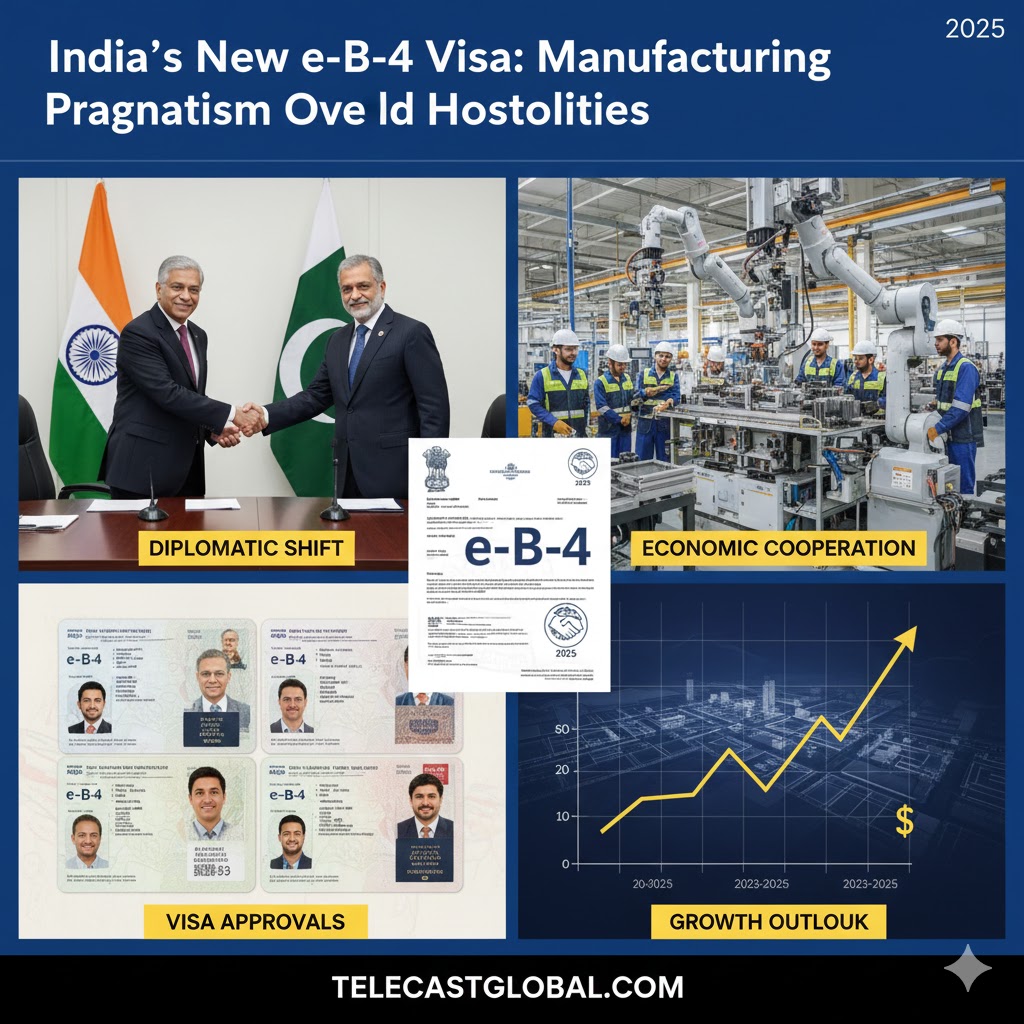
India’s decision to roll out the e-Production Investment Business Visa India 2026 marks a quiet but decisive shift in economic statecraft. At a time when global supply chains are fragmenting, China-plus-one strategies are accelerating, and India’s PLI ambitions face execution bottlenecks, New Delhi has chosen pragmatism over posturing. The data in the file clearly shows that this visa is not about reopening borders indiscriminately—it is about controlled, digital, sponsor-driven access for Chinese manufacturing experts essential to plant setup, machinery commissioning, and ERP integration. In 2026’s geopolitically tense yet economically interdependent world, this move reflects strategic realism.
Why e-Production Investment Business Visa India 2026 Fits the PLI Reality Check
Let’s be blunt—PLI looks great on paper, but factories don’t run on policy PDFs. They run on machines, timelines, and people who actually know how to make those machines work. That’s exactly why the e-Production Investment Business Visa India 2026 fits the PLI reality check better than any grand speech or summit photo-op.
India’s Production Linked Incentive push has brought billions in committed investments across electronics, EVs, solar modules, specialty steel, and semiconductors. But here’s the uncomfortable truth insiders already know: a large chunk of advanced machinery installed in Indian plants still comes from China. And when that machinery arrives, Indian factories often lack trained personnel who know the systems inside out. You can’t “Atmanirbhar” your way through a broken PLC controller.
This is where the e-Production Investment Business Visa India 2026 quietly fixes a structural flaw in PLI execution. Instead of forcing companies into the slow, security-heavy Employment Visa route, the government has created a time-bound, sponsor-driven, digitally monitored entry window. Six months. Specific tasks. No labor market distortion. No permanent footprint. Just execution.
From a policy realism standpoint, this is textbook governance. PLI rewards output, not intent. Delays in machine commissioning, ERP integration, or quality calibration directly eat into incentive eligibility. Miss deadlines, lose payouts. The e-Production Investment Business Visa India 2026 acts as a lubricant in a stiff system—allowing Chinese technicians to install, calibrate, train, and exit. No ambiguity. No long stays. No freelancing.
There’s also a strategic angle many commentators miss. India is not “opening doors” broadly. This visa is sponsorship-locked through DPIIT’s National Single Window System, meaning every Chinese entrant is traceable to a specific Indian project, company, and timeline. That’s tighter control than most traditional visas ever offered. In old-school terms, this is regulation with spine—not laissez-faire naïveté.
Critically, the e-Production Investment Business Visa India 2026 aligns with how modern manufacturing ecosystems actually work. Even countries far ahead of India—Germany, Vietnam, Mexico—allow short-term foreign technical experts during plant setup. India was the outlier, not the guardian. Correcting that imbalance strengthens PLI credibility with global investors who care less about slogans and more about operational certainty.
And let’s not kid ourselves: without this visa, many PLI-linked plants would either run below capacity or quietly outsource troubleshooting back to China remotely—slower, riskier, and less accountable. Physical presence matters in manufacturing. Anyone who’s run a factory knows that Zoom doesn’t fix misaligned robotics.
In short, the e-Production Investment Business Visa India 2026 accepts an old industrial truth: self-reliance is built in stages, not by denial. You import expertise today so you can indigenize skills tomorrow. That’s not weakness—that’s how every serious manufacturing power was built. If PLI is the engine, this visa is the missing gear. And without gears, even the best engines stall.
From Galwan to Governance: Economic CBMs in India–China Relations
Let’s not rewrite history. Galwan was a shock, not just militarily, but psychologically. Trust collapsed, visas froze, investments stalled, and India–China engagement went into a deep freezer. But here’s the hard truth mature states understand: borders and business don’t heal at the same speed. By 2026, New Delhi has quietly accepted that economic paralysis is not strategy—it’s self-harm. That’s where the e-Production Investment Business Visa India 2026 comes in as a classic economic Confidence-Building Measure (CBM).
This visa is not about romance or reconciliation. It’s about governance replacing grievance. India hasn’t softened its border posture, diluted security screening, or reopened student and tourist visas en masse. Instead, it has chosen a narrow, high-utility corridor—manufacturing and production—where economic logic outweighs political symbolism. That selectivity is the real signal.
The e-Production Investment Business Visa India 2026 allows India to separate strategic hostility from operational necessity. Chinese technicians enter only when an Indian firm sponsors them, only for defined technical tasks, only for limited time, and under full digital surveillance. That’s not appeasement—that’s leverage with paperwork.
Why does this matter in CBM terms? Because CBMs are not peace treaties. They are pressure valves. After Galwan, India learned that freezing all economic interfaces didn’t weaken China—but it did slow India’s own manufacturing momentum, especially under PLI schemes dependent on imported machinery. The visa is an admission that strategic autonomy requires execution capacity, not just political resolve.
There’s also a signaling game at play. By launching the e-Production Investment Business Visa India 2026, India tells global investors: “We are tough on security, not reckless with growth.” That distinction matters. Multinationals don’t want to invest in countries where geopolitical anger overrides administrative logic. This visa reassures them that India can manage risk without choking its own supply chains.
Importantly, this CBM is people-centric but not people-loose. Unlike earlier eras, there’s no open-ended engagement, no permanent migration, no ecosystem capture. Chinese experts come, finish the job, transfer know-how, and leave. Old-school industrial states have always worked this way. Japan did it. Korea did it. Even China did it in the 1980s—quietly importing foreign expertise while publicly preaching self-reliance.
The e-Production Investment Business Visa India 2026 also helps India regain narrative control. Instead of reacting to Chinese pressure or Western commentary, New Delhi is designing engagement on its own terms. That’s governance maturity—choosing what to open, where to open, and how much to open.
From Galwan to now, the lesson is clear: security is defended at borders, but power is built in factories. Economic CBMs like this visa don’t dilute sovereignty; they finance it. And in 2026’s fractured world, that kind of cold, calculated realism is not weakness—it’s statecraft done right.
Next up, we can unpack how digital visas and NSWS sponsorship turn this CBM into a surveillance-friendly governance tool.
Digital Visas, NSWS Sponsorship, and India’s Paperless State Push
If there’s one thing the Indian state has learned the hard way, it’s this: paper creates delay, delay creates discretion, and discretion creates trouble. The e-Production Investment Business Visa India 2026 is best understood not just as a visa reform, but as a governance upgrade—one that fits squarely into India’s long, stubborn march toward a paperless state.
Let’s call it what it is. Traditional visa regimes were opaque, embassy-heavy, and slow. Files moved across desks, approvals were fragmented, and accountability was conveniently diffused. In contrast, the e-Production Investment Business Visa India 2026 is born digital—applied online, processed electronically, and tracked end-to-end. No embassy hopping. No intermediaries. No “chai-paani” folklore. That alone marks a cultural shift in how India manages sensitive cross-border movement.
The real spine of this system is NSWS sponsorship under DPIIT. Every Chinese technician entering India under the e-Production Investment Business Visa India 2026 must be digitally sponsored by an Indian company through the National Single Window System. Translation: the Indian firm puts its name, credentials, and compliance history on the line. This flips the old model. Earlier, the foreign applicant carried the burden. Now, the Indian sponsor becomes the accountability anchor.
From a governance perspective, this is gold. The state no longer needs to guess intent—it maps it. Each visa is linked to a specific project, sector, factory location, and timeline. Authorities know who is coming, why they are coming, where they will work, and when they must leave. That’s not just digitization; that’s operational intelligence baked into administration.
The e-Production Investment Business Visa India 2026 also syncs neatly with FRRO’s electronic registration requirement. Within 14 days of arrival, the individual must digitally register—creating a second checkpoint that reinforces traceability. Old-school policing relied on physical surveillance. Modern states rely on data trails. India is clearly choosing the latter.
Zoom out, and the pattern is obvious. GST, UPI, Aadhaar-linked services, faceless tax assessments—this visa fits the same philosophy. Reduce human discretion, increase system memory. The e-Production Investment Business Visa India 2026 doesn’t just allow entry; it records behavior. That’s a big deal when dealing with a sensitive country like China, where security and economic interests constantly overlap.
There’s also a reputational payoff. For global manufacturers, India often felt administratively unpredictable—policies bold, execution messy. A fully digital, sponsor-driven visa signals that India is becoming a rules-based manufacturing state, not a personality-driven one. Investors trust systems more than promises.
And let’s inject a bit of old wisdom here: strong states don’t shout control—they design it quietly. The e-Production Investment Business Visa India 2026 doesn’t wave flags or issue grand declarations. It simply embeds oversight into software. That’s how serious governance works in 2026.
In short, this visa isn’t just about who enters India—it’s about how the Indian state sees, tracks, and governs economic activity. Paperless isn’t fashionable anymore; it’s necessary. And in this case, it’s finally being done with intent, not improvisation.
Next, we tackle the uncomfortable question everyone avoids: does this deepen China-dependence or help India break out of it?
Manufacturing Skills Gap, ERP Systems, and the China Dependency Dilemma
Here’s the uncomfortable part most policy panels avoid saying out loud: India’s manufacturing ambition has outrun its skills ecosystem. The machines are arriving faster than the people who know how to run them. And that’s exactly why the e-Production Investment Business Visa India 2026 exists—it’s a response to a real bottleneck, not a diplomatic experiment.
Let’s start with the skills gap. Modern factories are no longer about muscle and manpower; they’re about automation, PLCs, robotics, MES, and ERP systems stitched together into one nervous system. Many of these systems come bundled with Chinese machinery. Indian engineers are smart—no doubt—but hands-on familiarity with specific proprietary systems takes years, not crash courses. When a ₹500-crore PLI-linked plant is waiting to go live, “learning on the job” becomes an expensive luxury.
This is where the e-Production Investment Business Visa India 2026 steps in as a pressure-release valve. It allows Chinese technicians to physically install machines, calibrate production lines, integrate ERP and MES platforms, train Indian teams, and exit. No long-term employment. No ecosystem capture. Just task completion. That distinction matters more than critics admit.
Now comes the China dependency dilemma. Does this deepen reliance? Short answer: only if India wastes the learning window. Dependency is not created by temporary expertise—it’s created by failing to absorb it. The e-Production Investment Business Visa India 2026 actually creates a structured opportunity for skill transfer under Indian supervision. Earlier, companies either delayed production or relied on remote troubleshooting from China—slower, opaque, and harder to audit.
ERP systems deserve special attention here. ERP integration is not plug-and-play. It touches procurement, inventory, quality control, HR, compliance, and reporting. A poorly implemented ERP can cripple a factory for years. Many Indian manufacturers learned this the hard way. Allowing short-term ERP specialists under the e-Production Investment Business Visa India 2026 reduces execution risk while Indian IT teams shadow the process. That’s how institutional knowledge is built—by proximity, not PDFs.
There’s also a geopolitical irony worth noting. India talks about reducing China dependence, but refusing technical access doesn’t reduce dependence—it freezes it. Machines already installed don’t become Indian just because technicians are denied visas. They become Indian when Indian workers master them. The visa accelerates that transition instead of pretending it isn’t needed.
Traditional industrial powers understood this instinctively. Japan imported Western technicians. Korea did the same. Even China itself leaned heavily on foreign experts during its rise. The e-Production Investment Business Visa India 2026 follows that old, proven playbook—temporary openness to achieve long-term autonomy.
Critics who frame this as a security compromise miss the point. The real risk lies in stalled factories, missed PLI targets, and half-functional ERP systems that bleed competitiveness. Economic weakness is a far bigger strategic vulnerability than supervised technical visits.
In plain terms, the e-Production Investment Business Visa India 2026 doesn’t lock India into China—it gives India a chance to outgrow China technologically. But that only works if Indian firms treat these six months as classrooms, not conveniences.
Dependency is a choice. So is learning. This visa simply gives India the time to choose wisely.
Next, we confront the final tension: how India balances security risk with economic reward inside this tightly controlled framework.
Strategic Risks vs Economic Rewards: Security Screening in the e-B-4 Framework
Let’s address the elephant in the room without flinching: any Chinese presence in India carries strategic risk. Pretending otherwise would be naïve. But serious states don’t respond to risk with paralysis—they respond with design. The e-Production Investment Business Visa India 2026 is exactly that: a system built to extract economic value while keeping security risk on a tight leash.
First, understand what this visa is not. It is not an open employment visa. It is not long-term residency. It is not ecosystem access. The e-Production Investment Business Visa India 2026 is narrow by construction—short duration, task-specific, sponsor-controlled, digitally monitored. That alone separates it from the loose visa regimes of the past.
Security screening begins even before arrival. Every applicant under the e-Production Investment Business Visa India 2026 is tied to an Indian sponsor vetted through DPIIT’s National Single Window System. This flips the burden of trust. The Indian company becomes the guarantor—legally, reputationally, and digitally. If something goes wrong, the accountability trail doesn’t vanish into a foreign embassy; it leads straight to a registered Indian entity.
Then comes purpose limitation, a concept borrowed straight from old administrative wisdom. The visa permits only production- and investment-linked activities: machine installation, commissioning, quality checks, ERP/MES setup, and training. No wandering. No side gigs. No grey zones. In security terms, clarity reduces exposure.
Arrival doesn’t mean invisibility either. Mandatory FRRO electronic registration within 14 days ensures that every individual under the e-Production Investment Business Visa India 2026 enters the domestic monitoring grid. This is not old-school surveillance with boots and notebooks—it’s data-backed governance. Time stamps, locations, sponsor details, and duration all live in the system. Quiet control is always more effective than loud suspicion.
Critics argue that even limited access risks industrial espionage. Fair point. But here’s the counterpunch: most sensitive Indian manufacturing data already sits in imported machines, cloud dashboards, and software licenses. Blocking technicians doesn’t erase that reality. What reduces risk is supervision, compartmentalization, and time-bound access—all baked into the e-Production Investment Business Visa India 2026.
From an economic lens, the rewards are concrete. Faster commissioning means PLI targets met. ERP systems go live correctly the first time. Production stabilizes earlier. Exports scale sooner. Jobs stick. The cost of not allowing controlled access is silent but brutal—delays, penalties, idle capital, and lost credibility with investors.
There’s also a deeper strategic payoff. By formalizing access through the e-Production Investment Business Visa India 2026, India eliminates informal workarounds—remote logins, shadow consultants, undocumented visits—that are far harder to monitor. Systems create visibility. Bans create blind spots. Old administrators understood this long before cybersecurity became fashionable.
Security hawks and growth advocates usually talk past each other. This framework forces them into the same room. It acknowledges risk without surrendering growth. It values caution without worshipping stagnation. That balance is the mark of a state that has stopped reacting and started governing.
In the final analysis, the e-Production Investment Business Visa India 2026 doesn’t ask India to trust blindly. It asks India to verify relentlessly while moving forward. And in a world where economic power decides strategic autonomy, standing still is the riskiest option of all.
About The Author








Leave a Reply