

Table of Contents
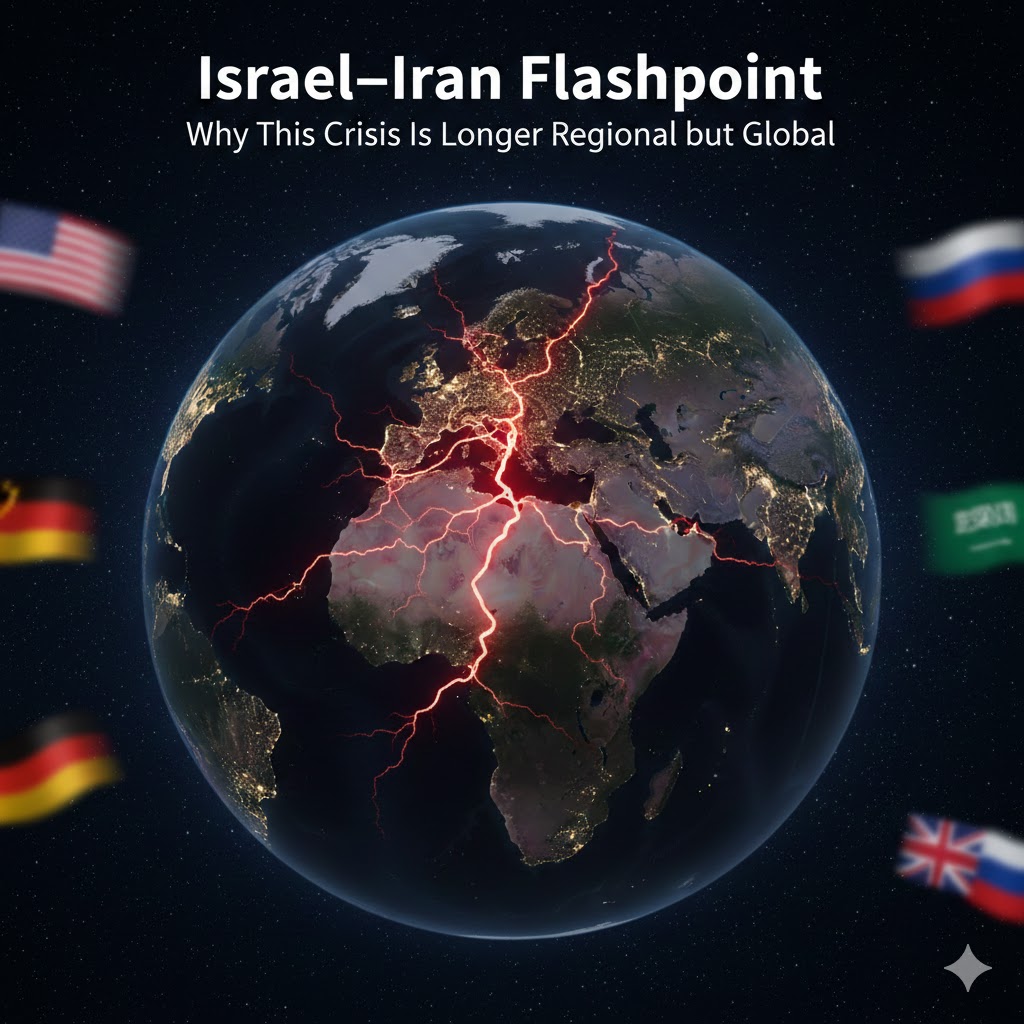
Israel Iran Tensions are no longer distant headlines—they are shaping real decisions for governments, markets, and citizens worldwide. The attached report highlights how India has issued urgent advisories for its citizens in Israel and Iran amid rising violence, protests, and security breakdowns. What began as regional instability is now colliding with global supply chains, energy security, diaspora safety, and diplomatic alignments. As 2026 approaches, this crisis mirrors a broader pattern: fragile states, ideological conflict, and governments preparing for worst-case scenarios. The Middle East is once again reminding the world that geopolitical negligence comes at a high price.
Israel Iran Tensions and India’s Emergency Advisories: A Diplomatic Red Flag
Israel Iran Tensions have crossed a point where quiet diplomacy is no longer enough—and India’s emergency advisories make that unmistakably clear. When a country like India, known for strategic restraint and balanced foreign policy, publicly urges its citizens to avoid travel, exit conflict zones, and stay on constant alert, it signals far more than routine caution. This is a diplomatic red flag, not a procedural memo.
At the heart of this warning lies the rapidly escalating confrontation between Israel and Iran—a rivalry that has long simmered through proxy wars, cyber operations, and covert strikes, but is now spilling into open instability. Israel Iran Tensions are no longer abstract geopolitical chess moves; they are triggering real-world emergency responses, evacuations, and crisis planning.
India’s advisories, issued through its embassies and coordinated by the Ministry of External Affairs, underline three hard realities. First, the security environment in the Middle East is deteriorating faster than official narratives admit. Second, governments are preparing for scenarios that include prolonged unrest, airspace disruptions, and sudden escalations. Third—and most importantly—citizen safety has become inseparable from geopolitics.
What makes this moment especially significant is scale. With thousands of Indian students, professionals, pilgrims, and businesspeople living across Israel and Iran, Israel Iran Tensions directly intersect with India’s human and economic interests. This isn’t a distant war affecting oil prices alone; it’s a situation where flights, visas, remittances, and even academic futures hang in the balance. Advisories urging citizens to keep documents ready and remain in constant contact with embassies are hallmarks of crisis-stage diplomacy.
From a strategic standpoint, these warnings also reflect India’s tightrope walk. New Delhi maintains relations with Israel for defense and technology, while also engaging Iran for regional connectivity and energy interests. When Israel Iran Tensions intensify, neutrality becomes harder to sustain, and every advisory becomes a carefully worded diplomatic signal—firm enough to protect citizens, cautious enough to avoid political fallout.
Looking toward 2026, this pattern matters. Governments across the world are shifting from reactive diplomacy to preventive crisis management. India’s advisories are part of that shift. They show how modern foreign policy isn’t just about treaties and summits—it’s about real-time risk assessment, evacuation planning, and public communication.
In blunt terms, Israel Iran Tensions have entered a phase where embassies behave less like administrative offices and more like emergency command centers. That alone should tell us something. When nations start planning for worst-case scenarios, history suggests they usually aren’t overreacting. They’re reading the writing on the wall—and it’s written in bold, uneasy ink.
From Protests to Proxy Wars: How Iran’s Internal Unrest Fuels Regional Chaos
Israel Iran Tensions have an internal dynamic most global audiences often overlook: the profound impact of Iran’s internal unrest on the entire Middle East power balance. The unprecedented protests that erupted in Iran beginning late December 2025 — driven by crippling inflation, economic collapse, and widespread dissatisfaction with the clerical regime — quickly ballooned into nationwide demonstrations demanding systemic change. (Wikipedia)
What began as demonstrations over skyrocketing living costs and currency collapse rapidly shifted into a broad political uprising challenging Tehran’s authority. By January 2026, protests had spread across all 31 provinces, with strikes paralyzing key commercial centers like Tehran’s Grand Bazaar and drawing in shopkeepers, truckers, students, and workers demanding fundamental change. (Wikipedia)
The Iranian government’s response has been brutal — with internet blackouts and violent crackdowns that have resulted in thousands of deaths and tens of thousands of arrests. (Wikipedia) This internal rupture has weakened the regime’s stability and created an opening for external forces, including opportunistic use by foreign powers and acceleration of existing proxy conflicts.
Here’s the key strategic link: Israel Iran Tensions do not exist in a vacuum. Iran’s capacity to manage regional alliances and proxy networks — including groups like Hezbollah in Lebanon, Houthi rebels in Yemen, and other militia affiliates in Iraq and Syria — is directly tied to its internal political cohesion. As Tehran’s domestic legitimacy erodes, these proxy networks become more volatile and less predictable. (Council on Foreign Relations)
Iran’s traditional strategy — balance domestic repression with assertive regional influence — now faces systemic stress. The government’s focus on quelling protests and maintaining internal order has diverted economic resources and military attention away from external operations. That’s significant because proxy wars are resource-intensive; they require funding, logistics, intelligence, and political bandwidth. With Iran’s economy battered by sanctions and internal disruption, its leverage over proxy groups weakens, enabling rival regional powers (notably Saudi Arabia, Israel, and even the United States) to reshape alliances and influence outcomes on the ground.
Moreover, the visible fragmentation has emboldened external actors. Countries concerned about Israel Iran Tensions are recalibrating their posture: some push for restraint to prevent broader conflict, while others consider capitalizing on Iran’s vulnerabilities to limit its regional ambitions. (Reuters)
Inside Iran, this has created further risk: as the regime tries to project strength externally, it may escalate support for proxy groups to signal that it remains a dominant regional power, even as its domestic authority weakens. This pattern of external force projection has historically pulled states deeper into conflicts they would otherwise avoid. And this isn’t hypothetical — conflicts like in Yemen and Syria have long reflected Iran’s proxy strategy, tying together local grievances, militia influence, and broader geopolitical rivalries. (Council on Foreign Relations)
As we head through 2026, the interplay between internal dissent and proxy engagement amplifies uncertainty. Economic hardship and political pressure push Tehran to consolidate power internally, often by stoking nationalist or sectarian sentiments that can fuel proxy wars. Meanwhile, opponents of the Iranian regime watch for opportunities to contain or roll back its influence.
In blunt terms: Israel Iran Tensions are not driven solely by direct military standoffs — they are deeply intertwined with the internal upheaval in Iran. Domestic unrest weakens centralized control, distorts strategic planning, and creates ripple effects across the Middle East’s complex web of alliances and conflicts. That’s how protests become proxy wars — and how localized instability can escalate into a regional crisis that affects energy markets, global diplomacy, and civilian safety well into 2026.
Middle East Instability and Global Energy Markets Ahead of 2026
Israel Iran Tensions are no longer just a security or diplomatic concern—they have become a structural risk for global energy markets as the world moves toward 2026. The Middle East still controls the heartbeat of global oil and gas flows, and any instability between regional powers like Israel and Iran immediately sends shockwaves through crude prices, shipping routes, insurance costs, and long-term energy planning.
At the center of this risk lies the Strait of Hormuz, through which nearly one-fifth of the world’s oil supply passes every day. Even the perception that Israel Iran Tensions could escalate into direct confrontation is enough to spike Brent crude prices. Markets don’t wait for missiles to fly; they react to signals, statements, troop movements, and proxy attacks. In today’s algorithm-driven trading environment, geopolitics translates into volatility within minutes.
Iran’s position makes this even more sensitive. Despite sanctions, Iran remains a critical swing factor in global energy calculations. When Israel Iran Tensions rise, the risk of tighter enforcement, shipping disruptions, or retaliatory actions increases. That uncertainty forces major importers—especially India, China, and parts of Europe—to rethink sourcing strategies, stockpiling, and long-term contracts.
For India, the stakes are particularly high. As one of the world’s largest energy importers, India’s economic stability is tightly linked to oil prices. Rising crude costs translate directly into inflation, pressure on the rupee, and fiscal stress. This is why Israel Iran Tensions have become an issue not just for foreign policy desks, but for finance ministries and central banks. Energy inflation can derail growth projections faster than any domestic policy failure.
Looking toward 2026, another layer complicates the picture: the global energy transition. While renewables are growing, fossil fuels still dominate industrial economies. That creates a dangerous overlap—high geopolitical risk combined with incomplete energy diversification. In simple terms, the world is not yet ready to absorb a major Middle East shock without pain. Israel Iran Tensions expose this vulnerability mercilessly.
Insurance and shipping data already reflect this reality. When regional instability rises, tankers demand higher risk premiums, shipping routes get rerouted, and delivery timelines stretch. These hidden costs quietly pass down to consumers. Fuel prices rise, logistics costs increase, and global supply chains—already strained post-pandemic—take another hit. Once again, Israel Iran Tensions prove how local conflicts can globalize economic stress.
There’s also a strategic recalibration underway. Major powers, including the OPEC bloc and Western economies, are factoring prolonged instability into their 2026 energy forecasts. Strategic petroleum reserves, diversification toward African and Latin American suppliers, and long-term LNG contracts are all responses to one uncomfortable truth: Middle East stability can no longer be assumed.
Historically, energy markets have punished complacency. Every major oil shock—from the 1970s to the Gulf Wars—followed a familiar pattern: ignored warning signs, sudden escalation, and economic fallout. Israel Iran Tensions are flashing those warning signs again. The difference now is speed—financial markets react instantly, governments scramble publicly, and citizens feel the impact almost immediately.
Heading into 2026, the message is blunt and unsentimental: Middle East instability is not a future risk; it is a present condition. And as long as Israel Iran Tensions remain unresolved, global energy markets will stay nervous, reactive, and expensive. History suggests that when energy and geopolitics collide, it’s ordinary economies—not just diplomats—that pay the price.
Why Israel Iran Tensions Matter for Indian Diaspora Safety and Foreign Policy
When Israel Iran Tensions flare, it’s not just a far-off geopolitical drama — it directly affects tens of thousands of Indian nationals, the broader diaspora, and India’s foreign policy playbook. Over the past week the Ministry of External Affairs and Indian embassies have repeatedly issued urgent advisories telling Indian citizens in both Israel and Iran to stay alert, avoid non-essential travel, and in many cases leave the region if they can. (VisaHQ)
For the Indian diaspora, many of whom are students, tech workers, missionaries, pilgrims and labourers, these warnings are more than diplomatic nuance — they are life-saving advice. Indian embassies in Tel Aviv and Tehran have explicitly urged Indian citizens to maintain close contact with embassy hotlines and adhere strictly to safety protocols due to volatile security conditions. (ThePrint)
The figure here is not trivial. India has thousands of nationals in both countries — with estimates of around 9,000 in Iran alone — and many more in Israel’s rapidly expanding Indian community. (The Economic Times) Amid protests, airspace disruptions, and sporadic violence on the ground, communications blackouts and transport shutdowns have made it difficult for families back home to stay in touch with relatives abroad. (The Times of India)
This situation matters for New Delhi on multiple strategic levels. First, protecting citizens abroad is a core principle of Indian foreign policy and a measure of diplomatic credibility. When Israel Iran Tensions escalate, the Indian government has historically taken proactive steps — most notably Operation Sindhu, a past evacuation initiative used to extract Indian nationals from crisis situations in Iran during earlier conflict phases — underscoring India’s readiness to act when citizens’ safety is imperiled. (Wikipedia)
Second, the fact that India must manage simultaneous advisories for Israel and Iran highlights the geopolitical tightrope New Delhi walks. India maintains strategic partnerships with both countries: robust defense and tech cooperation with Israel, and longstanding economic and connectivity ties with Iran. Escalating Israel Iran Tensions strain this balancing act and force New Delhi to recalibrate its diplomatic posture, all while trying to safeguard compatriots caught in the middle.
In plain terms, when Israel Iran Tensions rise, ordinary Indians — students, workers, families — can find themselves in harm’s way through no fault of their own. Governments rarely issue travel advisories unless there is a concrete threat or foreseeable risk, and India’s recent string of warnings reflects precisely that judgment. (ThePrint)
This is why these tensions matter so much for Indian diaspora safety and foreign policy: they trigger emergency responses, test diplomatic agility, and underscore how interconnected our world has become — where a flashpoint in the Middle East can ripple across continents and directly touch Indian lives.
2026 Outlook: Are Israel Iran Tensions Pushing the World Toward a New Conflicts Era?
Israel Iran Tensions are shaping up as one of the most consequential geopolitical fault lines as we move deeper into 2026 — not just for the Middle East, but for the global order. Recent developments show that a volatile mix of internal unrest in Iran, diplomatic brinkmanship, and regional power plays is creating a precarious equilibrium that could easily spiral into broader clashes or sustained proxy conflict rather than peace. (Reuters)
Across the region, leaders and analysts are sounding alarm bells. Russia’s recent diplomatic engagement with both Israel and Iran underscores how external powers are now actively trying to manage — or exploit — the crisis to avert a full-blown confrontation, but these efforts reveal just how serious the situation has become. (Reuters) Meanwhile, global risk assessments for 2026 highlight geopolitical instability — including in the Middle East — as one of the top threats to international security and economic stability. (Stimson Center)
At the heart of this tension is Iran’s internal crisis, which has rapidly evolved from economic grievances to nationwide protests and violent crackdowns. Iran’s internal upheaval has eroded the regime’s cohesion and could embolden hardliners to escalate regional assertiveness — or conversely, invite external intervention under the guise of protecting civilians. (epc.eu)
What makes Israel Iran Tensions especially explosive in 2026 is the unresolved legacy of the June 2025 conflict, where direct strikes and counter-strikes laid bare how quickly escalation can occur and how costly it can be for infrastructure, civilian life, and diplomatic norms. (Wikipedia) The lack of a diplomatic resolution means the underlying disputes — nuclear ambitions, missile programs, proxy militias — remain simmering threats.
The global context adds another layer. Major powers are already managing multiple theaters of tension — from Europe’s ongoing conflict to geopolitical rivalries in Asia and economic standoffs across trade networks. This means that U.S., EU, and Russian attention may be stretched thin, creating opportunities for local actors to act with greater autonomy — increasing the risk of misinterpretation and miscalculation. (The Guardian)
So is the world heading into a new era of conflict? The short answer: yes — but not in a uniform, world-war style. Instead, what 2026 appears to be shaping up as is a multiplex era of interlinked regional clashes, proxy wars, and geopolitical posturing, in which Israel Iran Tensions act as both a catalyst and a barometer of instability. (شفق نيوز)
Diplomacy — including recent efforts by Russia and other mediators — could still change this trajectory, but the baseline risk remains high. Absent substantial agreements on nuclear limits, security guarantees, and internal political reforms in Tehran, the world is likely to see periodic flare-ups rather than sustained peace. In practical terms, this means markets, governments, and communities worldwide must prepare for a 2026 where Israel Iran Tensions influence everything from oil prices and supply chains to migration patterns and defense planning. (LinkedIn)
In blunt terms: the globe is not sliding into a single global war, but we are entering an era where regional conflicts overlap, align, and amplify one another — and the Israel–Iran dynamic is right at the center of that dangerous pattern.
About The Author








Leave a Reply