

Table of Contents
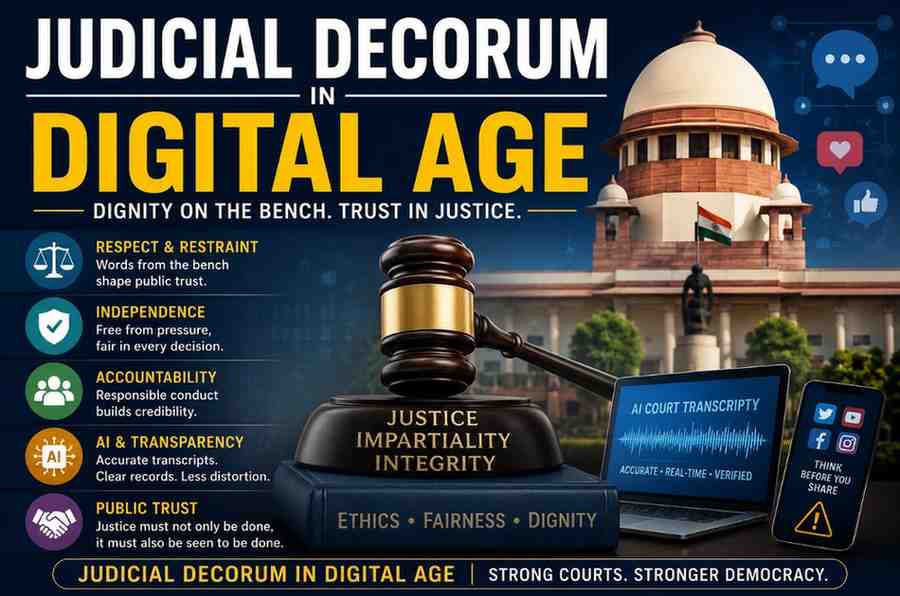
Judicial Decorum in Digital Age has become a major legal and public debate in 2026 as courtroom remarks now travel instantly through live reporting, social media, satire, and political commentary. The attached file highlights how sharp oral observations by the CJI triggered public outrage, mock online movements, and renewed questions about judicial restraint. In today’s digital world, one courtroom sentence can become a national controversy before the written judgment arrives. This makes judicial ethics, AI-based court transcripts, responsible legal journalism, and in-house accountability essential for protecting public trust, judicial independence, and the dignity of India’s constitutional courts.
Why Judicial Decorum in Digital Age Became a 2026 Public Trust Crisis
Judicial Decorum in Digital Age became a serious public trust crisis in 2026 because courtroom speech no longer remains inside the courtroom. Earlier, oral remarks by judges were mostly heard by lawyers, litigants, and reporters. Today, one sharp sentence can travel through social media within minutes, become a headline, trigger satire, invite political reactions, and shape public opinion before the final written judgment is even delivered. That is exactly why judicial speech has become more sensitive in the digital era.
The attached file shows how the controversy began after the Chief Justice of India issued a formal clarification following public outrage over strong oral observations made during a Supreme Court hearing. Terms like “cockroaches” and “parasites” were reportedly used while criticizing unmeritorious litigation and fake-degree concerns. The issue intensified online, where satire such as the mock “Cockroach Janta Party” turned a courtroom remark into a viral public debate. This shows how Judicial Decorum in Digital Age is now directly connected to online perception, institutional credibility, and public confidence in courts.
The real crisis is not only about one remark. The bigger concern is whether citizens continue to see courts as calm, impartial, and dignified institutions. When harsh words come from the bench, people may feel that the court has already formed an opinion. This can create a perception of bias, even if the final judgment is legally sound. In justice, perception matters almost as much as procedure. A court must not only be fair; it must also appear fair.
Judicial Decorum in Digital Age also became urgent because India’s legal system is now operating under intense digital scrutiny. Live reporting, legal influencers, short-form videos, and instant commentary have changed how citizens consume court news. Many people do not read full judgments. They react to clips, headlines, and viral posts. This creates a dangerous gap between oral courtroom discussion and the actual written order.
The Vijayabhaskar standard, mentioned in the file, is important here. It clearly says that a court’s formal opinion is found in its written judgments and orders, not in oral observations during hearings. But in the digital age, that distinction often gets lost. The public may treat a judge’s question, frustration, or passing remark as the final view of the court. That is why Judicial Decorum in Digital Age is no longer a narrow legal ethics issue; it is a communication challenge for the entire justice system.
Another reason this became a 2026 public trust crisis is the chilling effect on ordinary citizens. If courtroom language sounds humiliating, vulnerable litigants, young lawyers, minority groups, or first-time petitioners may hesitate to approach the courts. Justice should feel accessible, not intimidating. Strong judicial questioning is necessary, but dignity must remain non-negotiable.
The way forward is clear: Judicial Decorum in Digital Age requires updated ethical standards, better judicial training, responsible legal journalism, stronger internal accountability, and official AI-based court transcripts. These reforms can protect both judicial independence and public trust. In 2026, the judiciary’s authority cannot rest only on constitutional power; it must rest on restraint, reason, and the public’s continued respect.
How Social Media Outrage Is Changing the Meaning of Courtroom Speech
Judicial Decorum in Digital Age is changing because courtroom speech is no longer interpreted only by lawyers, judges, and litigants. It is now judged by social media users, news channels, legal influencers, political voices, and meme culture. A judge’s oral remark may be legally exploratory inside the courtroom, but online it can quickly become a final-looking statement, a controversy, or a symbol of institutional arrogance.
In the attached file, the controversy grew after sharp oral observations during a Supreme Court hearing triggered public outrage. The matter became bigger when social media users created satire around phrases like “cockroaches” and “parasites.” This shows how Judicial Decorum in Digital Age has entered a new phase where public reaction can reshape the meaning of courtroom language almost instantly.
Traditionally, oral observations were part of judicial dialogue. Judges ask difficult questions, test arguments, challenge weak claims, and sometimes use strong language to expose legal flaws. But social media removes that context. A short phrase travels faster than the full hearing. A clipped remark gets more attention than the final judgment. This creates a serious problem: the public may confuse judicial questioning with judicial conclusion.
That is why Judicial Decorum in Digital Age is now linked to the Vijayabhaskar standard. The file explains that the Supreme Court clarified an important principle: the formal opinion of a court is reflected in written judgments and orders, not oral remarks made during hearings. But online outrage often ignores this distinction. Once a remark goes viral, people may treat it as the court’s official position, even if the final written order says something different.
Social media also changes courtroom speech by increasing emotional pressure on institutions. Judges are expected to remain independent, but viral backlash can force clarifications, public explanations, and defensive communication. This may protect transparency in some cases, but it can also create pressure on judicial independence. If every oral remark becomes a digital storm, judges may become either overly cautious or unnecessarily combative. Neither is healthy for justice.
Judicial Decorum in Digital Age also affects litigants and lawyers. A harsh remark from the bench can damage reputation before any final legal finding. In the digital era, reputational harm is immediate and often permanent. Even if the written judgment later corrects the impression, the viral narrative may already be fixed in public memory. As they say, the internet never forgets—sadly, it also rarely reads the full order.
The rise of legal influencers and instant commentary has made this problem sharper in 2026. Many citizens now learn about court proceedings through short posts, reels, and headlines rather than full legal reporting. This makes responsible legal journalism essential. Reporters must explain whether a remark is an oral observation, a legal question, or a final ruling. Without context, Judicial Decorum in Digital Age becomes vulnerable to misunderstanding and outrage cycles.
The solution is not silence from judges. Courts need active questioning. Strong oral exchanges help clarify facts, test legal reasoning, and improve final judgments. But the language must remain restrained, precise, and dignified. Judicial authority is strongest when it sounds disciplined, not emotional.
Ultimately, Judicial Decorum in Digital Age shows that courtroom speech now carries public consequences far beyond the courtroom. In 2026, judges, lawyers, journalists, and citizens must understand one basic truth: oral remarks may start as legal dialogue, but social media can turn them into public doctrine within minutes. That is why dignity, context, and restraint are no longer optional—they are essential to preserving trust in justice.
Why AI Court Transcripts Could Protect Judges, Lawyers, and Citizens
Judicial Decorum in Digital Age needs AI court transcripts because courtrooms are now watched, reported, clipped, and debated in real time. When oral remarks are reported without full context, confusion spreads quickly. A judge’s question may be treated as a final opinion, a lawyer’s argument may be misquoted, and a litigant’s reputation may suffer before the written order arrives.
AI-based court transcripts can create an authentic record of what was actually said. This protects judges from selective reporting, protects lawyers from distorted summaries, and protects citizens from misinformation. In the attached file, official AI-driven real-time transcription is suggested as a reform to prevent media misreporting, provide reliable public records, and discourage careless oral observations. This makes Judicial Decorum in Digital Age a technology-and-trust issue, not just a legal ethics debate.
The biggest benefit is context. Social media often picks one dramatic phrase and removes the surrounding legal discussion. AI transcripts can show whether a remark was a question, warning, criticism, joke, or final direction. This matters because the Vijayabhaskar standard says written judgments and orders represent the court’s formal view, not every oral observation during hearings. AI transcripts can help the public understand that difference.
Judicial Decorum in Digital Age also requires protection for judges. Judges must ask tough questions. They must test weak arguments and expose false claims. But if every sentence is filtered through viral outrage, judicial dialogue becomes risky. A verified transcript reduces the chance that a judge’s words are twisted for clicks, politics, or online drama.
Lawyers also benefit. Young advocates, especially, can be affected by harsh courtroom exchanges or inaccurate reporting. A transcript gives them a fair record. It can show their full argument, not just the uncomfortable moment that went viral. For litigants, especially ordinary citizens, this creates more confidence that proceedings are not hidden behind elite legal language or media interpretation.
AI transcripts can also improve accountability. When everyone knows that courtroom speech is being accurately recorded, language naturally becomes more careful. Judges may avoid unnecessary harshness. Lawyers may avoid exaggeration. Media houses may report more responsibly. In this sense, Judicial Decorum in Digital Age can be strengthened without attacking judicial independence.
But AI transcripts must be handled carefully. They should be accurate, secure, officially verified, and corrected where needed. Courts cannot depend on raw machine output alone. Legal language, accents, interruptions, and multilingual arguments can create errors. So the best model is AI-assisted transcription with human verification.
In 2026, Judicial Decorum in Digital Age demands modern tools for a modern courtroom. AI transcripts can reduce misinformation, improve transparency, protect dignity, and preserve public trust. Technology cannot replace judicial restraint, but it can support it. A clear record is often the best shield against confusion—and in the internet age, clarity is not a luxury; it is survival.
Judicial Independence vs Judicial Accountability: The Big 2026 Debate
Judicial Decorum in Digital Age has made the old debate between judicial independence and judicial accountability more urgent in 2026. Courts must remain free from political pressure, media trials, and public intimidation. At the same time, judges cannot be completely beyond criticism when their oral remarks affect public trust, litigants’ dignity, and the reputation of the justice system.
Judicial independence means judges should decide cases according to law, not according to government pressure, public anger, or social media trends. This is essential for constitutional democracy. If judges fear political punishment or online backlash for every difficult question, justice becomes weak. But independence does not mean unlimited freedom to speak harshly from the bench. The attached file rightly highlights that judicial independence and judicial accountability are not enemies; they are symbiotic. One protects the court from outside pressure, while the other protects the court from internal decline.
This is where Judicial Decorum in Digital Age becomes important. In earlier times, intemperate courtroom remarks had limited reach. Today, one sentence can become a national controversy within minutes. When judges use language that appears insulting, biased, or dismissive, citizens may begin to doubt the neutrality of the institution. Public respect for courts is not built only by legal power; it is built by restraint, fairness, and dignity.
The 2026 debate is therefore not about weakening the judiciary. It is about strengthening it. A judge who speaks with discipline protects the authority of the court. A judge who avoids unnecessary personal remarks protects the dignity of litigants. A judge who remembers the difference between oral observation and written judgment protects public understanding of justice. That is the real meaning of Judicial Decorum in Digital Age.
Accountability also does not mean public humiliation of judges or political control over courts. That would be dangerous. The better solution is internal institutional correction. The file suggests stronger in-house accountability, where the Chief Justice or peer committees can advise judges against repeated intemperate remarks without compromising judicial independence. This is a balanced approach because it respects the autonomy of the judiciary while still demanding responsibility.
The Bangalore Principles of Judicial Conduct also matter here. They emphasize that a judge’s behavior must constantly reaffirm public faith in impartiality. In simple terms, judges must not only be fair; they must look fair. This is especially true in Judicial Decorum in Digital Age, where public perception is shaped by headlines, clips, and viral commentary.
There is also a risk of political misuse. If judges repeatedly make controversial remarks, political actors may demand external regulation in the name of accountability. That could threaten judicial independence. So restraint from within is the best protection against control from outside. Old wisdom still works: discipline at home prevents interference from the street.
In 2026, Judicial Decorum in Digital Age demands a mature balance. Judges should remain independent in decision-making, but accountable in conduct. They should be fearless in applying the law, but careful in language. They should question strongly, but not wound unnecessarily. The judiciary’s moral authority depends not only on what it decides, but how it speaks while deciding.
Ultimately, Judicial Decorum in Digital Age shows that independence without accountability can look arrogant, while accountability without independence can become political control. India needs neither extreme. It needs a judiciary that is free, disciplined, transparent, and dignified. That balance is the foundation of public trust in 2026.
Can India Create a New Digital-Age Code for Judicial Conduct?
Judicial Decorum in Digital Age makes a strong case for India to create a new digital-age code for judicial conduct in 2026. The existing ethical framework is important, but it was not designed for live-streamed hearings, viral clips, instant legal commentary, AI transcripts, and social media outrage. Courts now function in a public communication environment where every oral remark can be recorded, interpreted, misinterpreted, and circulated within minutes.
India already has a foundation. The Restatement of Values of Judicial Life, 1997, lays down standards for judges, including restraint from public debate on political matters or pending issues. The Bangalore Principles of Judicial Conduct, 2002, also stress impartiality, dignity, and public confidence. But Judicial Decorum in Digital Age requires these principles to be updated for today’s courtroom reality. A 1997-era code cannot fully answer 2026-era problems.
The attached file suggests a “Charter of Judicial Conduct for the Digital Age” to define the limits of bench speech, especially in live-streamed proceedings and interactions that may trigger social media virality. This is a practical idea because modern judicial speech is no longer confined to the courtroom. A sharp observation can become a national debate before the written judgment is even published.
Such a code should not silence judges. Strong questioning is necessary for justice. Judges must test arguments, expose weak claims, and seek clarity. But Judicial Decorum in Digital Age demands that questioning remain disciplined, precise, and respectful. The bench should challenge arguments, not humiliate people. It should criticize legal weakness, not attack personal dignity.
A new code could include clear guidance on oral observations, live-streamed hearings, media reporting, social media sensitivity, and AI-based court transcripts. It should also clarify the difference between exploratory courtroom dialogue and final judicial opinion. This would support the Vijayabhaskar principle that written judgments and orders—not oral remarks—represent the court’s formal view.
Judicial Decorum in Digital Age also needs stronger judicial education. The National Judicial Academy can train judges on the psychological impact of courtroom language, digital virality, reputational harm, and public perception. This is not modern softness; it is institutional discipline. Even traditional court authority depends on restraint.
Accountability must remain internal and balanced. A new code should allow the Chief Justice or peer committees to advise judges when remarks repeatedly cross the line. This protects judicial independence while ensuring responsible conduct. External political control would be dangerous, but internal correction is healthy.
In 2026, India can create a digital-age code for judicial conduct—and it should. Judicial Decorum in Digital Age is no longer just about manners in court. It is about public trust, constitutional dignity, judicial independence, and the credibility of justice itself. A modern code would not weaken the judiciary; it would strengthen its moral authority.
- Chandrayaan-3 Hop Experiment 2026: India’s Powerful Leap Toward Future Moon Bases
- RBI Intervention to Defend the Rupee in 2026: How India Is Fighting Currency Pressure
- How Neuro-Symbolic AI in Indian Education Can Redefine Learning in 2026
- India Public Health Spending Crisis 2026: Why Budget Cuts Are Becoming a National Risk
- Israel–Iran Flashpoint: Why This Crisis Is No Longer Regional but Global
About The Author












Illegal Sand Mining in Chambal Sanctuary: Warnings in 2026
[…] Judicial Decorum in Digital Age: Why 2026 Courts Must Balance Free Speech, Dignity, and Public Trust […]