

Table of Contents
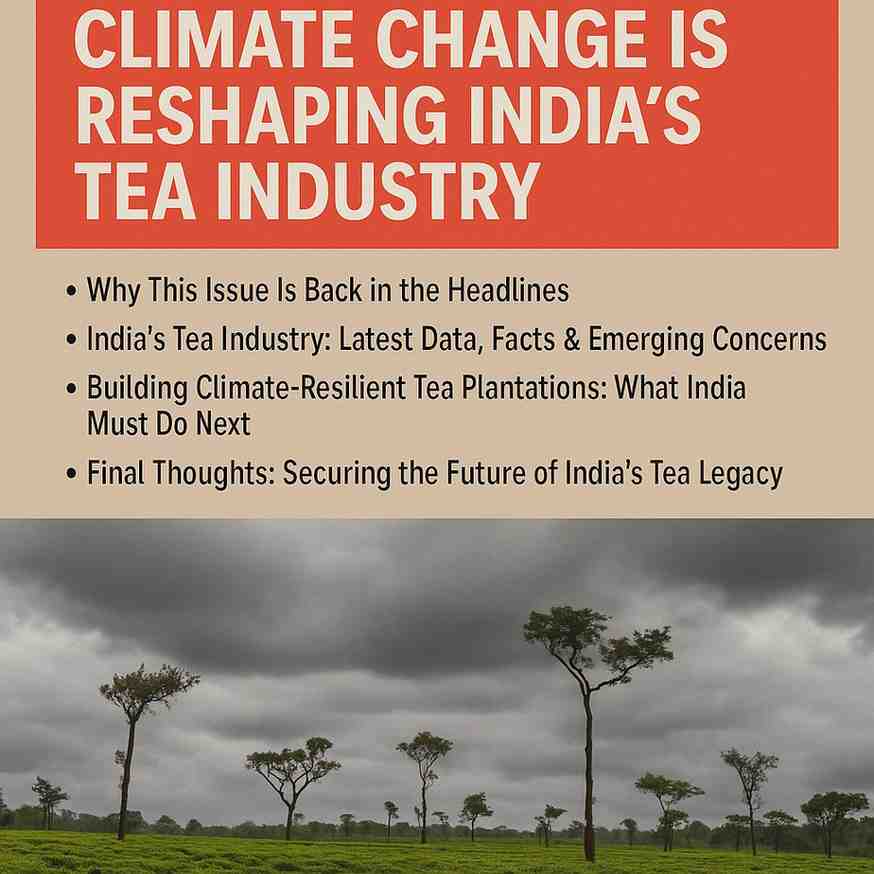
Climate Impact on Tea is emerging as one of the most urgent challenges for India’s century-old tea industry. With rising temperatures, unpredictable monsoons, and declining soil health, major tea-producing regions like Assam, Darjeeling, and the Nilgiris are experiencing significant stress. Recent 2024–25 data shows fluctuations in yield, changing flavor profiles, and growing threats to worker livelihoods. This crisis now affects agriculture, trade, and global supply chains. As climate pressures intensify, India must adopt smarter, science-backed strategies to protect its tea heritage and build a climate-resilient future for producers and consumers alike.
Why the Climate Impact on Tea Is Back in the Headlines?
Climate Impact on Tea sector isn’t a “new” headline — but the reason it’s trending again in 2024–25 is because the situation has officially moved from “concerning” to “critical.” Several new reports, climate models, production data drops, and global price shifts have forced policymakers, researchers, and tea boards to sound the alarm louder than ever. In short, the risk is no longer tomorrow’s problem — it has become today’s damage report.
The Tea Board of India’s 2024–25 estimates revealed one of the sharpest yield fluctuations in the last decade, especially in Assam and Darjeeling, India’s biggest tea hubs. Assam alone produces about 51% of India’s total tea, and recent data shows a 7–11% decline in high-quality leaf output during erratic monsoon months. When the heart of the industry shakes, the entire ecosystem trembles. That’s why India’s tea climate story is back in national and global headlines.
A big trigger behind this renewed attention was the Indian Meteorological Department’s 2025 seasonal climate assessment, warning that tea-growing regions may experience 1.2°C to 1.6°C above-normal temperatures through upcoming summers. Tea bushes are extremely sensitive; even a 1°C rise can reduce yields by 20% in certain estates. When the IMD drops numbers like that, journalists, policymakers, and the global trade market naturally sit up.
Another headline moment came when global buyers such as the UK, UAE, and Russia reported quality inconsistencies in Indian tea consignments in late 2024. India is the world’s second-largest tea producer, but quality sells more than quantity in international markets. Global tea auctions recently flagged Indian tea samples with lower aroma, weaker liquor quality, and unstable flavor profiles — all signs linked directly to rising humidity, pest attacks, and soil nutrient depletion caused by climate stress.
Adding to the media attention, Darjeeling estate associations released a joint statement in mid-2025 saying that “India’s premium tea reputation is under immediate threat.” Darjeeling already saw its production drop from 14 million kg (2010) to nearly 6.7 million kg (2024) — more than a 50% fall in just over a decade. When the “Champagne of teas” struggles this badly, the world pays attention.
Social impact stories also brought this issue back into the limelight. More than one million workers, most of them women, depend on tea estates across Assam, West Bengal, Tamil Nadu, and Kerala. Climate-induced yield drops have resulted in reduced plucking days, unstable incomes, and rising wage disputes. Newsrooms across the country picked this up because it hits at the intersection of climate change, labor crisis, and rural livelihood.
To top it off, multiple peer-reviewed studies in 2024–25 — including reports from the Indian Council of Agricultural Research (ICAR) and the Intergovernmental Panel on Climate Change (IPCC) — confirmed something that researchers long suspected: if warming continues at this pace, nearly 26–30% of India’s tea-growing land will become “unsuitable” by 2050.
All these factors re-ignited the conversation, making the climate-tea crisis one of India’s most urgent agricultural challenges — and a headline magnet once again.
India’s Tea Industry: Latest Data, Facts & Climate Impact on Tea
India remains one of the titans of global tea. As of 2024, the domestic tea market is valued at roughly USD 11.50 billion, and is forecast to grow to about USD 15.0 billion by 2033, expanding at a steady CAGR of ~3.1%.
📈 Production & Export Snapshot
- India is the second-largest producer of tea globally, and the world’s largest producer of black tea.
- In 2024, Indian tea exports rose to roughly 254.7–255 million kg, up from about 231.7 million kg in 2023 — marking a solid rebound.
- Export revenue also climbed: 2024 exports fetched about Rs 7,111.4 crore, up from Rs 6,160.9 crore in 2023.
- Black tea remains king: about 96% of India’s exported tea is black tea, with the rest comprising regular, green, herbal, masala, and lemon-based blends.
☕ Domestic Consumption & Market Dynamics
India isn’t just producing for export — it’s one of the world’s largest tea consumers. Roughly 80% of India’s tea remains within the country, making domestic demand a major pillar.
Per-capita consumption hovers around 840 grams per year — far less than heavy tea nations like Turkey, but still substantial given the sheer population.
🌱 Regions & Production Geography
The heartland of Indian tea production lies in the northeast — notably states like Assam and West Bengal — which together contribute a major chunk (≈ 80–85%) of total output.
Southern states (Tamil Nadu, Kerala, Karnataka) also contribute — though their share is smaller. Even so, in 2024, South India accounted for roughly 39% of export volume, underscoring its importance in trade-oriented tea production.
⚠️ Emerging Concerns & Warning Signals
Despite the healthy export and consumption stats, underlying tremors have begun to show:
- Production volatility: While early 2025 saw a 25.7% increase in tea production in the Jan–May window compared to previous year, output from premium regions like Darjeeling fell 10–18% over the same period — likely impacted by unfavorable weather and pests.
- Regional instability: Tea gardens dependent on stable rainfall and climate — especially in Assam and the northeast — face increasing unpredictability, which endangers both yield quantity and quality.
- Rising domestic consumption: As Indians drink more tea each year, roughly 80% of output being consumed domestically squeezes the surplus left for export. Participation of small tea growers, changing consumption patterns, and rising internal demand are pushing the supply-demand balance toward constraints.
- Market pressure on quality teas: Certain high-value teas — like orthodox teas from Darjeeling, Assam, Nilgiri — are vulnerable to climate stress, affecting flavor, aroma, and consistency. As global competition tightens, maintaining premium quality becomes a bigger challenge than just volume.
📊 Sector Outlook & Challenges
Analysts expect the Indian tea industry’s value to grow significantly over the next few years — but the growth rate will depend heavily on how producers adapt to changing climate, demand shifts, and international market pressures.
At the same time, structural issues remain. Over 6 lakh hectares in India are under tea cultivation. Many plantations rely on decades-old bushes whose productivity may decline under climate stress. Rising costs of labor, fertilizers, and processing — combined with unstable yields — create a precarious balance for growers, especially smaller estates.
How India Can Build Climate-Resilient Plantations Amid the Climate Impact on Tea
The solution isn’t a single silver bullet — it’s a stack of practical, science-driven moves across genetics, farm management, finance, and policy. First, R&D and replanting: research institutes like the Tea Research Association (TRA/Tocklai) and UPASI are already developing drought-tolerant and hardy clones and promoting replanting of ageing bushes. Scaling these improved clones and incentivizing estate replanting will reduce sensitivity to heat and water stress.
Second, water-smart farming: micro-irrigation, drip systems, rainwater harvesting and on-farm water storage can stabilize yields during dry spells. Where rainfall is erratic, conservation measures (mulching, contour bunds) and soil-moisture retention practices reduce evaporation and maintain root zone health — low-cost steps that estates and smallholders can adopt quickly. These measures align with broader climate-smart agriculture recommendations from ICAR and FAO.
Third, agroforestry and shade management: tea is a crop that benefits from moderated microclimates. Integrating shade trees and companion species lowers incident radiation, buffers temperature swings, and improves biodiversity — which in turn reduces pest outbreaks and soil erosion. Multiple studies and TRA extension programs advocate shade-based systems as a climate-buffering strategy.
Fourth, integrated pest management (IPM) and responsible chemical use: climate change shifts pest dynamics, so estates must pivot from blanket pesticide use to IPM — monitoring, biocontrol agents, pheromone traps, and targeted interventions. The Tea Board’s updated Plant Protection Code and industry IPM pilots emphasize reducing chemical dependency while maintaining yields. Implementing IPM cuts costs, builds long-term resilience and helps meet export compliance for residue limits.
Fifth, digital & decision-support tools: remote sensing, weather advisories, and TRA’s decision support systems help estates time pruning, plucking and pest controls to reduce weather risk. Partnerships between research bodies and universities (recent MoUs between Tocklai and Assam University) can accelerate field trials and extension services.
Sixth, finance, insurance & policy nudges: replanting, irrigation and mechanization need capital. Expanding targeted subsidies under Tea Board schemes, low-interest credit, and weather-based crop insurance tailored to plantation cycles will lower barriers to adaptation. The Tea Board’s 2024–25 schemes and ongoing financial support lists are a starting point for scaling such interventions.
Seventh, social safeguards & labour strategies: worker welfare must be central — heat stress protocols, adjusted plucking hours, shaded rest areas, and healthcare reduce labor loss and maintain productivity. Since estates employ millions (many women), social resilience is agricultural resilience. Reuters and field reports highlight how worker heat stress already cuts plucking efficiency and income.
Finally, market levers — certification and value-chain upgrades: promoting sustainable certifications (GAP, Rainforest Alliance), value addition (specialty orthodox teas, traceability), and premium branding can give estates the margin to invest in resilience. Global buyers increasingly prefer sustainably sourced tea, so aligning with certification standards opens both price premiums and technical support.
Taken together, these measures form a practical roadmap: better genetics + water and soil stewardship + IPM + digital monitoring + supportive finance + worker protections + market incentives. Implemented in coordination — research institutes, Tea Board, state governments, estates and smallholders — they can convert an industry under threat into one that’s adaptable, profitable, and future-ready.
Conclusion: Securing India’s Tea Legacy in the Era of Climate Impact on Tea
India’s tea story isn’t just about agriculture — it’s about identity, heritage, livelihoods, and pride. From Assam’s lush estates to Darjeeling’s iconic slopes, tea has shaped economies, cultures, and communities for more than a century. But the reality today is blunt: climate change is now rewriting this story faster than the industry can adapt. Rising temperatures, inconsistent rainfall, pest outbreaks, and declining soil health aren’t future risks — they’re present-day obstacles silently eating into productivity and quality. And unless India evolves its strategies at scale, the gap between demand, supply, and sustainability will widen further.
Still, this moment isn’t just a warning; it’s an opportunity. The tea sector now has the chance to reinvent itself with science-driven innovation, smarter farming practices, and stronger policy ecosystems. Research institutions are already developing climate-tolerant clones. Small growers are experimenting with shade-based systems. Digital forecasting tools are slowly reaching plantations. These are promising beginnings — but the pace must match the urgency.
A climate-resilient future will require collaboration instead of silos. Tea boards, estate owners, small growers, government agencies, climate scientists, and global buyers must move in sync. The industry cannot afford a fragmented approach where big estates innovate but smallholders struggle, or where the export market demands quality while climate stress reduces it. Collective action — through shared research, pooled resources, training programs, and financial support — will decide how well India’s tea sector copes with the next decade of warming.
Equally important is protecting the people who carry this industry on their shoulders. More than a million tea workers, a majority of them women, live directly inside plantation ecosystems. Their well-being, wages, housing, and health access form the social foundation of tea production. As climate stress increases, worker safety — from heat protection to stable incomes — must be treated as a core adaptation strategy, not a CSR afterthought. A resilient tea industry cannot stand on vulnerable workers.
On the global stage, India also has a chance to lead. Sustainable tea certifications, transparent supply chains, specialty orthodox varieties, and climate-positive production can help India strengthen its premium positioning in global markets. Quality, not just quantity, will shape the next phase of competition. If India invests now in branding its tea as ethical, climate-smart, and high-quality, it can turn environmental challenges into economic opportunity.
Ultimately, securing India’s tea legacy demands long-term vision rather than short-term fixes. Climate change isn’t going away; it will keep reshaping the landscape. But with modern science, traditional farming wisdom, supportive policies, and empowered workers, India can build a new era of tea — one that honors the past and embraces the future.
The message is simple: adapt boldly, innovate consistently, and safeguard the people and environments that nurture every leaf. If India commits to that path today, its tea story will not just survive the era of climate change — it will thrive in it.
About The Author












Leave a Reply