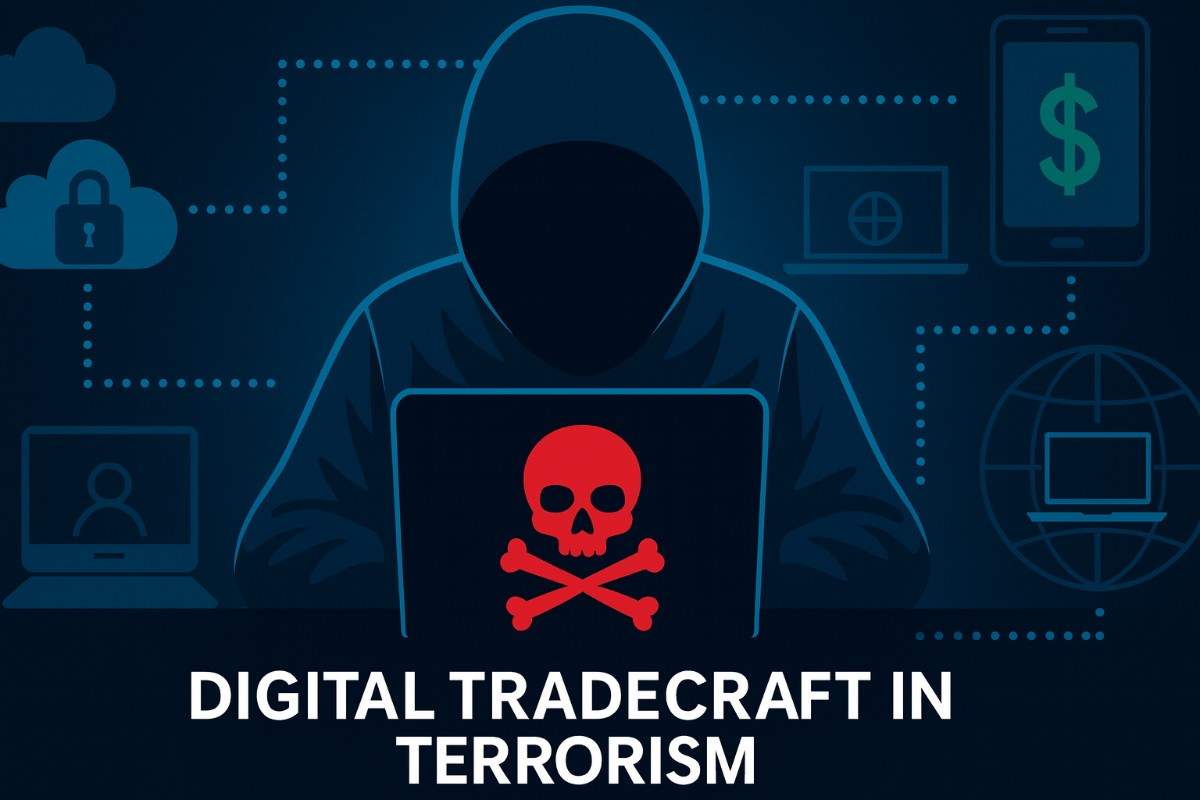
Digital Tradecraft in Terrorism
Digital Tradecraft in Terrorism has emerged as one of the most urgent threats shaping global security today. Extremist groups are no longer relying on traditional tactics; they’re shifting to encrypted clouds, AI-generated identities, darknet logistics, and crypto-based funding channels. This rapid digital evolution has turned terrorism into a borderless, tech-powered challenge that nations must confront head-on. For India, balancing internal vulnerabilities with external pressures, understanding this covert digital ecosystem is now essential. This blog unpacks the threat, the challenges for India’s counter-terror framework, and the global agenda India is driving to secure the digital future.
Why is Digital Tradecraft in Terrorism Making Headlines Today?
Digital Tradecraft in Terrorism has become the hottest talking point in global security circles because terrorism has shifted from dusty training camps to sleek laptops and encrypted phones. The modern extremist doesn’t need to cross borders physically — a stable internet connection and a bit of technical skill are enough to build networks, move money, plan attacks, and radicalize new recruits. This evolution has turned terrorism into a borderless, real-time challenge that governments can’t ignore anymore.
Several global events have pushed this term into the spotlight. From ISIS using advanced online propaganda to recruit across continents, to lone-wolf actors adopting AI-generated playbooks, recent cases have shown how dramatically terror operations have evolved. Groups no longer rely on traditional routes of communication or financing. Instead, they use VPNs, darknet forums, cryptocurrency wallets, burner devices, and cloud-based data vaults to stay invisible while coordinating missions thousands of miles apart. This kind of technological agility makes them harder to track, predict, or neutralize.
Tech itself has become the game-changer. Artificial Intelligence, deepfakes, encrypted messaging apps, and open-source intelligence (OSINT) tools are being weaponized with alarming speed. Terror outfits use AI to automate propaganda, disguise identities, or generate misleading content to stoke communal tensions. Deepfakes can fabricate speeches, create fake calls for violence, or plant disinformation powerful enough to trigger unrest. Even small extremist groups now operate like miniature intelligence agencies because the tools that were once expensive or restricted have become cheap, open-access, and incredibly sophisticated.
Another reason Digital Tradecraft in Terrorism dominates headlines is the rise of “DIY terrorism.” Online tutorials, 3D printing blueprints, and crowd-sourced malware give lone actors unprecedented independence. Instead of depending on an organized network, individuals can self-radicalize, self-train, and self-execute attacks — often without leaving a trail. This makes detection insanely difficult for intelligence agencies, who are already overwhelmed by the volume of digital chatter.
The geopolitical environment also plays a role. Global conflicts, cross-border tensions, and ideological polarization online have created fertile ground for extremist messaging. Social media algorithms amplify outrage, creating echo chambers where radical ideas spread faster than before. Terror groups exploit these digital vulnerabilities to push narratives, recruit sympathizers, and coordinate flash mobilization. Every trending crisis becomes an opportunity for them.
Finally, governments and security agencies are openly acknowledging that the threat has matured. Reports from agencies like Europol, Interpol, NIA, and global cybersecurity organizations consistently warn about the rising sophistication of digital terror strategies. Public disclosures, expert panels at global forums, and policy discussions at platforms like the G20 have pushed the term “Tradecraft in Terrorism” into mainstream attention.
In short, Tradecraft in Terrorism is trending because terrorism has fully transformed into a smart, tech-powered operation. It hides in encrypted channels, moves through invisible currencies, and adapts faster than laws or surveillance systems can keep up. The blend of technology, anonymity, and global reach has turned it into one of the defining security challenges of our time — and ignoring it is simply not an option.
Challenges Posed by Digital Tradecraft in Terrorism to India’s Counter-Terrorism Framework
India’s counter-terrorism machinery has always been built around traditional surveillance, human intelligence networks, and on-ground operations. But Digital Tradecraft in Terrorism has flipped the battlefield from physical to virtual, and that shift brings a whole new set of challenges. Terror groups now operate like tech startups — agile, anonymous, and algorithmically smart — making India’s existing systems struggle to keep up.
The first major challenge is encryption and anonymity. Terror outfits rely heavily on end-to-end encrypted messaging apps, onion-routed browsers, and VPN networks to mask their digital footprints. This makes it extremely difficult for Indian agencies like NIA, IB, and state ATS units to intercept communications. Even when they manage to gain partial access, metadata is limited, and conversations disappear through self-destruct features. Traditional wiretaps and interception orders simply don’t work against such high-grade digital privacy tools.
Another tough hurdle is the darknet ecosystem. A large portion of terror logistics — from weapon manuals to fake documents and crypto-funding channels — now circulates on hidden marketplaces. Accessing these spaces is not only complicated but dangerous, because they’re guarded by sophisticated encryption layers and constantly changing identities. Tracking illegal transactions or identifying vendors becomes a digital cat-and-mouse game that demands far more advanced cyber-forensics capability than most agencies currently possess.
A third challenge lies in AI-powered deception and disinformation. Deepfakes, cloned voices, AI-generated propaganda, and doctored visuals can trigger communal tensions, spark misinformation campaigns, or provide cover to operatives. Detecting and countering such content in real time is incredibly difficult. With social media platforms acting as accelerators, a single fake video can reach millions before authorities can verify, flag, or control the narrative.
Then there’s the issue of lone-wolf and micro-cell radicalization. Online radicalization bypasses physical barriers. Someone sitting alone in a room, consuming extremist content, can self-train using digital manuals and plan an attack without ever contacting a known terror network. This decentralization of terror makes intelligence gathering extremely unpredictable. India’s size, population density, and linguistic diversity make monitoring online radicalization far more complex than in smaller nations.
Another bottleneck is the skill and resource gap. While India has made strong progress in cybersecurity and digital policing, agencies still face issues like outdated software, uneven capacity among state police units, and a shortage of cyber-trained investigators. Terror groups, meanwhile, continually upgrade their digital arsenal using open-source tools, AI labs, and global darknet forums.
The challenge doesn’t stop at technology — legal and jurisdictional constraints matter too. Digital crimes often originate outside India, involve foreign servers, or use international crypto exchanges. Obtaining data through MLATs (Mutual Legal Assistance Treaties) or cooperating with tech companies across jurisdictions is a slow, bureaucratic process. Terror operations, on the other hand, move at the speed of the internet.
Lastly, coordination gaps among agencies create blind spots. While national, state, and specialized forces all collect intelligence, integrating this digital info into a single, real-time system remains a work in progress. Without seamless data sharing, patterns get missed, and small signals slip through the cracks.
In short, Digital Tradecraft in Terrorism has turned terrorism into a hyper-technical, borderless, invisible threat. India’s counter-terrorism system now needs equal parts tech muscle, legal reform, and inter-agency coordination to stay ahead of adversaries who are evolving faster than ever.
What Strategic Measures Can Strengthen India’s Response to Digital Tradecraft in Terrorism?
To counter Digital Tradecraft in Terrorism, India needs to upgrade from traditional counter-terror strategies to a hyper-digital, intelligence-led ecosystem. Terror outfits are using AI, encrypted networks, darknet marketplaces, and anonymous financial channels — and India’s response has to be faster, smarter, and far more integrated than ever before.
The first and most crucial step is strengthening cyber-intelligence capabilities. India must invest aggressively in advanced digital forensics, AI-driven threat analysis, and real-time monitoring tools capable of scanning encrypted chatter, detecting darknet activity, and mapping suspicious crypto transactions. Agencies like NIA, IB, NTRO, and state cyber cells need a unified digital command system that collects, analyzes, and flags threats instantly instead of working in isolated silos.
Next, India needs specialized counter-terror cyber units staffed with ethical hackers, data scientists, OSINT investigators, and AI experts. Terror groups are already operating like decentralized tech hubs; India’s response cannot depend solely on conventional policing. Dedicated cyber-terror labs can trace digital footprints, crack obfuscation techniques, monitor radicalization patterns, and forecast emerging digital threats with far higher accuracy.
A major structural reform India must push is modernized legal frameworks. Many digital terror tools operate outside traditional definitions of crime. Laws need to address encrypted communication, AI-generated deepfakes, cryptocurrency misuse, drone-based attacks, and digital radicalization. India also needs faster data-sharing protocols with global tech platforms. Waiting months for cross-border data under existing treaties is simply not practical when terror plots evolve in minutes.
Regulating and monitoring digital financial flows is another critical measure. Terrorist networks increasingly use crypto wallets, crowdfunding through anonymous platforms, or UPI-based micro-transactions. India must strengthen the Financial Intelligence Unit (FIU), mandate strict KYC on crypto exchanges, and develop blockchain analytics tools to trace money trails. Even a small pattern — like multiple ₹500 transfers spread across apps — can reveal a hidden operational network.
India must also expand AI-based counter-radicalization models. Using machine learning, the government can identify suspicious content clusters, radical forums, or individuals showing high-risk behavior. This doesn’t mean surveillance of ordinary citizens, but targeted tracking of extremist ecosystems where young users are groomed through memes, gaming chats, or encrypted communities. Soft intervention programs — counseling, community engagement, online de-radicalization content — are essential to prevent lone-wolf scenarios.
Another priority is deepfake detection infrastructure. Terror groups already use AI-generated videos to incite communal tensions or impersonate leaders. India needs national-level deepfake scanners integrated with social media platforms to flag such content within seconds. Rapid response matters because misinformation spreads faster than fact-checks.
International cooperation is also non-negotiable. Digital terror tools operate across borders, so India must strengthen intelligence-sharing with Europol, Interpol, FATF, and Indo-Pacific partners. Joint cyber drills, shared watchlists, coordinated takedowns of darknet markets, and global pressure on tech platforms to respond faster to terror-related content can dramatically enhance India’s preparedness.
Finally, capacity building at the grassroots level is essential. Local police stations are often the first to receive digital complaints, yet many lack technical expertise. Mandatory cyber training, updated equipment, and digital SOPs can transform local policing into a frontline defense against online extremism.
In short, India’s strategy must evolve from reactive policing to predictive, tech-led intelligence warfare. Terrorism has gone digital — and India’s counter-terror architecture must do the same, with speed, precision, and long-term vision.
How India is Shaping the Global Agenda Against Digital Tradecraft in Terrorism at the G20
India’s leadership at the G20 has pushed one clear message: global terrorism is no longer just boots, bombs, and borders — it’s algorithms, anonymity, and amplification. And if the world doesn’t treat digital terrorism as a collective threat, no nation is safe. During its G20 presidency, India stepped into the spotlight as the voice urging nations to build a unified, tech-driven, and future-ready security architecture.
One of India’s biggest contributions has been mainstreaming digital public infrastructure (DPI) as a global model for secure, transparent, and accountable digital systems. India’s DPI success — from Aadhaar to UPI — shows how digital platforms can be built at population scale with strong safeguards. At the G20, India pushed for ethical, inclusive, and secure digital governance frameworks capable of reducing vulnerabilities that terror groups exploit. The idea was simple: if countries build secure digital pipes, terrorists will find fewer digital hideouts.
India also took a strong stand on curbing the use of emerging technologies by terrorists, particularly AI-driven deepfakes, autonomous drones, encrypted terror coordination, and crypto-financed operations. By highlighting how these tools are destabilizing regions from the Middle East to South Asia, India placed Tradecraft in Terrorism at the center of global security discussions. This was a crucial shift—most global forums were still talking about old-school terrorism while India insisted on recognizing tech-powered threats.
Another core contribution was India’s push for a global framework on cryptocurrency regulation. Terror outfits increasingly use digital currencies to bypass formal financial systems. India called for unified rules around crypto exchanges, wallet identification, cross-border data access, and traceability standards. This aligns with FATF (Financial Action Task Force) recommendations but gives them political urgency. The aim: remove financial anonymity that fuels terror logistics.
The G20 also became a platform for India to advocate for responsible and secure AI governance. India urged nations to adopt safeguards against AI misuse — from deepfake misinformation to automated terror propaganda. This emphasis on ethical AI wasn’t just theory; India connected it directly to counter-terrorism, making global leaders understand that AI governance is now a security imperative.
A major pillar of India’s G20 agenda was enhanced intelligence cooperation. India encouraged member nations to share real-time digital threat intelligence, including darknet monitoring patterns, crypto-financing networks, and cross-border radicalization indicators. The idea was to create a global early-warning system against digital terror threats, something like a “cyber-Interpol for terrorism.”
India also took the spotlight with initiatives like the G20 Digital Economy Working Group (DEWG). Here, India emphasized the need for secure digital infrastructure, data protection norms, and cross-border data flow governance — all essential for monitoring and preventing digital terror operations. The DEWG’s recommendations reflect India’s belief that digital security must be baked into global economic growth, not treated as an afterthought.
Beyond policy, India projected itself as a bridge between advanced economies and developing nations, sharing scalable solutions like Digital India Stack, cybersecurity frameworks, and counter-terror best practices. This positioned India as not just a critic of digital terrorism, but a provider of workable, real-world solutions.
In essence, India used the G20 platform to shape a new global narrative:
Fight terrorism not only on the ground but in the cloud. Build digital security like public infrastructure. Cooperate globally or stay vulnerable individually.
With this, India established itself as a global leader pushing the world toward a unified digital security agenda — timely, necessary, and forward-looking.
Conclusion: Building a Resilient Security Architecture Against Digital Tradecraft in Terrorism
The rise of Digital Tradecraft in Terrorism has made one thing crystal clear: the battleground of terrorism is no longer limited to physical spaces. It has expanded into encrypted chats, cloud servers, crypto ledgers, and AI-driven misinformation networks. For India — a nation navigating complex internal and external security challenges — this shift demands a complete reimagination of counter-terrorism strategy. A resilient security architecture for the digital age isn’t just a national priority; it’s a global necessity.
Building this resilience begins with acknowledging that traditional approaches alone won’t work. Surveillance, border security, and physical intelligence grids remain essential, but they can’t detect an extremist radicalizing on a gaming chat server or a cell coordinating logistics via darknet marketplaces. India must blend its time-tested strengths with cutting-edge technologies, transforming its counter-terror framework into a hybrid model powered by digital intelligence, predictive analytics, and rapid response capabilities.
Equally important is India’s focus on institutional modernization. Agencies must be equipped with AI-based analytical tools, cyber-trained personnel, and advanced forensic systems capable of detecting patterns across millions of data points. A future-ready security architecture needs seamless coordination — between central agencies, state units, and international partners. Intelligence cannot operate in silos when terrorism operates without borders. Breaking bureaucratic walls and building integrated digital command structures is the only way forward.
But technology alone won’t fix the problem. Resilience also requires legal and regulatory frameworks that keep pace with innovation. Terror outfits exploit loopholes — anonymous crypto channels, foreign-hosted servers, AI-generated identities — using the speed of the internet to outrun outdated laws. India’s reforms must cover data access, encrypted platforms, synthetic media, drone misuse, and digital finance. At the same time, these regulations must balance security needs with individual rights, ensuring accountability without overreach.
Social resilience is another pillar. Digital terror tradecraft thrives on misinformation, polarization, and the manipulation of public emotions. Strengthening digital literacy, promoting fact-checking ecosystems, and empowering citizens to identify suspicious content can significantly reduce the impact of extremist messaging. A vigilant society is one of the strongest defenses against digital radicalization.
On the global stage, India’s leadership at the G20 showed that collective action is the only durable solution. Digital threats transcend borders; no single nation can tackle them alone. India has pushed for global crypto regulation, ethical AI governance, cross-border intelligence sharing, and secure digital public infrastructure. The future of counter-terrorism lies in strategic partnerships — from tech companies to governments — working together to eliminate digital safe havens and identify threats before they escalate.
Ultimately, building a resilient security architecture isn’t a one-time project; it’s a continuous, evolving mission. Terror outfits adapt rapidly, and India must stay several steps ahead. This demands political will, technological innovation, global cooperation, and a security mindset rooted in both tradition and transformation.
The digital age brings new vulnerabilities, but it also offers new strengths. With the right strategies, India can not only safeguard its borders and citizens but also shape the global fight against digital terrorism — leading with vision, capability, and unwavering resolve.
About The Author