

Table of Contents
Mamata Banerjee vs Central Agencies is no longer a regional political clash—it is a defining stress test for Indian democracy in an era of hyper-centralization, aggressive enforcement, and data-driven politics. The events detailed in the file echo today’s national debates on misuse of investigative bodies, erosion of institutional neutrality, and the fine line between accountability and intimidation. As India steps into 2026 with AI-powered political campaigns, digital evidence wars, and election-heavy calendars, this confrontation mirrors a global pattern where governments weaponize compliance, law, and surveillance. History teaches us one thing: when institutions bend, democracies don’t break immediately—they slowly corrode.
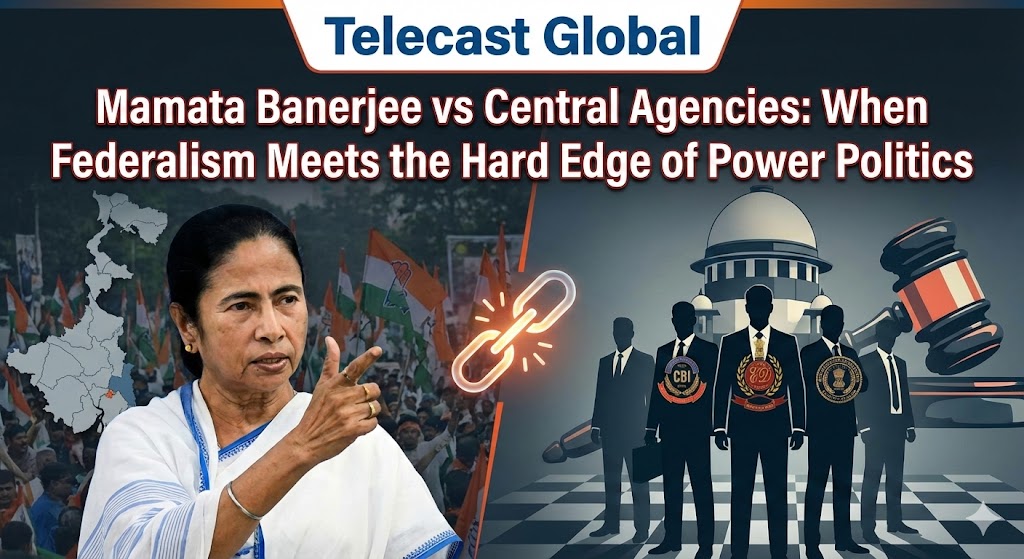
Mamata Banerjee vs Central Agencies and the Crisis of Cooperative Federalism
The clash framed as Mamata Banerjee vs Central Agencies is, at its core, a serious rupture in India’s idea of cooperative federalism—a principle that once balanced power between the Union and the states through mutual respect, not muscle-flexing. Federalism in India was never meant to be a tug-of-war; it was designed as a negotiated partnership. What we are witnessing now is that partnership fraying in public view.
When a sitting Chief Minister like Mamata Banerjee openly confronts institutions such as the Enforcement Directorate and the Central Bureau of Investigation, the issue goes beyond personalities. Mamata Banerjee vs Central Agencies reflects a deeper anxiety among opposition-ruled states: that central investigative bodies are no longer neutral referees, but active players in political contests.
Traditionally, cooperative federalism relied on restraint. The Centre held extraordinary powers, but used them sparingly. States, in turn, accepted oversight without assuming political vendetta. That unwritten code has weakened. In the current climate, raids, summons, and chargesheets often coincide with elections, policy resistance, or outspoken dissent. In this context, Mamata Banerjee vs Central Agencies becomes a case study in how enforcement can be perceived as coercion, whether or not courts eventually uphold the actions.
What makes this confrontation especially consequential is its timing. India is entering a phase where governance is increasingly centralized—taxation through GST, welfare delivery via national databases, and law enforcement through federal agencies with sweeping jurisdiction. States like West Bengal see this as an erosion of autonomy. Supporters of the Centre argue it ensures uniform accountability. The truth, as always, lies uncomfortably in between.
The crisis sharpens when constitutional morality is replaced by political optics. When state governments accuse agencies of overreach and agencies accuse state leadership of obstruction, institutions lose credibility on both sides. Citizens stop seeing law as impartial and start seeing it as tactical. This is the real danger of Mamata Banerjee vs Central Agencies—not who wins a court battle, but who loses public trust.
Historically, India has survived Centre–State tensions before: from the 1970s to the coalition era of the 1990s. What’s different now is scale and speed. Media amplification, digital leaks, and real-time political messaging turn every raid into a referendum on democracy itself. Federalism, once a slow-burning constitutional principle, is now debated like breaking news.
Looking ahead to 2026, this pattern is unlikely to fade. More states will push back. More agencies will assert authority. Unless boundaries are redefined—through judicial clarity, legislative reform, or political maturity—Mamata Banerjee vs Central Agencies will not remain an exception. It will become the template.
And that’s the uncomfortable truth: cooperative federalism doesn’t collapse overnight. It erodes one confrontation at a time.
From Coal Scam to Courtroom Chaos: How Enforcement Actions Shape Political Narratives
The story of Mamata Banerjee vs Central Agencies shows how enforcement actions no longer remain confined to investigation files—they rapidly transform into political weapons and mass narratives. What begins as a financial probe, like the coal smuggling and money-laundering allegations in West Bengal, quickly spills into rallies, courtrooms, prime-time debates, and election speeches. In today’s India, law enforcement doesn’t just investigate crimes; it shapes political reality.
At the heart of this escalation lies the coal scam narrative. Allegations of illegal mining, cash hoards, and hawala routes are serious by any standard. But in the framework of Mamata Banerjee vs Central Agencies, the timing and visibility of raids matter as much as the substance. Raids on politically connected consultants, IT strategists, or ministers are instantly framed by ruling parties as “accountability,” while opposition leaders label them “vendetta.” Facts get buried under framing.
This is where enforcement actions redefine politics. Agencies like the Enforcement Directorate operate under legal mandates, yet their actions unfold in an intensely political ecosystem. When raids occur close to elections or during protests, the perception hardens that investigations are not neutral processes but strategic signals. In the ongoing Mamata Banerjee vs Central Agencies conflict, every seizure becomes a headline, and every court filing becomes ammunition.
Courtrooms, traditionally places of quiet adjudication, now resemble extensions of political battlegrounds. The chaos witnessed during hearings—overcrowding, heated arguments, adjournments—feeds public skepticism. Supporters of Mamata Banerjee see obstruction as resistance against central overreach. Critics see it as evasion. Either way, enforcement actions stop being legal events and start becoming symbolic acts.
Narrative control is everything. When agencies allege thousands of crores in illicit funds, the numbers dominate discourse long before judicial verification. When political leaders counter with claims of planted evidence or selective targeting, those claims travel just as fast. In Mamata Banerjee vs Central Agencies, truth competes with perception, and perception often wins in the short term.
This pattern isn’t unique to West Bengal. Across India—and globally—governments increasingly use investigations to define opponents before verdicts arrive. The damage, however, is institutional. If agencies are seen as tools, their legitimate cases weaken. If politicians treat every probe as persecution, accountability erodes. The coal scam episode illustrates this perfectly: the alleged crime matters, but the political story matters more.
By 2026, enforcement-driven narratives will only intensify. Data leaks, digital evidence, and instant media amplification mean investigations will continue to double as political messaging. The lesson from Mamata Banerjee vs Central Agencies is blunt but necessary: when law enforcement becomes storytelling, democracy pays the price—even before the court delivers its judgment.
Investigative Agencies in the Age of Elections, Data, and Digital Evidence
The confrontation framed as Mamata Banerjee vs Central Agencies cannot be understood through old-school politics alone. This is a new-age conflict unfolding in an era where elections are data-driven, evidence is digital, and investigations move at the speed of headlines. Investigative agencies are no longer operating in silence; they are working inside a hyper-connected political ecosystem where every byte of data carries electoral consequences.
In earlier decades, probes relied on paper trails, witnesses, and time-consuming audits. Today, enforcement bodies deal with hard drives, cloud backups, encrypted messaging apps, and digital money flows. In the Mamata Banerjee vs Central Agencies episode, allegations of seized electronic devices, data access disputes, and digital evidence interference highlight how investigations themselves have become technologically sensitive—and politically explosive.
This matters because elections today are powered by data. Political parties depend on voter databases, campaign analytics, and micro-targeting tools. When investigative agencies raid firms or individuals linked to political strategy, the action is perceived not merely as law enforcement but as disruption of electoral machinery. In Mamata Banerjee vs Central Agencies, the overlap between political consulting, digital infrastructure, and enforcement action fuels accusations of institutional overreach, regardless of legal intent.
Agencies such as the Enforcement Directorate and Central Bureau of Investigation now wield extraordinary digital power. Access to emails, financial logs, call records, and encrypted files can redraw political narratives overnight. Yet this power comes with a credibility burden. In the age of social media trials, even lawful digital seizures can look suspect if transparency and timing are questioned. That tension defines Mamata Banerjee vs Central Agencies.
Elections amplify everything. A raid during a non-election year may pass quietly. The same action months before voting becomes a political earthquake. Leaders like Mamata Banerjee understand this dynamic well, which is why enforcement actions are framed as attacks on democracy rather than compliance checks. The agencies, on the other hand, argue that criminal timelines don’t pause for electoral calendars. This clash of logic sits at the heart of Mamata Banerjee vs Central Agencies.
Digital evidence also introduces new risks: selective leaks, partial narratives, and premature conclusions. A chargesheet summary, a leaked number, or a claim of seized data can dominate discourse long before courts examine authenticity. Once public opinion hardens, reversals rarely matter. This is the uncomfortable reality of Mamata Banerjee vs Central Agencies—the verdict of social media often arrives before the verdict of law.
Looking toward 2026, investigative agencies will operate under even greater scrutiny. Artificial intelligence, predictive analytics, and centralized data systems will make investigations faster—but also more controversial. Without clear safeguards, digital enforcement may deepen mistrust rather than restore confidence.
The lesson is blunt: in the age of elections, data, and digital evidence, power must be matched with restraint. Otherwise, Mamata Banerjee vs Central Agencies will not remain a political episode—it will become a warning sign for India’s democratic future.
Governors, Threats, and Security: When Constitutional Offices Become Flashpoints
The episode of threats against a sitting Governor adds a chilling layer to Mamata Banerjee vs Central Agencies, pushing the conflict beyond politics into the realm of constitutional stability and public security. Governors were meant to be neutral bridges between the Union and the states—quiet custodians of the Constitution, not lightning rods for political storms. Yet in today’s polarized climate, even these offices are being dragged into the crossfire.
When C V Ananda Bose received a death threat, it wasn’t just a law-and-order issue. It symbolized how deeply mistrust has seeped into India’s federal architecture. In the narrative of Mamata Banerjee vs Central Agencies, the Governor’s office becomes a proxy battlefield—scrutinized, politicized, and securitized. Supporters of the state government view gubernatorial interventions as Centre-backed pressure tactics. Critics see the Governor as one of the last constitutional checks on state power. Either way, neutrality gets questioned.
Security escalation tells its own story. Enhanced protection involving state police and central forces like the Central Reserve Police Force signals that constitutional roles now carry physical risk. This is unprecedented in spirit, if not in fact. The old assumption—that constitutional dignity provides insulation from political violence—no longer holds. In the era defined by Mamata Banerjee vs Central Agencies, symbolism attracts threat vectors.
The real concern is precedent. If Governors are perceived as political actors—whether fairly or not—public anger can target institutions rather than individuals. That erodes respect for the office itself. Historically, Governors were criticized for partisanship, yes, but rarely were they central characters in high-voltage confrontations involving raids, courts, and security alerts. Mamata Banerjee vs Central Agencies changes that calculus by collapsing institutional boundaries into one combustible narrative.
This also warps accountability. When threats emerge, immediate questions follow: Was it provoked? Was it exploited? Was it politicized? Each side accuses the other of leveraging fear for narrative advantage. Meanwhile, the essential issue—protecting constitutional functionaries so they can perform their duties without intimidation—gets lost. In such a climate, governance suffers, and so does the rule of law.
Zoom out, and the pattern is worrying. Across federations worldwide, constitutional offices are under stress as polarization rises. India is not immune. As elections approach, offices meant to calm tempers instead amplify them. Mamata Banerjee vs Central Agencies illustrates how quickly administrative friction can morph into security crises when trust collapses.
Looking toward 2026, this trend may intensify. Governors will be asked to arbitrate disputes in an environment where every decision is instantly politicized. Investigative agencies will operate under the shadow of perceived bias. And security arrangements will become permanent, not exceptional. That’s a steep price for a democracy built on conventions rather than coercion.
The blunt truth is this: when constitutional offices require barricades to function, something fundamental has shifted. Mamata Banerjee vs Central Agencies isn’t just a political saga—it’s a warning that India must either restore institutional restraint or get used to governing under siege.
Why Mamata Banerjee vs Central Agencies Signals What 2026 Politics Will Look Like
If there is one political storyline that clearly previews India’s near future, it is Mamata Banerjee vs Central Agencies. This confrontation is not an isolated clash driven by personality or province; it is a blueprint for how power, resistance, and institutions will collide as India approaches the decisive political cycle of 2026. Strip away the rhetoric, and what remains is a raw contest over who controls the narrative of legitimacy.
The first signal is normalization. What once felt extraordinary—raids, counter-allegations, constitutional confrontations—is now routine. Mamata Banerjee vs Central Agencies shows that investigative actions have become a permanent feature of political competition, not an exception. By 2026, voters will no longer ask whether agencies are involved in politics, but which side benefits more. That shift alone changes democratic behavior.
Second, opposition politics is evolving from accommodation to confrontation. Leaders like Mamata Banerjee are no longer playing defensive silence. They are openly challenging the legitimacy of central institutions, rallying public opinion, and framing resistance as democratic duty. In Mamata Banerjee vs Central Agencies, defiance itself becomes political capital. Expect more chief ministers to adopt this posture by 2026, especially in non-BJP-ruled states.
Third, institutions will increasingly operate under narrative pressure. Agencies such as the Enforcement Directorate and Central Bureau of Investigation may continue to function within legal boundaries, but public trust will hinge on perception, not procedure. Mamata Banerjee vs Central Agencies proves that even lawful action can appear suspect in a polarized environment. By 2026, credibility—not authority—will be the scarcest institutional resource.
Another clear signal is electoral weaponization of governance. Raids, court cases, and constitutional disputes are now campaign material. Supporters view them as proof of strength; opponents see persecution. In Mamata Banerjee vs Central Agencies, governance failures, enforcement actions, and security incidents merge into a single political storyline. This fusion will define 2026 elections, where governance will be judged less by outcomes and more by confrontation optics.
The fifth and most serious signal is democratic fatigue. Constant crisis dulls public sensitivity. When every week brings another clash, citizens disengage or retreat into partisan camps. Mamata Banerjee vs Central Agencies highlights how prolonged institutional conflict risks normalizing instability. Democracies don’t collapse loudly; they erode quietly, one accepted “new normal” at a time.
Looking ahead, 2026 politics will be sharper, noisier, and more centralized—but also more resistant. States will push back harder. Agencies will act more assertively. Courts will be dragged deeper into political resolution. The lines between law, politics, and perception will blur further.
The blunt takeaway is this: Mamata Banerjee vs Central Agencies is not about West Bengal alone. It is a rehearsal. What India tolerates here—politically, institutionally, morally—is what it will inherit in 2026. And history has always been clear on one point: democracies survive not on power, but on restraint.
About The Author










Leave a Reply