

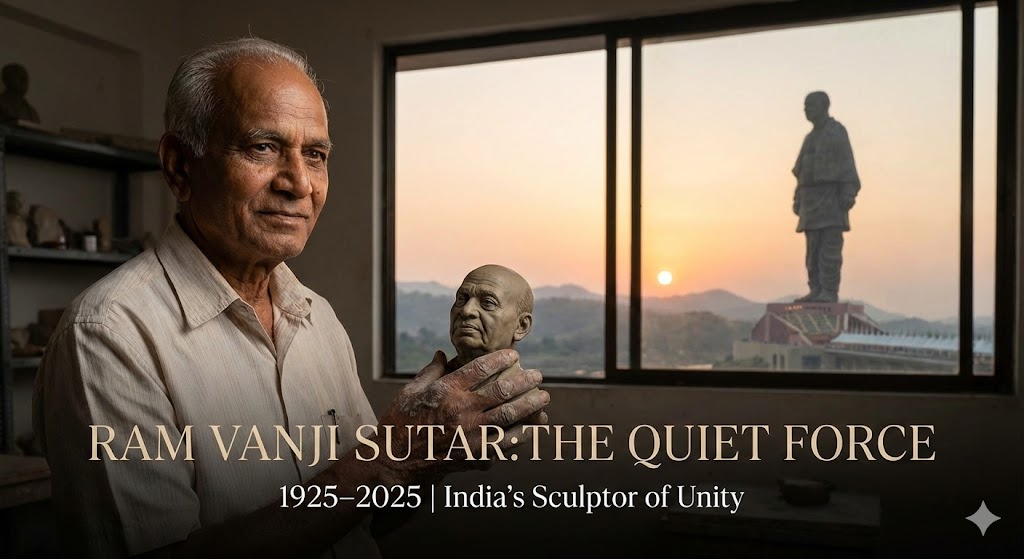
India lost more than a legendary sculptor on December 18, 2025—we lost a quiet force who literally carved our collective memory into stone and bronze. Ram Vanji Sutar, the mind behind the world-famous Statue of Unity, passed away at 100, leaving behind a skyline full of history. From humble beginnings in Maharashtra to designing the tallest statue on Earth, Sutar’s journey is peak old-school grit—no hype, just hard work. His monuments weren’t just art; they were statements of unity, dignity, and national pride. Real legacy stuff. Timeless. Solid. Unmissable.
Early Life to Art School: How a Village Boy Became a National Sculptor
Every legend has an origin story, and Ram Vanji Sutar’s begins far away from galleries, grants, and grand monuments—in the quiet village of Gondur in Maharashtra’s Dhule district. Born on February 19, 1925, into a modest family with no artistic lineage, Sutar didn’t inherit art; he discovered it the old-fashioned way—through instinct, curiosity, and relentless practice. No fancy tools, no mentors at home. Just raw talent and a stubborn love for shaping clay.
As a child, Sutar was drawn to the textures of mud and earth, often molding small figures with his hands. While other kids played, he created. And that’s the first real takeaway here: greatness doesn’t always announce itself loudly. Sometimes it’s just a kid quietly obsessed with making forms come alive. In rural India of the 1930s, pursuing art wasn’t exactly a “safe career option.” But Sutar didn’t care. Passion > practicality. Always.
His turning point came when his talent was noticed by local patrons and teachers, who encouraged him to seek formal training. That decision—to leave his village and step into the intimidating world of institutional art—changed everything. He moved to Mumbai and enrolled at the legendary Sir J.J. School of Art, a place that has shaped generations of India’s finest artists. For a village boy with limited means, this wasn’t just a college admission; it was entry into another universe.
At Sir J.J. School of Art, Sutar trained rigorously in sculpture and modeling. This wasn’t some casual, vibes-only art scene. It was discipline, anatomy studies, material science, and hours of hands-on work with bronze, stone, and metal. Here, his natural talent met technical mastery. And the results? Clean lines, realistic expressions, and a deep understanding of form—traits that would later define his monumental style.
What really set Sutar apart during his student years was his respect for tradition. While modern art movements were gaining traction, he stayed rooted in realism. He believed sculpture should communicate clearly with people—not confuse them. That mindset made him stand out, and it paid off big time. He graduated with a gold medal, a clear signal that this wasn’t just talent—it was excellence.
This phase of his life is important because it explains why Sutar’s later works resonated so deeply with the public. He wasn’t sculpting for elite circles; he was sculpting for India. His village upbringing gave him grounding, and his art school training gave him precision. Old roots, new skills—a lethal combination.
From Gondur’s clay to Mumbai’s studios, Ram Vanji Sutar’s early journey proves one thing loud and clear: you don’t need privilege to create history. You need vision, discipline, and the guts to chase what feels right—even when the world doesn’t get it yet.
Sculpting the Nation: Sutar’s Philosophy of Public Art and Identity
For Ram Vanji Sutar, sculpture was never just about beauty. It was about belonging. He didn’t believe art should sit quietly inside museums, whispering to elites. His thinking was old-school and unapologetic: public art should stand tall in open spaces, speak clearly to ordinary people, and remind a nation who it is and where it comes from. No confusion. No pretension. Straight talk—in bronze and stone.
Sutar’s philosophy was rooted in realism, and that was a conscious choice. At a time when abstract and experimental art was gaining global traction, he stayed grounded. Why? Because India is a lived civilization, not an abstract idea. Farmers, workers, freedom fighters, reformers—real people shaped the country, so real forms should represent them. His sculptures don’t need explanation placards. One look, and the message lands. That clarity became his signature.
He believed monuments were tools of national memory. According to Sutar, when citizens walk past a statue every day—on the way to work, school, or protest—it quietly shapes collective consciousness. A statue isn’t decoration; it’s a daily reminder of values. Unity. Discipline. Justice. Sacrifice. That’s why his figures aren’t dramatic or exaggerated. They’re calm, composed, and dignified. Power without noise. Confidence without arrogance.
Another core element of his philosophy was accessibility. Sutar wanted his art to feel familiar, not distant. Whether it was Mahatma Gandhi seated in meditation or Sardar Patel striding forward, his figures feel human. You can imagine them breathing. That emotional proximity is intentional. He once emphasized that public art must invite connection, not intimidation. Big scale, yes—but with warmth. That balance is rare and incredibly hard to pull off.
Sutar also saw sculpture as a nation-building exercise. Post-independence India was still figuring out its identity—diverse, complex, occasionally chaotic. His monuments acted like anchors in that uncertainty. They told people: this is who we respect, this is what we stand for. From unity between states to constitutional values, his work translated political and social ideals into physical form. No speeches required.
Importantly, Sutar respected history without being trapped by it. He studied ancient Indian sculpture deeply—Ajanta, Ellora, temple traditions—but didn’t copy them blindly. Instead, he absorbed their discipline and adapted it to modern materials and scales. That’s the sweet spot: tradition with relevance. Forward-looking, but rooted. Gen Z would call it “heritage with purpose.”
At the heart of Sutar’s philosophy was responsibility. He understood that when you’re sculpting figures that represent a nation, mistakes aren’t personal—they’re public. That’s why he obsessed over posture, gaze, proportion, and expression. Every angle mattered. Every fold of clothing carried meaning. This wasn’t art-for-art’s-sake. This was art-for-India’s-sake.
In short, Ram Vanji Sutar didn’t just sculpt statues—he sculpted identity. His work reminds us that nations aren’t built only by policies and borders, but by shared symbols that quietly hold people together. Solid, silent, and standing tall—just like his legacy.
Icons in Bronze: Gandhi, Ambedkar, Bose, and the Faces of Modern India
If Ram Vanji Sutar’s philosophy explained why public art matters, his statues of India’s greatest leaders showed how it should be done. Through bronze and scale, Ram Vanji Sutar gave physical form to the moral, political, and constitutional pillars of modern India. His sculptures of Mahatma Gandhi, B. R. Ambedkar, and Subhas Chandra Bose are not just likenesses—they are visual ideologies.
Sutar’s Gandhi is perhaps his most quietly powerful work. Unlike dramatic, walking depictions, his most famous Gandhi statue—installed in the Parliament complex in New Delhi—shows the Mahatma seated, calm, and contemplative. This choice was deliberate. Gandhi’s strength was never physical dominance; it was moral authority. The relaxed posture, the gentle expression, and the meditative stillness reflect restraint, self-discipline, and inner resolve. No theatrics. Just truth. In a noisy political world, this Gandhi sits silently—and still commands attention.
Then comes Ambedkar, a completely different energy. Sutar understood that Ambedkar represented assertion, intellect, and constitutional justice. His Ambedkar statues—installed across India from the 1990s onward—often show him standing upright, holding the Constitution close to his chest. The posture is firm, the gaze forward-facing. These statues don’t ask for approval; they demand recognition. Sutar captured Ambedkar not as a victim of history, but as its architect. For millions, these statues became symbols of dignity, empowerment, and self-respect—especially in public spaces where representation truly matters.
With Subhas Chandra Bose, Sutar shifted tone again. The Bose statue in New Delhi depicts him in military attire, standing tall and resolute. This is leadership forged in discipline and sacrifice. The sharp lines, controlled aggression, and commanding stance communicate urgency and courage. There’s no softness here—and that’s the point. Sutar respected the fact that India’s freedom struggle had multiple paths, and Bose’s path was bold, confrontational, and fearless. The sculpture reflects that without apology.
What ties all these works together is Sutar’s refusal to over-romanticize. He didn’t mythologize these leaders into unreachable gods. He humanized them while preserving their authority. That balance—human scale with monumental impact—is insanely hard to achieve, and Sutar nailed it repeatedly.
These bronze icons now stand across cities, campuses, courts, and public squares, shaping how generations visualize leadership and values. People may not know the sculptor’s name, but they recognize the posture, the presence, the feeling. That’s real influence.
Through Gandhi, Ambedkar, and Bose, Ram Vanji Sutar didn’t just immortalize individuals—he mapped the moral geography of modern India. Peace, justice, courage. Different paths. One nation.
Statue of Unity: Engineering, Symbolism, and Global Impact
The Statue of Unity is not just the tallest statue in the world—it’s the loudest silent statement India has ever made. Designed by Ram Vanji Sutar, this 182-metre colossus dedicated to Sardar Vallabhbhai Patel stands as a fusion of art, engineering, and national intent. This wasn’t about breaking records for flex value. This was about scale matching legacy.
From an engineering standpoint, the Statue of Unity is straight-up insane—in the best way. Built on Sadhu Bet island in the Narmada River, the structure uses a reinforced concrete core, a steel framework, and bronze cladding. It’s designed to withstand earthquakes up to 6.5 on the Richter scale and wind speeds of 180 km/h. Translation: this thing isn’t going anywhere. Much like Patel’s vision of India—firm, unshakeable, united.
Inside the statue, a high-speed elevator takes visitors up to an observation deck at 153 metres. From there, you get a panoramic view of the Sardar Sarovar Dam, the Narmada Valley, and the surrounding landscape. Nearly 200 people can stand there at once, literally inside a national symbol, looking out at the country it represents. That’s not accidental design—that’s narrative architecture.
But the real genius lies in the symbolism. Sutar chose a walking pose for Patel, not a static or heroic stance. This Patel is mid-stride—calm, focused, forward-moving. It subtly communicates leadership through action, not drama. No raised fists. No exaggerated gestures. Just quiet determination. Classic Sutar philosophy: power without noise.
Even the facial expression was refined using thousands of photographs and historical references. The folds of clothing, the posture of the shoulders, the tilt of the head—everything was calibrated to reflect Patel’s personality. This wasn’t artistic imagination running wild. This was disciplined realism at a monumental scale.
Globally, the impact was immediate. When inaugurated on October 31, 2018—Patel’s birth anniversary—the statue overtook China’s Spring Temple Buddha to become the tallest in the world. International media took notice. Suddenly, India wasn’t just exporting IT professionals and yoga—it was exporting civilizational confidence. The message was clear: India remembers its leaders, invests in symbolism, and isn’t afraid to think big.
Tourism followed, but more importantly, so did conversation. The Statue of Unity sparked debates about history, representation, public art, and national priorities. Love it or critique it—nobody ignored it. And that’s exactly what impactful public art is supposed to do.
For Ram Vanji Sutar, this was the peak of a lifetime dedicated to public sculpture. For India, it was a declaration: unity is not abstract—it can be seen, touched, entered, and remembered.
A statue this tall doesn’t just dominate the skyline. It anchors identity.
Legacy Beyond Stone: Awards, Influence, and the Future of Indian Sculpture
When people talk about legacy, they usually mean awards, titles, and applause. Ram Vanji Sutar had all of that—but his real legacy goes way deeper. It lives in roundabouts, river islands, parliament lawns, and public squares where people pass by his work daily without even realizing how much it shapes their sense of nationhood. That’s elite impact. Silent. Permanent.
Let’s get the honors out of the way—because they matter, but they weren’t the point for him. Sutar received the Padma Shri in 1999 and the Padma Bhushan in 2016, two of India’s highest civilian awards. In 2025, he was also conferred the Maharashtra Bhushan, the state’s top honor. These awards didn’t make him great; they simply caught up to what the public already knew. By then, his work was already taller than medals—literally.
Influence-wise, Sutar created a blueprint for Indian monumental sculpture. Before him, large public statues in India were often inconsistent in quality or symbolism. After him, realism, historical accuracy, and emotional restraint became the gold standard. He proved that scale doesn’t have to mean exaggeration, and nationalism doesn’t need chest-thumping. His work taught a whole generation of sculptors that dignity is more powerful than drama.
One of the most underrated aspects of his legacy is mentorship—especially through collaboration with his son, Anil Ram Sutar. This wasn’t just a family thing; it was continuity. Knowledge passed down the old way: through work, observation, and discipline. No shortcuts. No ego. That’s how traditions survive in a modern world.
Even in his later years, Sutar stayed creatively relevant. The Statue of Equality, conceptualized by him and inaugurated in 2022, shows that his vision wasn’t frozen in the past. A 216-foot statue dedicated to Saint Ramanujacharya, it symbolized equality, harmony, and spiritual unity—ideas that feel even more urgent today. The message was clear: monumental art doesn’t belong to one ideology or era. It belongs to values.
Looking ahead, Sutar’s influence sets a challenge for the future of Indian sculpture. The bar is high now. You can’t just build big—you have to build meaningfully. Future artists will have to balance technology with tradition, ambition with responsibility. And thanks to Sutar, they at least know what “good” looks like.
As India urbanizes faster than ever, public spaces will multiply—and with them, opportunities for public art. The question is whether upcoming sculptors will chase virality or value. Ram Vanji Sutar’s life gives a clear answer: value lasts longer.
In the end, his greatest achievement isn’t the Statue of Unity or any single monument. It’s the fact that he made sculpture a part of everyday Indian life. Solid. Familiar. Enduring.
Stone fades slower than memory—but Sutar managed to secure both.
Why Ram Vanji Sutar Still Matters: Public Art in a Rapidly Changing India
Even after his passing, Ram Vanji Sutar remains deeply relevant—and honestly, maybe more relevant than ever. India today is changing at breakneck speed. Cities are expanding, skylines are rising, and public spaces are getting redesigned almost overnight. In this rush, public art often becomes an afterthought—something decorative, trendy, or Instagram-friendly. Sutar’s life and work stand as a quiet warning against that mindset.
For Sutar, public sculpture was never filler. It was foundation. He believed that what a nation places in its public spaces reveals its priorities. Statues, according to him, weren’t about showing off wealth or technology; they were about preserving memory in a form that outlives political cycles and social media trends. That belief hits hard today, when attention spans are short but consequences are long.
One of the biggest lessons Sutar leaves behind is patience. His monuments took years—sometimes decades—from concept to completion. Research, historical accuracy, structural testing, artistic refinement—nothing was rushed. In today’s culture of “launch fast, fix later,” that approach feels almost rebellious. But the durability of his work proves the point: shortcuts fade, craftsmanship survives.
There’s also the question of representation. Sutar was deeply conscious of who gets immortalized in public spaces and how. His statues didn’t glorify power for power’s sake. They emphasized service, responsibility, intellect, and unity. In an era where public narratives are increasingly polarized, his balanced, dignified portrayals feel grounding. They don’t provoke outrage—they provoke reflection.
From an urban planning perspective, Sutar’s work shows how art can anchor cities emotionally. Landmarks like the Statue of Unity or Ambedkar statues don’t just attract tourists; they create shared reference points. They become places where people gather, protest, celebrate, and remember. That social function of sculpture is often ignored today, but Sutar treated it as essential.
His relevance also extends to young artists and designers. Sutar’s career proves that you don’t need to abandon tradition to be modern. You don’t need to mimic the West to be global. His work was unapologetically Indian in subject, technique, and philosophy—yet it earned global recognition. That’s a powerful lesson for creators navigating identity in a globalized world.
Finally, Sutar matters because he reminds us that permanence still has value. In a digital age obsessed with temporary trends, his statues insist on staying. They weather storms, politics, criticism, and time itself. They ask future generations to slow down, look up, and remember.
India will continue to build taller buildings and faster infrastructure. But whether it builds meaning along the way depends on whether it remembers artists like Ram Vanji Sutar—not just as a sculptor of statues, but as a sculptor of national conscience.
About The Author












Leave a Reply