

Table of Contents
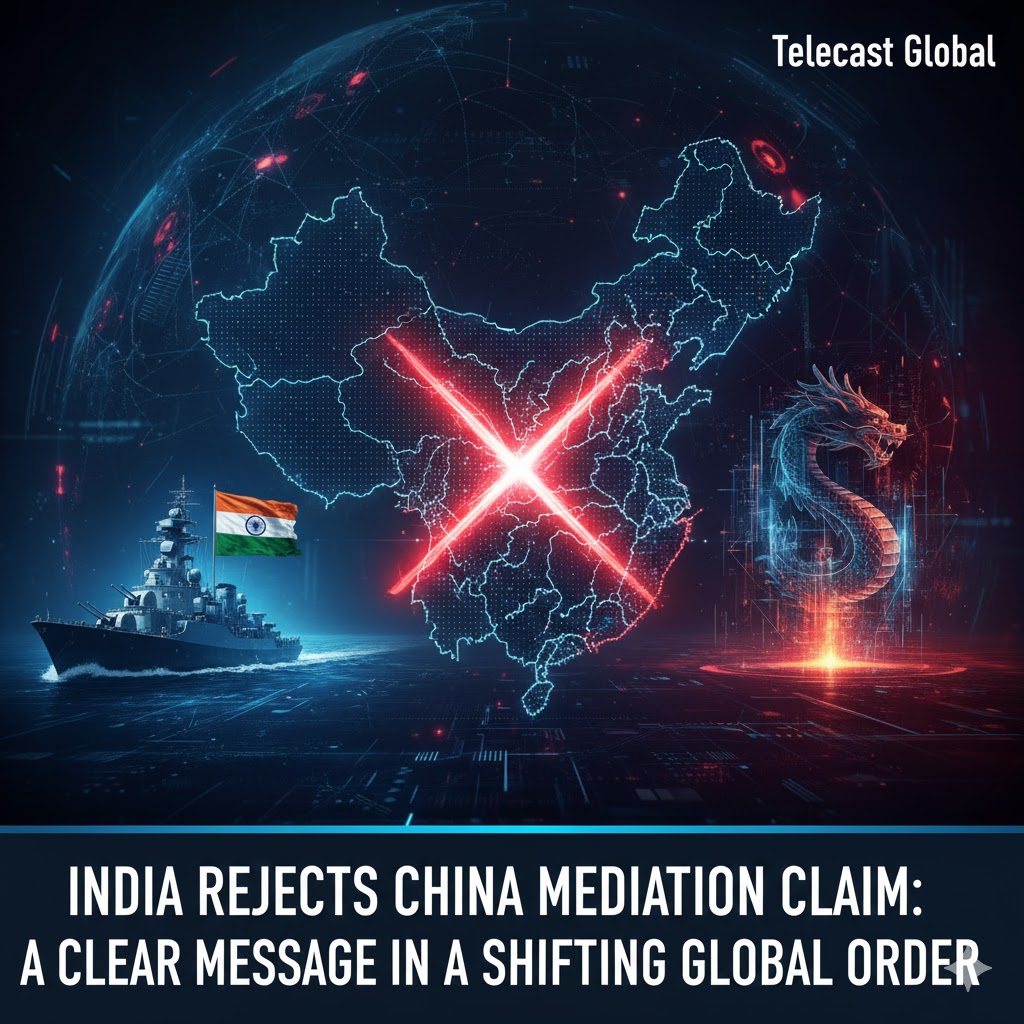
When India rejects China mediation claim, it is not merely rebutting a diplomatic statement—it is reinforcing a decades-old strategic doctrine in a rapidly changing world. As global power centers realign in 2025, India’s firm rejection of third-party involvement in India–Pakistan matters reflects its evolving role as a confident, self-directed power. The clarification following the May 2025 military escalation and Operation Sindoor highlights New Delhi’s insistence on bilateral resolution, even as Beijing seeks greater diplomatic visibility amid global conflicts. This moment connects regional security, great-power competition, and the future of Asian diplomacy into one decisive narrative.
Why India Rejects China Mediation Claim: The Doctrine of Bilateralism Explained
When India rejects China mediation claim, it is not reacting emotionally or impulsively—it is acting from a deeply entrenched foreign policy doctrine that has guided New Delhi for decades: bilateralism. This principle is simple, old-school, and unapologetically firm—issues between two countries must be resolved only by the two countries involved, without outside interference. In 2025, as global diplomacy becomes louder, messier, and more performative, India’s clarity stands out.
At the heart of why India rejects China mediation claim lies the Shimla Agreement (1972) and later reaffirmations, which clearly establish that disputes between India and Pakistan will be handled bilaterally. This is not a technicality—it is a red line. Any third-party mediation, whether from China, the US, or anyone else, directly violates this foundational understanding. India’s position has remained consistent regardless of which government is in power, proving this is institutional policy, not political theatre.
The 2025 context makes this even more significant. Following the May military escalation and Operation Sindoor, China publicly echoed claims of having acted as a peace broker. India’s swift rebuttal was deliberate. When India rejects China mediation claim, it is also rejecting Beijing’s attempt to project itself as a global peacemaker while simultaneously supporting Pakistan militarily. You can’t sell weapons on one hand and claim moral mediation on the other—New Delhi called that bluff, politely but firmly.
Another reason India rejects China mediation claim is strategic signalling. Accepting mediation—even symbolically—would internationalize the Kashmir and India–Pakistan issue, something India has consistently avoided. Once a dispute is internationalized, it becomes vulnerable to pressure, narrative manipulation, and power politics. India has learned this lesson the hard way in the past and has no intention of repeating it in 2025’s far more complex geopolitical environment.
There’s also a credibility angle. The ceasefire was finalized through DGMO-to-DGMO communication, with precise timings and terms mutually agreed upon. When India rejects China mediation claim, it is defending factual accuracy, not just policy. Allowing false narratives to stand would weaken India’s diplomatic credibility globally—and credibility, once diluted, is hard to regain.
Importantly, this stance reflects India’s growing confidence. A weaker nation seeks mediators; a confident one enforces frameworks. When India rejects China mediation claim, it is asserting that it has both the military capability and diplomatic maturity to manage its neighborhood without supervision. This is India signaling its arrival as a rule-setter, not a rule-taker.
Finally, in a world where China is increasingly positioning itself as an alternative global power broker—from West Asia to Southeast Asia—India’s rejection serves as a cautionary boundary. India rejects China mediation claim to make one thing unmistakably clear: South Asian security is not an open stage for geopolitical branding exercises.
Old principles, when they’re solid, age well. Bilateralism is one of them—and India isn’t abandoning it anytime soon.
India–Pakistan Ceasefire 2025: DGMO Talks vs Global Mediation Narratives
The 2025 ceasefire between India and Pakistan has become a textbook case of how facts on the ground can clash with global narrative-building. At the center of this clash is a simple truth that New Delhi has reiterated with surgical precision: India rejects China mediation claim because the ceasefire was achieved through direct military-to-military communication, not international intervention.
Let’s start with the facts. After the escalation that followed Operation Sindoor, the cessation of hostilities was finalized through a direct phone call between the Directors General of Military Operations (DGMOs) of India and Pakistan on 10 May 2025 at 15:35 hours. Timelines, conditions, and commitments were mutually agreed—no envoys, no shuttle diplomacy, no third-country backchannels. When India rejects China mediation claim, it is anchoring its stance in verifiable operational reality, not diplomatic wordplay.
So why did “mediation narratives” emerge at all? In today’s geopolitics, perception often travels faster than truth. As global powers compete for influence, conflict zones become opportunities to project relevance. China’s assertion—mirroring earlier remarks by Donald Trump—that it played a mediating role fits neatly into this pattern. But India’s response was blunt for a reason. India rejects China mediation claim because allowing such narratives to stand would dilute the clarity of its bilateral doctrine and invite unnecessary internationalization.
The DGMO framework is not new; it is time-tested. Hotlines between military leadership exist precisely to prevent escalation spirals and to enable quick de-escalation when political space is tight. In 2025’s high-surveillance, high-misinformation environment, this channel proved its worth again. By emphasizing DGMO talks, India rejects China mediation claim while also underscoring that responsible statecraft doesn’t always need grandstanding or global applause.
There’s also a strategic contradiction India is calling out—without saying it aloud. During the same conflict window, China was actively supporting Pakistan’s military ecosystem. Reports highlighted the operational use of Chinese-origin systems and subsequent arms offers. Against this backdrop, when India rejects China mediation claim, it is exposing the inconsistency of being both a security stakeholder on one side and a “neutral mediator” in public messaging. Diplomacy, like credibility, doesn’t work à la carte.
Another reason India rejects China mediation claim lies in precedent. If India were to acknowledge third-party roles—informal or symbolic—it would weaken its long-held position not just with Pakistan, but across its neighborhood. Nepal, Sri Lanka, Bangladesh, and others watch these signals closely. DGMO-to-DGMO resolution sends a clear message: India handles regional security through established bilateral mechanisms, not external arbitration.
In the broader 2025 context—marked by conflicts in Europe, West Asia, and Southeast Asia—many powers are eager to showcase themselves as peace brokers. India’s refusal to play along is deliberate. When India rejects China mediation claim, it is choosing substance over spectacle and process over propaganda.
The takeaway is simple but powerful: the India–Pakistan ceasefire of 2025 was not a diplomatic show curated for global audiences. It was a controlled, professional military de-escalation. And by standing firm, India rejects China mediation claim to protect not just a narrative, but a principle that continues to define its strategic autonomy.
China’s Expanding Diplomatic Ambitions and India’s Strategic Pushback
In 2025, China is no longer content with being just an economic heavyweight or a manufacturing hub—it wants the badge of a global diplomatic problem-solver. From West Asia to Southeast Asia, Beijing is increasingly projecting itself as a mediator in conflicts. But when India rejects China mediation claim, it is drawing a firm line between genuine diplomacy and strategic self-promotion.
China’s foreign policy messaging this year has been unusually assertive. Its leadership has publicly claimed mediation roles in multiple conflict zones, including tensions involving India and Pakistan. This is not accidental. As China faces economic slowdown, trade friction, and growing resistance in the Indo-Pacific, diplomatic visibility has become a tool to signal relevance and authority. However, India rejects China mediation claim precisely because these ambitions clash with ground realities and regional trust deficits.
One key issue is conflict of interest. During the India–Pakistan military escalation, China was not a neutral observer. It is Pakistan’s closest strategic partner and primary defense supplier. Reports highlighted the operational use of Chinese-origin weapons systems and post-conflict arms offers. Against this backdrop, when India rejects China mediation claim, it is calling out a contradiction: you cannot arm one side and then claim moral high ground as a mediator. That’s not diplomacy—it’s narrative management.
India’s pushback is also about resisting agenda-setting. China’s mediation claims are part of a larger attempt to reshape global governance norms—where Beijing positions itself as an alternative to Western-led diplomacy. Accepting such claims, even passively, would allow China to frame South Asian security through its own lens. This is exactly why India rejects China mediation claim with clarity and speed: silence would have been interpreted as consent.
Another layer is strategic signaling to the Indo-Pacific. India’s partnerships—with the Quad, ASEAN nations, and European powers—are built on transparency and rule-based engagement. By rejecting China’s mediation narrative, India reassures its partners that it will not allow unilateral reinterpretation of events. When India rejects China mediation claim, it reinforces its image as a stabilizing but sovereign actor—open to dialogue, allergic to interference.
China’s ambitions also extend to being seen as a peacemaker amid a fragmented world order. Yet, India’s response reminds the global audience that peace-building requires trust, neutrality, and consistency. Strategic pushback here is not aggressive; it is principled. India rejects China mediation claim to defend a rules-based approach where roles are earned, not announced.
Finally, this episode reflects India’s growing confidence. A decade ago, such claims might have triggered diplomatic ambiguity. In 2025, India is direct. It states facts, sets boundaries, and moves on. When India rejects China mediation claim, it is not escalating tensions—it is correcting the record and protecting strategic space.
In short, China’s expanding diplomatic ambitions met India’s strategic realism. And realism, especially in geopolitics, still matters more than rhetoric.
Operation Sindoor and the Message to the Indo-Pacific Power Bloc
Operation Sindoor was not just a limited military response—it was a calibrated strategic signal aimed well beyond the immediate India–Pakistan theatre. In 2025’s tense Indo-Pacific environment, actions speak louder than communiqués, and when India rejects China mediation claim, it does so from a position of demonstrated capability, not diplomatic insecurity.
The operation followed a familiar pattern: swift execution, controlled escalation, and a clear exit strategy. What made it different was the context. With the Indo-Pacific increasingly shaped by power competition involving China, the United States, and regional allies, India’s conduct during and after Operation Sindoor was closely watched. When India rejects China mediation claim, it is reinforcing that it can manage security crises independently—without external referees or narrative managers.
For the Indo-Pacific power bloc, the message was layered. First, to partners and observers: India remains a predictable, responsible actor. It acts decisively when provoked and de-escalates through institutional military channels. Second, to rivals: India will not allow its regional crises to be leveraged for geopolitical branding. That is why India rejects China mediation claim—to prevent its security environment from being subsumed into broader great-power rivalry scripts.
Operation Sindoor also exposed an uncomfortable reality for Beijing. Chinese-origin systems were used by Pakistan during the conflict, turning the episode into what some analysts called a “live lab” for weapons testing. Against this backdrop, China’s subsequent mediation claims rang hollow. When India rejects China mediation claim, it is implicitly highlighting this contradiction: participation by proxy undermines claims of neutrality.
From an Indo-Pacific standpoint, this matters. Countries like Japan, Australia, Vietnam, and Indonesia are wary of conflict management models where one power plays arsonist and firefighter simultaneously. India’s refusal to acknowledge China’s mediation reassures these states that New Delhi understands the risks of blurred roles. India rejects China mediation claim to protect not just sovereignty, but strategic coherence across partnerships.
There is also a doctrinal signal here. India’s approach aligns with its broader Indo-Pacific vision—open seas, balanced power, and respect for sovereignty. By handling Operation Sindoor bilaterally with Pakistan and shutting down third-party claims, India demonstrates that regional stability does not require external overseers. This is precisely why India rejects China mediation claim: stability achieved through strength and structure lasts longer than stability brokered through headlines.
Finally, Operation Sindoor reaffirmed India’s readiness to operate under pressure without losing strategic discipline. In an era where many conflicts spiral due to miscalculation or external meddling, India showed restraint without weakness. When India rejects China mediation claim, it is telling the Indo-Pacific power bloc that India is not just a participant in regional security—it is a pillar of it.
Old wisdom still applies: credibility comes from conduct. Operation Sindoor supplied the conduct; rejecting misplaced mediation claims protects the credibility.
What India Rejecting China’s Mediation Claim Signals for Global Geopolitics in 2025
When India rejects China mediation claim, it sends a signal far beyond South Asia. In 2025’s fractured global order—defined by competing power centers, narrative warfare, and selective diplomacy—India’s response is a statement of intent: sovereignty first, facts first, and no shortcuts to influence. This is not reactive diplomacy; it is calibrated positioning in a world where perception often tries to outrun reality.
At the global level, India rejects China mediation claim to challenge a growing trend where major powers attempt to convert every crisis into proof of leadership. Mediation today is no longer just about resolving disputes; it has become a branding exercise. By publicly correcting the record, India is reminding the international community that legitimacy in diplomacy is earned through trust and neutrality, not declared at conferences or echoed through friendly narratives.
This stance also reshapes how middle powers view India. Countries across Africa, Southeast Asia, and Latin America are watching closely. Many of them face similar pressures—offers of “help” that come bundled with influence. When India rejects China mediation claim, it provides a template: engage globally, but draw hard lines when core interests are involved. That clarity enhances India’s credibility as a partner that respects sovereignty because it fiercely protects its own.
For the West, the message is equally important. India’s position reinforces that it is not aligned blindly with any bloc. While it cooperates closely with the US, Europe, and Indo-Pacific partners, India rejects China mediation claim to show it does not outsource its security decisions. This autonomy is precisely what makes India valuable in a multipolar system—it acts independently but predictably.
China, meanwhile, receives a strategic reality check. Beijing’s attempt to position itself as a universal mediator runs into limits when regional actors refuse to validate those claims. When India rejects China mediation claim, it exposes the gap between ambition and acceptance. Global geopolitics in 2025 is not just about who speaks the loudest, but about who others allow to speak on their behalf.
There’s also a rules-based implication. By emphasizing DGMO-level resolution and bilateral mechanisms, India rejects China mediation claim to reinforce institutional conflict management over ad hoc diplomacy. In a world where wars increasingly spill across borders and narratives escalate faster than troops, this insistence on structure matters.
Finally, this episode signals India’s arrival as a norm-defender. Not a loud one, not a flashy one—but a firm one. India rejects China mediation claim to assert that global stability depends on respecting established agreements, factual accuracy, and regional ownership of problems.
In 2025, geopolitics rewards those who control both action and narrative. India is doing exactly that—quietly, consistently, and without asking permission.
About The Author







Leave a Reply