

Table of Contents
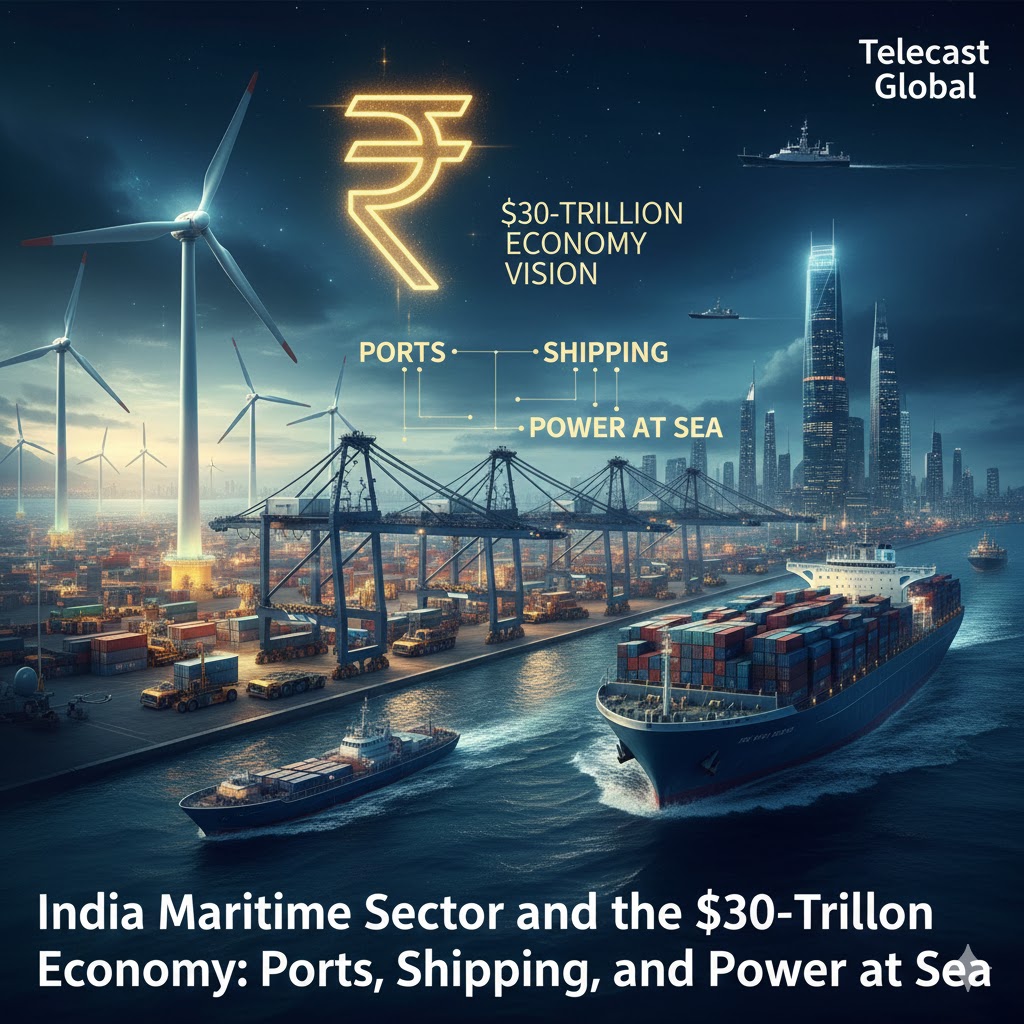
India maritime sector is no longer just about ships and ports—it has become central to India’s economic, strategic, and environmental future. With over 90% of India’s trade moving by sea and ambitious reforms unfolding under Maritime Amrit Kaal Vision 2047, the country is quietly executing a blue-water economic strategy. From record port capacity expansion and inland waterways growth to green shipping corridors and naval indigenisation, maritime reforms now intersect with climate goals, geopolitics, and global supply chain realignments in 2025. As India targets a $30-trillion economy, the oceans are turning into its most powerful growth engine.
Ports, Logistics, and the Race to Cut India’s Trade Costs
If India wants to be taken seriously as a global manufacturing and export hub, it has to win one brutal, unglamorous battle first: logistics costs. And this is where the India maritime sector steps into the spotlight. Right now, India’s logistics costs hover around 13–14% of GDP—way higher than global benchmarks like China (8–9%). That gap isn’t academic. It decides whether Indian goods are competitive or quietly priced out of global markets.
The good news? Ports are finally pulling their weight.
Over the last decade, India has massively expanded port capacity—from about 1,400 MMTPA in 2013–14 to nearly 2,762 MMTPA in 2024–25. Major ports alone handled around 855 million tonnes of cargo in FY 2024–25, a clear signal that scale is no longer the primary constraint . What mattered more was speed, and that’s where reforms have hit differently.
Average vessel turnaround time has been slashed from a painful 93 hours to about 48 hours. That’s not just an efficiency stat—it’s money saved on fuel, crew, inventory holding, and insurance. In logistics, time really is money. Faster ports mean ships don’t idle, exporters meet deadlines, and global shipping lines start taking Indian ports seriously rather than treating them as secondary stops.
But ports don’t exist in isolation. The real cost killer is connectivity.
Despite improvements, India still struggles with last-mile bottlenecks—cargo moving smoothly at ports but choking on roads or rail afterward. This is why the current push toward multimodal logistics integration matters so much. Dedicated Freight Corridors, port-linked rail projects, multimodal logistics parks, and inland waterways are being designed to work as one system, not disconnected silos. When cargo can shift seamlessly from ship to rail to river, logistics costs drop without subsidies or shortcuts.
The India maritime sector is also learning from Southeast Asian hubs like Singapore and Port Klang, where automation and AI-driven scheduling reduce pre-berthing delays. In India, a big chunk of delay still happens before ships even dock. Digitised port operations, automated stacking yards, and smarter vessel traffic management systems are now being rolled out to fix exactly that gap.
Another underrated factor: coastal shipping and inland waterways. The Coastal Shipping Act, 2025 officially recognising coastal shipping as a full transport mode is a game-changer. Inland waterway cargo has already jumped from 18 million tonnes in 2014 to over 145 million tonnes in 2024. Every tonne moved by water instead of road cuts fuel costs, emissions, and congestion—all while making Indian exports cheaper.
Zoom out, and the picture is clear. Cutting trade costs isn’t about one mega-port or one flashy reform. It’s about thousands of invisible improvements—faster cranes, deeper drafts, smoother rail links, cleaner data systems. And together, they’re quietly reshaping India’s trade competitiveness.
In 2025, as global supply chains diversify away from overdependence on China, countries aren’t chosen on sentiment—they’re chosen on efficiency. The India maritime sector is now racing to make sure high logistics costs don’t become India’s weakest link. If this momentum holds, ports won’t just handle trade—they’ll decide India’s place in the global economy.
And yes, boring infrastructure just became strategic power.
Maritime Laws 2025: How New Shipping Acts Are Rewriting India’s Sea Governance
For decades, India ran one of the world’s busiest maritime networks using laws written for a colonial economy. That mismatch finally snapped in 2025. The new wave of maritime legislation—the Merchant Shipping Act, 2025, Carriage of Goods by Sea Act, 2025, and Indian Ports Act, 2025—isn’t just legal housekeeping. It’s a hard reset of how the India maritime sector is governed, regulated, and trusted globally.
Let’s be blunt: outdated laws were quietly inflating costs, slowing projects, and scaring off serious investors.
Earlier, port governance was fragmented, approvals were slow, liability rules were unclear, and India often lagged behind international maritime standards. That’s fine if you’re a closed economy. It’s fatal if you want to anchor a $30-trillion economy on global trade. The 2025 reforms are designed to fix exactly that structural weakness .
Start with the Merchant Shipping Act, 2025. This law modernises vessel registration, safety standards, crew welfare, and environmental compliance. Crucially, it aligns Indian shipping regulations with International Maritime Organization (IMO) conventions. Translation? Indian-flagged ships face fewer regulatory headaches abroad, insurers price risks more rationally, and Indian shipping becomes more competitive without begging for protection.
Then comes the Carriage of Goods by Sea Act, 2025, which quietly does something powerful: it brings clarity. Clear rules on liability, cargo responsibility, and dispute resolution reduce uncertainty for exporters, importers, and insurers. In logistics, uncertainty is cost. This Act cuts that cost by replacing ambiguity with predictability—something global supply chains value more than tax breaks.
The real governance disruptor, though, is the Indian Ports Act, 2025.
For the first time, India gets a unified legal framework for port regulation across major and non-major ports. Earlier, state ports and central ports often operated under different rules, creating regulatory chaos. Now, port authorities have clearer powers, accountability mechanisms, and a stronger push toward landlord port models. That matters because modern ports aren’t just cargo handlers—they’re logistics ecosystems attracting private capital.
This legal overhaul directly feeds into ease of doing business in the India maritime sector. Faster approvals, clearer concession rules, and reduced litigation risks make port-led industrialisation under Sagarmala far more viable. Investors don’t fear competition; they fear uncertainty. These Acts reduce the latter.
There’s also a strategic layer most people miss. Strong maritime laws strengthen maritime security governance—from pollution control to vessel monitoring to emergency response. In an era where the Indian Ocean is crowded with geopolitical interests, legal clarity becomes national security infrastructure.
And yes, sustainability is baked in. Environmental compliance is no longer optional or vaguely defined. Green ports, cleaner fuels, and emission controls now have statutory backing, aligning maritime growth with India’s net-zero commitments instead of treating climate goals as PR slides.
The India maritime sector is moving from reactive administration to rule-based governance. From colonial leftovers to globally aligned frameworks. From uncertainty to confidence. Laws don’t move cargo—but they decide how fast, how cheap, and how secure that cargo moves.
In 2025, India didn’t just pass new shipping laws. It rewrote the rules of the sea—on its terms.
Maritime Laws 2025: How New Shipping Acts Are Rewriting India’s Sea Governance
For years, India tried to run a 21st-century maritime economy with 20th-century laws. That mismatch quietly raised costs, delayed projects, and made global players treat Indian shipping as high-risk paperwork territory. In 2025, that era officially ended. A fresh legal stack—the Merchant Shipping Act, 2025, Carriage of Goods by Sea Act, 2025, and Indian Ports Act, 2025—is fundamentally reshaping how the India maritime sector is governed, regulated, and trusted worldwide .
Let’s be real: laws don’t sound exciting, but they decide everything.
Earlier frameworks were fragmented, colonial-era, and misaligned with international norms. This meant higher insurance premiums, legal uncertainty for cargo disputes, slow approvals for port projects, and weak environmental enforcement. For a country aiming at a $30-trillion economy, that’s self-sabotage. The 2025 reforms fix this structural drag head-on.
The Merchant Shipping Act, 2025 is the backbone. It modernises vessel registration, crew standards, safety norms, and environmental compliance—while aligning Indian shipping with International Maritime Organization conventions. Why does this matter? Because Indian-flagged ships now face fewer compliance hurdles abroad, making flagging in India commercially attractive again. That directly strengthens the India maritime sector by expanding the national fleet and reducing dependence on foreign-flag vessels.
Next comes the Carriage of Goods by Sea Act, 2025, which does something exporters have wanted forever: clarity. It clearly defines liability, carrier responsibilities, cargo claims, and dispute resolution mechanisms. Earlier, ambiguity meant longer litigation and higher transaction costs. Now, contracts are cleaner, risks are priced accurately, and supply chains gain predictability—gold dust in global trade.
The biggest governance shift, though, is the Indian Ports Act, 2025.
For the first time, India has a harmonised legal framework covering both major and non-major ports. Earlier, ports operated under overlapping central and state laws, creating regulatory confusion and uneven standards. The new Act strengthens port authorities, promotes the landlord port model, improves private sector participation, and enforces uniform safety and environmental norms. This legal clarity directly boosts investor confidence in port-led development under Sagarmala.
Ease of doing business is where the impact compounds. Faster approvals, digitised processes, clearer concession rules, and reduced litigation risk lower the cost of capital. In practical terms, this means faster port modernisation, better logistics integration, and more competitive tariffs. The India maritime sector shifts from bureaucratic risk to business opportunity.
There’s also a strategic dimension. Strong maritime laws improve surveillance, pollution control, vessel tracking, and emergency response—critical at a time when the Indian Ocean is increasingly contested. Governance becomes a force multiplier for maritime security, not just an administrative function.
Sustainability isn’t an afterthought either. Environmental compliance, green shipping, and port electrification now have statutory backing instead of policy circulars. That aligns maritime growth with climate commitments and protects India’s vulnerable coastline while enabling expansion.
Bottom line? The 2025 shipping laws mark a governance upgrade.
The India maritime sector is moving from outdated control to modern regulation—from ambiguity to predictability, from delay to decisiveness. Ports may move cargo, but laws decide whether that cargo moves efficiently, securely, and competitively. In rewriting its sea governance, India is quietly building the legal foundation of its maritime power.
Green Shipping Corridors and Net-Zero 2070: India’s Blue Climate Strategy
For a long time, climate action and shipping lived in separate worlds. One talked about emissions; the other moved 90% of global trade. In 2025, that separation is officially over. India is now treating decarbonisation of shipping not as an environmental add-on, but as a strategic economic lever. At the heart of this shift lies green shipping corridors—and they’re quietly redefining the India maritime sector .
Let’s get the context straight. Shipping may look efficient compared to aviation, but it’s a major emitter. Ports burn fossil fuels. Tugboats idle on diesel. Cargo handling runs on carbon-heavy grids. If India wants to hit net-zero by 2070, cleaning up the maritime value chain is non-negotiable. That’s where green shipping corridors come in.
Green shipping corridors are designated maritime routes where ships operate using low- or zero-emission fuels, supported by green port infrastructure, digital monitoring, and regulatory incentives. India has already begun developing such corridors with countries like Japan, Norway, and the Netherlands—nations that sit at the cutting edge of green maritime technology. This isn’t symbolism. It’s supply-chain positioning.
Why? Because future trade won’t just ask how cheap your exports are—it’ll ask how clean they are.
The Green Tug Transition Programme (GTTP) is the most concrete signal yet. The goal is to induct at least 50 green tugs at major Indian ports by 2030. Tugboats may sound small, but they operate constantly inside ports and burn disproportionate amounts of fuel. Electrifying or switching them to green hydrogen delivers immediate emission cuts while building domestic capability in clean maritime tech.
Zoom out, and you see the bigger design. Green shipping corridors force ports to upgrade—shore power, electrified cargo handling, cleaner bunkering, and digital emission tracking. That modernisation doesn’t just cut carbon; it improves efficiency. Faster turnaround, lower fuel volatility, and compliance with future global carbon standards give Indian ports a competitive edge. That’s climate action with an ROI.
This is where the India maritime sector is being quietly rebranded—from cost centre to climate solution.
There’s also a geopolitical angle. Global shipping is moving toward carbon pricing and fuel mandates. Countries that don’t adapt will see their ports bypassed or penalised. By aligning early with IMO climate targets and partner countries, India avoids future trade friction and positions itself as a trusted green logistics hub for Asia, Africa, and the Indo-Pacific.
Of course, challenges remain. Green fuels are expensive. Port electrification is uneven. Inland connectivity still runs on carbon-heavy logistics. But the direction is locked in. Unlike earlier climate pledges, maritime decarbonisation now has funding, timelines, and international partnerships backing it.
Most importantly, this strategy protects India’s coastline. Over one-third of India’s coast is vulnerable to erosion and climate shocks. Cleaner shipping, resilient ports, and sustainable coastal development aren’t just about emissions—they’re about safeguarding livelihoods, fisheries, and long-term trade infrastructure.
In plain terms, green shipping corridors are doing three things at once: cutting emissions, upgrading infrastructure, and future-proofing trade. That’s rare policy alignment.
As India moves toward 2047 and beyond, the India maritime sector isn’t just carrying cargo—it’s carrying the country’s climate credibility. Net-zero 2070 won’t be achieved in conference halls. It’ll be achieved at ports, on ships, and along sea lanes where economics and ecology finally sail in the same direction.
Indian Ocean Security in 2025: Maritime Power, Navy Indigenisation, and the China Factor
In 2025, the Indian Ocean is no longer just a trade highway—it’s a strategic battleground. Nearly 90% of India’s trade by volume moves through these waters, which means maritime security is no longer a defence-only concern. It’s an economic necessity. This is where the India maritime sector intersects directly with geopolitics, naval power, and national sovereignty .
Let’s start with the obvious pressure point: China.
Beijing’s expanding footprint under the so-called “String of Pearls” strategy—ports and dual-use facilities across Gwadar, Hambantota, Kyaukpyu, Djibouti, and access points in the Maldives and Seychelles—has fundamentally altered the Indian Ocean’s balance. These aren’t just commercial ports. They provide surveillance reach, logistical depth, and strategic leverage. For India, ignoring this reality would be reckless.
India’s response in 2025 is no longer reactive—it’s structural.
The Indian Navy has undergone a quiet but profound transformation. Over 75% of naval vessels are now built domestically, marking a shift from a “Buyer’s Navy” to a “Builder’s Navy.” Indigenous aircraft carriers, destroyers, submarines, and patrol vessels aren’t just symbols of pride—they reduce dependence on foreign suppliers and ensure operational readiness during crises. This indigenisation directly strengthens the India maritime sector by linking defence manufacturing, shipbuilding, and strategic autonomy.
Maritime domain awareness is the second pillar. India has expanded coastal radar networks, satellite surveillance, and UAV deployments to monitor sea lanes and choke points. The Information Fusion Centre – Indian Ocean Region (IFC-IOR) has emerged as a critical hub for real-time intelligence sharing with partner countries. In an era of hybrid threats—piracy, cyber intrusion, and grey-zone tactics—information dominance is as important as firepower.
What makes 2025 different is integration.
Maritime security is now tied to port infrastructure, logistics resilience, and commercial shipping protection. Secure Sea Lines of Communication (SLOCs) ensure uninterrupted energy imports, export flows, and supply chain stability. Any disruption—whether from conflict or coercion—directly hits growth. That’s why the India maritime sector treats naval preparedness as an economic shield, not just a military asset.
There’s also a diplomatic layer. India is deepening maritime cooperation through groupings like the Quad, BIMSTEC, and the Indian Ocean Rim Association. Joint patrols, naval exercises, and capacity-building for smaller coastal states help counterbalance extra-regional dominance without escalation. This rules-based approach reinforces freedom of navigation while avoiding open confrontation.
Importantly, indigenous shipbuilding feeds back into civilian strength. Technologies developed for defence—advanced hull design, propulsion systems, cybersecurity, and surveillance—spill over into commercial shipping and port management. The line between security and commerce is deliberately blurring, and that’s strategic design.
In short, Indian Ocean security in 2025 is no longer about reacting to threats—it’s about shaping the environment. By combining naval indigenisation, surveillance dominance, and regional partnerships, India is securing the sea lanes that sustain its economy.
The takeaway is simple: without maritime security, trade stalls. And without trade, growth collapses. The India maritime sector now understands this truth clearly—and is acting on it with steel, sensors, and strategy.
From Sagarmala to Shipbuilding: How the India Maritime Sector Fuels Jobs and Industry
If you strip away the strategy jargon, one truth stands tall: the India maritime sector is no longer just moving goods—it’s creating jobs, building industries, and reshaping coastal economies. From the Sagarmala Programme to the renewed push for domestic shipbuilding, maritime policy in 2025 is doing something rare in Indian infrastructure: linking growth directly with employment and industrial depth .
Let’s start with Sagarmala, because this is where the multiplier effect kicks in.
Sagarmala isn’t just about ports. It’s about port-led industrialisation. Over 100 port modernisation projects have already added more than 230 MTPA of capacity, while 80+ connectivity projects have upgraded nearly 1,500 km of port-linked infrastructure. But the real impact lies inland—manufacturing clusters, logistics parks, coastal economic zones, and export-oriented industries growing around ports instead of choking landlocked cities.
This model does two things at once: it reduces logistics costs and decentralises industrial growth. Coastal districts that were once economically marginal—home mostly to fishing communities—are now seeing formal jobs in warehousing, processing, ship repair, logistics, and services. That’s the India maritime sector quietly solving a regional inequality problem.
Now layer shipbuilding on top of that.
India currently ranks around 16th globally in shipbuilding, but the ambition is clear: top 10 by 2030. Backing this is a ₹70,000 crore financial package aimed at shipbuilding and repair infrastructure, domestic ship ownership, and port-linked manufacturing. This is industrial policy with teeth. Shipbuilding isn’t a single industry—it pulls in steel, electronics, engines, design, software, welding, logistics, and finance.
Each ship built domestically generates thousands of direct and indirect jobs. Ship repair yards alone are labour-intensive and globally competitive if done right. And unlike many sunrise sectors, maritime manufacturing creates skilled blue-collar employment, not just white-collar tech roles.
The Shipping Corporation of India’s plan to expand its fleet to 216 vessels by 2047, adding 10 million gross tonnage, reinforces this ecosystem. More Indian-owned ships mean more Indian crews, more domestic maintenance, and fewer freight payments bleeding out to foreign operators. Remember: India currently pays nearly $75 billion annually to foreign shipping companies. Retaining even a fraction of that transforms the India maritime sector into a revenue anchor.
Human capital is the underrated piece. India already supplies over 3 lakh trained seafarers globally, making it one of the world’s top maritime workforce providers. In 2025, this is expanding into maritime cybersecurity, vessel traffic management, port IT systems, and autonomous navigation. These aren’t legacy jobs—they’re future-facing, exportable skills.
And yes, coastal communities matter. Improved fishing harbours, cold chains, and port-linked services under Sagarmala have directly improved incomes for fishermen while integrating them into formal logistics networks. That’s inclusive growth—not trickle-down theory.
Put it all together and the pattern is obvious. Ports create connectivity. Connectivity attracts industry. Industry creates jobs. Jobs stabilise regions. That’s the growth loop.
In 2025, the India maritime sector isn’t just a trade facilitator—it’s an industrial engine. From Sagarmala’s coastal clusters to shipyards turning steel into strategy, the sea is doing what few sectors manage: growing the economy while putting people to work. And that’s exactly the kind of growth a $30-trillion ambition demands.
About The Author











Leave a Reply