

Table of Contents
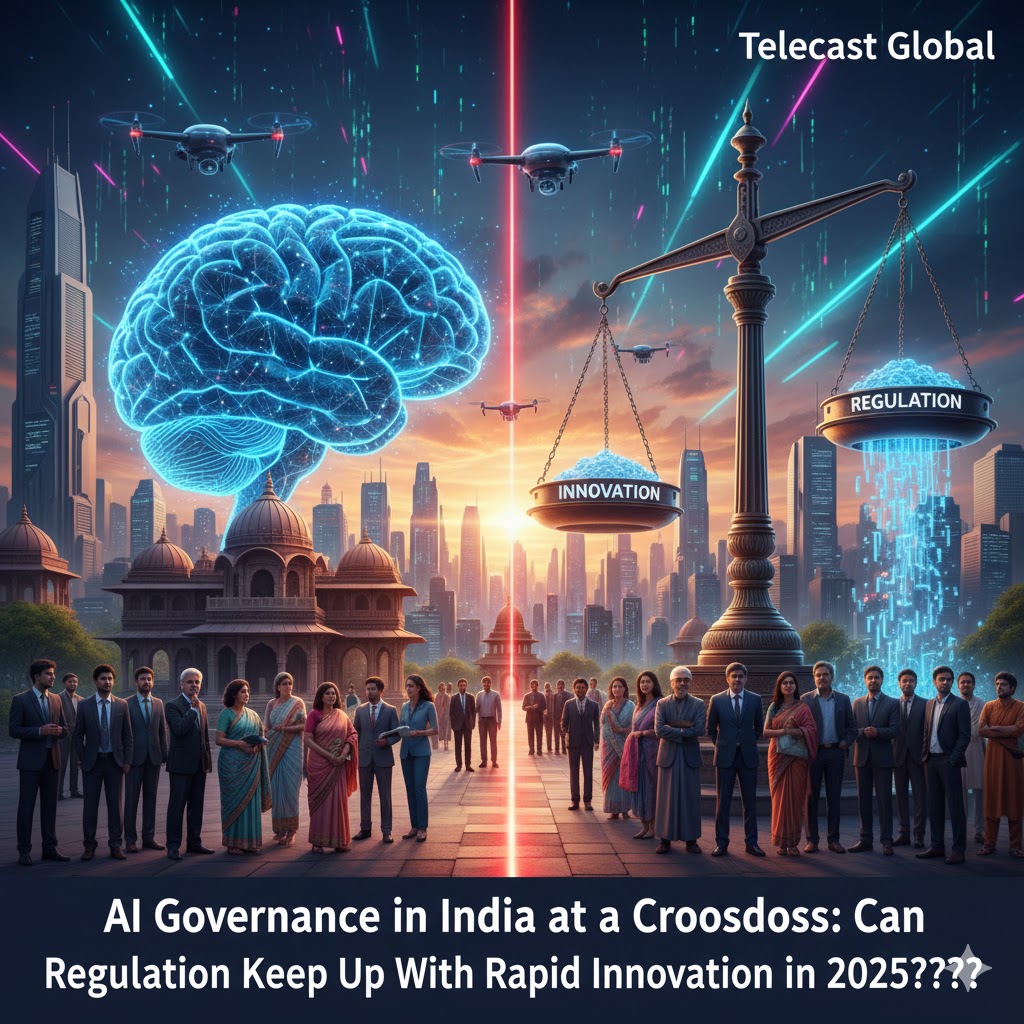
AI governance in India has moved from a theoretical policy debate to an urgent national priority in 2025. As artificial intelligence reshapes elections, finance, healthcare, and public services, India’s existing laws—from the IT Act, 2000 to the DPDP Act, 2023—are being stress-tested by deepfakes, algorithmic bias, and generative AI platforms. While India has avoided heavy-handed regulation and chosen an innovation-friendly path, global developments like the EU AI Act and OECD principles are raising the stakes. The question today is no longer whether India should regulate AI, but how fast and how smartly it can do so.
India’s Current AI Governance Framework: How IT Laws and the DPDP Act Are Being Stretched
AI governance in India today runs on legal jugaad—and let’s be honest, it’s impressive but fragile. Instead of a dedicated AI law, India is stretching legacy digital laws to cover technologies they were never designed for. The backbone of this approach is the Information Technology (IT) Act, 2000, the IT Rules, 2021, and the Digital Personal Data Protection (DPDP) Act, 2023. Together, they form a patchwork system that keeps AI in check—for now—but shows visible strain as generative AI explodes across sectors.
Start with the IT Act, 2000. Written in an era of emails and cyber cafés, it still anchors AI governance in India through provisions on identity theft, impersonation, and intermediary liability. Sections dealing with fraud are now being invoked against deepfakes, voice cloning, and AI-driven scams. Section 79’s “safe harbour” clause has become especially important, as platforms hosting AI-generated content must prove due diligence or risk losing legal protection. The law works—but only by stretching its original intent.
The real pressure valve is the IT (Intermediary Guidelines and Digital Media Ethics Code) Rules, 2021. These rules quietly became India’s frontline AI regulator. By forcing platforms to label synthetic or manipulated content, set up grievance redressal mechanisms, and act quickly on government orders, the Rules indirectly regulate generative AI systems. Recent government advisories have made it clear: AI platforms are not outside the law. This has turned content moderation into a de facto AI compliance exercise, especially during elections, communal flashpoints, and misinformation spikes in 2025.
Then comes the DPDP Act, 2023—the most future-facing pillar of AI governance in India. AI systems run on data, and lots of it. The DPDP Act enforces consent, purpose limitation, data minimisation, and security safeguards. For AI developers, this means models trained on personal data now face legal scrutiny. You can’t just scrape, train, and deploy anymore. Fairness, transparency, and data protection are no longer “ethical nice-to-haves”; they’re legal expectations. This has huge implications for sectors like fintech, health-tech, and HR tech where algorithmic decisions directly affect lives.
But here’s the uncomfortable truth: these laws were not designed for autonomous, self-learning systems. Liability remains blurry. If an AI system discriminates, who is responsible—the developer, deployer, or platform? AI governance in India currently answers this question indirectly, case by case, regulator by regulator. RBI handles financial AI risk, SEBI watches algorithmic trading, CDSCO oversees AI medical devices, and CERT-In deals with cybersecurity incidents. This sectoral approach keeps things moving but creates coordination gaps.
In 2025, this stretched framework is both India’s strength and its weakness. It allows innovation without choking startups—but it also leaves grey zones around accountability, bias, and psychological harm. The laws are bending, not breaking—yet. How long they can keep doing that without a dedicated AI statute is the real question India must now confront.
Deepfakes, Generative AI, and Elections: Why 2025 Is a Turning Point for AI Regulation
If there was ever a moment that exposed the cracks in AI governance in India, it’s elections in the age of deepfakes. 2025 isn’t just another tech milestone year—it’s the point where generative AI collides head-on with democracy, trust, and public order. Cheap, fast, hyper-realistic AI-generated content has turned misinformation from a nuisance into a systemic risk, and India is feeling it at scale.
Deepfakes are no longer sci-fi. Political speeches fabricated with cloned voices, leaders shown saying things they never did, and viral videos designed to inflame caste, religious, or regional tensions are already circulating. The scary part? Most of this content is technically legal until harm is proven. That’s why AI governance in India is being stress-tested hardest during elections, where speed matters more than intent and damage is done before fact-checkers even wake up.
The government’s first line of defence has been the IT Rules, 2021. Platforms are now expected to label synthetic content, remove manipulated media quickly, and respond to official takedown orders without delay. In theory, this sounds solid. In practice, enforcement during election cycles is chaos. AI-generated misinformation spreads faster than compliance mechanisms can react. This is where AI governance in India starts to look reactive instead of preventive.
Generative AI has also blurred the line between satire, political messaging, and outright deception. Earlier, misinformation needed human effort—editing videos, writing fake news, coordinating networks. In 2025, a single prompt can generate thousands of tailored political messages in minutes. Micro-targeting voters using AI-written content is cheap, scalable, and dangerously effective. India’s election laws were written for rallies, posters, and TV ads—not synthetic personalities and algorithm-driven persuasion.
The DPDP Act, 2023 adds another layer to this debate. Election-related AI tools often rely on personal data—location, language, behaviour patterns—to tailor messages. Under the DPDP Act, consent and purpose limitation are mandatory. But enforcing these rules during political campaigns is tricky. Who audits campaign tech stacks? Who checks whether voter data is being legally processed? AI governance in India currently lacks real-time oversight capacity during elections, which creates a regulatory blind spot.
Globally, this is not just India’s problem. Democracies everywhere are scrambling. But India’s scale—900+ million voters, dozens of languages, high social media penetration—makes the risk exponentially bigger. That’s why 2025 is widely seen as a turning point. The conversation is shifting from “platform responsibility” to “systemic safeguards.” Should there be mandatory watermarking of political AI content? Should generative AI tools face temporary restrictions during elections? These questions are now mainstream policy debates.
What’s clear is this: elections have turned AI governance in India from a tech-policy issue into a constitutional concern. Free speech, fair competition, and informed consent of voters are all on the line. Stretching IT laws can only go so far. Without sharper rules for political deepfakes, real-time enforcement mechanisms, and clear liability frameworks, India risks fighting 21st-century election manipulation with 20th-century laws.
And history is brutal about this—once trust in elections erodes, rebuilding it is painfully slow.
IndiaAI Mission and Digital Sovereignty: Competing With Global AI Powers
If regulation is the defensive side of AI governance in India, the IndiaAI Mission is the offensive play. And honestly, it’s overdue. For years, India has been one of the world’s biggest users of AI—but not a rule-maker or infrastructure owner. In 2025, that gap is no longer just economic; it’s strategic. Whoever controls compute, models, and data controls the future. That’s why the IndiaAI Mission sits at the heart of India’s push for digital sovereignty .
At its core, the IndiaAI Mission is about capacity-building. High-performance computing infrastructure, public AI platforms, indigenous foundation models, and skilling pipelines are all part of the plan. This matters because AI governance in India cannot work in isolation from capability. You can’t regulate what you don’t understand, and you can’t enforce standards if your ecosystem depends entirely on foreign models, foreign clouds, and foreign chips.
Right now, that dependence is real. Most advanced AI systems used in India—whether in finance, healthcare, language tools, or governance—run on non-Indian cloud infrastructure and foundational models trained abroad. This raises serious questions about data sovereignty, national security, and policy autonomy. If tomorrow a global AI provider changes terms, restricts access, or aligns with another country’s strategic interests, India’s digital backbone is exposed. The IndiaAI Mission is meant to reduce that vulnerability.
From a governance perspective, this is crucial. AI governance in India isn’t just about ethics and harm prevention; it’s also about who sets the technical defaults. If risk frameworks, safety benchmarks, and alignment norms are defined elsewhere, India becomes a policy taker. By investing in domestic models and public compute, India gains leverage—both to innovate and to regulate on its own terms.
There’s also a startup angle here, and it’s massive. Over-regulation without infrastructure would crush Indian AI startups, forcing them to rely on expensive foreign APIs. The IndiaAI Mission tries to flip that script by lowering entry barriers—shared datasets, public compute access, and open innovation platforms. This allows AI governance in India to stay innovation-friendly while still enforcing accountability, especially for high-risk applications.
Globally, the timing couldn’t be sharper. The US is backing its AI dominance through private-sector scale and strategic controls. China has gone all-in on state-backed AI with tight surveillance-driven governance. The EU is regulating aggressively through the AI Act. India is carving a fourth path: democratic, rights-respecting, but strategically assertive. The IndiaAI Mission is what makes that path credible rather than aspirational.
But here’s the blunt truth: missions don’t win races—execution does. Semiconductor shortages, limited domestic chip manufacturing, and talent migration remain hard constraints. Without alignment between the IndiaAI Mission, the National Semiconductor Mission, and long-term funding, digital sovereignty risks becoming a slogan.
In 2025, AI governance in India is inseparable from AI capability. You can’t be a global AI power by only writing rules—you need to build the engine too. The IndiaAI Mission is India’s bet that it can still do both, and do them its own way.
Global AI Rules vs India’s Approach: Lessons From the EU AI Act and OECD Principles
When you zoom out, AI governance in India doesn’t exist in a vacuum—it’s being shaped in constant comparison with global rulebooks, especially the EU AI Act and the OECD AI Principles. In 2025, this comparison matters more than ever because AI regulation is quietly becoming a tool of economic power, not just ethics. Countries that set the rules early end up exporting standards along with technology. India knows this—and that’s why its approach looks deliberately different .
Start with the EU AI Act. Europe has gone full compliance-first. The Act classifies AI systems into risk categories—unacceptable, high-risk, limited risk, and minimal risk—and then slaps strict obligations on high-risk uses like biometric surveillance, credit scoring, recruitment, and law enforcement. On paper, it’s clean, structured, and rights-focused. But it’s also heavy. For startups, compliance costs are high, timelines are slow, and innovation risks getting buried under paperwork.
India has watched this closely and chosen not to copy-paste. AI governance in India leans toward a risk-based philosophy without codifying it into a single, binding AI statute—at least not yet. Instead of one mega law, India is spreading governance across sectoral regulators like RBI, SEBI, CDSCO, and CERT-In. It’s messier, yes—but also more flexible. Regulators who understand domain-specific risks are shaping AI oversight where it actually gets deployed.
The OECD AI Principles offer a softer, more values-driven model—and this is where India aligns most comfortably. Human-centric AI, transparency, accountability, robustness, and fairness are all baked into India’s policy language, from the IndiaAI Mission to government advisories. Unlike the EU’s legal enforcement-heavy approach, the OECD model emphasises norms, coordination, and trust-building. For a diverse, fast-growing economy like India, this makes practical sense.
That said, alignment doesn’t mean imitation. AI governance in India faces constraints that Europe doesn’t. Large informal sectors, uneven digital literacy, and massive scale mean rigid rules could backfire. Over-regulation risks locking India into dependence on foreign AI vendors who can afford compliance, while domestic startups struggle. Under-regulation, on the other hand, opens the door to bias, surveillance misuse, and democratic harm. India is walking a tightrope—and it knows it.
Another key difference is geopolitical context. The EU regulates from a position of institutional maturity but limited tech dominance. India regulates while still building foundational AI capacity. That’s why India keeps emphasising “innovation-friendly” governance in global forums like G20 and GPAI. AI governance in India is as much about catching up strategically as it is about controlling risks.
The real lesson India is drawing from global rules is this: governance must evolve with capability. The EU AI Act works because Europe already has strong data protection, enforcement capacity, and legal clarity. India is still building those muscles. Jumping straight to EU-style enforcement without institutional depth would create chaos, not safety.
In 2025, India’s approach looks intentionally incremental—learn from the EU’s structure, borrow values from the OECD, but adapt everything to domestic realities. Whether this hybrid model becomes a global alternative or a temporary bridge depends on what India does next: convert principles into enforceable standards without killing innovation. That balance will define the future of AI governance in India far more than any imported rulebook.
The Missing AI Law Debate: What India Must Fix to Lead in Responsible AI
For all the progress India has made, the biggest unresolved question in AI governance in India is still staring policymakers in the face: Should India have a dedicated AI law? In 2025, this is no longer an academic debate—it’s a structural gap that’s getting harder to ignore. India currently governs AI by stretching old laws and layering sectoral regulations, but that approach is reaching its limits .
The core problem is clarity. Existing laws like the IT Act, 2000 and the DPDP Act, 2023 were never designed for autonomous, self-learning systems that evolve after deployment. As a result, AI governance in India suffers from fuzzy accountability. When an AI system discriminates, misinforms, or causes psychological harm, who is legally responsible? The developer who built the model? The company that deployed it? The platform that hosted it? Right now, the answer depends on which regulator you ask—and that’s a recipe for legal uncertainty.
This ambiguity hurts everyone. For citizens, it weakens trust and redress mechanisms. For startups and enterprises, it increases compliance risk without offering clear guardrails. Ironically, the absence of a clear AI law doesn’t create freedom—it creates fear. Companies over-comply or avoid high-impact AI use altogether, slowing innovation. That’s a hidden cost of weak AI governance in India that rarely gets discussed.
Another missing piece is a legal definition of AI itself. Without a statutory definition, regulators are forced to improvise. This leads to inconsistent standards across sectors—finance, health, policing, and welfare all follow different logic. A dedicated AI law doesn’t have to be rigid, but it must establish baseline principles: what counts as high-risk AI, what explainability means in practice, and when human oversight is mandatory. Global examples like the EU’s AI Liability framework show this can be done without micromanaging innovation.
Institutional design is the next fix India must confront. Today, AI oversight is fragmented across MeitY, RBI, SEBI, CDSCO, and others. Coordination happens, but it’s informal. AI governance in India would benefit massively from a central nodal authority—not a super-regulator, but a standards-setter and coordinator. Think risk classifications, audit benchmarks, and crisis-response protocols, especially for elections, surveillance tech, and critical infrastructure.
Then there’s enforcement capacity. Laws are only as strong as the institutions behind them. Algorithmic audits, impact assessments, and bias testing require technical expertise that many regulators currently lack. Without sustained investment in skills and tools, even the best AI law will remain symbolic. Responsible AI leadership demands boring but essential work: training regulators, judges, and auditors who actually understand how these systems function.
The good news? India doesn’t need to rush into a copy-paste AI Act. What it needs is a principle-based, risk-tiered AI law that plugs accountability gaps, strengthens redress, and aligns with India’s innovation-first reality. In 2025, leadership in AI governance in India won’t come from being the fastest regulator—but from being the smartest one.
About The Author








Leave a Reply