India BRICS Presidency 2026: Can New Delhi Lead the Global South Without Angering the West?
Table of Contents
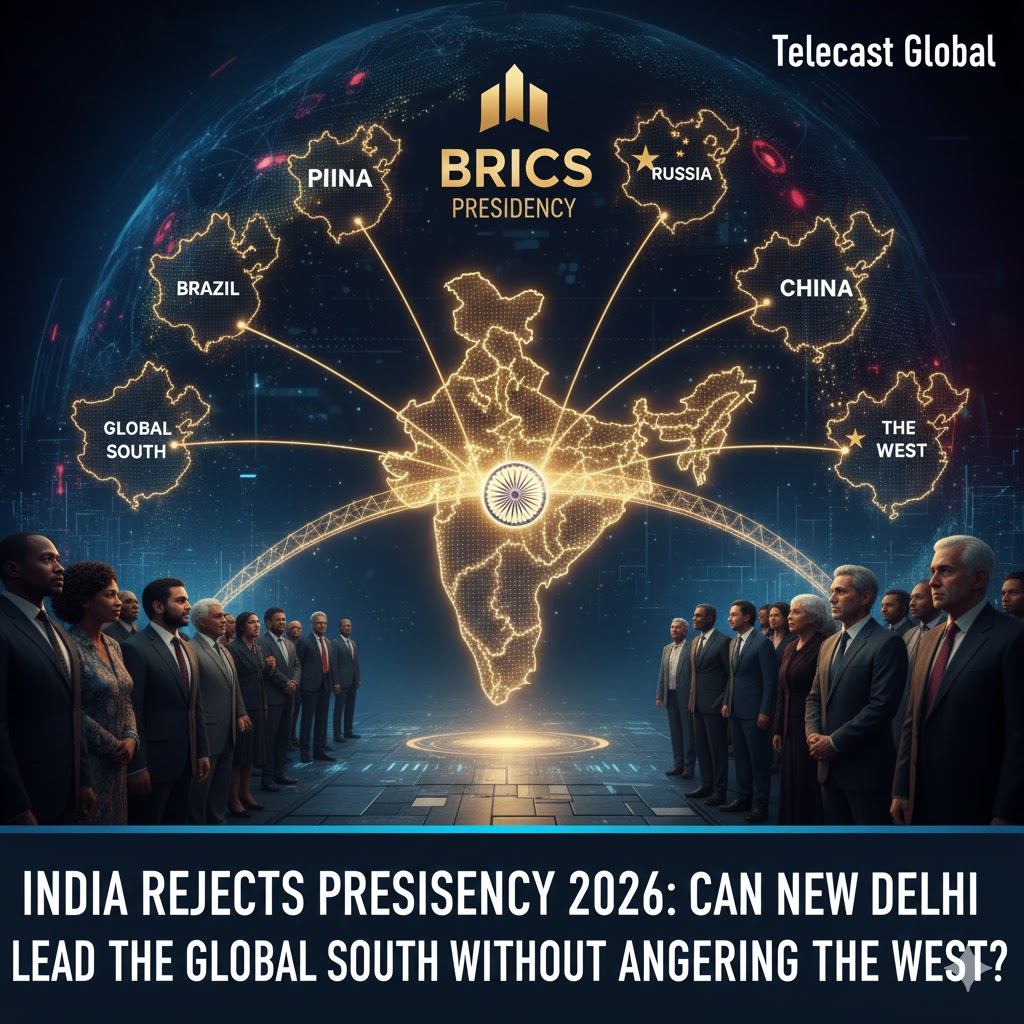
With India BRICS Presidency 2026, New Delhi steps into one of the most complex geopolitical roles of the decade. As leadership of BRICS shifts amid global fragmentation, India faces the dual challenge of championing the Global South while preserving strategic stability with the United States. Expanded BRICS membership, rising US–China rivalry, trade tensions, and regional instability have turned this presidency into far more than a ceremonial role. Much like its G20 stewardship, India’s 2026 agenda is anchored in a people-centric, development-first vision—yet the diplomatic tightrope has never been tighter. The world is watching how India balances principle with pragmatism.
India BRICS Presidency 2026 and the Reimagining of Global South Leadership
India BRICS Presidency 2026 is not just another turn in a rotating multilateral calendar—it is a strategic moment where New Delhi is attempting to reshape what leadership of the Global South actually means in a fractured world. Unlike the Cold War-era idea of bloc politics, today’s Global South is diverse, ambitious, and impatient. India’s task is to give this coalition direction without turning it into an anti-West pressure group, a balance very few countries are capable of managing credibly.
At the heart of India BRICS Presidency 2026 lies a clear message: development must come before ideology. India has consistently positioned itself as a bridge—between developed and developing economies, between democratic systems and alternative governance models, and between growth aspirations and sustainability concerns. This approach echoes India’s G20 presidency, where it successfully elevated issues like debt relief, climate finance, and digital public infrastructure for poorer nations without provoking institutional backlash.
The expanded nature of BRICS makes this leadership both powerful and precarious. With new members from West Asia, Africa, and Southeast Asia, the Global South today represents nearly half the world’s population and a growing share of global GDP. However, these countries do not share uniform political systems, security priorities, or foreign policy alignments. India BRICS Presidency 2026 must therefore focus on convergence around practical outcomes—trade facilitation, development finance, energy security, and technology access—rather than abstract declarations.
One of India’s biggest contributions to reimagining Global South leadership is its insistence on inclusivity without dependency. Unlike traditional power centers that often tie aid and cooperation to political alignment, India emphasizes capacity-building and sovereign choice. Digital public goods like Aadhaar-inspired identity systems, UPI-style payment frameworks, and low-cost digital governance models are examples India is promoting as scalable solutions rather than imposed templates. This philosophy strengthens India BRICS Presidency 2026 as a leadership model based on partnership, not patronage.
Crucially, India understands that Global South leadership today must coexist with global economic integration. Many BRICS members rely heavily on Western markets, capital, and technology. Turning BRICS into an overtly anti-US or anti-EU bloc would fracture the very economies it claims to represent. Hence, India BRICS Presidency 2026 is expected to prioritize development finance reform, South–South trade, and institutional strengthening without pushing for abrupt de-dollarization or confrontational monetary agendas that could destabilize markets .
There is also a moral dimension to India’s leadership pitch. By foregrounding a “humanity-first” approach, India is attempting to redefine power not as coercion, but as responsibility. Issues like climate adaptation funding, food security, and health resilience resonate deeply across the Global South—and India has credibility here because it faces many of the same challenges domestically.
In plain terms, India BRICS Presidency 2026 is about proving that the Global South does not need a single dominant power to speak for it. Instead, it needs a coordinator—steady, pragmatic, and trusted. If India succeeds, it won’t just lead BRICS; it will redefine how emerging powers lead in the 21st century.
Balancing Washington and Moscow: India’s Strategic Autonomy Test in 2026
India BRICS Presidency 2026 places New Delhi at the center of one of the most delicate diplomatic balancing acts in modern geopolitics: managing deepening ties with the United States while sustaining a historically important partnership with Russia. This is not theoretical diplomacy—it is real-world pressure, unfolding amid wars, sanctions, tariffs, and intensifying great-power rivalry. How India handles this will define the credibility of its long-claimed “strategic autonomy.”
At one level, India BRICS Presidency 2026 strengthens India’s engagement with Russia through the BRICS platform itself. Energy cooperation, defense legacy systems, and Moscow’s role as a counterweight to China inside BRICS all remain relevant for New Delhi. Russia is not just another member; it is a veto-wielding power in global institutions and a long-standing strategic partner. Walking away is neither practical nor desirable.
At another level, India’s relationship with the United States has expanded rapidly in defense, technology, space, and critical supply chains. Yet 2025 exposed the fragility beneath this partnership—tariffs on Indian goods, tightened visa regimes, and unilateral pressure tactics shook trust. India BRICS Presidency 2026 therefore becomes a test of whether India can cooperate with Washington without appearing aligned, and engage Russia without appearing defiant.
This is where India’s approach sharply differs from both Russia and China. New Delhi is not interested in turning BRICS into an anti-American alliance. Doing so would undermine India’s own economic interests and strategic flexibility. Instead, India BRICS Presidency 2026 is expected to emphasize development cooperation, institutional reform, and Global South priorities—areas where US opposition is limited, and Russian participation is acceptable. That middle path is narrow, but intentional.
Energy policy offers a clear example. India reduced Russian oil imports after new US sanctions, signaling responsiveness without severing ties. Washington welcomed the move, Moscow absorbed it without escalation. This calibrated decision-making reflects how India BRICS Presidency 2026 will likely operate: transactional where necessary, principled where possible, and always guided by national interest rather than bloc loyalty .
The Ukraine conflict adds another layer of strain. If diplomatic efforts stall or escalate, India may face renewed pressure to “choose a side.” But India’s position has remained consistent—dialogue over escalation, sovereignty alongside humanitarian concern. Under India BRICS Presidency 2026, New Delhi is likely to resist any attempt to drag BRICS into explicit geopolitical alignment on Ukraine, preserving the forum’s economic and developmental focus.
Strategic autonomy, often misunderstood as indecision, is in fact disciplined restraint. India engages Washington, Moscow, Beijing, and Brussels without surrendering decision-making space. India BRICS Presidency 2026 amplifies this doctrine on a global stage. Success will not be measured by applause from any one capital, but by India’s ability to keep options open when others are closing doors.
In blunt terms, balancing Washington and Moscow in 2026 is not about pleasing both—it’s about being indispensable to both. If India pulls that off, India BRICS Presidency 2026 will stand as proof that strategic autonomy still works in a polarized world.
Expanded BRICS, New Members, New Fault Lines in Global Power Politics
India BRICS Presidency 2026 unfolds at a moment when BRICS itself is no longer a compact club of five emerging economies but a sprawling coalition with competing ambitions, regional rivalries, and divergent worldviews. Expansion has boosted the bloc’s numerical strength and symbolic weight, yet it has also introduced new fault lines that India must now manage with diplomatic precision.
With the addition of countries from West Asia, Africa, and Southeast Asia, BRICS today represents nearly half of the world’s population and a substantial share of global GDP. On paper, this strengthens the Global South’s collective voice. In practice, it complicates consensus-building. Energy exporters sit alongside energy importers. US-aligned economies coexist with nations under Western sanctions. Regional rivals now share the same table. India BRICS Presidency 2026 must navigate these contradictions without allowing them to paralyze the forum.
One emerging fault line lies in the role BRICS should play in challenging Western-dominated institutions. Some members advocate aggressive moves toward alternative financial systems and currency arrangements. Others—India included—prefer gradual reform over disruptive experimentation. For New Delhi, India BRICS Presidency 2026 is not about tearing down existing global structures but reforming them to reflect contemporary economic realities. Pushing too hard risks market instability; moving too slowly risks irrelevance.
Geopolitics adds another layer of tension. The presence of rival regional powers within the expanded grouping increases the risk of BRICS becoming an arena for proxy competition rather than cooperation. India’s challenge under India BRICS Presidency 2026 is to keep contentious bilateral disputes out of the multilateral space. That means steering discussions toward shared interests—development finance, infrastructure funding, food security, and climate resilience—where consensus is achievable and outcomes are tangible.
China’s growing economic and diplomatic footprint within the expanded BRICS also reshapes internal dynamics. While Beijing sees expansion as a way to amplify its global influence, New Delhi views it as a test of balance. India BRICS Presidency 2026 is therefore expected to emphasize procedural fairness, rotating leadership norms, and agenda-setting transparency—subtle but important tools to prevent dominance by any single power .
Importantly, expansion also creates opportunity. New members bring capital, energy resources, strategic geography, and political reach that can make BRICS more relevant if managed well. India’s leadership pitch rests on converting this diversity into functional cooperation rather than ideological alignment. Under India BRICS Presidency 2026, success will mean transforming BRICS from a loose political statement into a problem-solving platform that delivers real value to its members.
Put plainly, expansion has made BRICS stronger and more fragile at the same time. India BRICS Presidency 2026 will be judged on whether New Delhi can hold this enlarged coalition together—acknowledging differences without letting them define the bloc. If India can do that, it won’t just manage expansion; it will set a template for multilateral leadership in an era of fractured power politics.
From G20 to BRICS: How India’s ‘Humanity-First’ Doctrine Shapes 2026 Diplomacy
India BRICS Presidency 2026 is best understood as a continuation—not a departure—from the diplomatic philosophy New Delhi showcased during its G20 leadership. That philosophy, often framed as a “humanity-first” doctrine, rejects zero-sum geopolitics in favor of practical problem-solving rooted in lived realities of the developing world. In 2026, India is exporting this approach from the G20 table to the far more complex and ideologically diverse BRICS platform.
During the G20, India deliberately shifted focus away from elite financial debates toward issues that affect everyday lives: debt distress, food security, climate resilience, digital inclusion, and sustainable development. India BRICS Presidency 2026 carries this same DNA. Rather than turning BRICS into a protest forum against Western dominance, India is positioning it as a delivery mechanism for development outcomes—especially for countries that feel underrepresented in existing global institutions.
This “humanity-first” doctrine matters because the Global South is no longer asking for symbolism; it is asking for solutions. Climate shocks, energy price volatility, supply-chain disruptions, and digital inequality are immediate concerns. Under India BRICS Presidency 2026, the emphasis is expected to remain on cooperation in health systems, climate adaptation finance, and technology sharing—areas where ideological divisions fade and collective action becomes possible.
A critical element of this doctrine is India’s insistence on dignity and agency. Unlike traditional donor-recipient frameworks, India promotes co-creation: shared platforms, scalable digital public infrastructure, and policy models that countries can adapt rather than adopt wholesale. This approach strengthens India’s credibility inside BRICS, where many members are wary of conditionalities tied to aid or investment. India BRICS Presidency 2026 thus frames leadership as service, not superiority.
There is also strategic wisdom behind this moral framing. By grounding its diplomacy in universally acceptable themes—poverty reduction, sustainability, and inclusive growth—India reduces the risk of geopolitical capture. BRICS discussions under India BRICS Presidency 2026 are less likely to be derailed by confrontational narratives if the agenda is anchored in human development rather than power politics. This is not idealism; it is calculated pragmatism.
Importantly, the humanity-first approach allows India to maintain strategic autonomy. It engages Western partners on shared humanitarian goals while retaining space to cooperate with Russia, China, and newer BRICS members on development priorities. India BRICS Presidency 2026 benefits from this flexibility, especially at a time when global forums are increasingly polarized and brittle .
In blunt terms, India is betting that moral clarity combined with policy realism is a stronger leadership formula than ideological confrontation. If successful, India BRICS Presidency 2026 will demonstrate that global leadership in the 21st century does not require choosing sides—it requires choosing people.
Why India BRICS Presidency 2026 Could Redefine the Global Economic Order
India BRICS Presidency 2026 arrives at a moment when the global economic order is visibly creaking. Supply chains are being restructured, trade is increasingly weaponized, debt stress is rising across developing economies, and trust in post–World War II financial institutions is weakening. Against this backdrop, India’s leadership of BRICS has the potential to quietly—but decisively—reshape how economic power is negotiated and exercised.
The first reason India BRICS Presidency 2026 matters is scale. With its expanded membership, BRICS now represents a larger share of global population and output than traditional Western groupings. This is no longer a symbolic counterweight; it is an economic reality. India’s presidency is expected to leverage this scale not to dismantle existing systems, but to demand overdue reforms—especially in global lending institutions, development finance mechanisms, and trade governance.
Unlike more radical voices within BRICS, India’s approach to economic restructuring is evolutionary, not revolutionary. India BRICS Presidency 2026 is unlikely to push abrupt alternatives to the dollar-dominated system or aggressive financial decoupling. Instead, New Delhi favors incremental diversification—greater use of local currencies in trade, expanded development bank lending, and improved financial safety nets for emerging economies. This steady approach reduces shock risks while still shifting long-term balances.
Debt relief and development finance are central to this redefinition. Many Global South economies are trapped between high borrowing costs and shrinking fiscal space. Under India BRICS Presidency 2026, there is a strong push to amplify the role of multilateral development banks, reform credit rating methodologies, and create fairer access to climate finance. These steps don’t grab headlines, but they directly influence growth trajectories across continents.
Another structural shift lies in technology and digital economics. India’s advocacy of open, interoperable digital public infrastructure offers an alternative to both closed Western platforms and state-controlled digital ecosystems. By promoting scalable, low-cost digital frameworks, India BRICS Presidency 2026 positions emerging economies to leapfrog legacy systems—reshaping productivity, inclusion, and cross-border commerce in the process.
Crucially, India understands that credibility is currency. Overplaying BRICS as a challenger to the West could trigger capital flight and investor uncertainty. Under India BRICS Presidency 2026, economic messaging is therefore expected to remain stable, predictable, and reform-oriented. This reassures markets while still advancing Global South priorities—an equilibrium many major powers struggle to achieve .
In plain terms, India BRICS Presidency 2026 could redefine the global economic order not by overthrowing it, but by recalibrating it. If India succeeds, future economic governance will be less concentrated, more representative, and harder to ignore—without becoming more chaotic. That, quietly, would be a historic shift.
About The Author